
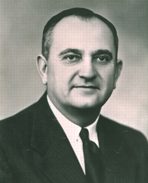
Overall Kentucky Record: 876 - 190
Years Coached: 1930-31 to 1971-72 (41 seasons)
Date of Birth: September 2, 1901
Date of Death: December 10, 1977
Hometown: Halstead, KS
Alma Mater: Kansas [1923]
| Season | Won | Lost | Rank | Notes |
|---|---|---|---|---|
| 1930-31 | 15 | 3 | - | Adolph Rupp's First Season |
| 1931-32 | 15 | 2 | - | - |
| 1932-33 | 21 | 3 | - | - |
| 1933-34 | 16 | 1 | - | - |
| 1934-35 | 19 | 2 | - | - |
| 1935-36 | 15 | 6 | - | - |
| 1936-37 | 17 | 5 | - | - |
| 1937-38 | 13 | 5 | - | - |
| 1938-39 | 16 | 4 | - | - |
| 1939-40 | 15 | 6 | - | - |
| 1940-41 | 17 | 8 | - | - |
| 1941-42 | 19 | 6 | - | - |
| 1942-43 | 17 | 6 | - | - |
| 1943-44 | 19 | 2 | - | - |
| 1944-45 | 22 | 4 | - | - |
| 1945-46 | 28 | 2 | - | - |
| 1946-47 | 34 | 3 | - | - |
| 1947-48 | 36 | 3 | - | - |
| 1948-49 | 32 | 2 | 1st by AP | - |
| 1949-50 | 25 | 5 | 3rd by AP | - |
| 1950-51 | 32 | 2 | 1st by AP and 1st by UPI | - |
| 1951-52 | 29 | 3 | 1st by AP and 1st by UPI | - |
| 1953-54 | 25 | 0 | 1st by AP and 2nd by UPI | Declined NCAA bid due to stipulation that Graduate Students could not compete in the NCAA Tournament |
| 1954-55 | 23 | 3 | 2nd by AP and 2nd by UPI | - |
| 1955-56 | 20 | 6 | 9th by AP and 12th by UPI | Accepted NCAA bid when Alabama declined |
| 1956-57 | 23 | 5 | 3rd by AP and 3rd by UPI | - |
| 1957-58 | 23 | 6 | 9th by AP and 14th by UPI | - |
| 1958-59 | 24 | 3 | 2nd by AP and 2nd by UPI | Accepted NCAA bid when Mississippi State declined |
| 1959-60 | 18 | 7 | - | - |
| 1960-61 | 19 | 9 | 20th by AP and 18th by UPI | Accepted NCAA bid when Mississippi State declined |
| 1961-62 | 23 | 3 | 3rd by AP and 3rd by UPI | - |
| 1962-63 | 16 | 9 | - | - |
| 1963-64 | 21 | 6 | 4th by AP and 3rd by UPI | - |
| 1964-65 | 15 | 10 | - | - |
| 1965-66 | 27 | 2 | 1st by AP and 1st by UPI | - |
| 1966-67 | 13 | 13 | - | Adolph Rupp's Worst Season |
| 1967-68 | 22 | 5 | 5th by AP and 5th by UPI | - |
| 1968-69 | 23 | 5 | 7th by AP and 5th by UPI | - |
| 1969-70 | 26 | 2 | 1st by AP and 1st by UPI | - |
| 1970-71 | 22 | 6 | 8th by AP and 8th by UPI | - |
| 1971-72 | 21 | 7 | 18th by AP and 14th by UPI | Adolph Rupp's Final Season |
Obituary: by Sam Goldaper New York Times
Adolph F. Rupp Dies; Tribute for Renowned Coach Scheduled Tonight
The Rupp Arena on the campus of the University of Kentucky in Lexington will be the site of a tribute tonight for Adolph F. Rupp, the renowned basketball coach of the Wildcats for 42 years, who died Saturday night at the age of 76.
The Kentucky basketball team will be host to South Carolina tonight in a game in the 23,000 seat arena that was named for Mr. Rupp, the most successful college basketball coach in history.
The arena was dedicated last Dec. 11 with Kentucky opposing Kansas, the school where Mr. Rupp had played under the legendary Dr. Forrest (Phog) Allen.
When the arena was built, Mr. Rupp said, "I hope they give me a parking pass for it."
Not only did the university give him a parking pass, but included a blue velvet chair to be used whenever Mr. Rupp attended a game. He sat in that chair for only a few games, however, because of deteriorating health.
Told of Mr. Rupp's death Saturday night at Madison Square Garden after the Portland Trail Blazers beat the New York Knicks, Larry Steele, one of the innumerable Rupp players who graduated into professional basketball as a Blazer, said:
"He was an unbelievable coach. Everyone around the country knew what kind of a coach he was, but if you mention his name in Kentucky, it was impossible to describe the reaction you'd get. He was a true legend."
"As a person, he was the type of coach who was remarkable when it came to discipline and fundamentals. You played basketball the way he wanted it played. He always had his way and that's why we won so much when I was there [1969-71]"
Ray Meyer, the DePaul coach who played and coached against Mr. Rupp, called him "one of the fiercest competitors in the game of basketball. I would always like to play his team early in the season because he always told us what was wrong with our team."
In another tribute to Mr. Rupp, Marv Harshman, the University of Washington coach, said "I've had some great moments just being around him and reminiscing about the old times. He was a legend before his death. He was a giant in his time."
"The guy was keen-minded. He was controversial, but sometimes people are controversial because others are envious. I think we can thank people like Rupp for the development of college basketball as it is today. I think he probably popularized the fast break more than any one person. You knew Kentucky was always going to get the ball off the board, get up and down court and put it up pretty quick."
Mr. Rupp, who retired in 1972 after winning 879 games and four national titles, was suffering from cancer of the spine and diabetes. He disclosed his illness to a few close friends late last year and said then that his doctors considered his condition inoperable. He was admitted to the University Medical Center Nov. 9.
In Kentucky, Mr. Rupp was not only the dean of basketball coaches, but also for more than 40 years he was the only "Baron" in a land of honorary colonels.
No more rabid enthusiast for the state of Kentucky existed than Mr. Rupp, a Kansas boy who traded a Midwestern twang for a soft-spoken drawl. He had a true Chamber of Commerce outlook on life in Kentucky and delighted in reciting the glories of the state.
Victory in First Game
A heavy-set man, and a pleasant one when he wasn't coaching, Mr. Rupp was dynamic, controversial and colorful. Because of his estate in the rolling farm country outside Lexington, where he tended to his prize Herefords and crops of burley tobacco, he was known to all as The Baron of the Bluegrass Country.
Since his favorite coaching attire out of superstition, was usually a double-breasted brown suit, he also picked up the nickname of the Man n the Brown Suit. At other times he was referred to as Mr. Basketball and Ol' Rupp and Ready.
In the first college basketball game he coached in 1930, his fast-breaking Wildcats raced to a 67-19 victory over Georgetown (Ky.) College. In the 41 seasons that followed, he took his teams into tiny, old gymnasiums, new field houses and big-city arenas, where he was often hooted and despised, but always respected.
Unlike some coaches, Mr. Rupp rarely played the role of a substitute father to his players. He was not the chummy sort. He had stern and demanding qualities, inherited from his German-immigrant father. He had reverence for order and precision and demanded it from his players. To some person, he appeared to be a mean old man.
"A lot of people think we run a Marine Corps outfit," he once said. "Fine, if they think that, that's fine. I knew when I came here that the only way I could be successful would be to go out and win these basketball games."
Joe Hall, the Kentucky coach who succeeded Mr. Rupp and for many years was his assistant and chief recruiter, once said:
"Coach operates from an extreme competitive desire and has a strong dread for losing."
Regardless of the reason, he always put forth this kind of effort. On his weekly television shows he often said:
"We want to win, we just have to win. Goodness knows, no one wants to win any more than we do."
Winning was Mr. Rupp's passion. Someone once recited to him the famed Grantland Rice line, "when the one Great Scorer comes to write against your name, he marks not that you won or lost, but how you played the game."
To this, Mr. Rupp answered:
"Well now, I just don't know about that. If winning isn't so important, why do you keep score?"
Mr. Rupp's achievements were endless. During his coaching tenure and his 879 victories more than any other basketball coach. Under his leadership, Kentucky won four National Collegiate Athletic Association championships and was the runner-up twice. The Wildcats also won 27 Southeastern Conference titles. Mr. Rupp was honored for his achievements by election to the Helms Athletic Foundation Hall of Fame and the Basketball Hall of Fame in Springfield, Mass.
During his fight to remain as the Kentucky coach after he reached the mandatory retirement age of 70 in 1972, he said, "If they don't let me coach, they might as well take me to the Lexington cemetery."
Mr. Rupp remained in basketball until his death. After his retirement, he was president of the Memphis Tams of the now-defunct American Basketball Association and vice chairman of the board of directors of the Kentucky Colonels.
His 1948 championship team and the Phillips Oilers of the Amateur Athletic Union combined to represent the United States in the Olympic Games. Kentucky also won National Collegiate titles in 1949, 1951 and 1958.
During the 1969-70 season, Mr. Rupp started to show the effect of his age and poor health, but he refused to retire. That season, looking ghastly and with his voice raspy, he spent five weeks in bed, arising only to go to games, practice sessions or to his doctor.
During Kentucky's first few games, he sat with his foot supported by a cushion on a chair. His foot ailment was complicated by his diabetic condition.
On Dec. 26, 1967, when Kentucky defeated Notre Dame, 81-73, the victory -- No. 772 -- established Mr. Rupp as college basketball's leading winning coach. The honor previously belonged to Forrest (Phog) Allen of Kansas, who retired with 771 victories after 46 seasons of coaching.
During Mr. Rupp's winning habit, he became a victim of his success. He never heeded criticism and his recruitment of players was said to have reached every hamlet in Kentucky and its adjoining sates.
But with all his success, Mr. Rupp had trying moments, especially in October 1951, when three of his former players admitted they had accepted $1,500 in bribes to lose deliberately a National Invitation Tournament game at Madison Square Garden on March 14, 1949.
The Kentucky players were involved in a national basketball scandal that touched many college players throughout the nation.
During the trial in New York, in which the three former Kentucky players were placed on indefinite probation, Judge Saul S. Streit in General Sessions Court condemned the athletic practices of the University of Kentucky.
He described them as "the acme of commercialism and overemphasis."
In August, 1952, the Southeastern Conference suspended Kentucky from basketball competition. Three months later the N.C.A.A. penalized the university for rules violations and Kentucky canceled its 1952-53 basketball season.
The following season, Mr. Rupp and his team, the Wildcats, were back. They won all 25 games.
Mr. Rupp was born on Sept. 2, 1901 in Halstead, Kan., where his father homesteaded a 163-acre farm.
Mr. Rupp is survived by his wife, Esther, his son, Adolph F. Rupp Jr., a grandson, Adolph F. Rupp 3d, a granddaughter, Carlyle Farren, three brothers and a sister.
Funeral services will be held tomorrow afternoon in Lexington. Gov. Julian Carroll ordered a day of mourning in Kentucky to honor Mr. Rupp. Flags will be flown at half-staff.
Basketball's Baron - Rupp Turns Philosopher and Coaches Love It
by Joseph Litsch, Atlanta Journal-Constitution, March 26, 1977.
College basketball has never experienced such a lineup: Hobson, Meyer, Iba, Hinkle, Holman, Longborg, Hickey, Rupp, Wooden.
Among the nine are more than 4,500 wins, 17 NCAA championships, 14 NIT championships and five Hall of Famers. The Hyatt Regency's Phoenix Ballroom was packed to standing room only to hear each in turn reminisce and evaluate various aspects of basketball.
But it was only when Adolph Rupp, affectionately and respectfully called the Baron of Bluegrass Basketball, spoke that the multitude responded with a standing ovation.
"Gentlemen, I don't know where basketball is going," Rupp began in the familiar quavering voice. "I don't think preachers are overpaid, I know they pray like hell over that collection plate, but I don't think it's filled. And when a preacher's son enrolls as a freshman driving a Thunderbird, I wonder about it. When I get back home to Lexington, I'm going down to check the Thunderbird prices. I didn't know they were in that range."
Rupp leaned heavily on the lectern. He had been assisted by Abe Lemons and Ray Meyer. "This is not one of my good days," Rupp explained later. He is 75 and seriously ill.
"I thought I'd throw in a little philosophy." Rupp went on. "I think we get a little thin-skinned if we stay in this business long. And believe me, I've had some sharpies thrown at me.
"Just the other day, I heard of one - and it was a sharp one - from Arizona," Rupp continued. "Things like that can hurt, especially if you've got children who are old enough to read.
"But let me tell you one thing about criticism. Forget it. If you worry about what people think and say about you, you'll never last in this game," Rupp said.
The room was quiet save the gravelly voice. Those present were seeing an Adolph Rupp they had never before seen. A sharp contrast to the quick wit and sharp tongue of previous coaching clinics.
"I think a lot about Rudyard Kipling. I remember when he was still living and an editor for the Manchester Guardian wrote that the junk Kipling was writing would never last.
"Well, it hurt Kipling," Rupp continued. "He was greatly depressed. And while he was in that depression, he sat down and wrote the poem 'L'Envoi'."
And those that were good will be happy; they shall sit in a golden chair;
They shall splash at a ten-league canvas with brushes of comets' hair;
They shall find real saints to draw from - Magdalene, Peter and Paul;
They shall work for an age at a sitting and never be tired at all!
And only the Master shall praise us, and only the Master shall blame;
And no one shall work for money, and no one shall work for fame;
But each for the joy of the working, and each, in his own separate star,
Shall draw the Thing as he sees It for the God of Things as They Are!"
"Thank you."
There was an air of benediction, but the reverence was broken by thunderous applause. The crowd stood, applauding and wondering if this would be the last time they would listen to the man in the brown suit. This was a different man from the one who had won 880 games while Kentucky's head basketball coach.
"Well, this is the first time I've ever said this," Rupp said later. "This is my philosophy and I've always tried to live by that poem. I learned it back in 1919.
"When I got up, I didn't know what I was going to say. Everybody else had talked about the game, so I decided to give them some advice."
Rupp has never dodged criticism nor the public. His telephone number to this day is listed in the Lexington directory. Dial it and he answers.
"I saw no reason for an unlisted number," he said. "If somebody wanted to talk to me, I wanted to talk to them."
When he shows up at Rupp Arena, the 23,000-seat coliseum named for him and built for the Kentucky team he established, it's cause for a five-minute standing ovation.
"I don't go when they play Mississippi or a team like that. I want to see a contest," he said the old fight blazing through.
Hundreds of coaches filed past Rupp, shaking his hand and asking for his autograph.
"You know what you've meant to me, and I want to thank you," said North Carolina Coach Dean Smith.
"And good luck to you," answered Rupp.
"This is the most enjoyable session I've ever been to and I've been to plenty," said former Georgia Tech Coach John "Whack" Hyder.
Rupp waited until the crowd had thinned then asked someone to help him up. "This has been a long session. They tire me out," he said.
The crowd in the lobby parted to let him through. Hands thrust out to shake his, Rupp accepted the praise graciously.
"Now that's what you call a real legend," said one young coach. "He IS college basketball."