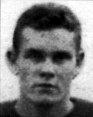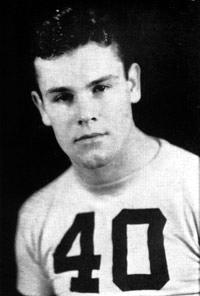
Hometown: Lexington, KY (Senior)
Position: G Playing Height: 6-1 Playing Weight: 190
Date of Birth: December 1, 1911
Date of Death: October 6, 2010
Additional Photos: (1) (2) (3) (4) (5) (6)
Game by Game Statistics
Kentucky Career Notes:
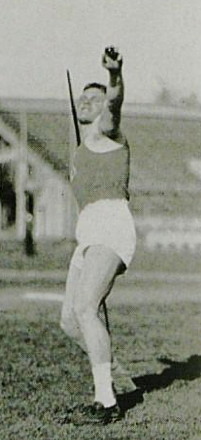
Multi-Sport Player [Football and Track]
Post-UK Career Notes:
Served in the Military
State of Kentucky Athletic Hall of Fame
University of Kentucky Athletic Hall of Fame Professional Football Statistics [External Link]
| Season | Games Played | FG | FT | Total Points |
|---|---|---|---|---|
| 1932-33 | 4 | 1 | 1 | 3 |
| Total | 4 | 1 | 1 | 3 |
Obituary - Ralph Kercheval, former trainer, breeder and star UK football player, dies at 98, Lexington Herald-Leader (October 7, 2010) by Laura Butler
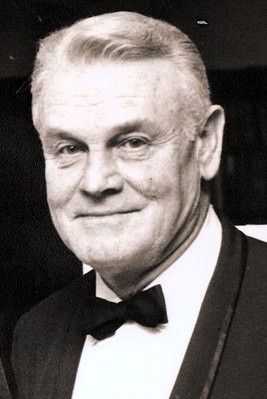
Ralph Godfrey Kercheval, a former University of Kentucky football star, prominent member of the Thoroughbred industry and the oldest living former National Football League player, died Wednesday in Lexington at the age of 98.
Born in Salt Lick, Kercheval graduated from Lexington's Henry Clay High School and earned a degree in animal husbandry from UK, where he played basketball, track and football.
According to a news release from UK, Kercheval was the first player to be named first-team All-SEC when the league started in 1933. He was inducted into the Henry Clay High School Hall of Fame, the UK Athletics Hall of Fame and the Kentucky Athletic Hall of Fame.
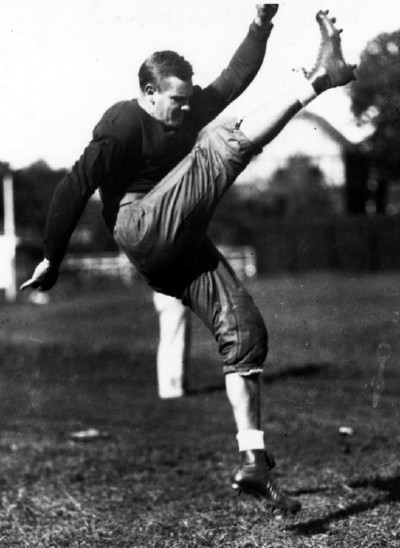
While he played quarterback, defensive back and kicker, he was best known for his punting for UK and later for the Brooklyn Dodgers of the NFL.
He set several SEC records, including most punts in a season, 101 during his senior year, in 1933, according to UK. During his time as a Wildcat, Kercheval punted 234 times for an average of 44.8 yards per kick.
He was a running back and punter in the NFL for seven years.
Kercheval had a love for horses, and he worked part-time on the C.V. Whitney farm during the offseason. His friends from the horse industry remember him fondly.
"Ralph Kercheval was one of the greatest gentlemen I've ever met," said one of those friends, Marylou Whitney. "He was a very devoted husband, wonderful to his friends ... and I'll always miss his great dancing. I love his wife very much. I loved them both."
Kercheval went on to train and breed horses at farms across the country. When he was general manager at Sagamore Farm in Maryland, he bred Native Dancer.
Kercheval is survived by his wife of 74 years, Blanche, and three sons: Ralph Jr., Hal and Ron.
His funeral will be 11 a.m. Monday at Lexington's Central Christian Church, 219 East Short Street. Milward Funeral Home is handling arrangements.
Instead of flowers, the family is requesting contributions to Hospice of Bluegrass, 2312 Alexandria Drive, Lexington, KY 40504, or Sanders-Brown Center on Aging (designated for Alzheimer's research) at 101 Sanders Brown Building, 800 South Limestone Street, Lexington, KY 40536.
'30s UK Star Had a Leg Up on Kicking by Billy Reed Lexington Herald-Leader (October 29, 1993)
At 81, Ralph Kercheval's eyes aren't quite what they used to be, but he's still fit enough to jog and go to the races at Keeneland whenever he feels like it.
He also follows college and pro football, mostly through TV, and he can only shake his head when he talks about the sorry state of kicking in today's game.
"Some of the kicking in the pro league is pathetic," says Kercheval, who virtually cringes whenever he sees a punt that's shanked or a chip-shot field goal that goes awry.
To this day, of course, Kercheval is arguably the greatest kicker in the University of Kentucky history and one of the best to ever play in the NFL.
A s a UK sophomore in 1931, he came off the bench in the team's second game, against Washington & Lee, and boomed a 75-yard punt on his first attempt for Coach Harry Gamage.
"I remember, as a kid would, that everybody rose in their seats on both sides of the field," Kercheval said. "I couldn't help but see and hear them."
During his senior year of 1933, Kercheval set four Southeastern Conference records that still stand, punting 101 times for 4,413 yards and an average of 43.5
His best game that season came against Cincinnati, when he punted 10 times for 520 yards, one of the league records he still holds.
"We drove to Kentucky's goal line time after time," former Bearcat Bill Schwarberg once told writer Russell Rice, "and Kercheval would simply stand back and kick the ball all the way back."
If anything, Kercheval was an even better kicker than his magnificent numbers indicate, considering that the ball in those days was rounder and heavier. He also never played on punter-friendly artificial turf.
Many of his punts were difficult quick kicks out of the single-wing formation, meaning that he had to take the snap only 5 or 6 yards behind the line of scrimmage and boot it quickly.
Finally, punters in those days were given credit only for yardage in the air. Today's kickers get credit for total yardage in the air. Today's kickers get credit for total yardage per punt, including whatever comes from bounces and rolls.
So while Paul Calhoun's 80-yard punt against Indiana in 1983 is the official UK record, Kercheval's 78-yarder against Georgia Tech in 1933 probably was the more impressive kick.
During his seven-year NFL career with the Brooklyn Dodgers (1934-40), Kercheval's longest punt was an 86-yarder against the immortal Bronko Nagurski and the Chicago Bears on Oct. 20, 1935.
In addition, he kicked a 51-yard field goal on Oct. 10, 1934, to help the Dodgers to a 10-10 tie with the New York Giants before a crowd of 55,000 in the Polo Grounds.
"Lord, we never hardly tried a field goal in those days." Kercheval said. "The first pro game I was in, I kicked on 41 yards in the mud to beat the Boston-Redskins."
But the numbers and records don't mean as much to Kercheval as the fact that, in college and the pros, he was a 60-minute man who played in the backfield on offense and defense.
"So many people mistakenly think that all I did was go in and punt," Kercheval said. "That was just a sideline. I don't think I would have enjoyed football if kicking was all I did."
As a sophomore at UK, for example, he gained 161 yards rushing in a 7-0 loss to Duke and scored on a 90-yard run to beat Florida, 7-2, in Jacksonville.
In the pros, on the day he kicked the 51-yard field goal against the Giants, Kercheval also scored a touchdown and kicked an extra point, leading to his headline in a New York newspaper: "Kercheval 10, Giants 10"
In his best season with the Dodgers, Kercheval made $3,600 and was the only player on the team that had a contract.
"As a rookie," he says, "I played all but five minutes of the entire season."
The other love of Kercheval's life has been thoroughbred racing. After graduating from UK with a degree in animal husbandry, he went to work for famed breeder C.V. Whitney, who let him take off in the fall to play pro ball.
After retiring from the NFL following the 1940 season, Kercheval spent the rest of his professional life in the horse business, with the exception of a four-year Army stint as a cavalry officer during World War II.
Although he did some training and breeding, he's probably best known in the horse business for his work a manager of Alfred Gwynn Vanderbilt's Sagamore Farm in Maryland (1948-58) and the Mereworth Farm in Kentucky (1969-79).
Last year, Kercheval and his wife, Blanche, who were married in 1936, gave away their last two horses. However, Blanche says they might buy another horse or two just to have something to do.
At an interview earlier this week at the Thoroughbred Club of America, Kercheval was at a loss to explain how he became such a superb kicker.
"The only thing I can imagine," he said, "is that when I was a kid, my brother had this old, beat-up football. We took the bladder out of it and stuffed it with rags and then stitched it back up with shoelaces. It was heavy, but maybe kicking with that helped me."
He also says that he always put a lot of emphasis on his follow-through, and, indeed, photos of Kercheval in action show that hi right knee ended up so high that it was almost even with his face.
The last time he remembers kicking a football was in the early 1960s, when he used to fool around on the farm with some kids.
"But I really think I could go out there right now and kick one 50 yards," Kercheval said.
He wasn't kidding, either.
Since the inception of modern football at the University of Kentucky almost 100 years ago (1891), Wildcat teams have featured many multitalented performers who, among other things, really out the "foot" in football, but no Wildcat has surpassed the overall feats of Ralph Kercheval, who almost six decades ago made his mark as perhaps the greatest UK kicker of all time.
Kercheval, now semi-retired after many years of managing thoroughbred farms and training horses, was born at Salt Lick but came at an early age to Lexington, where he was coached at Henry Clay High School by John Heber, former Wildcat star (1916-17-18-19-20) who called Kercheval the best kicker he had ever seen.
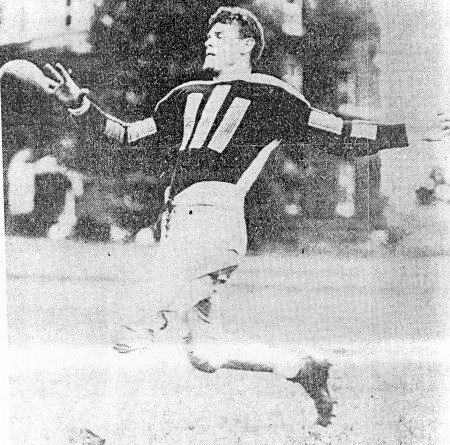 "He was a natural born punter," Heber said. "I didn't teach him a thing. In fact I tried to stop him from taking two or three steps before kicking and it hurt his effectiveness. So I just moved him back a few yards. He was great when I first saw him. I suppose he taught himself."
As part of his punting technique, Kercheval seemed to throw the ball downward. He once explained that he held the ball with one hand on top and a little to to the side, which allowed the left arm to swing as if he were in stride and gave him excellent balance.
"Even as a kid I could kick the ball 55 or 60 yards," he said. "When I was about 12 or 13, we used to go over to where the Kentucky players were punting. We'd get behind the goal, in case they missed, and shag balls. Sometimes they'd let us punt. I used to kick it over their heads. They'd get a bang out of that.
"We used to climb over the fence (at old Stoll Field), hide and get lost during the games. That's when they put up barbed wire over the cyclone fence. The players had to walk through a garden area from the dressing room to the playing field, and we'd often walk with them, hiding under their blankets. When we got inside, they would turn us loose."
One of those Wildcat players was the flamboyant John Simms "Shipwreck" Kelly,backfield standout and a punter in his own right who would play one year (1931) with Kercheval at UK and then draft the Wildcat punter two years later when Kelly was a player and part-owner of the Brooklyn Dodgers pro grid team.
Kercheval, who also was an offensive back, played a secondary role his freshman season as the Kittens overran six opponents and his punting services seldom were needed; however, he kicked the extra points.
As a third-string fullback behind the Phipps brothers -- Tom and Jack of Ashland -- his sophomore year, Kercheval failed to see action in an opening victory over Maryville, 19-0. He was languishing on the bench late in the first half against Washington & Lee the following Saturday when the Wildcats were assessed a 15-yard penalty that put them deep in their own territory. Wildcat coach Harry Gamage looked down the bench and yelled, "Kercheval, go in there and kick it."
"I caught the ball real well and kicked it 75 yards in the air," Kercheval said. "I remember, as a kid would, everybody rose in their seats on both sides of the field, and I couldn't help but see and hear them. When we went back to the dressing room, Gamage sat beside me and said. 'I'm going to start you this half, and we're going to kick every time on first down.'"
After playing well in that game, which UK won, 45-0, the multitalented Kercheval was assured a starting position for the remainder of his career at UK.
John McGill, former sports editor of the Lexington Herald, wrote that Kercheval could be called the "Babe Ruth of Kentucky football because his puns linger so vividly in fans' memories that his all-around ability is often overlooked."
Kercheval's record for the most punts in one game is 17 against Alabama n 1931, a game won by the Tide, 9-7. On a free kick, he booted the ball 65 yards to the Tide 15. He rushed for 161 yards in a 7-0 loss to Duke. He tried his first quick-kick, a 58-yarder against Tennessee, and punted one 68 yards out of bounds on the Vol four. In the final game of his sophomore season, he ran nine yards for a Touchdown to beat Florida, 7-2, at Jacksonville. His nine punts averaged 48 yards, one traveling 66 yards. "We had them beat with fourth down and seven or eight inside our own 35," Shipwreck Kelly recalled years later. "In the huddle, I told (captain) Babe Wright that I anted to see Kercheval kick one more time before the season ended. Ralph took the ball and kicked it out of the end zone and into the bay. That was the only time I've ever seen a ball kicked out of a stadium."
According to available records, Kercheval finished that season with 64 punts for 2,627 yards, a 41.0 average in those days when the ball was, as Kercheval recalls, "shaped like a pumpkin."
Injuries kept Kercheval out of the Duke and Alabama games his junior season, when he unofficially punted 69 times for 2763 yards with three of the punts traveling 60 yards or better. He set school and national records the following season with 101 punts for 4,394 yards, a 41.8 average.
In a 7-6 victory over Georgia Tech in 1933, he had a 77-yard punt, a school record that remained on the books until Randy Jenkins kicked a 78-yarder in 1983. Later in the game, he kicked a 73-yarder, going against the wind, and averaged 45 yards on 16 kicks. He also kicked the winning point and made two key defensive plays.
Another memorable game occurred midway of that season was against Cincinnati in the "Queen City," where the Wildcats and Bearcats, both undefeated, met before a record 16,000 fans in Nippert Stadium. Here is how UC's fleet halfback Bill Schwarberg described Kercheval's kicking in that game:
"We drove to Kentucky's goal line time and time and Kercheval would simply stand back and kick the ball all the way back. In those days the UC lighting system was not too good and his kicks were so high that we lost them in the lights."
Kercheval punted 11 times in that game, with long punts of 73 and 66 yards, as he averaged 47 yards per punt. He also kicked a 25-yard field goal to win the game, 3-0, with less than three minutes remaining.
In signing Kercheval to a Dodger contract, Kelly chose his former teammate over Tennessee All-American Beattie Feathers, who signed with the Chicago Bears and that year (1934) became the first pro back to rush for 1,000 yards. Meanwhile, Kercheval became an "iron man," playing nearly 60 minutes of each game, as he had at Kentucky, during a six-year career with the Dodgers.
"One season I played every minute of every game, both ways, for 11 games," he recalled. "In one of the later games, I was out of play for only five minutes. And top linemen were getting $150 and back $200 for a full 60-minute game."
One of his fondest memories was during his first year with Brooklyn, when the Dodgers had the ball fourth down in ankle-deep mud on the other team's 40 with the score tied 7-7. Kercheval kicked the field goal for a 10-7 Dodger victory. His longest field goal in the pros was 51 yards, his longest punt traveled 91 yards in the air against the Bears.
During the off-season, Kercheval, who had a degree in animal husbandry from UK, worked as an apprentice horse trainer, getting a leave of absence in the fall for pro football. His first full-time job was working for C.V. Whitney. He then managed Milldebrook Farm and Coldstream Stud Farm before serving in the Army during World War II. From 1941-45, he was with the Army Remount Service, with 13,000 horses at Fort Robinson, Neb. Before the war ended he was promoted to lieutenant colonel and was commanding officer at that base.
After the war, Kercheval served 10 years as manager of Alfred G. Vanderbilt's 582-acre Sagamore Farm in Glyndon, Md., where he trained the great Native Dancer. He also spent 10 years at Hurstland Farm and eventually managed Mereworth Farms, one of the largest in the nation while serving also as the master of his own spread, the old Gallaher property, both in Fayette County.
Although "retired to a certain extent" and living at the homeplace on Richmond Road after giving up the lease on his farm, Kercheval still keeps a few horses, and has more time for golf.