
Right after bourbon whisky, the biggest thing in Kentucky is a basketball coach named Adolph Rupp. And if you don't think he's the greatest one who ever lived, just ask him
Published in True Magazine, March 1960, pp. 58-60, 90-94
by BILL SURFACE AND JIMMY BRESLIN
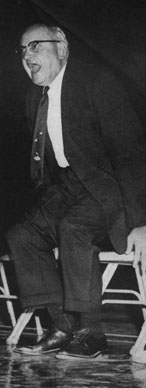 |
It is this way in any sport played on the big, bust-out level of major colleges, and that's why Adolph Rupp of the University of Kentucky is the best coach of basketball in the history of the sport. In 29 seasons at Kentucky, Rupp's teams have won 609 games and lost only 108 and won four national championships. The record makes him the perfect college coach. He is, simply, a guy who wins. Rupp, the person, is acutely aware of the value of winning. He is a big, intense, 58-year-old man who has one thought in life: win tomorrow night before a sellout house.
"I'm not in the public relations business," he tells you. "I'm paid to win basketball games and the national championship. And I win more than anybody else in the country. I know I have a lot of enemies, but I'd rather be the most hated winning coach in the country than the most popular loser.
"Now you know that stuff about building character when you lose ? Damn, that's silly. There was that thing that sportswriter wrote. He said:
'And when the last great scorer comes to write against your name. He writes not if you won or lost, but how you played the game.'
"Well, everybody just loved that and quoted it all over. See, they even got me to rememberin' it. But it's a joke. The hell with how you played the game. They still keep score, don't they ?"
More than a few of the coaches Rupp murders year after year say he is a man with a box score for a heart. Tills is not quite correct, but only because Rupp's success drive isn't restricted to basketball. The Baron, as they call him in Kentucky, is one of the richest men in sports through his Hereford cattle and tobacco interests. And, as is always the case with a winner in this country, he is immensely popular. His name has a fantastic draw on people from every walk of life in Kentucky. Whether you are in the governor's office at Frankfort or a diner in Lexington, people talk of "Ole Adolph" in words normally used for the President of the United States or maybe Robert E. Lee.
He speaks with a nasal, bottled-in-dear-old-Kaintucky twang which he made sure to acquire when he came to the school from the Midwest. And when he does talk, he feels more comfortable telling you about himself and his basketball team than anything else.
"So you're going to write a story ?" Rupp will say to a sportswriter he knows. "Why, that's just fine. We'll sit down together and make this a great story. I'll tell you how we'll do it. Let's brag on me and my team. Write up something real good about us. People will love it."
He means it, too. For this modest opening is followed immediately by a thorough discourse on how fine a coaching pb Adolph Rupp does and why the University of Kentucky basketball team is so good because of it. "Now don't you say I said this." Rupp will say. "You say it yourself. It'll look a bit better than if you have me boosting myself."
He attacks basketball games with a bit less worry about the niceties. In the 1954-55 season his Kentucky team won 23 out of 25 games. Both losses came to Georgia Tech, which was incredible. They just don't play basketball well at Tech, and Kentucky had beaten them as a matter of course for years.
But on January 8, 1955, Tech broke a streak of 129 straight home court victories for Rupp's Kentucky teams with a 57-56 victory which was not easy to believe.
The next day was Sunday, but Rupp scheduled a practice, anyway. The kids showed up, frightened half to death of what was going to happen to them. But instead of screaming, Rupp walked calmly onto the court and called the jittery team around him.
"Now I want you boys to listen to me carefully." he began. "I want you to go out and buy a copy of the paper with the headline saying, 'Georgia Tech Beats Kentucky.' Then I want you to tuck it away safe someplace so's it won't ever be lost. It is a famous clipping.
"There have been two catastrophes of our time," he concluded slowly. "One was Pearl Harbor and the other was last night."
But Rupp uses no emotion in his approach to-plotting out a game. He is a cold master at figuring how to knock your brains out. In the 1958 National Collegiate Athletic Association championship tournament. Kentucky destroyed Miami of Ohio by 24 points and Notre Dame by 33 on its way to the final - for the college championship - against Seattle University. Seattle's big man was Elgin Baylor, the 6-5 high-jumping kid who now is practically unstoppable in the professional National Basketball Association.
Rupp and his assistant, Harry Lancaster, started working out a system to use against Seattle at 7:30 in the morning. By lunchtime their mimeographed diagrams were distributed to the team. But Rupp is a man who thinks basketball constantly and by 5:30, when it was time for dinner, he had decided to change everything. So three hours before gametime he locked his team in the dressing room and announced that every defensive assignment which had been given out should be ignored.
"The scouting report says Elgin Baylor is the finest defensive man in the country," Rupp began. "Well, Harry and I questioned that. We don't think so. We are going to prove it, too. We are going to throw everything at Baylor. I believe we can get him to foul out of there and then we'll be home free."
When the teams took the floor for the tip-off, Baylor broke out of the Seattle huddle and walked over to shake hands with John Crigler, Kentucky's forward. He was going to guard Crigler and Rupp's kid took a deep breath. . He was going to be in for most of the work.
A Rupp-trained basketball team plays the game automatically. The kids all have the same style. They work their plays with a simple but flawless style, and they follow orders as it they were in the Army.
So Kentucky immediately set up its pick-offs and weaves and cuts and the other things basketball teams do with the single purpose of getting Crigler the ball. Crigler, moving to the corner, would take a pass from outside and then drive along the base line of the court toward the basket. It is a difficult play for the defensive man because it is too easy to foul a man. Crigler made it easier for Baylor. He drove through and then went up for twisting under-the-basket lay-ups. Baylor fouled him three times at the start and the game was virtually over right there.
Seattle's coach, John Castellani, had to order a time-out and then instruct his team to go into a sagging zone defense in order to protect Baylor from picking up a fourth foul, which would put him in jeopardy. If you collect five fouls in college basketball, you also get a hand from the crowd after the referee tells you to leave the game.
Kentucky got hot against the zone - a defense which gives the team with the ball good chances for outside shooting. Vernon Hatton and Johnny Cox, a couple of lean, crewcut kids with those fantastic eyes college basketball players have, tossed up a couple from outside and they hit. Seattle had to go back into a man-to-man defense at those prices and that's when Kentucky went to work on Baylor again.
Rupp's kids started to work their guard-around plays. This is a pick-off play worked methodically by any Rupp team. Down at Lexington, they say, "The schedule for any basketball game is: Star Spangled Banner, tipoff, number seven and eight guard-around." It is an uncomplicated play but worked to perfection it is murder to stop.
Everytime they set up a guard-around it was with the idea of getting Bayor to grab somebody and foul out. Don Mills, a 6-7 1/2 center, found Baylor on him and Mills went up to shoot and Elgin hit him on the elbow with his arm. That was the fourth foul. Now Baylor couldn't afford to touch anybody, so Kentucky set up plays that would have Hatton, the team's best shot, coming through on Baylor. The big kid from Seattle couldn't touch him and Hatton scored 30 points and Kentucky went on to win the national title easily.
Rupp loved it. "When we got the four fouls on Baylor we had him at our mercy, boys," he chortled after it.
It is this type- of winning - murdering you is closer to it - that has made Rupp anything but popular with coaches in the Southeastern Conference (Tulane, Mississippi, LSU, Georgia, Mississippi Stale) . In fact, perhaps the oldest joke told in the area concerns the time a report got around that Rupp had died. A coach immediately asked his athletic director for permission to go to Kentucky for the funeral. The athletic director thought it was a fine gesture.
"Tain't no gesture," the coach said. "I just want to make damn sure he's dead."
Rupp is quite certain that playing basketball his way is the most important business in the world. He made that rather plain the day Art in Rubenstein, the concert pianist, arrived in Lexington for an appearance. Rubenstein was to give his concert on the movable stage of the university's gleaming, 11,000-seat coliseum which is listed as a "War Memorial," but actually is Rupp's basketball building. At a little after 3 o'clock in the afternoon, Rubenstein, flexing his fingers, walked onto the stage to rehearse for the evening's concert.
"Will you please keep the building empty?" he asked a couple of university officials with him. "I must accustom myself to the acoustics here. I need silence."
The officials nodded in reverence. This was a pretty good score for their cultural program and they would be quite happy to do anything. Rubenstein started to play. Trouble was, the clock said it was now 3:14 p.m. and, as it happens every day during the basketball season at Kentucky, Rupp was walking up a runway from the lockerrooms and onto the floor. He and his assistant coach. Harry Lancaster, were dressed alike - in Army khaki shirts and pants. And behind the Baron came a file of 30 tall, crewcut kids dressed in white T-shirts and blue basketball pants. It was time for Kentucky's basketball practice, and this is, to Rupp, a sacred thing. Like money.
One of the officials spotted him and tip-toed quickly over to him. "You can't come out here," he whispered. "You'll have to forget about today. Mr. Rubenstein must rehearse."
"We can't come out here ?" Rupp bellowed. "Listen, Mr. Music Lover. Rubenstein's gonna play here tonight and he can miss 100 notes and ain't anybody in the entire audience gonna know the difference. But we're playing Louisiana State on this very same floor tomorrow night. Let mah boys miss one foul shot and the whole world will hear about it."
Then Adolph waved impatiently with his hand and the 30 kids stomped onto the floor and started their usual half-hour of shooting before the practice drills began.
Rubenstein clutched at the air for a moment, glared at Adolph, then stomped off the stage. "Probably cain't play worth a damn, anyway," Rupp muttered at the retreating pianist.
Playing for Adolph is about as sentimental as a job in a bank. He is an austere coach who demands perfection and has no room for personalities. Dan Chandler, the governor's son, was talking about this one day. "I made Adolph's varsity in 1954 and he hdd me a good seat on the bench," he said. "Well, we had to go to Knoxville to play Tennessee and a lot of my friends from prep school were going to be at the game. So I told Coach Rupp, 'I'm in a bit of a predicament. I told my friends I was the coming star of the team here, and now they're all going to be watching me. I'd appreciate it lots if you'd use me in the game first chance you get. We ought to beat them easy, anyway.'
"He never said a word to me. That meant he was going to do it, I thought. Well, in the middle of the first half, Cliff Hagan, he was our big star then, got into a mixup and he hit his head on the floor and he was laid out cold. I hear Rupp yelling, 'Chandler!' and I jump up. I rip off my warmup jacket and I run over to Rupp. 'Who'm I guarding?' I yell at him.
"'Guard, hell,' he yells. 'Go out there and help the trainer carry Hagan off the floor.'" Although Kentucky had the game under control from the opening gun, Rupp did not use the governor's son until the last few seconds.
This year, Rupp's only child, 19-year-old Herky, made the Kentucky varsity as a sophomore. He made it, you may be assured, simply because he stands 6 foot 5 and can shoot.
'If I think he's good enough to play," Adolph says, "he'll play even if they tear every seat out of the Coliseum and throw them at me. But if he isn't good enough, even his mother couldn't get me to use him."
A Kentucky practice session is a silent, sweat-filled affair. Nobody talks, except Rupp, and nobody sits. And Rupp settles for nothing but the best. Late one afternoon last season, for example, he was sitting in the dressing room waiting for the last of his players to finish practicing foul shots. Sid Cohen, his backcourt star this season, was the last one and he came off the floor wearily, but with a smile on his face.
"How many, son ?" Rupp asked.
"Twenty-three out of twenty-five, coach," Cohen smiled.
"What in hell happened to those other two ?" Rupp snapped.
Rupp leads a sparse, detail-filled life during the basketball season. At 7:15 each morning he walks out of his white-frame seven-room house on the North Side of Lexington, gets into his 1956 Cadillac and drives up the hill to the gleaming white Coliseum to start the day's work.
At precisely 7:30 he is at his desk in a cluttered 12-foot-square office which has 31 plaques and as many photos jammed together on the walls. Two cardboard boxes atop an empty desk are filled with various testimonials Adolph didn't have room to hang up. But anybody who asks about them will start a wholesale unpacking. He is good, and he wants to make damn sure you know it.
When Harry Lancaster, his burly, black-haired assistant arrives, Rupp snaps off the light and the two watch movies of the previous day's practice session. Adolph is the only college coach alive who has movies taken of practice sessions. It is, of course, common in football. Rupp borrowed the idea and likes it fine. "I take a good picture," he points out.
Rupp and Lancaster speak softly and make notes as they watch the movies. Then they sit and plan the day's practice. After this Rupp goes through the day's mail. The Baron gets mail telling him how great he is the way most people get bills. It comes in every day and he answers most of it.
"See," he was saying one morning early this season, "here's a letter from a little high school coach in Bourbon County. Says he's been to my clinics - thinks they were great; helped him a lot - but he still needs some help with a defensive drill. Well, I'll just sit right down now and diagram him a whole flock of the best defensive drills in the world - the ones I made up myself."
At lunchtime, Rupp walks across the street to the lunch counter at the University bowling alleys, where, with a cautious scanning of the price list, he'll come up with something light. And economical.
During one such lunch with the Baron - hamburger, a bowl of canned tomato soup and black coffee - the total for himself and a guest was $1.08. He nipped a dollar on the counter and then started to twist himself into contortions trying to fish up eight cents from his pockets.
"Now ah've got it here someplace," he cautioned the kid working behind the counter. "Hell, I've just got to have it. Cain't go around breaking dollar bills for an ole eight cents."
At exactly 3:15 his practice session starts. It rarely varies. From 3:15 until 3:45, the players have warm-up shooting. Then they have a 20-minute offensive drill, a 20-minute defensive drill, a 20-minute scrimmage and end it with foul shooting practice.
During this time the gym doors are locked - no spectators are allowed - and the players do everything at full-tilt. They have certain ways to do everything. They have the same basic style of shooting, running, cutting - in fact everything they do this side of pulling on an athletic supporter is done the Rupp way.
"I tell them when they come here," the Baron beams, "that they'll get to play on the best team in in the world, on the best college basketball court in the world and - this is the most important thing - they'll get the best coaching in the world."
He is a stickler for details to the point where it unnerves you. More than one pilot of a chartered plane taking the Kentucky team out of Lexington's Blue Grass Airport has had to grind his teeth and swear silently while Rupp goes into a harangue because the scheduled 8 p.m. take-off is as much as ten minutes late.
Late one afternoon a couple of years ago the team was taking off for Cincinnati and after Rusty Payne, the trainer, made a quick head-count down the aisle he found one of the players was missing and called to Rupp about it.
"Who is he?" Rupp snapped.
"That big boy, Harold Hurst," the kids around him said. "He just went to the men's room."
"Now isn't that something," Rupp exploded. "He's had all week to go to the men's room and he picks a time like this." He sat and muttered the best college basketball court in the world and - this is the most important thing - they'll get the best coaching in the world."
But this by-the-numbers coaching turns out a product which almost everybody in the business considers matchless. Red Auerbach, who coaches perhaps the best basketball team ever assembled, the for an hour over it.
But this by-the-numbers coaching turns out a product which almost everybody in the business considers matchless. Red Auerbach, who coaches perhaps the best basketball team ever assembled, the Boston Celtics, chewed on a cigar in the lobby of New York's Hotel Paramount one night this season and talked about it.
"A Rupp ballplayer ?" he mused. "I'll tell you what it's like to get one. It's like running a police force and getting your patrolmen right from boot camp at Parris Island. I mean these kids from Kentucky do it automatic. They got the whole thing down and they're not going to do anything except what you tell them.
"Now let's see - I got Frank' Ramsey and Lou Tsioropoulos. Bob Brannum played for him, too. And I see his kids around the rest of the league. Cliff Hagan of St. Louis, for example. I'd have to say they're the best-coached kids to come to the pros. It's the things they don't do that help you. They don't turn the head on defense. You'd die if you knew how many do. They make moves on offense and cut without worrying over the ball. They're looking to win, not be stars.
"Another thing they don't do - take crazy shots. Ramsey, Tsioropoulos, they only shoot when they have a chance to make it. That's a rare thing in this day. Kids come up today, all they want to do is shoot. It's too late to try and change them now. But these guys come up and work around for the good shots and if they don't get them, they give the ball to somebody else. Let me tell you, only a real coach can train a kid like that."
They say I'm hard on kids," Rupp snorts. "Whenever I win something, the first thing they say is 'Rupp drives his team to victory.' With anybodv else, they'd say, 'so-and-so leads his team to victory.' They just don't let themselves give me full credit. Well, what's the difference. Of course you drive a team. Somebody has to be behind them. Eisenhower didn't lead his troops into Germany. He followed them. And as far as character building goes, you build more character by winning than you do losing. Don't ever forget that. And they say it's no fun to play for me. How silly can you get? What's more fun than winning?
"Basketball is a game of rhythm. The only way you're going to get that rhythm is by repetition. You do a thing thousands of times and pretty soon you do it easily and gracefully. That's the way my boys put the ball in the basket. They practice everything so much there's no stuttering around during a game. They move and they know where they're moving and why they're moving. Personally, I think it's a damn good system."
Because of this opinion of himself, Rupp burns whenever anybody else receives even a minor coaching award. In the world of sports today nearly everybody, from news wire services to chewing gum companies, gives out trophies to the "Coach of the Year." the "Player of the Year" and the like. In 1958, Rupp, who had just won his fourth National Championship, railed when he heard two or three polls had named Harry Litwack of Temple as "Coach etc."
"I beat him twice this season." Adolph snorted. "So they name him the best coach in the country. Now I wonder what that makes me ? I guess I'm too good to include in any competition."
But coaching basketball, for Adolph Rupp, has not been just a matter of teaching kids to keep their heads straight on defense and then watching them pile' it on the others. All you have to do is stand at the bar of the Kentucky Hotel in Louisville to know this.
There was an afternoon last May, a day or so before the Kentucky Derby, when a lot of sports guys were hanging around and drinking and looking out the window at the people who passed by on Walnut Street. You'd see Toots Shor and Archie Moore and all the other names in town for the race. Then somebody pointed across the street to where a slim, crew-cut guy was going into a drug store.
"That is Ralph Beard," the guy at the bar said. "Do you remember him?" Everybody nodded. They all knew of Ralph Beard.
He was a gum-chewing, whippet-fast kid who came out of Louisville to form, along with Alex Groza and Dale Barnstable, the heart of one of the best college basketball teams ever put together. The "Fabulous Five," was the tag Kentucky people gave them and they swept through the 47-48 season with a 36-3 record, winning the national title, helping the U.S. win an Olympic title, and then coming back to win 25 of 28 the next year and another title. They were awesome. And after the first year they put in with the gamblers and did tricks with the point spreads.
Against weak opponents, Kentucky went all out, trying to top the spread. But then they tried shaving and in March of 1949 at Madison Square Garden in New York, during a National Invitation Tournament game against Loyola of Chicago, Kentucky played queerly and lost and people who knew scoffed. They were right.
When the first fix scandals broke in New York the next winter, Rupp proudly announced, "They can't touch my boys with a 10-foot pole."
But on October 21, 1951, Rupp was coaching in an All-Star game at Chicago Stadium and outside the building detectives from New York were putting the arm on Groza and Beard and taking them to a police station where they were charged with taking bribes to blow games, Back in Louisville, Barnstable was grabbed. By 5 a.m. all three had confessed. The figure given out was $5,000. For that money they had sold their names. The three were given suspended sentences in New York when District Attorney Frank Hogan, prosecuting the case - it was in his jurisdiction - asked for clemency.
The "10-foot pole" remark was hurled back at Rupp. And it was discovered that he was friendly with Ed Curd, the big Lexington gambler. Curd, it came out, had been at a party with the Kentucky team in New York. Judge- Saul Streit, who sat on the case, devoted 18 pages of his 63-page opinion on the basketball scandals to Rupp.
"Basketball," Streit snarled, "is a highly commercialized enterprise at Kentucky . . . The undisputed facts are that Coach Rupp aided and abetted in the immoral subsidization of the players. In view of his conduct, Mr. Rupp's sanctimonious attitude becomes ludicrous and comical."
Beard, Groza and Barnstable, it was found, had been getting money from Kentucky boosters around Lexington. Rupp listened to the judge's murderous report, then said simply, 'I'll let the people of Kentucky be my judge."
He was playing with a cold deck of cards here. For in Kentucky, Adolph Rupp is a powerful, respected figure. You cannot tell anybody around there that he ever did anything wrong.
Adolph acted as if nothing ever happened. He refused to talk of the scandals. He didn't want to hear Beard or Groza mentioned. The players were murdered.
"I knew Ed Curd," Adolph explained. "Sure I did. I went to Ed Curd to get donations for the Shriners' Hospital. And as for the players, well now just how could I ever suspect a team that was two-time national champion ? How could anybody ?"
And one Sunday afternoon, when it became apparent Kentucky was not going to fire Rupp, Dr. Herman L. Donovan, the school president, sat in his study and listened as a New York reporter asked him bluntly, "How can you afford to keep Rupp ?"
Adolph, sitting off to one side, didn't blink an eye. "That's a fair question. This boy doesn't know the facts, except what he had heard in New York."
Donovan smiled. "We think Coach Rupp is not only an honest man," he said. "We think he is an outstanding man."
Which he is in Kentucky. In 1949, he was named Kentucky's outstanding citizen. He is considered one of the ten outstanding Shriners in the nation, a group that includes such as Harry Truman.
Rupp started with a small farm 29 years ago and now owns 1,250 acres of rich Blue Grass farming area. Thirty-five acres are devoted to tobacco, which brings close to $1,000 an acre each year. His Hereford cattle interests are sprawling and he is considered one of the country's leading experts on the strain. And this is not to mention a little thing he had going for him called the governor's office. Rupp and Chandler were always close.
So Rupp was left alone. The Southeastern Conference and the NCAA banned Kentucky from any basketball competition in the 1952-53 season, the roughest penalty ever given a college., Rupp's answer was simple. "We'll practice and we'll be back. When we do, look out." His club won 25 games the next year, including one game against Tulane, whose coach. Cliff Wells, was something less than friendly to Kentucky when it came to voting on the ban.
"Boys," Rupp told his club before the game, "this is one of the fellows who was against us." Kentucky slaughtered them, 94-43.
Since then, it has been impossible for anybody to put the finger on Kentucky for anything. Rupp rarely goes outside of the state for players. "We've only got two out-of-staters on this year's team," he tells you. "And they're junior college boys. I met Sid Cohen at a coaching clinic in Landsburg, Germany, before he went to Kilgore College. The other junior college boy, Bennie Coffman, is from Huntington, West Virginia, and played at Lindsey Wilson Junior College, which is in Kentucky and only about 100 miles from here."
His hole card here is the Kentucky secondary school system. For 29 years now high school coaches have listened to Adolph Rupp preach about himself and they play his system exclusively. And the kids they send him are rangy, fast country boys willing lo take orders. Of this year's team. Billy Lickert, 6-3 forward from Lexington, was the hardest for Rupp to catch. Lickert had 30 offers from schools outside Kentucky.
Rupp came out of Halstead. Kansas, and he played college basketball under Phog Allen at the University of Kansas, which could account for some of his ability to exaggerate. The now-retired Allen was perhaps the best at this little game that sports ever has known.
According to Adolph, his days in college were more like fighting a war than getting an education. "I filled every minute of the day during my time in college." he tells you. "Why, you hear these boys today saying they don't have time to practice a sport and study, too. Makes me mad. Why I worked summers in the fields at $1.25 a month - that's a month, not a week. Did that for eleven years. At school, I took four years of business administration, played on the varsity basketball team - we were undefeated in 1922-23 - and worked every night from eight to midnight in a restaurant. Nights we had a ball game, I'd start earlier at the restaurant. At 7:15, I'd take off my apron, walk to the gym and play the game, then run back to the restaurant to finish the night. Now who else do you know who could do a thing like this ?"
After graduation, Rupp coached at Marshalltown, Iowa, and Freeport, Illinois, before coming to Kentucky. He immediately put together a wardrobe consisting of only brown clothes - they call him "The man in the brown suit"; a tagline he was looking for - and started on his cold, calculating method of winning basketball games.
To him nothing else counts. He calls card playing, movies, television and any entertainers a waste of time. "That goes for art, too," he says. "I'm color blind and I can't see anything exciting about a picture of somebody's granny."
His attitude toward vacations is the same. A few years ago, doctors forced him to take one. His wife Esther and he drove to Daytona Beach, Florida, and Rupp appeared on the beach for about 30 minutes. Then he went back to his motel room and got dressed.
"Nothing's wrong," Rupp told his wife. "But we've seen everything. Been in the ocean, seen the sun. Now let's go home."
His first view of the Grand Canyon lasted five minutes, after which he told his wife: "Let's go. No sense sticking around here any longer unless we want to live here."
Rupp's only real hobby is reading. He has subscriptions to 22 magazines and gets five papers daily, including the Wall Street Journal. The only thing he uses his television set for is to get the late news, weather and basketball scores.
"Otherwise, it's not worth a damn," he growls. "Except my own program Sunday nights. I'm on for a half-hour during the basketball season on the Lexington station and I believe if they made it a national show I'd have some of the highest ratings in the country. Everybody likes to watch the show.
"Hell, it makes sense. Lot more sense than these silly comedians they got around today. You know something ? Now I don't ever want to have you say I said it. But you can say it as your own opinion and it would be true. I'm funnier than all these comedians. I'd make a big hit telling jokes on the television."
Rupp also fancies himself as more than an average literary critic. He is, as far as he's concerned, sort of the Clifton Fadiman of the Blue Grass.
At the start of this season, for example, he was talking about the New York newspaper sportswriters, nearly all of whom have labeled Adolph as anything from a tyrant to Lord-knows-what in a hangover from the scandal days.
"They're the worst," Adolph said. "Their journalism is bad. And they just don't know how to write constructively. This isn't just my opinion. Ask the Giants and Dodgers. They moved all the way across the country to get away from them, didn't they?"
Then he reached onto a pile behind his desk and came up with a small basketball magazine, whose cover and lead story was devoted to Adolph. "Now this is a coming magazine," he said. "I believe this is the finest cover they've ever had." It was an austere, Horatio-at-the-bridge photo of himself. "And I believe this is the finest story they ever had. Damn, a few more like this and they'll have millions in circulation. You mark my words. Except for one thing." He thumbed through to one page of the story. He had a minor typographical error circled with a big blue marking pencil. "They just don't have good proofreaders anymore. I ought to go up to that magazine and show them how to improve their proofreading. They shouldn't have any errors in an important story like this."
As a winning coach, 1960 variety, about the only error Rupp has made in the last decade came last season after a game against Mississippi State. Bailey Howell, a big, dead-eyed kid from State, poured in 34 points and Kentucky was beaten 87-83. The game was played at Mississippi State and after it Rupp, ever the gracious sportsman, brushed aside a radio interviewer's questions, took the microphone and gave his own version of the defeat to the listening audience.
"It's damn difficult when you come down here to play," he said. "I mean, it's awfully difficult to win when you come down here. This just seems to be one of those places where it's awfully difficult to win."
In one breath he had maligned the referees, the other team, the other school, the Southeastern Conference and the good people of Starkville, Mississippi.
It was something he shouldn't have done because even robbery isn't an excuse when you lose. All that counts is the final score. Nobody knows that better than Adolph Rupp. The next time he played State he won by 15.
Return to Kentucky Basketball page, Kentucky articles, statistics, team schedules, team rosters, opponents, players, coaches, opposing coaches, games, assistance or search this site.