
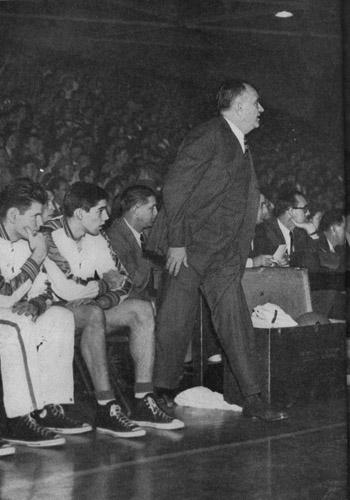
If Adolph Rupp didn't win so many basketball games he'd be a lot more popular with other coaches -- if he didn't talk so much. and any coach who thought this was the year for Rupp to get his comeuppance had better think again
 |
Published in True Magazine, February 1950, pp. 34-35, 91-96
by STANLEY FRANK
This is the season college basketball coaches have been awaiting for five years with great expectations and blunt instruments. This is the season, if there ever is to be one, for getting hunk with Adolph Rupp, the University of Kentucky's resident wonder worker. Brother Rupp has been marked lousy by his colleagues on two counts, both unpardonable: (1) He is much too successful; (2) He pops off too much. The fact that his caustic cracks happen to be true makes them all the more unpalatable.
The first rap against Rupp is, of course, the graver offense. Who listens to a losing coach? Mr. Frank Leahy, who may be described as the Rupp of football, is as genial a fellow as you'd care to meet anywhere except on Saturday afternoons in October and November. He gives the other side encouraging pats on the back before leaving it for dead in the arena, humbly deprecates his good fortune and conducts himself like a perfect little sportsman, yet nobody in the profession wants any part of him, either. Rupp dispenses with the sweet talk on the theory that it is impossible to win basketball games and popularity contests at the same time.
Having made his choice, Rupp has gone whole hog in concentrating on ball games. His last two teams won the N.C.A.A. championship. He was co-coach of the Olympic championship team in 1948 and had five of his boys for company and comfort against the rest of the world at London. Kentucky went into the current season with sixty-three consecutive victories and six straight titles in the Southeastern Conference. During the four-year reign of what Rupp modestly calls the Fabulous Five, Kentucky gained the final round of a national tournament every year and won the grand total of 130 games in 140 by the the average score of 67-42. The case against Rupp is as plain as the nose on Alex Groza's face. The guy is a menace to everyone's job security and peace of mind.
 |
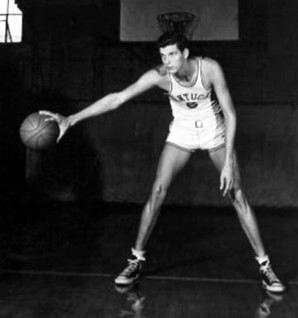
Kentucky has Jim Line and Dale Barnstable, who alternated at a regular position on the Fabulous Five. Walter Hirsch, the Number 7 man, and four other substitutes from the N.C.A.A. championship squad, also are among those present. Over and above all these material benefits towers Willie Spivey, a sophomore who is SEVEN feet tall and is a better basketball player, by at least 25 per cent, than Oklahoma A. & M's Robert Kurland was at the same stage of his career. (This opinion is mine, not Rupp's.)
You might as well get acquainted with Willie Spivey, out of Warner Robbins, Georgia, because you're going to be hearing a lot about him. Willie is a quarter of an inch taller than Kurland, appreciably faster and a good deal more agile. Kurland controlled rebounds off the backboards better, but just give Willie time and he will be stealing popcorn from customers sitting in the mezzanine. Willie doesn't dunk the ball into the basket on lay-up shots. He palms the ball and fires it through the hoop after the manner of a man killing a snake with a rock. Willie has another cute trick that will entrance the addicts. He goes through the motions of getting off a one-handed shot, but holds the ball in his huge paw at the end of his push. Then, having feinted his opponent out of the building, he brings the ball back for an unobstructed shot or a lay-up dribble.
"The people will get lockjaw gaping at Willie," Rupp says happily.
Kentucky's remarkable flow of material is a sore point with Rupp and rival coaches. The opposition regularly accuses Rupp of wandering into its territory for talent. The Big Ten resents his alleged poaching so bitterly that it refused for five years to schedule games with him until Purdue booked the nation's best drawing card in December. Two years ago a Big Ten coach, in denouncing Rupp, contemptuously called him a "carpetbagger," a fightin' word in the Kentucky hills. A few weeks later Rupp was invited to give a speech in Ohio, where proselyting is neither unknown nor neglected. The man they call the a Baron -- among many other things -- looked his audience in the eye and and announced, "My text for tonight's sermon will be: A Carpetbagger in the Holy Land."
"Sure, we go out and get the boys," Rupp admits. "We have to before they're stolen from us. During the Civil War, Kentucky was known as the Parade Grounds because the Union and Confederate armies marched all over the place. The situation is no different today. Scouts from the South looking tor good boys in the North, and northerners going South to prowl around, pass through Kentucky. They'll grab any boy they see along the way if "we don't beat them to the draw.
"I'll tell you something you may find pretty hard to beleive, but it's the Lord's truth. Kentucky is the cleanest college in the United States of America, bar none." He watches closely for the look of incredulity that statement produces. When it comes, he guffaws loudly. "Yes sir, we've got two big laundries right opposite our football stadium." The Baron is a great little joker, as you can see.
Cutting through the smoke screen of accusations and countercharges, it does seem that in the past Kentucky kept its recruiting pretty well within territorial limits in the sense that most of its boys probably would have wound up at Lexington even if athletic scholarships did not exist. The five regulars of the 1946 team, which won the National Invitation Tournament and laid the foundation for the Fabulous Five, all were native Kentuckians from little backwoods towns, All-American Ralph Beard came from Lewisport (population 200), Wah-Wah Jones from Harlan (pop. 5,122), Jack Tingle from Bedford (pop. 387), Joe Holland from Benton (pop. 1,906) and Ken Rollins from Barlow (pop. 584). Gaps left by graduation were filled by players from states next door to Kentucky. The great Alex Groza came from Martins Ferry, Ohio, just across the state line, and Cliff Barker, from Yorktown in adjacent Indiana, returned to school after sixteen months in a German prison camp.
Looking realistically at the entire -- and sometimes sordid -- business of proselyting, Rupp does not have to go far for good boys. Indiana and New York City are commonly regarded as the great incubators of basketball talent, but Kentucky has come along with a rush since the 1930s, when the WPA built eighty-seven high-school gyms throughout the state. Small crossroads communities that haven't enough kids for football -- and couldn't equip them if they did -- have gone wild over basketball. Fine teams constantly pop up in highly improbable places. A few years ago Carr Creek High, which didn't even have a gym, sent a team that wore cutdown overalls for uniforms to the finals of the state tournament. It lost in four overtime periods to Ashland.
Rupp gets the cream of the homegrown crop by working hard at it. He makes about 100 speeches a year spreading the gospel of Kentucky's educational advantages -- and keeping up his contacts with high-school coaches who are the eyes and ears of his volunteer scouting staff.
"I'm the university's only paid talent hunter," he declares. "There are hundreds of other folks -- coaches, alumni, fans -- on the lookout for likely boys, but none expects or receives a penny for his services. They're basketball nuts who get a kick out of sending me local boys who "will make headlines in New York, Chicago and New Orleans. I get about a thousand letters a year through the grapevine. Figuring duplications, that means we're tipped off to five hundred kids. We keep a file of newspaper clippings on each boy throughout his high-school career and by the time he's ready for college, we have a pretty good idea of what he can do without ever having seen him." (Rupp showed me his high-school files. They were as voluminous as a set of the Encyclopedia Britannica.)
"Every spring we bring a hundred of the best seniors down here for a look-see. That's standard operating procedure and if any of those lily-whites in the Big Ten deny they do the same thing, you can tell them they're damn' liars, with my compliments. From those hundred boys, we keep twenty. That's how we and every other college in America get material. We round up more good boys because our grapevine and my judgment are better."
Rupp is no shrinking violet in blowing his own horn. Last summer while he was lecturing at a coaching school in Albuquerque, New Mexico, a student asked what the secret of his success was. "The fact that I'm a good coach," Rupp replied blandly. Once at Tennessee, he was charged with a technical foul for coaching from the bench. "Hell, my coaching is worth a foul any time," he yelled at the referee.
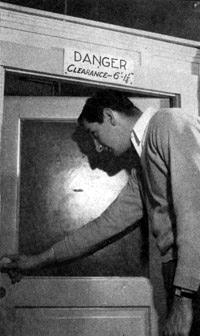
A good deal of nonsense has been circulated about Rupp's method of selecting players. Over the door of his office there is a sign plainly stating that the clearance is 6 feet, 1/2 inches. "If a boy doesn't bump his head coming in, I don't even shake hands with him," Rupp repeatedly has been quoted. The whole thing is an amiable fable. Ralph Beard, on everybody's All-American for three years, was three inches shorter than the door. On this year's squad there are half a dozen players, including two vest-pocket forwards who will alternate at a starting position, less than 6 feet tall.
Loud criticism of Rupp's recruiting has erupted all over again, stimulated by his snagging of Willie Spivy, Roger Lane, 6:9 center from Magnolia, Arkansas, and two youths from Florida. Without being naive about it, this influx of talent from places never before tapped by Kentucky can be described as another example of the rich getting richer. Rupp's towering reputation has attracted kids who are anxious to cut themselves a piece of the nation-wide publicity Kentucky enjoys.
The day I arrived in Lexington last October, Rupp received a letter from Buenos Aires. It was written by Oscar Furlong, captain and leading scorer of Argentina's 1948 Olympic team which gave the United States a bad scare before bowing, 59-57. In his unsolicited letter, Furlong asked whether his two years of college at the University of Buenos Aires qualified him for entrance to Kentucky.
Lane, who has only one year of eligibility left, frankly told Rupp he transferred because the prestige of playing with Kentucky would help him get a high-school coaching job.
 |
"I'll fill out. Coach, if I can really pitch in and eat," Spivy answered. "There's never been enough food around our house."
Rupp is not an ogre, all reports to the contrary. He was touched by the boy's story -- and he was intrigued by those seven, perpendicular feet, Rupp got Willie a job in Owen Williams' drugstore downtown, where he was put to work polishing neon lights -- without a stepladder. Customers came a-running from miles around to look at Willie, but Williams barely broke even on the deal after feeding him three malted milks, with eggs, a day and all the ice cream he could eat.
Before leaving for the Olympic Games, Rupp told Harry Lancaster, his assistant, to keep him posted on Willie's weight. Upon arriving in London, he found an air-mail letter from Lancaster informing him that Spivy had gone from 165 to 180 pounds. Reports arrived twice a week telling of pretty incredible things back home. Spivy weighed 190 ... 201 ... 223. Finally, when Willie hit 229, Rupp sent a cable to Lancaster: "I'm convinced he can eat, but can he play basketball?"
He couldn't, but the Baron took care of that detail. A metal cover was put on a basket to give Willie the knack of using his hands on rebounds and tip-in shots. Willie was given a series of jumping exercises, with two skipping ropes tied together, to teach him agility. He was fed double doses of vitamin pills and a special bed, 7'2 feet long, was ordered for him. And Rupp, with infinite patience, began to pound the principles of his system into Willie's receptive head.
Getting good material is one thing -- and a very important one, too -- but molding it into a smooth, cohesive unit is something else again.
Rupp teaches a curious combination of old-fashioned and advanced tactics. His entire offense is based on the guards-around play featured by the pros thirty years ago. He has eleven set variations of the play, with or without a man in the pivot, but it's still the same old chestnut tricked out with a few modern refinements.
"I don't permit my players freedom of action," Rupp admits. "When a boy gets the ball, he has to do one of two things according to a prearranged plan. I don't want him guessing out there or making the other boys guess with him. Everybody knows what he has to do in any given situation. Sure, all the teams we meet know our system. What of it? The plays still work with perfect timing, ball handling and execution. That's what makes any system click."
Unlike other purists, Rupp does not frown on unorthodox, one-handed shooting. A boy can throw that thing off an ear or the crook of his elbow and play for Kentucky as long as he makes between 30 and 35 per cent of his shots. "Any time your shooting average tails below thirty per cent, the other club is breathing down your neck," he comments.
The most radical departure in Rupp's system is his defense. For one thing, he does not drill on it until two weeks before the season opens. "A team derives most of its confidence from its offense," he says. "Besides, I have only one, simple rule to follow on defense. Stick with your man wherever he goes. We don't switch assignments on screen plays. pick-offs or high water. I tell my men to fight through screens and avoid pickoffs. If you let players switch, you'll have boys telling you, 'Hell, Coach, on two of those eight field goals my man made were scored against me. The other times I shifted to another guy and somebody didn't cover my man.' I don't want to hear excuses. I want to know what's going on out there every second.
I'm saying, here and now, that Kentucky's defensive record stacks up with any team's in the country. Oklahoma A. & M. always winds up with the best defense on paper, but the statistics are phony, and I'll show you why. Last year, Oklahoma beat St. Louis, 29-27, in an overtime game. The same night we licked Xavier of Cincinnati, a pretty good club, 96-50. That Oklahoma game looked as though it was a tight defensive battle but it really wasn't because St. Louis tried to beat the Aggies at their own slow-moving game and, as a result, didn't press offensively.
"Here's the payoff. Forgetting out-of-bounds ball, intercepted passes, missed shots and penalties for walking, Oklahoma gave up the ball to St. Louis about twenty times after scoring. We gave the ball to Xavier exactly fifty-five times after scoring. St. Louis made a shade less than a point and a half every time it got the ball. Xavier made a little more than three quarters of a point when it took possession. Make all due allowances for the difference in tempo and the caliber of the opposition in both games and I still say we put up a better defensive show than Oklahoma. If you want more proof, look at our game last year for the N.C.A.A. championship. We scored forty-six points. Oklahoma got thirty-six."
In his relationships with the players, Rupp is at once severe and aloof. Practice sessions are conducted in an eerie silence broken only by the pounding of feet and the ball thudding against the backboard and the floor. Horseplay and kidding are strictly taboo. "No visiting during practice!" Rupp yells sharply if two players exchange a few pleasantries. Every session is marked by the precision and intensity of a football workout. The first half hour is devoted to shooting, with the players moving continually to designated spots on the floor. During the next half hour the men line up and run through the eleven basic plays they are taught as freshmen. A long scrimmage, generally a good deal more strenuous than an actual game, concludes the workout with Rupp and Lancaster observing silently from opposite ends of the court. Rupp seldom interrupts the action to correct a mistake. That comes later, when he analyzes each man's performance and scouting reports of the forthcoming game.
Although Rupp, a spellbinder in the florid, southern tradition, is in constant demand for speaking engagements, he seldom gives his teams pep talks. His comments before and during games are confined chiefly to technical remarks -- with a touch of irony for emphasis. Last year, when Ralph Beard was playing languidly against a hopped-up youth, Rupp called him aside between the halves.
"You go out and explain to that boy you're an All-American," Rupp said. "Tell him it's not nice to make a monkey of you in front of all those people." Beard got the idea and his customary bushel of points.
Despite his chilly attitude toward the players, Rupp has done a remarkable job of maintaining high morale with teams surfeited with success. In this respect he rates with Joe McCarthy and Frank Leahy, who are past masters in keeping teams hungry for victory. In recent years Rupp has been confronted with psychological problems few coaches ever have had to face. When the 1946 squad assembled, he was embarrassed to pieces by more top players than he could use. The return of men from the services and an influx of precocious freshmen posed a situation that found Bob Brannum and Jim Jordan, wartime All-American selections, riding splinters on the bench. Kentucky had five centers, each of whom could have played regularly on any team in the country. Alex Groza was the Number 1 center, Brannum Number 3 and Dutch Campbell, who had been an All-Conference choice, was no better than Number 5.
Against Texas A. & M. that season, Kentucky's first-stringers ran up a 23-2 lead in the first four minutes and watched the rest of the game from the sidelines as the Wildcats coasted to an 83-18 walk-over. That's when Beard made his famous crack: "The reward for playing well around here is sitting on the bench."
Going into the annual Southeastern Conference tournament at Louisville in March, 1947, Rupp had a difficult and delicate choice to make. Tournament rules limited each squad to ten players. Rupp, wanting to give faithful veterans and deserving freshmen a break, suggested that each team be permitted to name twelve players, thereby encouraging more boys to report for basketball.
"The suggestion was voted down, of course, because I made it," Rupp continues. "The next year Cliff Wells of Tulane put up the same proposal and it was passed unanimously. Back there in forty-seven, when I could take only ten men to Louisville, I had my brains knocked out for leaving Brannum and Jordan, the former All-Americans, at home. People said I was an ungrateful dog. Harmful propaganda was spread around the high schools. 'Why go to Kentucky when All-Americans don't even make the trips?' kids were told.
"All right. I didn't take Brannum and Jordan. In my opinion, I had ten better players. Do you know who my ninth and tenth men were? Line and Barnstable, freshmen. It was the best and fairest move I ever made. Line and Barnstable went on to become important substitutes on two N.C.A.A. championship teams and this year they're the backbone of my club. Taking them to Louisville in place of Brannum and Jordan gave them confidence and proved to them that ability was recognized."
The Fabulous Five last year was the only Rupp team ever seized by a rush of temperament, and it's a wonder the trouble was not more serious. There was a team that literally had run out of worlds to conquer. Four men -- Groza, Beard, Jones and Barker -- went into their fourth year of varsity basketball fresh from winning the Olympic and N.C.C.A. championships. Groza and Barker had been in the service and could have been pardoned for keeping low temperatures when exhorted to go out and bust a gut for the greater glory of dear old Kentucky. The Big Four had been in training for the regular schedule, post-season tournaments and the Olympics from the previous October through August when practice began in the fall of 1949. They must have been fed up with basketball and somewhat overwhelmed by self-esteem, yet they put out for Rupp after a fashion. It was a very fashionable demonstration indeed.
There was a slight groundswell of dissatisfaction. The boys thought at times that they knew more about the game of basketball than Rupp. Distracted by a deluge of pro offers, they occasionally took their eyes off the immediate business at hand. Kentucky last year lost two games in thirty-four. One came in the Sugar Bowl against St. Louis when, after leading by nine points at the half, the boys caged only three shots in thirty-three and blew a 42-40 decision. They went on to win twenty-one straight before being unhorsed in the prime upset of the season. Attempting to turn the unprecedented trick of winning the National Invitation and N.C.A.A. tournaments the same year, Kentucky was ambushed by Loyola of Chicago, 67-56, in the first round of the N.I.T. Rupp later learned that the Big Four signed contracts to turn professional on the afternoon of the game and were occupied that evening with pleasant thoughts of spending their money before earning it.
If Rupp is not the best basketball coach in the business he certainly is the wealthiest. His salary from Kentucky, reputed to be $9,500, is tops perhaps in the college field, but it is so much chicken feed compared to his other enterprises. He gets $125 and expenses for speaking dates, and he fills close to one hundred a year. Basketball-minded businessmen in Lexington have put him next to many cosy propositions. He owns two, elegant 200-acre farms which produce fine tobacco and white-laced cattle and he is negotiating to buy another 200-acre place. The price he casually mentions in discussing it is $87,000. That is by no means the extent of the Baron's activities. He is a stockholder in the world's second largest tobacco warehouse, he has the franchise for five insurance companies in Kentucky, Florida and Georgia, and he is a director in the Kentucky Hereford Breeders Association. Then, there are fees for lecturing at summer coaching schools -- he appeared at seven last year -- and royalties from books.
In keeping at the head of the parade, Rnpp has submerged all outside interests for his work. "His only hobbies are hunting and breeding -- hunting basketball players and breeding white-face cattle on his farms. Although he is a johnny-come-lately in the cattle business, he has plunged into it with such characteristic energy that he speaks authoritatively, and at great length, about blood lines and conformation. He will drop everything and rush out to one of his farms if a hired hand calls to report that a prized head of livestock is acting strangely.
Rupp's home life is a cross between an umpire's and a traveling salesman's. What with speaking engagements, road trips and appearances at coaching schools, he spends less than half the year at his modest home in Lexington with his wife and 9-year-old son Huckey. When he is home, though, Rupp takes Huckey with him everywhere, teaching him the intricacies of farm management and giving him free run of the gym. Rupp's schedule is so crowded that he has been forced to give up teaching Advanced Basketball in the department of physical education. It was the most popular course in school -- for the best of all possible reasons. Anyone who was fairly diligent in showing up for classes three times a week was given an A.
"I figured it was a reflection on me as a teacher if a boy didn't know enough to get an A." Rupp says blandly.
The poor farm boy, who was born at Halstead, Kansas, in 1901 and was left fatherless when he was 9, has come along way under his own drive and ambition. After graduating from Halstead High, Rupp entered the University of Kansas in 1919, arriving there with Phog Allen. The game invented by Dr. James A. Naismith has not been the same since. Rupp never was any great shakes as a basketball player, although he was a regular on the undefeated Kansas team of 1923. Those were the days of the standing guard and Rupp, who had little more to recommend him than hustle and 6 feet 2 inches of meat and muscle, was noted chiefly for his impersonations of Horatio at the bridge. It was an event when he took a shot at the basket and cause for celebration when he made one.
Upon graduating from Kansas, Rupp went to Marshalltown, Iowa, High School as basketball coach. At least, that's what he thought until he arrived on the scene and was told the folks were under the impression he was a wrestling coach. Rupp bought a 25-cent handbook on the gentle art of grunt and groan and promptly turned out the state championship team. The following year, 1925, he went to Freeport, Illinois, High School after making sure basketball was to be his dish and remained there until the call came from Kentucky in 1930.
Basketball always had been a hot-and-cold affair at Kentucky and the climate was on the frigid side when Rupp appeared. The Wildcats had won the championship of the old Southern Conference in 1921 but were close only once thereafter, in 1926, during the next decade. Rupp turned on the heat his first year by taking a green team to the finals of the Conference tournament before it lost to Maryland 27-25, in the last forty seconds. The flickering finger of the spotlight has been playing on Rupp ever since.
One of the very first basketball incidents that provoked a national uproar involved Rupp. Soon alter Madison Square Garden became the Rose Bowl of basketball in 1934, Rupp invaded it with an unbeaten team and lost to N.Y.U., 23-22, on a furiously disputed foul called on LeRoy "Big Boy" Edwards in the last half minute. (I saw the game, but not the foul. It was called in midcourt while N.Y.U. had the ball under its own basket.) On returning to Lexington, Rupp was asked what had happened.
"Riding back yesterday, I tuned in on a radio broadcast from a church in New York," he answered. "The minister's text was, 'He was a stranger and they took him in.' That's all I know."
Rupp threw a first-class fit last March in Seattle when he learned the identitis of the two officials working the N.C.A. A. championship game. The N.C.A.A. has a rule which states that an official from one of its eight sections cannot handle the whistle in a tournament game involving a team from his section. Yet the referees assigned to the final game were Albert Curtis, of the Southwest Conference, and Cliff Ogden, of the Missouri Valley Conference -- Oklahoma's "home" league. Rupp demanded a meeting of the tournament committee and the officials.
"I'm not impugning your honesty or anything of the sort," he said to Curtis and Ogden. "I just want to ask you one question. How many games this season have you worked with Oklahoma?"
Curtis said four, Ogden seven.
"That's eleven games you've had a chance to see how Oklahoma operates and eleven times Oklahoma has had a chance to familiarize itself with the way you call 'em," Rupp snapped. "I submit, gentlemen, that's giving Oklahoma an unfair advantage. There are officials here on the Coast who haven't seen either team this year. Why not use them?"
The committee declined to act on Rupp's suggestion. Everybody was mad at him -- possibly because they had no satisfactory comeback to his protest.
The one charge that makes Rupp blow his top concerns the "inducements" Kentucky gives its basketball players. Fed up with snide whispers, Kentucky two years ago adopted the N.C.A.A. "Sanity Code," which is a good deal more elastic than the Southeastern Conference rules governing aid to athletes. Prior to 1948, a Conference member could give an athlete board, room, tuition, laundry and $10 a month. The new Conference rule specifically states that all money from any source "shall not exceed the student's actual and necessary expenses." The N.C.A.A. code imposes no restrictions on financial aid. It simply says students can be given tuition, fees and one meal a day during the season.
"We adhere to both codes, but the N.C.A.A. thing is a farce," says Bernard Shively, Kentucky's athletic director. "I'll tell you what we give basketball players. Fifteen varsity men and about ten freshmen have their tuition and fees paid. Any money they get is earned on the campus. Payments are entered on our books to prove they do not violate the 'actual and necessary' provision. That's more than the finger-pointers in the Big Ten will tell you. Ask them what sort of jobs they give athletes and how much they're paid and you'll get a lot of double talk." (At Kentucky, basketball players work around the equipment room, help tape sixty-five football players for practice and put up and take down bleacher seats for their own games. A recent investigation disclosed that forty-three Ohio State football players drew $34,600 from the State Highway Commission for unspecified part-time work.)
The folks in Lexington are firmly convinced violent antipathy to their man Rupp is part of an ugly plot threatening the foundations of the republic. Along with Warren Wright's famous Calumet Farms on the outskirts of town, Rupp's basketball team is the community pride and joy in the capital of the blue-grass country.
The strangest part of all the excitement is that the general public of Lexington has not seen a home game in the last three years. Old Alumni Gym accommodates only 3,600 and with 8,000 students enrolled at the university, all tickets are rationed to undergraduates for alternate games.
Local citizens soon will be able to cheer for the Wildcats to their hearts' content, for a magnificent steel-and-stone monument to Rupp now is getting the finishing touches on Kentucky's campus. It is a $4,000,000 coliseum, larger than Madison Square Garden, with a permanent seating capacity of 12,000 that can be expanded to 15,000 by temporary bleachers. The country's finest basketball arena may be completed in time for the last few games on the current schedule. If not, it certainly will be ready tor Rupp next season. And vice versa.
Return to Kentucky Basketball page, Kentucky articles, statistics, team schedules, team rosters, opponents, players, coaches, opposing coaches, games, assistance or search this site.