
These are the official selections of the National Association of Basketball Coaches and a panel of the nation's leading basketball writers. They present their firt 15 choices of the outstanding court luminaries of the recent season.
 |
Published in True Magazine, April 1947, pp. 28-29, 65-66
by BLAIR GULLION with HASKELL COHEN
Modern basketball - the All-Amercan game of today - is a far cry from the "peach basket-soccer ball" activity originated by the late Dr. Naismith as an indoor activity for gymnasium classes at Springfield College. That the rapid action and the unpredictable outcome of the modern game has a great appeal for both spectators and players is reflected in the tremendous increase in attendance at games in recent years.
Consistent with the growth of interest in the game, the National Association of Basketball Coaches of the United States has accepted a position of leadership in all phases of basketball development. This has resulted in appropriate rule changes, intersectional basketball, research in fatigue problems, recommendations for officiating techniques, planning modern gymnasia and the myriad other factors which are a part of the progressive functions of the Association.
In line with its forward-looking policy the Association now assumes another major project in the selection of the All-American college basketball team for the 1946-47 season. For many years it has been standard procedure for various agencies to select an All-American team and for coaches to lament the injustice of the selections. Another common criticism of All-American teams has been that of an inequality of votes in certain sections of the country, an overloading in one area and a sparsity of votes in another. Still another complaint hurled by, the coaches and the fans is that of the inability of the writers to determine accurately the necessary requisites of an All-American.
Through the years the dissatisfaction with the personnel comprising the All-American ,teams has been reflected by the, increasing number of All-American teams selected in a number of ways by a number of groups. The practice has spread until almost every top-ranking team claims an All-American or two with a subsequent loss of prestige for those few players meriting the honors. These indiscriminate selections leave a question in the minds of the fans relative to how All-American players are selected.
The National Association of Basketball Coaches, realizing the injustices to players and fans through the confused selection of All-American teams in past years, decided to use the resources of the Association in an effort to select an authentic and bona fide team for the 1946-47 season. Who should be aware of the skills, knowledge and attitudes of the ranking players in the nation better than college coaches who spend weeks during the season analyzing the strengths of these players as they prepare their teams to meet them? And to guard against prejudice on the part of the coaches, what betler check could be adopted than to augment the opinion of the coaches with a special panel of 120 leading basketball writers selected by the coaches themselves? This plan of selection will insure the overall vote of the coaches, will not include a "flash in the pan" who had a "big night" at an opportune time, nor will it eliminate a "stellar player who did not reach top form in a climactic game. Rather it will measure the all-around ability of players in all of the games during the season.
The broad scope of the thousand-odd college coaches eligible to ballot and the writers' panel of 120 should reflect a balanced All-American team. Ball handling, color, clever defensive play, sportsmanship, astute play making, and offensive and defensive rebounding are given equal consideration with scoring skill. The tall man has to prove his worth to make the team; the little man with marked ability receives thorough consideration.
The Association has employed the machinery of the organization to present to the public our AII-Amencan team. May all of the players selected feel justifiable pride in being chosen to the authentic All-American team.
The 1946-47 season witnessed the return of most pre-war college hoop stars. A majority of schools and coaches found themselves blessed with an overabundance of material and several schools adopted the idea of playing two separate squads.
During the war years the accent was on offense. Coaches didn't have too much time to work with players. Since many performers were routed to schools by the government on a more or less loan basis and for brief periods, we found it expedient to give the boys their freedom thereby encouraging a great deal of shooting and resulting in high game scores.
The trend towards this free-wheeling game slackened during the past season. Coaches once again began stressing defense. Colleges in the Southwest sector, impressed by Oklahoma A & M's success with the possession style of play, almost as a unit adopted the hold-the-ball brand of play. Consequently scores in that region, as a rule, were considerably lower than in those areas where the shooting game predominated. Oklahoma, a former fast-breaking aggregation, came to Madison Square Garden and knocked City College from the ranks of the unbeaten with a slow, deliberate style of play that threw Nat Holman's boys off balance. St. Louis played the Oklahoma Aggies and beat the Iba-coached team at their possession brand of play to the tune of 38-20. St. Johns started the year with a fast breaking style of game but slowed down to play possession ball in midyear demoralizing a highly-favored City College five.
The 1946-47 season was hotly contested all the way with most of the bigger name teams fairly evenly matched. Many of the preseason favorites were dropped from the undefeated ranks early in the campaign but still came through in good style. Kentucky, generally rated far and above all other competitors for national honors in the preseason listings, succumbed to the Oklahoma Aggies in the Sugar Bowl after convincing every one who saw them prior to their downfall, they were invincible.
Basketball schedules are so long and competition so keen that it is almost an impossibility for a college quintet to come through a full season unscathed. Aggregations losing three, four, and even five contests figured prominently in the races for sectional and national honors. Illinois and Utah greeted the return of their Whiz Kids and Blitz Kids by looking forward to undefeated seasons only to be shocked early in the campaign when their favorites were removed from the unbeaten ranks. Both clubs came back splendidly to battle down to the season's end for the possibility of sharing championships in the Big Nine and Rocky Mountain Conference hoop races.
Intersectional schedules were resumed on a vast scale with several new western and mid-western quintets showing in the East for the first time.
Attendance records continued to mount all over the country. Madison Square Garden accommodated more people than in any previous winter.
The well-stacked Kentucky five, led by Ralph Beard, stood out like a beacon among the nation's stronger quintets. Leading independents included New York University, Notre Dame, City College, Syracuse, Bradley Tech, Seton Hall, Navy, Rhode Island and West Virginia. Two schools returning to the basketball campaigns after a three year layoff, Duquesne in the east and Santa Clara in the west, met and conquered many of the nation's best outfits. Among the smaller independents Marshall and Eastern Kentucky served notice that they were the equal of the top ranking clubs.
Many players who were tap notch before entering the service found they could not regain their past form. Several slowed down due to their work for Uncle Sam while still others took on weight that could not be reduced in the course of one season. On the other hand many players reporting overweight worked their way into shape too rapidly and found themselves too weak to compete with better conditioned hoopsters.
The problem of the big man was not accentuated so much during the past campaign as in previous seasons. With the departure of Kurland, Mikan, Otten, and Komenich via the graduation route the trend was towards speed rather than too much height. A new school of thinking evidenced itself this winter by many coaches who concluded that speed and more speed might be the answer to the "goon" problem.
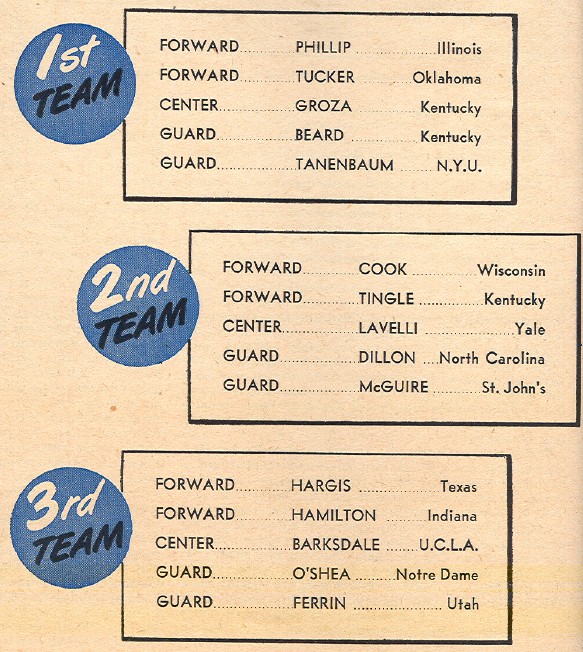
FIRST TEAM
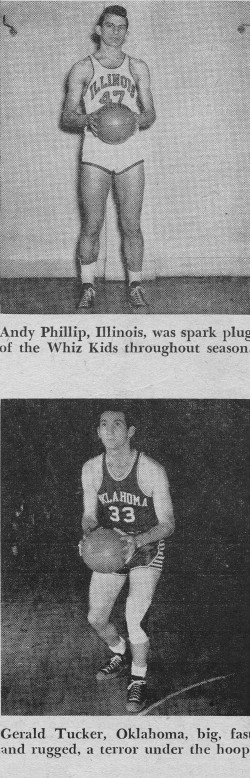 |
GERALD TUCKER: Returned to Oklahoma after serving as first lieutenant in Army, coaching and playing with the 41st Division team of Honshu, Japan, that won the National Service basketball championship. Holds Big Six individual scoring record of 175 points for one season of 10 games and of 38 points for one game. A powerful 6' 4" 208-pounder, who is impossible to move under the boards. Works off the pivot and taps in rebounds. After watching him score eight field goals against Wisconsin, Roundy Coughlin, the newspaper sage of Madison, Wisconsin, wrote:. "This Tucker is the best visiting basketball player I have ever seen in the fieldhouse here and I was here when they built it, too." Native of Winfield, Kansas.
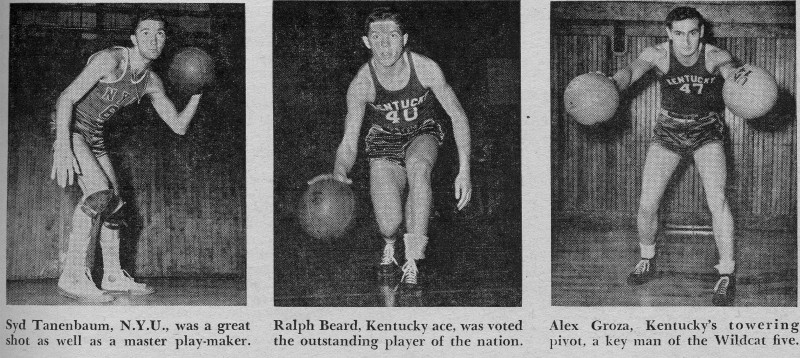
ALEX GROZA: A 6' 7" pivot man who made the Kentucky varsity team as a freshman two years ago. Left for the service at the mid-semester mark but had already established himself as All-American material. Comes from Martins Ferry, Ohio, a hotbed of crack high school football teams. Southern coaches, almost to a man, hail Groza as the best center prospect in that sector during the past decade. Operates out of the pivot and scores in double figures every game. Bats in a regular share of rebounds every time he takes to the court. Is adept at tapping in missed foul shots of his own teammates.
RALPH BEARD: At 5' 10", smallest regular on Kentucky's slick outfit. Despite lack of height is tower of strength under both boards. A streak of lightning down court, can dribble ball down floor faster than most players can run. A very good outside pop shot, Beard's speed enables him to cut and drive through for numerous lay ups. Always assigned to enemy's strongest offensive player. A leech on defense throttling the best. Held Ernie Calverley, Rhode Island State star, to eight points in Metropolitan Invitational Tournament finals, last winter, after Ernie scored" in very high brackets during quarter and semifinal contests. A native of Louisville, Ky., Beard was voted Player of the Year by coaches and sports writers.
SIDNEY TANENBAUM: The best exponent of the "give-and-go" play in college playing ranks. Equally adept on offense and defense. A remarkable set shot from outside. Always assigned to play defense for N.Y.U. against the strongest enemy scorer. Has handled nation's leading scorers with ease. A genius at setting up plays. Professional players maintain he makes plays on court reminiscent of best pros in Original Celtic era. Selected as New York City's most valuable player last year and picked best performer to appear in Buffalo. A member of the All-City five since his freshman year. Sid is a New Yorker.
 |
SECOND TEAM
BOB COOK: A football, tennis, and basketball hero at Harvard High School, Illinois. Played for Wisconsinin 1943 then left for the service. Returned last winter to lead the Badger scorers and finished fourth among the Big Nine Conference scorers. Only member of the Wisconsin team under six feet, standing 5' 10". Weighs 155 pounds. His coach, Bud Foster, maintains Cook is a better shot than John Kotz, Badger flash before the war. A bucket shooter who is impossible to stop when he is having an "on" evening. Played third base on Wisconsin's Big Nine baseball championship team.
JACK TINGLE: A senior, having played forward for Kentucky during entire college career. Is 22 years old, 6' 3", weighing 185 pounds. In his freshman year (1943-44) he racked up 78 field goals and 21 free throws for 177 points. In his sophomore year, he was high scorer for the team with 293 points on 124 field goals and 45 free throws. Last year he tallied 278 points and 117 field goals and 44 free throws. Jack took All-Southeastern honors in 1943-44, 1944-45 and 1945-46. As a center for Trimble High School at Bedford, Ky., Tingle rated top honors as a scholastic player.
TONY LAVELLI: Star of Yale five last year as freshman. Entered New Haven institution from Somerville, Mass. Although he stands 6' 3" can out-jump opponents several inches taller. A hook-shot artist who throws the ball through net from either the right-hand side or the left-hand side. After watching him in action one game last winter Coach Ossie Cowles, then of Dartmouth, now at Michigan, labeled him one of the best shots he ever saw. Despite Yale's uncertain record in the early part of the current season, Lavelli managed to score in double figures every time out and earned the plaudits of opposition coaches.
JOHN DlLLON: Probably the most talented left-hand hook-shot artist in the country. Although standing but 6' 2" does not find it difficult to outscore rivals much taller. Stations himself around foul line with back to hoop. Upon receiving pass from teammate darts to right and pivots on left side hooking the' ball off the board into the net. Shot is virtually impossible to stop. Defense concentrates on forcing play away from his station so mates cannot feed him. Paced North Carolina mates to N. C. A. A. finals last winter when North Carolina was topped by Oklahoma A. & M. Main cog in upset victory over N. Y. U. in Garden this winter. Hails from Savannah, Ga.
DICK McGUIRE: A smooth, polished floorman who sets up the plays for his teammates. Often called a "floor coach." A good set shot, McGuire prefers to set other teammates up with blind passes thrown while looking away from intended receiver. Although medium in height Dick manages to retrieve balls consistently off the defensive board. Quick to size up opponents' weaknesses and paces St. John's team accordingly. Strong on defense, always taking care of opposition's highest scorer. A sophomore at St. Johns, McGuire toured the Philippines and Japan last winter as member of Navy All-Star quintet. He is a Brooklyn resident.
THIRD TEAM
JOHN HARGIS: A native of Nagocloches, Texas, where he starred in four sports at high school. Helped Texas to co-championship of Southwest Conference and scored 59 points in two NCAA play-off games before entering Marines. Won commission and served on Okinawa before coming home for senior year of basketball. Voted top player in Oklahoma City All-College meet at beginning of current season. His specialty is a leaping, sharp one-hand shot which he gets off either hand. Averaged 17.5 points in Conference games. Married and has a year-old son. Is 26 years old and stands 6' 2 1/2". Came to Texas primarily as a baseball star.
RALPH HAMILTON: Turned down $10,000 pro basketball contract to finish college career at Indiana. A native of Ft. Wayne, Indiana. Regular forward on Hoosier squad in 1942 and 1943. Served as lieutenant in Army three years. Played with Camp Lee. Later, during 1945-46 season, with Army Service Depot team at Atlanta, Ga., scored more than 1,000 points averaging 31 points per game. Averaged 16 points per game during first half of current Big Nine Conference season. Created new three-year Indiana scoring record held since 1930 by Coach McCracken. Very adept at maneuvering for shots.
DON BARKSDALE: U. C. L. A.'s 6' 6" colored center who returned after serving Uncle Sam. Was mainstay of UCLA's 1943 combination. One of nation's leading high jumpers; is terrific rebounding off both boards. Amazed Madison Square Garden fans this winter by grabbing rebound off defensive board, passing off to teammate and cutting down court away from opponent for return pass and lay-up shot. A constant scorer in double figures. After watching him for five minutes Coaches Clair Bee and Joe Lapchick said, "One of the best centers in the country today."
KEVIN O'SHEA: Campus observers at Notre Dame claim that O'Shea is the finest freshman basketball prospect to ever enter the school. A product of St. Ignatius High School in San Francisco, where he made All-City guard in basketball in 1943. At that time was hailed as the greatest high school player on the Coast since the days of Hank Luisetti of Stanford fame. Starred for the classy Alameda Coast Guard quintet while in the service. Last winter performed for the Borlo Athletic Club in the National A.A.U. tourney in Denver. A deadly one-hand shot from all corners of the court.
ARNOLD FERRIN: First caught the fancy of Madison Square Garden fans during the 1944 post season tournaments, participating with Utah in both Metropolitan Invitational and N. C. A. A. tourneys. A shifty ball handler and dribbler, Ferrin drives opponents crazy with his deceptive change of pace as he cuts under the hoop. Plays a double pivot with center-man Gardner and drives off pivot repeatedly to score in double figures. Led Utes in upset victory this year in Garden over St. Johns with his 19 points high total for both teams. Exceptionally talented dribbler for a player standing 6' 4".
Return to Kentucky Basketball page, Kentucky articles, statistics, team schedules, team rosters, opponents, players, coaches, opposing coaches, games, assistance or search this site.