
There's no substitute for winning -- including if you're building character -- says the winningest basketball coach, Kentucky's great Adolph Rupp. IN this exclusive and frank interview, you get a good idea of why Rupp wins
Published in Sports Review Magazine, January Special Basketball Issue, Vol. 21, No. 1 pp. 56-63
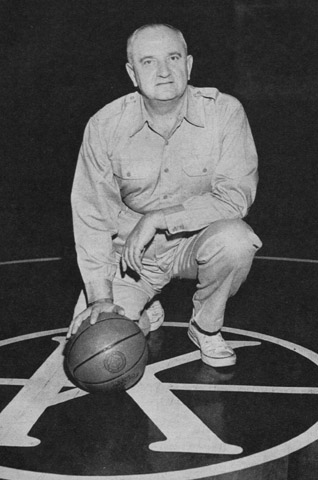 |
| Adolph Rupp of the University of Kentucky has won more national basketball championships and major college games than any coach in the world. Thirty-one plaques and twice that many pictures decorate his office walls, and two cardboard boxes contain awards he hasn't had time to display. The door to his office is blank: an office down the hall in the University's Memorial Coliseum bears his name on the door to confuse the curious and provide a measure of privacy. When Rupp sits in his office and speaks from very near the heart of his fiery character, it isn't difficult to see why his teams have been 8 per cent indomitable in winning 627 games over the past 30 years; and why he reigns as the "boss of basketball." |
by BILL SURFACE
LET me tell you how hard it was to find a day to spend with you," Adolph Rupp was saying. "I had to practically insult 25 people, get off jury duty, and take the phone off the hook."
"Since most of the coaches are talking about you retiring," I said, "let's start off with that."
"All right," Rupp said. "Most of the guys I beat regularly would like for me to quit. The managers who were finishing behind Casey Stengel and the Yankees for nine or ten years wanted him to quit, too. So would those New York writers -- hatchet men, I call them."
"Yeah, I know I have plenty of enemies and the New York writers love chopping me apart," Rupp said. "But I'd rather be the most hated winning coach in the country than the most popular losing one. I don't try to be unpopular; it just works that way.
"I'm not paid to win popularity contests. I'm paid to win basketball games and the national championship and I've won it more than anyone else in the country -- four times. The people can boo and hoot and ride me all they want to as long as I'm winning."
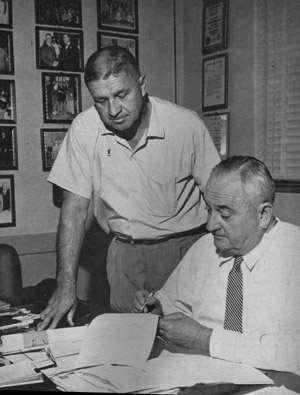 |
| The Old Master of Kentucky, right, with Assistant Coach Harry Lancaster. Despite the rumors, Rupp won't retire. |
"You know," he continued, "some darned writer made the statement that I drove a bunch of kids to my last N.C.A.A. championship. If anybody else in the country had won the thing he would have said, 'So and so LEADS his team to the N.C.A.A. crown.' But me, I drive mine, he says. Somebody has to get behind a team. Ike didn't lead the troops into Berlin. They beat him there.
"I'II admit we work hard. But that's the kind of boys we're looking for -- the type who are willing to work hard and sacrifice.
"We don't have a lot of fun during practice. We work hard. We have our fun at the end of the season. What's more fun than winning the N.C.A.A. championship? You don't win the thing by playing around.
"Where were those big stars. Oscar Robertson and Wilt Chamberlain, when we won our last national championship in 1958 ? Home listening to the game on the radio, that's where."
I asked if he would like to finish on the subject of sports writers before we went any further.
"Yes, I would," Rupp said with a bite in his voice.
"There are some fine sports writers in New York. Unfortunately, there are some who obviously know little about sports and are destructive. I've been saving this one for them. A great artist is one who paints great pictures; vandals destroy them.
"It takes a great architect to design great buildings; any common laborer can tear them down. If the New York writers had been constructive in their writing, they would still have the Dodgers and Giants up there.
"They chased those teams out of town and cut their own throats. What are they doing with the guys who used to cover baseball ? Writing about horse racing and dog shows or something. That's just like me blasting college basketball until the school abandoned it.
"I think the Chicago writers are better than New York's anyway. Chicago is the only city in the country with two major-league baseball teams. They have better basketball attendance at Chicago Stadium than at Madison Square Garden. Do you think Chicago would have this if the press had been brutal all the time?"
We were interrupted by a would-be visitor who wanted to chat about the team prospects.
Then I recalled to Rupp that I was the student manager for some of his greatest teams and couldn't remember a year when he didn't have a good outfit.
"No, and you won't either. Unless I. win, basketball means entirely nothing to me. I don't agree with coaches who say they're building character when they're losing. You build the best character by winning.
"Some sports writer once wrote this thing:
'And when the last great scorer comes to write against your name.
He writes not if you won or lost, but how you played the game.'
"How you played the game, hell! They still keep score, don't they? People don't drive hundreds of miles and pay good money to see how two teams played. They want to see somebody get beat."
"Do you like any other sport?" I asked.
"Not particularly, but basketball, naturally, is the best, even though I'm disturbed at the slow-up that's crept back into the game. Some of the stalling like last year's could ruin it like -baseball."
"What's wrong with baseball?" I asked.
"Baseball has gotten to the point where it's plain sorry," he declared. "I saw about 15 Cincinnati Redleg games last year. I was downright disgusted at some of the things -- especially the pitchers."
"Say it's the pitcher's time to bat. Somebody in the on-deck circle has to tell him to hit. He stands up, smiles like he's posing for a toothpaste ad,, gets a drink, takes off his jacket. Then the bat is too light. He gets the same bat he knew beforehand that he was going to use and strolls to the plate, knowing all the time he's going to strike out anyway."
"Did you do anything different, or anything in particular, in winning your last national title in 1958, than you did in the other three (in 1948, 1949, and 1951)?"
"A heck of a lot of different things. The other years we won I had the horses to do the job and knew it. That year I had only hackney ponies to do a thoroughbred's job. I still was as strict as ever, but I'm getting mellower with age."
"About basketball in the future," I asked. "Do you think the scores will be any higher?"
"No, as long as there's defense it's only human nature for some kid to try and prevent the other from scoring. Scores won't be any higher than they are now. The reason they're increased so is that we've got better basketball players now.
"Defense is the way a boy makes my team. With my system of offense, anybody can score. All the boys can shoot or we wouldn't have gotten them. Give me the kid who wants to keep the other from scoring. I'd rather have a boy who gets four points and stops his man than somebody who scores 21 and gives his man 29. He helps the team more."
"Now, about your defense, coach?" I started to ask.
"I use an aggressive man-to-man defense that switches on every screen or possible screen.
"I hate a zone, but I can whip one. I've got two offenses-- one for a man-to-man defense and another for a zone. A lot of coaches have sprung a zone on me, but I was ready for them. Zones can ruin the game. They take out the action and pattern plays that spectators like and eliminate good basketball. The pros were smart in outlawing the zone.
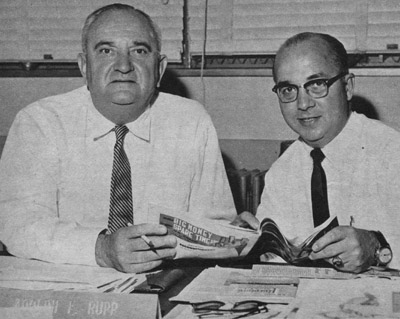 |
| Coach Rupp with Kentucky U.'s sports publicity director Ken Kuhn. Rupp says the scores won't keep getting higher. |
"You getting hungry?" Rupp asked. "Let me look at the mail and we'll go eat lunch. Here's a letter from Spain. Some outfit wants me to start a drive for uniforms. I got so many letters from Japan that my book. Championship Basketball, was translated into Japanese."
"Rupp walked from Memorial Coliseum, where Kentucky plays its home basketball games and has its athletic offices.
"The coliseum isn't just a basketball gym," Rupp said while walking. "They have concerts, registration, graduation and everything in there."
"Yes, I know," I said. "Remember the time vou had to practice on one end of the court while Lily Pens was rehearsing on the other?"
"Yeah, yeah, that's right," Adolph laughed. They had Artur Rubenstein here once. I came out on the floor with my team and they said, "You can't come out here. Mr. Rubenstein has to practice for his performance tonight."
(Rupp said, 'Listen, if Rubenstein misses a hundred notes tonight, there won't he a soul who'll know, but if we blow one easy basket against Tennessee tomorrow, the whole world will read about it.')
"If you don't like entertainers," I asked, "what do you do for entertainment?"
"Win basketball games. Outside of that, read. I'm what you might call nosey. I want to know everything that's going on. I take five daily papers, the Wall Street Journal, every farm publication possible, and 22 other magazines.
"I don't play cards. That's a waste of time and I can find a more profitable way to relax than that."
"Don't you attend movies?"
"No, but I encourage my players to attend them on the road to relax. I hadn't been to a movie in years until I was invited to this 'Cat On A Hot Tin Roof' thing. It wasn't too bad."
"Do you like art, then?"
"No, for two reasons. Number one, I'm color blind. Number two, the only art I was accustomed to as a youngster was the picture on a yearly calendar sent to our family by an elevator company."
"You must do something for relaxation," I said. "Do you take a vacation every summer?"
"I don't believe in vacations." Rupp replied. "A few years ago everybody, including the doctors, said I was sick and needed a vacation. My wife always wanted to visit Daytona Beach. I sunburn easily and spent about 30 minutes in that hot sun. So I went back inside the cabin and got dressed. Esther asked what's wrong? I said, 'Nothing's wrong. We've seen everything; we've been in the ocean. Lets go back home.' I stayed, but it was the most miserable and useless two weeks of my life.
"If I'm going to take a vacation, I like the mountains where there's a new scene around every curve. We stopped at the Grand Canyon once. I looked at the thing about five or ten minutes and said, 'Let's go. My wife said she was stunned. 'Stunned, hell,' I said. 'We've seen the thing. Why stick around any longer unless we want to live here ? ' "
"What do you look for when scouting high school players?"
"Well, there's more to coaching than copying plays. You've got to get the boy. The first thing I look for in a boy is speed. This includes quick reactions and the ability to start quickly. The second thing is hustle. A lot of my kids with less ability play because they outhustle the more talented boys.
"A boy must have confidence, be certain about his moves. A hustling boy with some ability and confidence is hard to beat -- if he can take criticism. Some kids sulk when you criticize them or try to correct them. Then a lot of our boys are lazy. I like a boy who's willing to stay out there and work to adapt himself to our system. This helps develop rhythm. Thousands of repetitions bring about the quality known as rhythm. Boys have to have team sense and intelligence. One kid can spoil a play and keep someone else from scoring. I want boys who will accept defense -- not just offense. That's where you win.
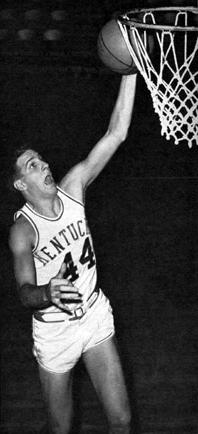 |
| Bill Lickert, 6-3 185-pound hard-driving forward, is in Sports Review's Top Ten, is one of the key men in Rupp's campaign for 1961. |
"It's getting near practice time," Rupp remembered. "Let's go to the dressing room and we can talk there while I'm getting ready."
Switching from his customary brown suit into army khaki, Rupp walked through the corridors to practice, where the gates are covered, chained and padlocked after the last arrival to keep out visitors.
Rupp and his assistant, Harry Lancaster, huddled. Student managers started distributing red shirts. The freshman team worked on defense against the varsity. A sophomore drove in lor a lay-up and put a fancy spin on the ball.
Rupp was disturbed. "Son, the season box holders don't pay a cent more to see shots like that."
Another player was slow driving under the basket.
Rupp put an edge in his voice. "Boys, the trots are over. They're running this week at Keeneland Race Course. We can't win when we're running like we've got rheumatism."
Billy Lickert, a star forward, did more dribbling than passing. "Hold it, hold it," Rupp yelled. "The Southeastern Conference has made a new ruling. You're allowed to pass off this season. You don't have to dribble the entire game."
Meanwhile the sideline brigade of statisticians, ex-players and sports writers began recalling "Ruppisms," a favorite pastime at Kentucky practice sessions.
"Remember the time he told a boy he had violated the 11th commandment?" laughed ex-student manager Humzey Yessin. "Thou shall not be stupid."
"Yeah, yeah," someone else said quietly. "Rupp was coaching the Kentucky College All-Stars for a game against Indiana. His team really was out of shape. So he went to the timer and told him to notify him at the end of four minutes.
"The players were dragging when he ordered the fast break drill. Four minutes later the timer signalled. Then Coach Rupp said, 'Boys, see how long a minute drags out when you're not in shape."
Rupp was holding a conference at the center of the court. "Time for some action," he was saying. "Oh, manager. Get the clock out so we can have some accurate timing."
I then left the playing floor and walked to the office of Ken Kuhn, the university's sports publicity director. "I need some more information on Coach Rupp," I said. "Let's look briefly at his record," Kuhn replied.
Rupp's record:
A total of 626 victories out of 739 starts for an unparalleled winning per- centage of better than 84 percent over the 30 years he has been at Kentucky.
An unprecedented honor roll of four N.C.A.A. Tournament championships picked up by his Wildcats, who hold the all-time record of 11 appearances in the national classic and can claim more victories in N.C.A.A. play (21) than any other team.
A nominal world's championship as co-coach of the winning U.S.A. entry in the 1948 Olympic Games, which included members of Kentucky's N.C.A.A. champions.
Selection as the national "Coach of the Year" in 1959 for the second time in his career as he guided an inexperienced group of sophomores to a 24-3 record.
A total of 19 Southeastern Conference titles since the league was organized in 1933.
Development of more All-America players (21) and more material for the pro ranks (17) than any other coach.
Four Sugar Bowl Tournament championships, a National Invitation Tournament title and four successes in the first seven University of Kentucky Invitational Tournaments.
Election to the Basketball Hall of Fame in 1946 by Helms Athletic Foundation and to the Naismith Memorial Hall of Fame in 1959.
Membership on the N.C.A.A. Basketball Rules Committee.
"The outstanding success of this man as a basketball coach is matched only by the personal fame he has at tained outside the sports world," Kuhn reported. "Coach Rupp is currently in his seventh term as President of the Kentucky Hereford Association. He is a member of the Board of Directors of the Central District Warehousing Corporation, the world's largest tobacco marketing organization. He owns and operates one of the largest farms in he Bluegrass area.
"Rupp is a Kentucky Colonel, is active in Shrine affairs and serves as Vice-Chairman of the Shrine Crippled Children's Hospital in Lexington," Kuhn went on. "He is a Past Potentate of Oleika Temple and has been honored as one of the ten outstanding Shriners of the nation. He was elected to the Kentucky Hall of Fame in 1945 and four years later was honored as the outstanding citizen of the University city of Lexington. In 1959, he also was the recipient of the Governor's medallion for meritorious service to the Commonwealth of Kentucky and of a plaque of appreciation from the U. S. Air Force."
Born in Halstead, Kansas, Rupp attended the University of Kansas where he played under Phog Allen. Following graduation in 1923, he coached high school ball one year at Marshalltown, Iowa, and was at Freeport. Ill., for four seasons before coming to Kentucky in 1930. And "The Man In The Brown Suit" has been a "hit" ever since.
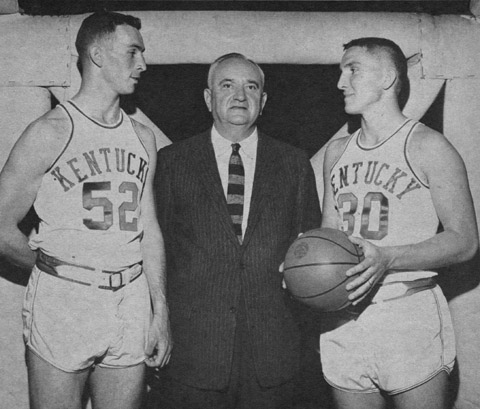 |
| Rupp with Junior College boys Vince del Negro and Doug Pendygraft; 87% of Rupp's players are Kentuckians |
What kind of team will Kentucky have this season? After following Rupp's teams for 30 years, the safest way to phrase Kentucky's basketball prospects for any year is to say: "Don't sell the Wildcats short."
Adversity, in the form of injuries, sickness and ineligibility, plagued the Wildcats all last season with the result that they were saddled with an 18-7 record that stood as the second poorest season ever in Rupp's 30-year Kentucky dynasty. And anyone who knows the Baron and is cognizant of Kentucky's winning habits in basketball should realize that both Rupp and his men are determined to "get back in business."
While the Kentucky quintet of last season was universally recognized as one of the nation's strongest when at full physical strength and losses were comparatively light, prospects for the current season might not be considered good except for the anticipated presence of a pair of junior college All-America transfers.
The new faces Rupp is counting on heavily to boost Kentucky back into contention for the Southeastern Conference title and an unprecedented fifth N.C.A.A. championship are Vince Del Negro, 6-5 1/2 center-forward from Northeast Mississippi Junior College and Doug Pendygraft, sharpshooting 6-3 guard of Kentucky's Lindsey-Wilson Junior College. Del Negro, a two-year All-American, has been one of the nation's leading junior college scorers in his first two collegiate campaigns while Pendygraft picked up Most Valuable Player honors in the National J.C. Tournament last season and set many new scoring records in tournament and All-Star play.
Kentucky opponents also look with considerable apprehension on the return to top physical condition of the Wildcats' All-American, Bill Lickert. The versatile, 6-3 forward-guard repeated as an official All-Southeastern choice last season despite being incapacitated nearly a month in mid-season with calcification of a thigh muscle that required surgery. As a sophomore in 1958-59, Lickert had gained SEC Sophomore of the Year recognition and last season seemed to be on his way to an even greater year as indicated by a 29-point performance against Ohio State's eventual national champions.
Aside from Lickert, however, the returnees are not so highly regarded. Past performances stamp them as dependable, but it's debatable in most observers' minds whether they can take up the slack of the losses. Missing will be leading scorer Don Mills 6-7 center, and a pair of guards who saw extensive action -- starter Sid Cohen and alternate starter Bennie Coffman. All three were drafted by professional clubs.
The biggest man in the Kentucky lineup this season will be 6-9 pivotman Ned Jennings. After that, there is a sharp drop-off in the height department that has Rupp worried to some degree over his board control. With the expected availability of Del Negro. Jennings might not see regular duty as Rupp sacrifices what little height he will have for speed which was lacking last season. The probable starting unit would graduate from Del Negro at 6-51/2 down to Captain Dick Parsons, 5-9 guard. Much help is hoped for from 6-4 senior forward Roger Newman, who will be playing his first, varsity year due to absences and quirks of eligibility rules.
Defensively, Coach Rupp is hopeful of a continuation of the high standards his teams have maintained in the past several seasons.
Return to Kentucky Basketball page, Kentucky articles, statistics, team schedules, team rosters, opponents, players, coaches, opposing coaches, games, assistance or search this site.