
 |
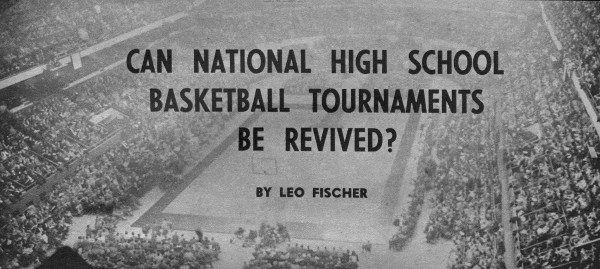
There are many who believe and say that now is the time to bring back the two national high school championship cage tournaments that thrilled the nation in the '20s during golden age of sports.
Published in Sports Review Magazine, January 1960, pp. 34-36.
by LEO FISCHER
IN these days when everybody is about doing something for the kids, has any thought been given to the revival of two basketball events which once stirred the imagination of teenagers -- and grownups -- from coast to coast?
The National Interscholastic championship basketball tournament flourished at the University of Chicago from 1917 to 1930, with two years out for World War I. The National Catholic Interscholastic championship meet registered its first goal in 1924 and continued until 1941 at Chicago's Loyola University.
Many years and another world war have gone into the records since the final gun sounded for these two spectacular and exciting tournaments, but the memories linger on. More important than that, in every section of the United States you will find business, civic, educational and sport leaders who proudly boast that they once played in one of these two national championship high school meets.
Then why were they discontinued? Basically it was because of pressure from the National Association of State High School Athletic Associations, which maintained that it was "harmful" to the youthful contestants to take them away from home for these competitions, even though for the most part their dates corresponded with the Easter vacations in the majority of the nation's schools.
The University of Chicago reluctantly gave up in 1930 after venerable Amos Alonzo Stagg, then athletic director, had exhausted every avenue to keep it alive. He realized it was a futile battle when one of his own faculty members brought the North Central Association into the fight on the side of the National Federation by threatening to withdraw accreditation of any high school which competed.
That was in the era when the University of Chicago was beginning to "de-emphasize" athletics, which explains the rather strange action. Stagg was also trying to save 'another event which was dear to his heart, the National Interscholastic track championship meet, in which the greatest prep stars of the nation competed, and it is reported he was promised by C. W. Whitten, then executive secretary of the National Federation, that if he ended the basketball tournament there would be no interference with the other. But it, too, was forced out of existence a couple of years later.
At the time there were many rumors that the National Federation planned to stage a basketball tournament under its own auspices, but nothing ever developed and it has remained dead since. Loyola continued its National Catholic meet a dozen years longer because parochial schools at the time did not belong to the National Federation. Gradually the bars were let down to them and as more and more Catholic schools joined the organization, it became increasingly difficult to obtain representative teams. Finally Loyola, too, gave up.
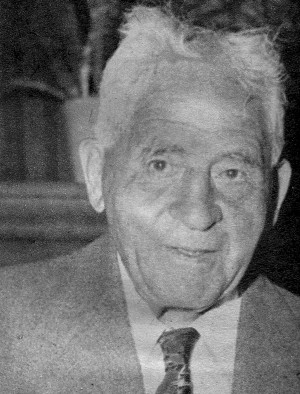
Stagg, who celebrated his 97th birthday last August by mowing his lawn, still feels that his tournament was one of the finest events ever held for high school boys. He declares:
"It was an educational experience which had tremendous values in future life. Many a youngster had never been away from his own home state before he came to Chicago as a member of his championship team, and the experience of meeting with boys from every part of the country in thoroughly supervised play and recreation was an opportunity which helped them in every way.
"Certainly I would not permit anything harmful to be associated with this tournament and the men like Nels Norgren and Fritz Crisler who worked with me in conducting it were the highest type of leaders. So far as physical harm is concerned, I can think of only one serious injury-and the boy recovered well enough to now be president of a bank in Chicago today."
The "boy," John J. McDonough, also has another unique distinction. In these days of high-pressure proselyting of athletes, it may seem incredible that during the dozen years Chicago ran its tournament, sometimes with as many as 45 state champions competing, he was the only athlete whom the school was able to enroll as a student, so far as can be ascertained.
Digging into memory -- and a lot of old score-books -- is an intriguing experience. Norgren, who ran the tournament in its early days, was a 12-letter winner in basketball, football, track and baseball and an All-American in the first two. He retired a few years ago after more than 30 years as Chicago's basketball coach.
Back in the '20s, the technique was the "work the ball in" for a sure shot before you let go. This was in the days of the center jump after every score, and there 'was no guarantee that you'd get the ball back if you missed. Accordingly it was rather rare for anyone to try a long shot, and Norgy decided to keep a record of them. So whenever a youngster let fly and caged one from beyond the free-throw key, he'd call time and mark it in chalk on the floor. Later it was measured.
If you're interested, the record at old Bartlett gym, where the games were played, was 43 feet, 9 inches, made by a youngster named Moran from Boone, la., in 1920. (That's a pretty hefty shot even in these days.) The tournament was won that year by Crawfordsville, Ind., which defeated Wingate, Ind., 22-16, a score which may make point-conscious Hoosiers blink in disbelief. Yet it was every bit as exciting as any 99-85 game these days -- and probably a great deal more scientific.
McDonough came down to the 1924 tournament with Yankton, S. Dak. which lost the final game to Windsor, Col. by a 25-6 score in a field of 39 teams. Bo Molenda and Joe Truskowski, who won all-American football laurels at Michigan, were members of a Detroit team in the tournament. Forrest Twogood, who later won laurels at Iowa and in the coaching profession, was a member of the Sioux City, Ind., team.
Doug Mills, for many years Illinois athletic director, was on the Elgin, Ill., quintet, while Bennie Oosterbaan, who retired last Fall after 15 years as Michigan football coach, played for a Lansing high school.
Chicago area high schools won their only Stagg tournament title in 1927 when Morton of Cicero defeated Batesville, Ark., in what must have been the ultimate in "slow break" basketball, by an 18-16 count.
Every University of Chicago tournament was jam-packed with color as the kids rolled in from the highways, the byways, the farms, the villages and the big cities, but none ever equalled the 1928 meet towards the end of what has become known as "sport's golden age.' That was the tournament which had the entire nation pulling for a crew-cut group of youngsters representing Carr Creek, in the mountains of Kentucky, where the total enrollment was 18.
Only eight of the boys could play basketball. They had no indoor court, so they drilled outside when the weather permitted with a manual training teacher as their coach, and makeshift baskets made out of barrel hoops. The boys had never been away from home until they went to the state tournament in Kentucky and won in their class. Then they received an invitation to Chicago and made the trip when the townspeople raised enough funds to send six men - two boys named Adams and three cousins.
Forty high school teams, most of them state champions, took part that year. It was typical of the affair that in addition to Carr Creek, Ky., the first round listed such places as Berlin, N.H.; Morris, Ala.; Vienna, Ga.; St. Paul. Neb.; Purdy, Tenn.; Mize, Miss.; CatsonviIIe, Md.; Miami, Ariz. ; Yankton, S. Dak.; St. George, Utah and Oregon, Mo., in addition,to the bigger schools. Truly, no national tournament before or since (with the possible exception of the Loyola meet) could ever claim so tremendous a coverage of the nation.
But back to Carr Creek. They won their first game from a group of Indian school boys representing Albuquerque, N.Mex., knocked off the pre-tournament favorites from Austin, Tex., in the second round and then moved into the quarterfinals with a victory over Bristol, Conn.
By this time.the team was top headline news not only in the Chicago newspapers but throughout the country. Then it ran into another tournament favorite, the youngsters from Vienna, Ga., who had plenty of speed and finesse.
It was the end of the road for the Cinderella team. They were unable to cope with the height of the southerners and lost, 22-11. Vienna, in turn was beaten by Ashland, Ky., which went on to take the title in a final with Canton, Ill., 15-10, in a game where the score was 7-4 at half time. The losers were coached by Mark Peterman" famous in Illinois prep annals for his deliberate stalling style which had won the state title that Winter.
The margin of victory was on free throws. Ashland didn't make a foul.
That was the high point of Chicago's tournaments. The next two years Athens Tex., coached by Jimmy Kitts and featuring the three Tompkins' brothers, all of whom went on to win fame at the University of Texas, won the championship. In 1930 they rang down the final curtain by defeating Jena, La., for the title, in spite of the brilliance of one of the tournament's most colorful stars, "Sparky" Wade, later a Louisiana State star and coach.
 |  |
In the meantime, on the north side of Chicago the National Catholic tournament was building up followers and interest. It originated in 1924 when St. Ignatius high school of Chicago, with a city championship team, was denied admission to the Maroon tournament because it was not a member of the National Federation. Catholic educational and sport leaders met and organized their own tournament.
Like the Chicago meet, it was full of color and action -- and similarly, its "graduates" are everywhere among the nation's leaders in every capacity. The first winner in 1924 was Spalding of Peoria, III., led by Tony Lawless, who recently retired after almost three decades as football coach at Fenwick high school in Oak Park, III., to become athletic director.
George lreland, one time Notre Dame star and now coach at Loyola of Chicago, made his bow with the quintet from Campion, Wis. Zeke Bonura, long before he had any thoughts of being a baseball star, showed spectators some brilliant performing on the basketball court when he competed with the club from Bay St. Louis, Miss.
Star of the two-time champion De La Salle Institute of Chicago was a tall, gangling youngster named Ed Krause, who went on to win All-American fame at Notre Dame in both basketball and football and has been the school's outstanding athletic director for many years. His brother Phil, as fine an athlete as Ed, later started for Chicago's De Paul university.
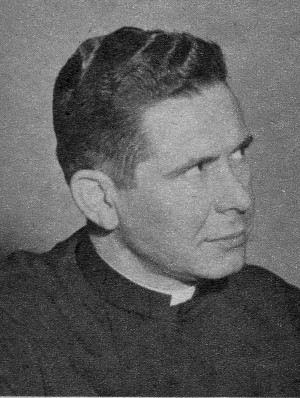
One of the early tournament directors was the Rt. Rev. William J. Schmidt, S.J., now head of the Chicago province of the Society of Jesus. Father Schmidt and the others who conducted the Loyola tournament saw it grow in stature each year and move into the sports picture as the outstanding high school event on the sports calendar.
Then came the double blow of pressure from the National Federation and war-time travel restrictions. Like the University of Chicago, Loyola decided to give it up after a 17-year span in which it had built up a tradition of its own and a host of vivid memories.
What are the chances of reviving them? First you'd have to find an educational institution willing to spend the time and money on it, since the transportation and housing expense of a tournament of this calibre would preclude much chance of profit.
Then you'd have to face the opposition of the National Federation, which now includes all 50 state high school associations in its membership, representing some 21,000 schools. Standing alongside of them in the ban against national high school championship meets are two other powerful groups, the American Association for Health, Physical Education and Recreation and the National Association of Secondary School Principals.
 |  |
C. B. Fagan, executive secretary of the National Federation, points out that this has been its policy since 1934:
"The action concerning high school national championship meets was the result of overwhelming sentiment on the part of high school administrators that the high schools are provided with enough competition by their own leagues and state associations."
He also points out that most state associations have further strengthened this opposition by adopting limitations on travel. Quoting the National Federation handbook:
"Any games which require a team to travel more than 600 miles for the round trip must be sanctioned by both interested state associations through the National Federation. The restriction on interstate meets and tournaments and distant travel is necessary to prevent excesses which would otherwise develop. In places where a large meet of this kind has been discontinued, many small meets have been substituted and a greater number of athletes participate."
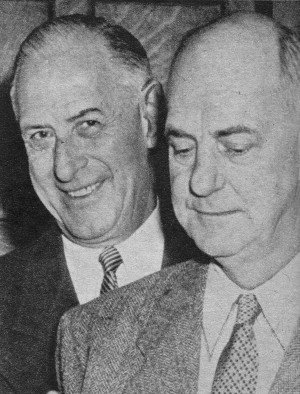
H. O. (Fritz) Crisler, director of athletics at the University of Michigan and for years an outstanding figure in college sports, directed the University of Chicago tournament for its last eight years when he was Stagg's assistant on the Midway.
"I would certainly not wish to quarrel with the National Federation, which has done a magnificent job among the high schools," he says. "I have never questioned the sincerity of the men who felt that our tournament was not in the best interests of the high school boy. On the other hand, I'm sure no one has ever doubted the high principles or motives of Mr. Stagg, nor could anyone criticize the manner in which he conducted his interscholastic competitions.
"For eight years I had a chance to be in close contact with the youngsters who came to Chicago from every point on the compass. I'm certain that there wasn't one of them who wasn't benefitted by what was a great educational experience as well as a wonderful athletic event.
"The chance to travel, the chance to mingle with boys from all sections of the nation and the chance to compete on a championship level under the finest auspices and under the best interpretation of sportsmanship in my opinion gave the event values which far outweighed any criticism -- justified or otherwise -- which could be leveled at it. I was sorry to see it discontinued."
So were all the others who had a chance to watch or compete in either this one or the National Catholic tournament. Maybe the time is ripe for the National Federation to re-examine its position if sponsors like Chicago and Loyola can be found once again willing to bring back to life two of the finest events ever listed on the American sports calendar.
Return to Kentucky Basketball page, Kentucky articles, statistics, team schedules, team rosters, opponents, players, coaches, opposing coaches, games, assistance or search this site.