
When Big Bill first showed up in Lexington, he looked like anything but an athlete. But he was determined to play basketball, and Baron Rupp is glad he let him try
Published in Sport Magazine, January 1951, pp. 42-43, 88-89.
by FRED RUSSELL
SEVEN-FOOT Bill Spivey was a sensation in Lexington well before his first varsity appearance in a Kentucky basketball uniform.
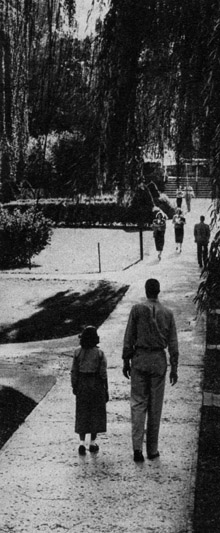 |
| Walking along the campus with cheerleader Nancy Lee Brown,, Spivey's height is sharply accented. Asked to fill in for the graduated Alex Groza, Bill confounded the skeptics by scoring 494 points in his first season with the Wildcats. |
While business at the drugstore picked up at a startling clip, the quiet, shy Spivey went about his specialized duties, consisting wholly of plucking the fluorescent lamps from the ceiling and cleaning them. Curious patrons packed the store to get a glimpse of this eighth wonder of the world. Invariably, as proprietor Williams quickly noted, they bought something.
When the basketball-crazy citizens of Lexington discovered that the giant Spivey was one of Rupp's prospects - the biggest he ever had - they conferred with Williams. Several days later, a Negro boy as small as Spivey is big was in the act. Wearing stout, white gloves, he cleaned the lamps. The basketball fanatics didn't want the ticklish fluorescent lamps blowing up and cutting Spivey's hands. So all Bill had to do was stretch a bit and pull down the lamps, still a spectacular sight for awed onlookers.
From the day Spivey first appeared at Williams' drugstore, he was surrounded by something approaching legend. Many tall tales, based on half-fact and half-fancy, have been told and written about the high-scoring Kentucky center, projecting the mild, quiet Georgian as a fugitive from "Tobacco Road."
It is true that Rupp and his assistant, Harry Lancaster, worked two to three hours a day, every day except Sunday, with a kid who looked raw and awkward to them. It is true, too, that the Kentucky coaches at first discouraged the big fellow from attempting to play college basketball at all. And it is also true, finally, that one Vince Boryla was the first to recognize the terrific basketball potential of Spivey. A former Notre Dame and AAU star, Boryla was a member of Rupp's 1948 Olympic squad that drilled in Lexington, and he urged Adolph to develop the seven feet of cage timber.
However, the "Tobacco Road" story is an injustice to Spivey. Just because the behemoth likes the Deep South dish of hominy, and his teammates have therefore nicknamed him "Grits," it doesn't follow that he never had enough to eat before he entered U. K. It isn't fact, additionally, that:
(1) His mother, supposedly impoverished, worked in a Georgia cotton mill.
(2) He played without basketball shoes and in his bare feet in high school.
(3) Lugging a decrepit suitcase which contained only a change of socks and one shirt, he was turned away, like po' little Liza, from all Southern colleges until Uncle Adolph gave him shelter.
A deceiving thread of half-truth is woven throughout the truth is woven throughout the pattern. Embroidered further by the nimble and imaginative minds of fans and writers, it is easy to see how a colorful personality like Spivey could, in two years, have such colorful fiction inspired by him.
There was one time, of course, when Bill actually did play basketball in his stocking feet. Spivey's family shuttled between Columbus, Georgia, and the little town of Warner Robins, near Macon. His father was a civil service employe, a superintendent of electricians at the United States Army Air Corps Base at Warner Robins. (Incidentally, he always made enough money to feed his family both regularly and well.) The community had built a new Warner Robins High School and the principal was interested in having basketball representation in the district tournament. He asked one of the state athletic big-wigs for permission to enter a team.
"You'll have to prove yourself capable, first, of flooring a decent basketball team," he was told. "I'll schedule three games for you. Win those, and we'll include you in the tournament."
It was a problem getting the size 15 basketball shoes that Spivey needed. Besides, before investing in the shoes, the school wanted to be sure the team would get in the tournament. So Spivey skittered around in his socks. The team not only didn't win all three games; it lost all three. And Warner Robins didn't rate the tournament.
That didn't matter much, for Bill. The Spivey family moved back to Columbus, its original home. It was there that the growing bean-pole actually started playing basketball, never again to slip around in shoeless feet.
"I really didn't like the game at first," Bill admits. "Couldn't get interested in it."
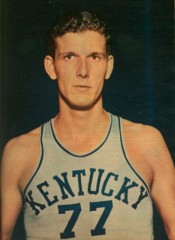 |
| Bill Spivey |
Register finally decided to give Spivey his first important test, against Phoenix City High. He played the entire second half, and dumped in 18 points. "It was the first time I was fired up by a game," recalls Spivey. "I never had a write-up in the papers before, but after that game, some stories said I had potentialities. It kinda helped keep me interested and finally I fell in love with the game."
Spivey returned to Warner Robins for most of his junior year and all of his senior year. He averaged 24 points per game as a junior, and was Georgia's leading high school scorer with a 29-point game average in his senior year. Which weakens the yarn people around Lexington like to tell about Spivey having played in high schools where girls' teams got top billing over the boys.
There is an element of truth in Spivey's persistence in wanting to attend Kentucky. But, like other stories, it has been twisted in the telling and retelling. Actually, the University of Georgia offered Spivey a scholarship, sight unseen. Georgia Tech was interested, too, but sorrowfully had to decline him because Bill lacked the mathematics entrance credits. Another Southern school was hot after him, one of its alumni offering Spivey an all-expenses-paid trip to the Olympic Games in London. Bill refused. Someone had sent a clipping about Spivey to Rupp and Adolph invited Bill to Kentucky for a look-see. The boy jumped at the chance. Kentucky always had been his No. 1 choice.
"I went up there all excited and tight as a drum, and in my first workout I didn't do very well," Bill recalls. "That night, I couldn't sleep, I was so scared and worried about flopping again next day. But I did better. Mr. Rupp talked to me and asked me if I'd like to come back and gave me the usual line. I thought I was a goner and that he was being just polite in asking me back."
Rupp, one of the game's all-time coaching greats, agrees on that point - up to a point. "That seven feet was interesting," says the Baron. "But, to tell you the truth, he didn't look like very much. He lacked coordination, he was awkward, he didn't have any shots, and he just stood around flat-footed. We found out, though, that he could run, and fairly fast. He was very sincere, too, and very anxious to play for us. But he weighed just 168 pounds, much too light for big time basketball. So I told him if he could push his weight up to 220, he could become a college basketball player. To tell the truth, I never thought he'd come close to 220. Bill said he could do it. We told him goodbye and never expected to see him again."
Bill did gain some weight. He returned to Lexington after Rupp got him the job at the drugstore for the Summer. Those were busy times for Adolph. He was one of the two coaches going to London with the U.S. Olympic team, made up of the Phillips Oilers, Kentucky players, and others. Rupp left Spivey in the hands of Lancaster, his valued and thoroughgoing assistant, and boarded a boat for London. Just before he left, he gave Lancaster these instructions: "Make Spivey eat, and make him drink three milkshakes a day, each with an egg, at the drugstore. And work with him every day on basketball fundamentals."
The faithful Lancaster wrote to Rupp regularly. "Spivey is up to 180," read the first communication. And then, in succeeding letters. "Spivey is up to 185 . . . He's reached 190 ... Hooray! 196 !"
Now Adolph was getting itchy. He sent a wire to Lancaster. "I'm convinced Spivey can eat," it read, "but can he play basketball?"
Boryla, a member of the Olympic squad, was the first to be convinced that Spivey could become a great basketball player. Before the team left the States, it practiced in the Kentucky gym and played a Summer exhibition game at Stoll Field in Lexington. Spivey worked out with these players, the best amateurs in the world, and caught Boryla's eye.
"That guy is amazing in the way he picks things up," Boryla told Rupp after the final practice in Lexington. "He learned everything I showed him and he imitated all my best shots perfectly."
Boryla's faith in Spivey paid off in succeeding Summers and Winters of practice.
"We had to teach him everything," said Lancaster. "He had the world's worst defense. He had picked up some bad habits in high school, where he played against those short kids and just had to stand flat-footed by the basket. But we also discovered Bill was a workhorse who loved to practice. What's more, he took well to coaching. And we found another admirable trait. He was cool, hard to get excited."
The colorful Rupp, master of the quip, also noted a certain intensity of purpose in Spivey which keeps the big kid unemotional and calm in time of crisis and turmoil. "He'll listen to what you have to say and do just what you tell him to do," Rupp cracked recently. "But if you give him a pep talk, hell, no tears roll down his cheeks."
Lancaster, who shares his head coaches sense of humor, illustrates Spivey's calmness in another way. "The atomic bomb could explode near here," says Lancaster, "and all Spivey would say is, 'Where are the grits ? Hide the grits !'."
This unemotional approach to life partially explains the great showing Spivey made in his first important test as a Wildcat. Kentucky had lost the "Fabulous Four" - Alex Groza, Wah Wah Jones, Ralph Beard, and Cliff Barker - by graduation. So, as a sophomore, the prodigious Spivey faced the enormous task of replacing All-American Groza. Physically, he could more than fill Groza's shoes. Whether or not he could do it out on the floor, under fire, was the question. Was he really a basketball player or just an overgrown kid ?
THE answer came quickly. Kentucky was to play an important early-season game against St. John's. What's more, the green, sophomore-studded Wildcats were to play in the awesome caverns of Madison Square Garden. And Spivey was to go up against Bob Zawoluk, the pivot man for St. John's who was, in pre-season predictions, stamped as a hardwood great.
"When we got up there in the Garden," recalls Rupp, "I told Lancaster to make sure the ushers locked all the exits. I didn't want my young bunch screaming in terror and running off the floor, when they saw all those people."
For a time, once the game got under way, it did seem a good idea to lock the exits. St. John's all but ran Kentucky off the floor. The Red Devils amassed a staggering lead before the Wildcats knew what had happened. Slowly, but steadily, Kentucky regrouped its forces. Behind at one time by something like 30 points, the 'Cats made a dazzling stretch finish and came within five points of their conquerors near the game's end.
Afterward, Rupp was elated. He knew he had a team with plenty of courage and, for a bunch of sophomores, poise. What's more, he had discovered that Spivey was a basketball player. Bill pumped home 17 points. Zawoluk, whom he guarded, was held to three points - one field goal and one free throw. Previously, the St. John's ace had averaged 19 points per game.
As far as the folks in Lexington were concerned, they were ready to prepare a shrine for Spivey next to that of Man o' War. To them, he was "in." And they were right, as the future showed.
Spivey had a phenomenal season for a sophomore. By scoring 494 points in 26 games, he smashed one of Groza's records, tied a second, and approached a third. Against Georgia Tech, he ruffled the netting for a staggering 40 points - two better than Groza's Southeastern Conference mark for a single game. Later, in the SEC tournament, Spivey tied the tournament record established by Groza with 37 points. Two heart-breaking shots which rolled around the hoop and out in the final minutes against Tennessee stopped him from another record-smashing performance.
There was a unique twist to Spivey's shattering of Groza's record of 38 points in a single game. On the opposing Georgia Tech team was Benny Register, his former high school pal and one of the boys who had urged Bill to play basketball. Spivey credits Benny and his coaching father, B. F. Register, with giving him his start in the sport. His old coach now is city commissioner of Columbus, Georgia.
In the relatively short time he has lived in Lexington, Spivey has been accorded hospitality and adulation no native hero could exceed. The Sleepy Head House provided a special bed for his huge seven-foot, one-quarter inch frame. The bed is eight feet long, six feet wide. However, Bill still has trouble in hotel rooms. He has to shove a chair over to the bottom of the bed, put a pillow on the chair, and thereon rest his outstretched feet.
Spivey's height has caused Rupp to turn exclusively to air transportation for his team. Pullmans aren't big enough for Bill, and furthermore, planes get the Kaintucks to their destination, quickly enough not to cause the skyscraper too much discomfort.
Spivey went on several scoring rampages during the 1949-'50 season, and his work helped put the Wildcats in the National Invitation Tournament. That was quite a feat for a team which had lost the "Fabulous Four" and was expected to have trouble defending its Southeastern Conference title.
EVEN in defeat, Spivey turned in some brilliant work. For instance, when Notre Dame tamed the Wildcats, Bill was the outstanding man on the floor with 27 points. He had some poor games, too, particularly when Tennessee and Georgia upset the Wildcats. There was a reason for the giant's sluggishness both those nights. Tennessee and Georgia were played on the same road swing. Spivey developed a thyroid ailment before the team departed. Medics prescribed pills, which Bill dutifully took. But the pills made him nervous and he couldn't sleep. When a somewhat subdued Kentucky returned home, Rupp took Spivey off the pills. Both Bill and the young team snapped back.
Again, it was a case of the steady, unemotional Spivey not cracking up in a crucial situation. Those two bad games, coming within a four-day stretch, could have destroyed the selfconfidence of a more sensitive person. Spivey, however, has shown in more than one way that he doesn't allow things to disturb him.
Last Summer, just when he had finished his vacation job in the basketball "Borscht Belt" of the Catskill Mountain resort hotels in New York State, Spivey's draft board in his Georgia hometown told him to come home for an examination on a Wednesday. The average fellow, scared and jittery, would have climbed on the first jet-job flying by and hustled down to Georgia to find out his draft status. Not Spivey. With complete nonchalance, he wired back: "Can't make it Wednesday. Be in later this week."
Because of his height, the draft board rejected Bill.
Breathing normally again, Rupp declared, "The minute that big guy walked in, they must have given up. They knew he couldn't dig a fox hole deep enough to get in."
Clothing and housing undoubtedly were important factors, too, in Spivey's deferment. His size suits (54) aren't found on any racks. His pants length is 41. No raincoat will fit him; he uses a poncho. Bill was of normal size when born and didn't promise unusual height until 12 years old.
Weight, the thing that caused Rupp to worry about the boy's future two years ago, is no longer a problem. By absorbing all the starch and all the desserts he could eat, Bill now weighs around 210. But, even more important, he has learned - the hard way - how to shoot. His best shot today is a right hand, fadeaway hook. He also amazes his fans with a long push shot from outside. He's getting his share of the rebounds, too, and has acquired the knack of tipping them in. Those pointed elbows are right useful, too.
As a student, Grits is average. His grades at Kentucky are a passing "C." Once, in a political science class, he showed a dry approach to world problems. He was reading a paper on the Yalta Conference. When he finished, the professor asked, "Why weren't the results of the conference more permanent?"
Spivey came up with as good an answer as any international expert. "Well, sir, I'll tell you," said Bill, unruffled by the implications of the query. "That Stalin, he spoke Russian. Churchill spoke English, and Roosevelt spoke American. None of the three could understand the other."
Spivey has not allowed his height to make him sensitive. Gawking people don't disturb him. As a matter of fact, he enjoys going out for a night of dancing. His real hobby, though, is collecting college pennants. He has more than 150 of them, and is still going strong.
While on the job this past Summer in the romantic Catskills, Spivey met dainty Charlotte Scott, a young lady employed as a singer at the same hotel, who is now headlining at a New York City supper club. The two found much in common and were seen together on many dates, despite the fact that Charlotte is only five feet, one inch tall - virtually two feet shorter than Bill.
"I guess we look pretty funny together, but I don't mind," Bill says.
The funniest thing about Spivey is that wherever he goes, he can overhear people's conversation. Invariably somebody will say: "Jeeminy, get a load of the big guy! What a basketball player he'd make !"
Could be they are right.
Return to Kentucky Basketball page, Kentucky articles, statistics, team schedules, team rosters, opponents, players, coaches, opposing coaches, games, assistance or search this site.