
The Wildcat's Seven-Foot Center is Neither "Goon" or Tough Guy - He Just Doesn't Like to be Stepped On When He's Playing
Published in Sport Life Magazine, March 1951, pp. 12-15, 90, 92
by ED ASHFORD
 |
Register looked over the substitutes sitting on the players' bench and motioned to one, a gangling lad with long arms who towered head and shoulders over the others.
"William," Register said, "you might as well get in there now. You can't do us any harm."
The youngster drew his sweat shirt over his skinny shoulders and started toward the scorers table. Now only 30 seconds of playing time remained.
Halfway to the scorer, the kid's long legs tangled with each other and down he went in a heap. The crowd laughed at his predicament, but he picked himself up and reported to the scorer.
The spectators howled as the six-foot, 10-inch, 16-year-old lad ambled awkwardly onto the playing floor. He had time only to report to the referee and run half the distance of the court when the gun went off -- the game was over.
That five-second stint back in 1945 was the formal basketball debut of a Georgia kid named Bill Spivey. He didn't even get his hands on the ball.
Today, five years later, Bill Spivey (his name rhymes with ivy) is an established basketball star -- one of the top collegiate cagers in the nation and a player deemed almost certain to go down in-basketball history as one of the great stars of all time.
The boy who was so ungainly and lacking in co-ordination in 1945 that he couldn't run from the bench to the scorer's table without falling down is the Georgia Pine himself, Bill Spivey, a standout performer on one of the nation's standout basketball teams -- the University of Kentucky.
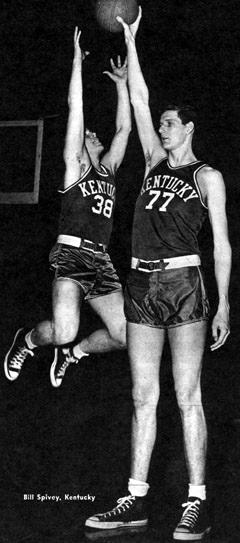
Standing seven feet and one-quarter inch, Spivey, as a sophomore last season, eclipsed the first-year scoring records of such basketball immortals as George Mikan, Alex Groza, Bob (Foothill) Kurland and Ed Macauley, and in so doing led a predominantly sophomore Kentucky aggregation to 25 wins in 30 games.
Bill was born in Lakeland, Fla., March 19, 1929, but his family moved to Georgia when he was only a few months old. It was in Georgia that Bill grew up -- and he grew up in a hurry.
When he was only 12 years old he was six feet, two inches tall and weighed 192 pounds.
He entered high school at Warner Robins, Ga., in 1944 when his father, an electrical supervisor, took a civil service job at Robins Field.
Warner Robins High never had fielded a basketball team but when Principal Bert Ramble saw young Spivey in the classroom, he rounded up a basketball, a couple of Dackboards and nets and attempted to organize a team.
He couldn't arrange a schedule, however, as Warner Robins High was not a member of the Georgia High School Athletic Association. And when it came to outfitting young Spivey, there wasn't a basketball shoe to be found big enough to encase the kid's big feet.
 |
 |
It was the next year that Bill transferred to Jordan High, where he spent most of the season on the bench. He still was awkward and hadn't learned how to take advantage of his height, but he was beginning to learn a little basketball.
After attending Lanier High in Macon for three months the following year, Spivey returned to-Warner Robins, which by this time was a member of the state association and had an organized team.
The season already had started but Bill earned a berth on the first team. Despite his late start and his 24.5 average, the team finished no higher than runner-up in the district tournament,
Next year, as a senior, Spivey upped his average point output to 29, the highest in the state, but with little help from his mates, the team bowed out in the semi-finals of the district event.
While at Jordan High, Bill heard about the top basketball teams being turned out by Coach Adolph Rupp at Kentucky and decided then and there that he would play basketball under Rupp if Rupp would have him.
In the meantime Rupp had the word on Spivey from a Kentucky alumnus who forwarded a clipping from an Atlanta paper telling of the Georgia youth's prolific scoring activities.
The Kentucky coach got in touch with Bill and the Georgia youngster, now standing six feet, 11-3/4 inches, came to Lexington and worked out with the United States Olympic team, composed mainly of the NCAA champion Kentucky quintet of 1948 and the Phillips Oilers of Bartlesville, Okla., AAU titlists. Bud Browning of the Oilers and Rupp were preparing their squad for the forthcoming Olympic Games in London.
Spivey was given pointers by Alex Groza, the man he was to succeed as Kentucky center; Bob Kurland, ex-Oklahoma A. and M. star, playing with the Oilers, and Vince Boryla, former Notre Dame center who had been performing with the Denver Nuggets.
Spivey's performance was far from impressive, but he showed enough promise to get Rupp's approval for a basketball scholarship and when the Kentucky mentor left for London he instructed his assistant, Harry Lancaster, to keep him posted on Spivey's progress.
At that time Bill had fallen off to 175 pounds and Lancaster was given the job of putting needed weight on the youngsters huge frame.
 |
In the fall of 1948 Rupp and Lancaster began concentrating on Spivey, grooming him as a replacement for Groza, who would graduate in 1949.
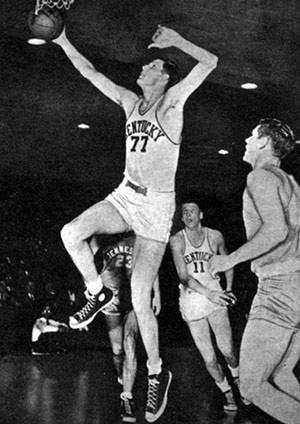
Spivey made progress, lots of it, but he still was far from a finished performer, despite the fact that as a freshman he hit 48.3 per cent of his shots from the field in leading Lancaster's UK yearlings through an undefeated campaign.
In 1949 Spivey was deemed ready for varsity play but the youngster, apparently awed by the fact that he was filling the shoes of the great Groza, who had shattered Southeastern Conference scoring records right and left his senior year, got away to a shaky start in his first game.
He fumbled passes, missed easy shots and muffed rebounds all during the first half. His nervousness left him after the intermission, however, and he was much looser in the second half, winding up with 16 points. In his next outing he scored 19.
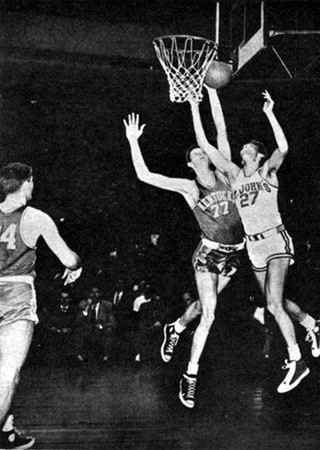
But the real test was to come in the third game. Kentucky's first two contests had been against minor opposition but the third called for an appearance in Madison Square Garden against St. John's.
St. John's had a high-scoring center, also a sophomore, Bob Zawoluk, who had been hitting at a 19.3 average against major competition in the Garden. Spivey had never seen the Garden, let alone play in it.
Rupp feared Spivey might have stage fright, playing before 18,000 hostile fans. And he had his doubts as to Spivey's defensive ability. Usually when a tall boy gets the ball, he scores, but when the opponents have the ball, he can't stop them. For that reason many coaches think twice before they give a "goon" a place on their squads.
But Spivey wasn't a "goon." Although Kentucky lost to St. John's, Spivey was the star of the game. It was the Kentuckians -- not Big Bill -- who had stage fright.
St. John's piled up a 23-point lead in the first half, but it wasn't Spivey's fault. In the second half the Wildcats settled down and were only five points behind when the two-minute rule halted their comeback.
 |
It wasn't until the second half of the season, however, that the Georgia Pine hit a scoring stride that threatened to wipe out Grozas Kentucky and Southeastern Conference scoring records.
His highest single-game total before mid-season was 22 -- a mark he reached as Kentucky whipped favored Bradley for the Sugar Bowl title (Paul Unruh, Bradley's All American, was limited to 16) and equalled against Arkansas a couple of nights later.
Against Notre Dame at South Bend, when Kentucky was beaten for one of its four regular-season losses, Spivey tossed in 27 points despite all efforts of the Irish to stop him.
He reached 27 again against Alabama -- then tossed in 34 points against Tennessee, which had inflicted the first Southeastern Conference setback in five years on Kentucky in an earlier game.
Near the end of the season he smashed Groza's single-game mark of 38 by whipping in 40 points against Georgia Tech. In the SEC tournament finals he equalled Groza's tourney record by tabbing 37 points as the Wildcats crushed Tennessee, 95-58, to win the title for the seventh straight year.
Groza, who played three and a half years of varsity basketball, set his records in his senior year but Spivey made his in his first varsity season.
Although lacking the finesse and polish of Groza, now an established professional star with the Indianapolis Olympians, Spivey appears a cinch to erase big Alexis scoring marks from the record books during the next two seasons. Groza scored 393 points in 37 games as a sophomore; Spivey made 578 in 30 games. Bill also surpassed Groza's junior year total of 488 points in 39 starts but failed to equal Alex's record of 602 for 30 games as a senior.
Only one major college skyscraper is on record as having scored more points during his sophomore year than Spivey -- Washington State's 6-9 Vince Hanson, who tabbed 592 points in 39 games in 1945. However Hanson's average was only 15.3, four points under Spivey's 19.3. Bob Kurland made 444 points in 33 games in his sophomore year while George Mikan made 486 at DePaul in 26 games his first season. Kurland's average was 134. Mikan's 18.7.
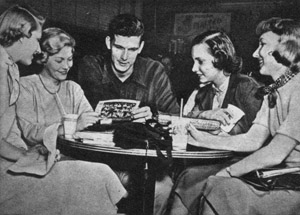
SPIVEY ON THE CAMPUS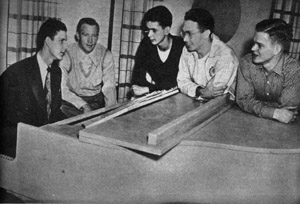 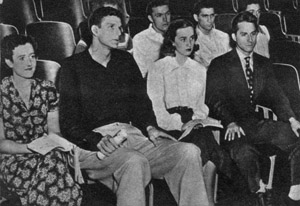 | 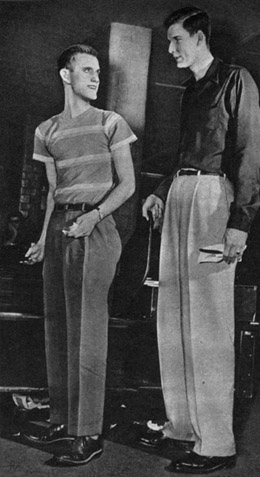 |
 | 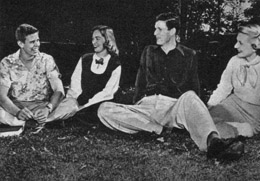 |
Spivey's pet peeves are Pullman berths and hotel beds. He can't get his proper rest on trips unless he has adequate sleeping space. He says he'd rather sleep in a day coach than double himself up in a berth. At hotels where there are no special size beds, he usually puts two beds together or stretches out on a double bed, his head at one corner and his feet at the opposite corner.
A big advantage in being tall, Spivey says, is that in a crowd he's always able to see what's going on. The biggest drawback, he believes, is in buying clothes. With the exception of ties and handkerchiefs, his wardrobe must be made-to-order.
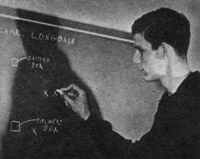
As a youngster he found his height frequently embarrassing. "Whenever there was a fight," he recalls, "I'd always get the blame because of my size. Somebody was always calling me a bully, but I wasn't. I just didn't like to be pushed around." Bill doesn't like to be pushed around on the basketball court, either. "It makes me mad," he says, "when three or four guys are hanging all over me under the basket. And when some fellow stands on my foot -- that really makes me mad!"
 |
As for romance, Bill opines he still has plenty of time to think of that. But he admits he met a mighty sweet girl last summer while he was serving as a waiter and playing basketball on the side in the Catskills. She's Charlotte Scott, a Brooklyn lass who was singing with Ned Harvey's band at the Brickman hotel, South Fallsburg, N. Y. Charlotte, who is 5-2 and has eyes of blue, started kidding Spivey about his height and it wasn't long before they began seeing a lot of each other.
Charlotte worked up a comedy singing act which she and Bill put on once weekly for the guests. Bill admits his singing wasn't so good, although the act was a big hit.
But Bill isn't thinking about singing now. It's basketball season again and there are still records to be broken.
Return to Kentucky Basketball page, Kentucky articles, statistics, team schedules, team rosters, opponents, players, coaches, opposing coaches, games, assistance or search this site.