
Meet Alex "The Beak" Groza, vice-president-in-charge, and the key man in the Indianapolis pro cage enterprise featuring the former U. of Kentucky Wildcats
Published in Sport Life Magazine, March 1951, pp. 36-37, 88, 90.
by BOB RICHELSON
 |
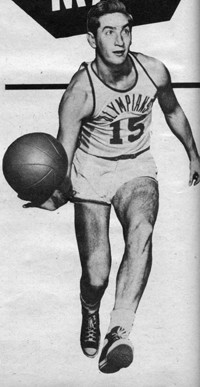
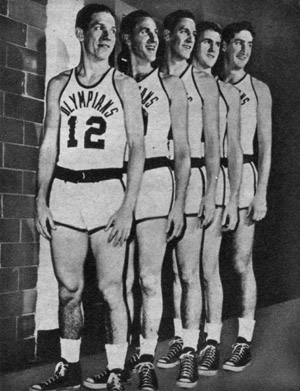
The newspapers said that Groza was a vice-president of the Indianapolis Olympians basketball team. Somehow you found it difficult to picture this quiet, unassuming lad in the role of the over-stuffed, cigar-chewing financial wizard.
Reports further stated that Groza, along with four fellow Kentucky players, owned all the team's common stock. It was there in black and white, yet you just couldn't think of Alex in terms of a lynx-eyed stockholder, wringing his hands in anticipation of a larger share of the corporation's profits.
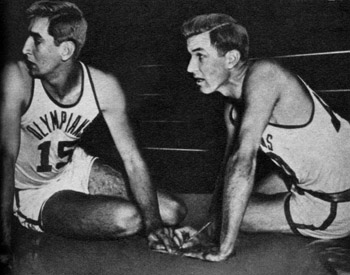
The more you investigated, the more confused you became. Here was a clipping from an Indianapolis paper -that said the Olympians had held their annual stockholders' meeting at the Lincoln Hotel and that all the officers had been re-elected. You read the slate -- J. R. Kimbrough, president; Joseph Holland, treasurer; Wallace Jones, Ralph Beard and Alex Groza, vice-presidents.
Vice-president. Stockholder. Annual meeting. So Groza, the 24-year-old Hungarian lad from Martins Ferry, a sleepy Ohio mill town of 15,000 population, was now a full-fledged business executive. You'd have to look into this. Had the big guy gone big time ?
You got the long distance operator and told her that you'd like to make a person-to-person call to Mr. Alex Groza in Indianapolis.
 |
A few minutes later word came back.
"I'm sorry," the operator informed you in a nasal-toned voice, "Mr. Groza is out of town. Would you care to speak to Mr. Kimbrough?"
You allowed as how you would and in a matter of seconds you were talking with "Babe" Kimbrough, the balding, rotund, reformed Lexington sports editor who serves as president, general manager and publicity director of the Olympians.
You asked several questions in rapid-fire order, then settled back with pencil and paper as the club spokesman spouted forth.
"What you've read is basically true," he said. "The former Kentucky players and I own all the common stock in the club. Our operating capital comes from the sale of preferred stock. At present, this preferred stock is in the hands of about 45 local businessmen."
That was fine, but you wanted to know more about the former Kentucky sensations, especially Groza. How much did he originally invest in the club ? How much did he make last year ?
"Groza didn't invest a cent and neither did any of the other players," Kimbrough said. "All the Kentucky boys, and that includes Groza, played for a guarantee of $5,000, plus a percentage of the profits."
This, in itself, was an indication that Alex had not gone big time. Last year, after completing a brilliant collegiate career at Kentucky, he turned down an offer of $10,000 per year, plus a bonus of $6,000 for signing, so that he could join his old team-mates in forming the nucleus of the Indianapolis entry in the N.B.A. The reader can imagine what fate would have befallen the ex-Kentuckians if big Groza had decided to perform elsewhere. Their drawing power would have been practically nil.
I'd rather not say how much Groza and the others made in their first year of professional ball," Kimbrough continued. "But I will say that we enjoyed a successful season and that all the player-owners got more than the original guarantee."
That satisfied you to some extent, but you wanted to know more. How much truth was there to the reports that Alex and his team-mates lent administrative assistance to the front office?
Kimbrough laughed.
"Alex and the boys drop in once in a while for an occasional meeting, but most of the administrative assistance they lend is for publicity purposes," "Babe" said with frankness uncharacteristic of a business executive.
With that you thanked the Olympian president, said good-bye and hung up.
 |
A few days later you contacted Groza, whose "business trip" turned out to be nothing more than a pre-season exhibition game. But first you thought back to your initial meeting with the six-foot, seven-inch center.
It was in the spring of 1948, just before Alex had finished his junior year at Kentucky. You had arranged to meet him, along with brother Lou, the placekicking specialist of the Cleveland Browns, and other members of the family at the Groza home at 701 Main Street, which turned out to be anything but the main street of Martins Ferry.
The Groza homestead was a plain, two-story wooden structure located on a corner a scant two blocks from the muddy Ohio River. The neighborhood tavern, owned and operated by "Big Spot" Groza, 300-pound father of the famous athletes, occupied the ground floor. The second floor was the family residence.
You learned a lot about the Grozas in the following forty-eight hours. You learned that they were humble, down-to-earth, sincere people -- deeply respected by the whole community. In Alex, the youngest and tallest of the four brothers, you saw a youth who was completely unimpressed by his own importance. That he had catapulted from obscurity to fame in a matter of a few months apparently had not affected the boy one iota. You said to yourself that the banquet table would never replace the family living room in this boy's life.
Those were the thoughts that were running through your mind when you finally reached Groza in Indianapolis.
In the midst of exchanging the usual pleasantries, Alex told you that his dad had passed away during the summer months. You were sorry to hear that, for "Big Spot," with his husky voice, massive physique and gentle heart, was a man you could never forget. His nickname, you remembered, was in reference to a scar planted on his upper lip by a mule's hind hoof and not to the establishment he ran.
 |
 |
"I like pro basketball," Alex said in response to a question. "It's a lot tougher than college ball because the competition is stronger and we play more often. As far as the boys on our club are concerned, I think we all feel more optimistic this year because we know what to expect. We weren't quite sure what was going to happen in our first season, but this year I think we'll do all right. After all, we didn't do too badly last year and now we've got some good new men -- Bob Lavoy, from Western Kentucky; Charlie Mrazovich, from Eastern Kentucky State and Leon Blevins, from Arizona."
How did the former Olympic Games star like Indianapolis?
"Just fine," he said. "The people here have been swell to us. Last year I lived in a rooming house. This year Paul Walther, who played for Tennessee, and I have a small apartment about halfway between town and the Butler Field House, where we play all of our home games."
Alex answered several questions in quick succession. No, he wasn't married. Lou had gotten married several months ago, however, after working as a television salesman in Cleveland during the off-season. Yes, he knew that his friend "Wash" Serini, the hulking guard with the Chicago Bears, was married and living in the Windy City, but he doubted if he'd see much of "Wash" this season. No N.B.A. franchise in Chicago, you know. As for Kenny Rollins, the man he once called "the most under-rated player on the Kentucky team," why that refugee from the Chicago Stags was listed on the roster of the Louisville entry in the new basketball league.
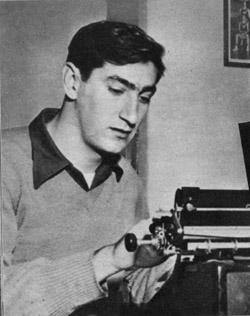
Groza laughed when asked about the clerical work he, Beard, Jones, Barker and Holland did.
"We don't do much," he admitted, "although they occasionally take a picture of one of us behind a typewriter. Actually we leave all that to 'Babe.' He takes care of signing all the players, sees that our hotel rooms are o.k. and does a thousand other things."
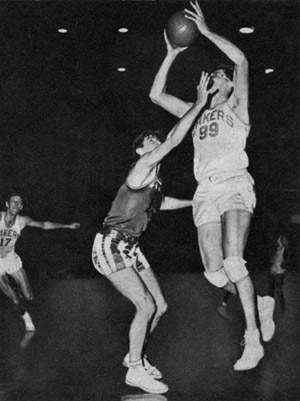
What about George Mikan?
"I suppose he'll be as tough as ever," said the man who is Mikan's biggest headache. "It's impossible to stop him from scoring."
With that you thanked the big fellow, wished him the best of luck and told him you'd try to see him next time he was in town.
You paused for a moment. Had Alex Groza changed? The answer was obvious. He hadn't changed a bit, even if he was the Olympians' vice president in charge of production. Point production, that is.
Return to Kentucky Basketball page, Kentucky articles, statistics, team schedules, team rosters, opponents, players, coaches, opposing coaches, games, assistance or search this site.