
 |
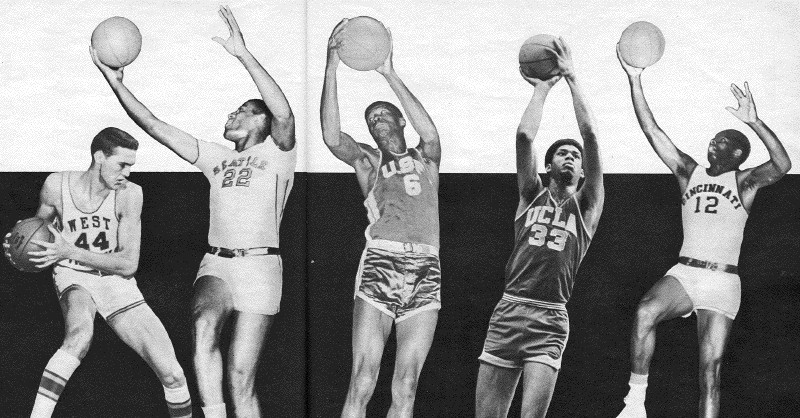
| Over 100 coaches took part in SPORT's exclusive poll, with the majority stating a strong preference for the recent stars |
Published in Sport Magazine, April 1970, Vol. 49, No. 4 pp. 38-41.
By DAVE SENDLER
YOU OPEN THE voting for best college player ever and you can understand coach Press Maravich's favorite-son nomination: Pete Maravich. But Johnny Wooden's choice. . . well, you've got to say the UCLA coach is one-up on Richard Nixon when it comes to discovering a talent. Spiro Agnew may not have been exactly a household word throughout America, but at least Maryland knew him as Governor. Wooden went historical - back to the 1930s - and small-town folksy - to Indiana's Franklin College. "I've never seen a better player than Franklin's Robert (Fuzzy) Vandiver," Wooden told SPORT. And Wooden, winner of five NCAA titles and coach of several All-Americas, should know, shouldn't he?
Vandiver and another 85 more-or-less household names popped up as SPORT canvassed the nation's current and former coaches for (1) their all-time college All-America team (first and second squads) and (2) their selection as the best college player of all-time.
Vandiver had some stiff competition in an election that produced such quirks as:
Responses came from 110 coaches. A player received five points for each first-team vote and three for each mention on the second team. The separate tallying of the best-player-ever balloting allowed one point per vote.
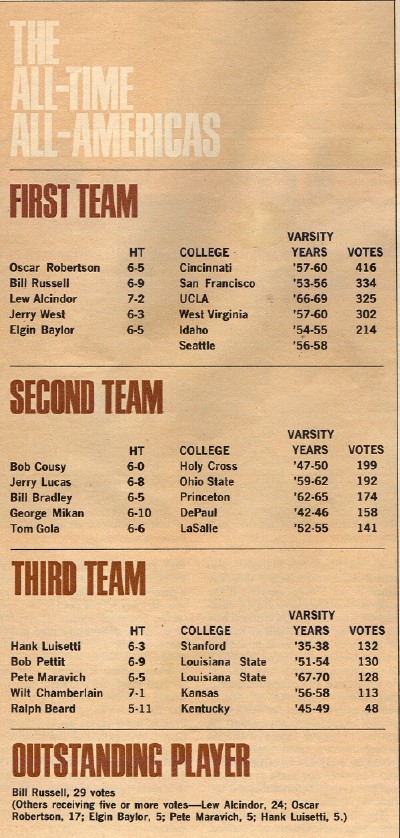
Though the coaches were requested to pick by position, it isn't surprising that they put two centers on the first team. Few were willing to choose between Lew Alcindor, who carried UCLA to three consecutive NCAA championships, and Bill Russell, who drove San Francisco to two straight national titles. The two guards, Oscar Robertson of Cincinnati and Jerry West of West Virginia, ran away from their nearest backcourt competitors, and the fifth man, forward Elgin Baylor of Seattle, made the team by a respectable margin.
Robertson, the second-highest scorer in major-college history, drew the top total of 416 points (to runnerup Russell's 334). But when it came to choosing the best player of all-time, the vote went to Russell -- "the first man," said coach Hank Iba of Oklahoma State, "to make people keep the ball outside." Russell led his team to 55 straight victories in his last two seasons and brought the art of blocking shots to a new and terrifying level. Bill's 29 votes won him the honor over Alcindor (24 votes) and Robertson (17).
The second team was especially interesting for the men it did not include. Louisiana State's Pete Maravich, who scored more career points than any other major-college player, didn't make it. Houston's Elvin Hayes, third-highest scorer ever, was missing. And so was Wilt Chamberlain of Kansas. Wilt was an All-America in the two seasons he played. . . he was the MVP of the NCAA tournament in 1957 . . . he was a force who compelled the rigging of special defenses. . . and he subsequently became the most productive scorer in pro history. Still, he lost out to George Mikan of DePaul as second-team center. Mikan was joined by Jerry Lucas of Ohio State and Tom Gola of LaSalle at forwards and Bob Cousy of Holy Cross and Bill Bradley of Princeton at the guards.
The third team had Chamberlain, Maravich, Hank Luisetti of Stanford, Bob Pettit of Louisiana State and Ralph Beard of Kentucky. LSU, never a perennial force like, say, Kentucky, was the only school placing two men on the first three squads. (Kentucky, of course, did have five men getting votes-Beard, Frank Ramsey, Cliff Hagan, Alex Groza and Bill Spivey.)
Some entries, it seems, were put forward more for nostalgia than for strictly objective reasons. Bevo Francis, for example, got nine points. Francis, a 6-9 player out of little Rio Grande College in Ohio (96 students), got national attention when he averaged 48.3 points a game in 1953. Then, in 1954, he scored 113 points in a game against Hillsdale. The '53 scoring average and the 113-point game were NAIA record performances.
 |
Wooden also touts another man from his playing days, Charles (Stretch) Murphy, an All-America in 1929 and 1930. "We played together for a year at Purdue," says Wooden, "and Stretch, 6-7, was one of the first great big men. He was fast. He could jump. He could shoot. And he was a team player. I believe we lost just once that season and it happened when we had some injuries." Wooden, by the way, received 25 points in the balloting.
Another sentimental choice came from South Carolina's Frank McGuire. He listed Lennie Rosenbluth as a first-team forward. Rosenbluth was the high scorer for McGuire in 1956-57, when Frank coached the University of North Carolina to a 32-0 season, the best record ever for an NCAA champion. Carolina did it with a dramatic finish, winning successive triple-overtime games against Michigan State and Chamberlain's Kansas to capture the title. Rosenbluth's 140 points in five games were high for the tournament. "He was 6-5 and too skinny ever to make the pros," McGuire says affectionately, "but he was a great jump shooter and a great college All-America."
The 15 greatest All-Americas, as selected in SPORT'S poll, won praise for their obvious achievements; but also drew both compliments and criticism for less-noticed aspects of their games.
Robertson, naturally, got recognition as an unstoppable one-on-one player. He was national scoring leader in his three varsity seasons while his team took 79 of 88 games and three Missouri Valley Conference crowns. Coach Wooden, though, remembers Oscar as an assist man: "He was great because he looked for the pass first. Most others look for the shot. He was a team man and he got his points, too." But for all his individual feats, he was denied the honor that perhaps he cherished most: He never won a national title with Cincinnati.
Russell, on the other hand, was a winner twice, amassing spectacular scoring statistics. No one was much awed with his shooting touch, but he could stuff and hook and put in clutch points. He was the leading scorer and MVP in the NCAA tournament in 1955 and he scored 23 points in the title win over LaSalle. Defense, of course, was his forte and his 1956 team limited the opposition to just 52.2 points a game. "He didn't have Robertson's all-round skills," says Iba, "but he is the greatest defensive player ever."
Alcindor, with a talented set of teammates, enjoyed an unprecedented prosperity in college. In his three varsity years, UCLA lost only two games while Lew was averaging 26.4 points per game and shooting 62.4 percent from the field, an NCAA record. He was a three-time All-America and won the MVP award for the NCAA tourney all three years. Says Wooden, Lew's coach: "There was no one as valuable as Alcindor."
Frank McGuire calls Jerry West "perhaps the greatest pure shooter" in basketball, and adds some observations on Jerry's attitude that show what makes the talented into superstars: "Jerry had played a game one night in which he scored 26 points, but he felt he had not done as well as he should. He was in the gym the next morning at ten to practice shooting for an hour or so all alone. That night he went out and scored 36. Another time, I saw him break his nose in a game against Kentucky. He went to the sideline to get it packed and then went right back to work. He got 26 points in that game." Jerry and his West Virginia team got one good shot at the national championship in 1959, when they played California in the finals. West was the game's high scorer with 28 points, but the team lost, 71-70.
For sheer excitement on the court, Elgin Baylor had no peers. With his soft jump shot and those twisting, hanging miracle shots around the basket, Baylor produced points. He averaged more than 30 a game in 1957-58 and made it all the way to the finals with his Seattle team. But though he scored 25 points against Kentucky and was named the MVP of the tourney, Seattle lost, 84-72.
Cousy, top vote-getter on the second all-time All-America squad, is rated by Rupp "as maybe the greatest ballhandler of them all." "I picked him over Oscar," says Frank McGuire, "because he was so great every time I saw him. He'd take the in-bounds pass at one end of the court and have it down at the other end and in the basket in four seconds. He'd usually hit the open man underneath, but he could shoot the ball, too." Cousy played for the Holy Cross NCAA champs in 1947 and helped them put together an 18-game winning streak in 1947-48.
Pete Newell, who coached such players as Robertson and West on the U.S. Olympic squad, said that another of his Olympic standouts, Jerry Lucas, is "the best player I have ever coached." Lucas was the center for an Ohio State team that took three straight Big Ten titles, one NCAA championship, and 78 of 84 games in all. An unselfish player, he passed off frequently, yet still managed to average 24.3 points a game. He could hook inside and hit from outside as well and he paced the nation all three years in field-goal percentage.
Bradley averaged 30.1 points a game over his three All-America seasons and is remembered for his uncanny passing as well as for his shooting. His 58 points against Wichita in his last college game in 1965 set an NCAA tourney record. "Bradley," says Adolph Rupp, "is possibly the best shooter I've seen in college."
Mikan, at 6-10 and 245 pounds, set up inside and, though not terribly agile, would throw his weight around as a scorer and rebounder. He was top scorer in the National Invitation Tournament in both 1944 and 1945 and reached a high of 53 against Rhode Island in the '45 tourney. In an AP poll, he was named the best basketball player for the first 50 years of the 20th century.
"I'm not sure Gola was enthusiastic every night," says Hank Iba, "but when he wanted to beat you, he could." Said Tom's coach Ken Loeffler: "I have never seen anyone player control a game by himself as well as Gola does." A 6-6 forward, Gola could rebound, shoot and play defense. As a freshman in 1952, Gola was cowinner of the NIT's MVP award. LaSalle beat Dayton in the finals. He was MVP and leading scorer in LaSalle's triumph in the NCAA tourney in 1954.
Luisetti, who led the third team in votes, pioneered the one-hand shot. While Hank set a national scoring record for his four years (1596 points), Johnny Wooden says Luisetti "wasn't as good a player as some of the others" on SPORT'S top three squads.
Pettit didn't play with the flash of, say, a Baylor. But he did everything a 6-9 player should. He was an aggressive rebounder, a strong scorer and an excellent defender. He was an All-America in 1953-54.
Maravich, the only current collegian on the first three squads, burst upon the college scene at a record-setting pace of 43.8 points a game his sophomore year and never let up. "Maravich," says Frank McGuire, "can do everything with a basketball. He can pass. He got 55 points against Kentucky and you know Rupp's teams always play good defense.
Rupp reports that some of those 55 were made against his subs, but adds: "Maravich has lots of great moves and I was impressed one time when he was double-teamed in backcourt and burned a pass underneath that reached a teammate just a half-step ahead of my man."
Beard, who made the third team by one point over Kentucky teammate Alex Groza, supplied backcourt speed and outside shooting for those great Kentucky teams of the late 1940s. Twice an All-America, he played with one NIT and two NCAA titlists.
Fifteen years ago, SPORT conducted a similar poll, and it is interesting to note that not a man from the 1955 first team of Luisetti, Mikan, Cousy, Gola and Chuck Hyatt (of Pittsburgh) reached similar heights in 1970. Mikan, voted the best player ever in 1955, placed ninth in that department in 1970.
Adolph Rupp, who has coached more than 1000 games for Kentucky since 1930, put it all in perspective for SPORT when he said over the telephone, "You may want to know that there's a 7-1 student here, Tom Payne, who just walked past my office and he may be better than all of them." That was the future marching. Would you believe the Alcindors, Russells, Robertsons, Wests and Baylors as second- and third-teamers 15 years from now? Better be prepared.
Return to Kentucky Basketball page, Kentucky articles, statistics, team schedules, team rosters, opponents, players, coaches, opposing coaches, games, assistance or search this site.