
Convicted of point-shaving in 1951, Alex struggled hard to regain a respectable place in society. He didn't feel he was really regaining it until he came full cycle - back to basketball, the sport that had brought him both glory and disgrace
Published in Sport Magazine, July 1963, pp. 30-31, 72, 74-76
by FRED KATZ
IN FEBRUARY, 1963, an agent from the Federal Bureau of Investigation drove up to the Bellarmine College fieldhouse in Louisville, Kentucky, climbed a flight of stairs and entered the office of basketball coach Alex Groza. The FBI man flashed his credentials and explained his visit. He wasn't checking on anyone in particular, the agent said, this was merely a kind of preventive maintenance. The FBI was sending men all over the country to make coaches and schools aware of the gambling problem.
Alex Groza smiled, amused at the irony. "I'm one fellow you don't have to tell this to," he said.
The agent returned the smile, acknowledging the irony. Here he was, warning the man who probably had lost more than any other person involved in the 1951 point-shaving scandals.
One of the few things Groza hadn't lost was his courage. When, in 1959, he actively sought and received a second chance in the sport he had once betrayed, he became the first and only convicted pointshaver to return to college basketball. Could the FBI agent tell a man with this kind of background anything he didn't already know?
Groza realizes, of course, that precautionary measures by law-enforcement agencies are going to be a major factor in halting future scandals. But this doesn't prevent him from deeply regretting that such measures are necessary and that the lesson others should have learned from his error in judgment didn't register. "We should have been an example to them,". he says, referring to the athletes in the 1961 scandals, "and I'm only sorry we weren't."
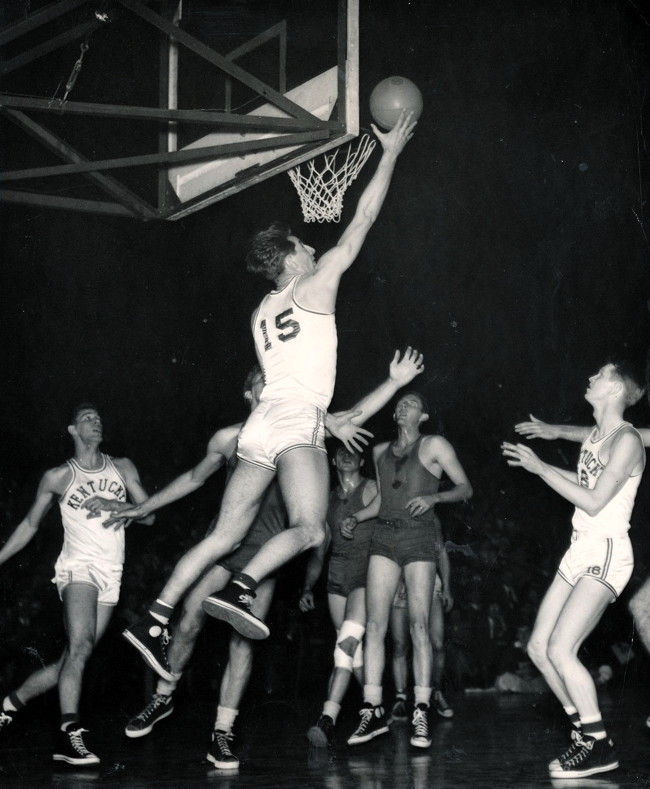
Alex should have been the greatest example of all. Of the many players to stand trial before Judge Saul Streit, Alex Groza clearly had the brightest, future in professional basketball. He had been a three-time All-America at the University of Kentucky from 1947-49 and had set a career scoring record there that still stands. In 1948 he had led the United States Olympic team to the championship. In his two seasons with the NBA's Indianapolis Olympians, a team he partially owned. Groza had averaged 23.4 and 21.7 points a game, second to George Mikan.
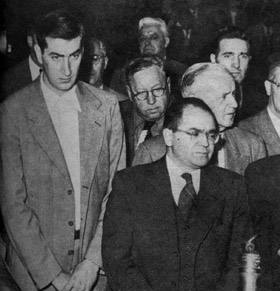
Then the police closed in. Groza and Ralph Beard, a teammate on Kentucky's "Fabulous Five" and at Indianapolis, were watching an exhibition game in Chicago when detectives quietly asked them to come along. On October 22, 1951, they were flown to New York and were found guilty of accepting money to juggle scores. They received suspended sentences and were placed on probation for three years, a period that included the suspension of all basketball activities.
 |
Today Groza talks about his losing fortune with barely a trace of bitterness penetrating his flat Midwestern tones. Perhaps it is because he has lived with his economic fate for 12 years and has become resigned to it. Perhaps, too, it is because Alex, whose father was a coal miner and then the owner of a small neighborhood tavern, doesn't miss what he never had. But most accurately, it seems, it is because during the past 12 years Groza has been more concerned with earning respect than earning money.
"I lost a lot and it hurt to lose that much," he says. "I was bound and determined to make a success of myself after this thing happened. There were a lot of people who had faith in me and I wanted to restore that faith."
EIGHT years after the trial Alex recognized the path he had to take to win back the people he felt he had failed. He knew he had to return to basketball. He had tried other things -- working in General Electric's planning department in Louisville; television broadcasting in Wheeling, West Virginia; running the family tavern in Martins Ferry, Ohio -- but Alex was only fooling himself. He couldn't hide forever. As a basketball star he had gained national fame. As a basketball point-shaver he had endured national shame. Now he had to earn national forgiveness -- in basketball.
And so in 1959 Alex applied for the basketball coaching job at Loyola of New Orleans. He almost got it. Though Alex was the only one of 50 applicants without previous coaching experience, he was one of four finalists. Ultimately, the lack of experience cost him the job; Loyola wanted a coach to double as its athletic director.
There had been a great deal of publicity regarding Alex's application. One man in particular took more-than a passing interest in the wire service stories. He was Father John Davis, a member of the Bellarmine College Athletic Faculty Committee. Bellarmine, a small, all-male school founded in 1950 by the Catholic archdiocese of Louisville, had recently lost its basketball coach and the school was looking for a replacement.
One day Father Davis mentioned Alex as a possibility to Father Henry Schuhmann, chairman of the faculty committee. Father Schuhmann thought his colleague was joking. "You're nuts," he said. "Why, Groza is in a different league. How much of a chance do you think we have to get him, especially with the amount of money we have to offer? And besides, is he even interested in coaching?"
Father Davis said Alex had applied for the Loyola job. This convinced Father Schuhmann that it was at least worth a try and the two priests went to Msgr. Alfred F. Horrigan, Bellarmine president, with their proposal. Msgr. Horrigan raised his eyebrows in surprise and shrugged his shoulders. The gestures meant: What have we got to lose? Go for broke.
Ollie Mershon, the Bellarmine Athletic Association's president, was next informed of the plan and he was immediately in favor of it. "We thought Alex would be a great attraction to the school and that he would attract the caliber of player we wanted," Mershon says today. "And as for his past mistake, I don't think we were as concerned about it as Alex was. We felt if he had the character and plain guts to get back into basketball, that was the kind of person we wanted."
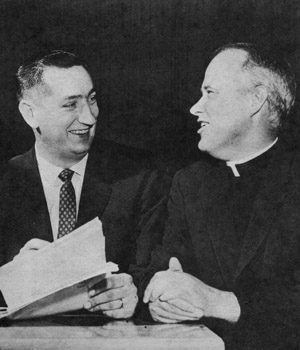
FATHERS Davis and Schuhmann called Alex, asked him if he was interested in the position and that if he was, could he come to Louisville the next day. Alex said yes, he was interested, but no, he couldn't come tomorrow because it was payday at the Martins Ferry mills and it would be a very busy day at the tavern. Alex came instead the following Monday and met with Msgr. Horrigan. That afternoon he signed a contract.
From the beginning the linking of Bellarmine and Groza was excellent. The school had won only 80 of its 200 basketball games and it wanted desperately to build an athletic tradition. Hiring a big name like Alex Groza was the answer. Groza, on the other hand, wanted to get into college coaching so badly that "I would have taken $50 a month if that's all they could have paid me," he says. "To be honest, they asked me what I wanted and I said $6000. When they handed me the contract, the amount typed in was $7000."
The figure on the contract was no typographical error, but neither was it a display of sentiment. Bellarmine officials knew the building job they were asking Groza to do was not easy because Bellarmine is an academically rigid liberal arts college with no physical education curriculum. The year before Alex signed his contract, four members of the starting team had been dropped due to academic failure and players had been recruited from the student body to fill the roster.
 |
But Alex had no difficulty reconciling himself to the school's standards. It took him 14 years to get his degree and he knows full well the value of academics. (He went to Kentucky for one quarter in 1944, spent 21 months in the army and left the university in 1949 one-third of a credit shy of his diploma. In 1957 he earned the needed hours by taking a French course at West Liberty College in Wheeling. His degree from Kentucky was dated the following year.)
Shortly after Groza arrived at Bellarmine, he sent a mimeographed letter to faculty members saying he wanted no special consideration for his players. "I have yet to go to any teacher and ask him to pass my kids," Alex says, "because it's an injustice to the boy. A kid can only play four years and if he doesn't have a good education, Lord help him." And then he adds proudly: "Out of a possible three-point average, the overall student average is 1.3; the 1962-63 basketball team averaged 1.7."
BELLARMINE, with an enrollment of 950, can't begin to match the offers of larger schools and Groza learned quickly that he would have to forget about recruiting All-Staters and settle for overlooked boys. It is his dream that perhaps some day he will uncover a potential All-America the way Kentucky coach Adolph Rupp did in 1944.
In 1944 Rupp received a clipping from the Martins Ferry paper that stated a 6-5, 165-pound center named Alex Groza was thinking about going to Kentucky. Rupp checked out the lead, came to Martins Ferry, spoke at a banquet, offered Groza a scholarship and Kentucky's gain became Ohio State's loss. Alex had originally leaned toward OSU because his brother Lou (a placekicker of some note and who would soon be even more notable with the Cleveland Browns) was starring there in football. But the school had no scholarship for a skinny kid called "Weed."
So far at Bellarmine, Coach Groza hasn't come up with a Player Groza, not even a reasonable facsimile. The school's officials aren't too worried about it, though. Their concern is that their team simply play good basketball within the limits of its ability —and within the limits of the school's stringent policies. "When we were looking for a coach and when different names came up," says Father Schuhmann, "I always felt that it was in the man's favor if he had had pro experience. But if he did have this experience, I always worried that he'd find it too hard to live with our policy. We laid this on the table to Alex and he said he could do it. And to his credit, he has."
To outsiders who judge a coach strictly on his ability to mold a winner, Groza's record is equally impressive. Alex won seven and lost 15 his first season, improved to 11-17 and then broke even at 11-11 his third year. Last season was the crucial one, for he had promised the student body when he was hired that he would give them a championship team in four years. Alex kept the promise. With a team of all underclassmen but two, Bellarmine won 20, lost seven. It won the KIAC (Kentucky Intercollegiate Athletic Conference) and the Quincy (Illinois) Invitational Tournament and played in the NCAA small-college tournament for the first time.
More rewarding to Bellarmine and Groza than any of the trophies, however, was a letter from Stix Morley, coach of the Western Illinois team Bellarmine beat 62-60 for the Quincy title. Wrote Morley: "I want to congratulate you on the well-coached team Bellarmine had ... If I were to give a trophy for sportsmanship, it would go to your team."
When I visited Alex in his office last March, Bellarmine had finished its season ten days earlier, but things were as hectic as ever. That morning it had been announced that Alex was the KlAC's coach of the year. The phone didn't stop ringing. If the calls weren't from friends extending congratulations, they were from friends asking Alex if he could get them a couple of tickets for the major-college NCAA tourney in Louisville that weekend. And last-minute preparations were being made for the Bellarmine basketball awards banquet that night. (The banquet is an excellent barometer of the avalanching basketball interest Alex has induced at Bellarmine. After his first two seasons the dinner was held in the school cafeteria. The next year it was moved to a restaurant. This year it would be at the Sheraton Hotel.)
I sat down next to Alex' desk and he cleared away a clutter of letters. "I'm behind with all this mail because of this darn thing," he said, holding up a swollen, bandaged finger. "It started as an infection, but I've got blood poisoning now. I guess I'll have to have it operated on."
"Excuse me," Alex said, answering the phone. "Hi, Doc . . . You're coming to the banquet tonight, aren't you? . . . Good. But just don't bring that damn cowbell. You know, next year I'm going to put you in charge of a whole special section at our games -- the cowbell section . . . How you feeling? Well, take care of yourself. You've got to get yourself a fifth of bourbon -- and make sure it's Kentucky bourbon . . ." He laughed.
"Where were we?" said Alex.
"The finger . . ."
"Oh. Well, my problem is I worry too much about coaching and not my personal health. I get so wrapped up with basketball during the season I can't sleep at night. And my stomach kills me. If I try to eat before a game, sometimes I'll vomit, not because I'm sick but because of the tension."
Though Alex is a prime prospect for giant-sized ulcers, he doesn't seem to be in any danger of wasting away. There are 255 pounds on his 6-7 frame and in recent years his belly has become the center of gravity. Alex comes from a big family. His father, who died in 1950, was 6-3, 340 pounds.
Alex also got his intensity from his father. Pa Groza, known as "Big Spot" because of a scar he bore after being kicked in the face by a mule, took athletics seriously. After Martins Ferry High School had lost a football game one afternoon, the Groza family gathered around the dinner table. But "Big Spot," still fuming from the defeat, was in no mood to eat. "Damn, we never should have lost that game!" he roared, and his big fist hammered the table like a sledge.
"The table crumbled and food spilled everywhere," says Alex. "We went without dinner that night."
Except for the nights Bellarmine has a game, Alex misses few meals these days, but, in the tradition of hoboes and coaches, he often doesn't know where his next dinner is coming from. "My first year here I made 54 speeches in three months," he said, picking up a calendar pad. "I wanted to tell everyone about Bellarmine. I still can't refuse, whether they pay me or not. A fellow called me from Paris, Kentucky, the other day and asked me what my fee was. I said I didn't have one and that they could pay me anything their budget could afford. Sometimes I get $25, or $10 or nothing. Mostly nothing."
"Your wife must find it pretty difficult having you gone so much," I said.
"If she does, she doesn't seem to show it," said Alex. "I know I've come home some nights and she'll say isn't there a game you can go to and I'll say I've seen this team play and she'll say well, isn't there another game you can go to since, after all, it's a part of your job."
"So I'm liable to be away from home any night. Any night, that is, except this one," he said, pointing to April 11 on his calendar. "Before I make up my speaking dates I write out 'Anniversary' next to April 11. That's our day and I don't want any conflicts."
Though Alex and Jean Watson both had grown up in Martins Ferry (population 15,000) they didn't meet until July, 1951. Jean, five years younger than Alex, never had seen him play ball. They dated often that summer, but before Alex left to rejoin the Olympians he told her: "Don't get serious over me because I'm not ready to settle down." For a guy who wasn't serious, Alex fed an extraordinary number of quarters into Indianapolis telephones, paying for conversations with a certain Martins Ferry girl.
At noon on Saturday, October 20, Jean Watson left the accountant's office where she worked. She passed a group of young men she thought were Alex' friends. They laughed when she passed by and they said some things she didn't understand. Jean continued on her way home and later that afternoon turned on the radio. She couldn't believe what she heard.
"I was in a daze," she says now. "It was like a ton of bricks hitting me. I was so worried about Alex. I didn't know where he was and when I called his mother, she didn't either. He finally called me and asked if I still wanted to see him if and when he got home. I was never unsure about my feelings. I knew what he did wasn't right, but it didn't seem bad, either. Alex is just good, that's all."
"Between the day the news broke and the day the judge gave the verdict, it seemed like I spent all my time praying. When the day for the verdict came, I was in the office. I would do a little work and then pray a little. When I finally heard the verdict I was so thankful. We were afraid he'd have to go to jail."
Alex and Jean became engaged on May Day, 1952, and were married the year after that. Today they have three children -- Lex, 8; Lisa Marie, 6; and Leslie Jean, 4 -- and the only apparent problem they face regarding Alex's past is determining the proper time to tell Lex about it before he hears it from a playmate.
The Grozas live in a vari-colored brick ranch home in a suburban subdivision and there are few mementoes to remind a visitor that a former All-America lives there. In the living room there is only a souvenir book from the 1948 Olympics, placed inconspicuously in a wall bookcase. In the finished basement a few trophies rest on a mantelpiece; they are there only because of Jean's insistence.
The house is modestly furnished and Jean laughs whenever she thinks of Alex' "secret wealth." "I've heard stories that he got lots of money from the gamblers and has it buried," says Jean, "and that one day, when everything blows over, he'll get it. You can tell it's not true because we would have needed it long before now."
"But, all in all, people have been wonderful to us, even strangers. As soon as Alex' appointment at Bellarmine was announced, we received phone calls from California and Las Vegas from people we didn't even know. They were just so happy that Alex was given another chance. Those are two phone calls I'll never forget."
Alex received other phone calls after he was hired -- phone calls more inquiring than congratulatory. "A lot of sportswriters from all over the country called me," he said. "I told them then that I would talk to them and they could either help me or crucify me. Fortunately, they helped me."
"I'm proud of what I've done and that I've been able to come back. If I wasn't, you would have had a hard time finding me today. I realized I couldn't afford to make another mistake and that I had to go out and prove I was a good man. I want other people to know what I've done. I want them to know that I didn't turn out to be a bum."
It would be pleasant to report everyone was willing to forget about Alex' past. But a few isolated incidents indicated that there were people who either couldn't or didn't want to forget.
"During Alex's first year I traveled everywhere the team went," says Father Schuhmann. "I was a little over-sensitive and on edge each time to see what kind of reaction Alex would get. I remember in one game he jumped off the bench -- he's tamed down now but he used to be up and down the bench a lot -- and a spectator yelled, 'Sit down!' and referred to Alex' background."
Later that year, at the NCAA finals in Louisville, Alex was invited to appear as a halftime guest on a regional network telecast. The man who invited him was sportscaster George Diab, with whom Alex had shared a five-nights-a-week show over Wheeling station WTRF from August 1955 to April 1957. Alex appeared the first night but not the second, which in itself is meaningless. But when I talked to Diab about it he said that "we ran into problems and it was a touchy situation." Diab, now the assistant general manager at WTRF and more aware than ever of the importance of good relations with potential sponsors, realized that he had volunteered more information than he wanted to and refused to say any more. "I could give you a sensational story," he said, "but I'm not about to do it, not for anything."
But Diab did say something else that amounts to a kind of eternal truth for those convicted in gambling scandals. We were talking about the possibility of Alex advancing to a larger school some day and Diab had said, "The thing that will hold Alex back will be this mess in the Southeastern Conference or further basketball scandals. This only serves to open the old wounds and makes it tougher for him."
This point was proved at the 1961 Mideast regional tournament, again at Louisville. The most recent point-shaving activities had been exposed and there was a great deal of tension at the tournament, particularly in the hotels that housed the competing players. Armed police guards were even stationed outside the players' rooms.
One night during the tournament, University of Kentucky athletic officials staged a press party at the Kentucky Hotel. A reporter who attended recalls that "Alex was in considerable evidence around the hotel and came to the party. After a while some guy came up to me and, pointing to Groza, said, 'I wish he'd go away.' " It may or may not have been a coincidence, but moments later Alex talked to Kentucky athletic director Bernie Shively in private and then left. He didn't return.
People generally, however, have greeted Alex warmly wherever he has gone, though none can exceed former baseball commissioner and Kentucky governor A. B. (Happy) Chandler.
"Happy is a good friend of mine," says Alex, "and he's been with me all the way. The first time I saw him after everything broke was in 1959. It was Governor's Day at the State Fair and I stood in a reception line for quite a while to say hello to him. When I finally reached him, he turned to Mrs. Chandler and said, 'Mama, here's our boy.' He gave me a big hug and told me to be sure and call on him if I ever needed anything. He said I was always welcome at his house."
 |
"The first time I talked to coach Rupp after 1951 was at a clinic at the U. of K. after I took the Bellarmine job," said Alex. "I called him and asked if it was okay if I came and that I wouldn't come if it was embarrassing to him. He said it was all right. I've only talked to him one other time and it was only to say hello. We've never sat down and had a good talk. I wish our relationship could be different but I understand."
To find out Rupp's reaction to Alex' success, I had arranged to meet the Kentucky coach in his Louisville hotel room. Like some 800 other coaches, he was in town for the tournament. When I called to see if he was ready, he said, "You might as well come up. I'm still in bed, so that's about as harmless as you'll find me."
Rupp was wearing fire-engine-red pajamas, a strange costume for a man noted for the drab brown suits he wears in public. After disposing of the pleasantries and explaining the reason for my visit, I said, "I imagine you must be quite happy that Alex has done so well the past four years."
"I think everyone is glad to see him a success," Rupp said with calm huskiness. He stared at me, waiting for the next question.
"I'm sure they do," I said, "but how do you feel?"
"I think Alex has done a fine job," Rupp said at last. "He's brought a little school that was unknown into a place with other schools. And I'm glad he had a chance to get into something he was interested in. I think Bellarmine gave him a break most schools wouldn't have given him."
"In recent years," I said, "have you ever felt that you were at least partly to blame for what happened to Alex and the others?"
"Jesus H. Christmas," Rupp growled, and even in bed he didn't seem so harmless now. "We win two NCAAs, the NIT, two Sugar Bowls, the Olympics and four Conferences. If I was suspicious, what were these other coaches thinking who couldn't win?"
Rupp rubbed his hand through his sleep-ruffled strands of salt and pepper hair. "Even in a game we lost that we should have won -- the game in the 1949 NIT against Loyola (of Chicago) -- they had a pretty good boy who whipped Alex's butt all over the place. It was a bona fide whipping and Alex fouled out of the ballgame. But the judge said this was one of the games that . . ."
"Let's just skip these things. You're just digging up some things that have no place in the story. If you're going to rehabilitate Alex Groza, let's leave these things out. I'm just tickled to death that he's doing so well," said Rupp, and the storm died as quickly as it had begun. "I understand he has a nice coached team -- I've never seen them play -- but I'm glad to hear that."
Later, when I relayed Rupp's kind words to Alex in his office, he was surprised and delighted and it seemed apparent that Rupp never had said these things to him. Sensitive and friendly, Groza has had to have been hurt by this. One suspects that Alex will never regard his comeback as really complete until he and Rupp can sit down and have that "good talk."
It is particularly ironic that Rupp should remain so distant from Alex, for few persons will absolve Rupp of his share of the responsibility for the scandals as readily as Groza. Surely not Alex' friends and associates, many of whom openly despise Rupp. Surely not Judge Streit, who after ordering a four-month investigation of Kentucky basketball, wrote a scathing 63-page report condemning Rupp for failing to "instill any morals -- indeed if he did not impair them."
What Alex really believes only he knows. But what he says is this: "I made the mistake, no one made it for me. We were young and a fellow says 'you're favored by 20, you beat 'em by 15.' There's nothing wrong with that, I thought. Little did I know how wrong it was. The fellow told us he was only betting a little for himself. Little did we know he was tied up with the big boys. No matter how long I sit down and bare my soul and be honest and serious with you, I can't tell you why and how it happened, except that it happened. And I have no one to blame but myself."
Alex, obviously, is the kind of guy who also will blame himself should one of his own players ever be seduced by a gambler's whispered overtures. To lessen this possibility he tells his teams: "All of you are old enough to know what happened to me. I don't want it to happen to you."
I asked Alex if he employed any visual aids with his yearly lecture, such as showing his players a scrapbook of trial clippings the way St. John's coach Joe Lapchick does. And then I added: "Or don't you have any of those clippings?"
It was the only time I saw Alex indignant. "I don't show them to the players," he said, "but I have them. After all, this is a part of my life. Through athletics I've learned to take the bad with the good. If you're going to have a scrapbook, there's no sense just having the good. How well off would all of us be if we just remembered the good?"
Will Groza be content to remain at Bellarmine where he has molded his new life? If you had asked him that four years ago, he would have said yes and meant it, but he would have been drugged by his overwhelming gratitude to the school. Today, however, he realizes that Bellarmine may be just a beginning. "You have a ladder to climb," he says, "and if you have any ambition you want to keep going up. After the scandal broke, I wasn't even on the first rung. At least now I've gotten off the ground."
In a hotel room 14 stories above Louisville, Alex and I talked about his future. As he lit a cigarette he looked out the window and saw what looked like toy cars and Lilliputian figures streaming down Fourth Street. The first game of the NCAA tourney was only hours away and the city had been besieged by armies of fans.
Some day, perhaps, people will travel great distances to see a team coached by Alex Groza play for the national title. Alex is only 36 and, as University of Miami coach Bruce Hale says, "He's one of the budding young coaches in the game." But Groza has indicated that wherever he goes from here, it will be on his own terms. "I've had offers since I've been at Bellarmine," he said, "but I wasn't interested in them because a school will say 'If you don't win in four years, you're out.' I don't think this is a proper challenge."
I thought of what George Diab had said -- that recurrent gambling scandals could hinder Alex' chances for moving up his ladder -- and I mentioned this to Alex.
"If that's what people judge a person on," he said, "then I don't care to be judged by them. If I had turned out to be a criminal, then all right. But I haven't. I just want them to judge me since then. I just want them to judge my record as a coach."
Return to Kentucky Basketball page, Kentucky articles, statistics, team schedules, team rosters, opponents, players, coaches, opposing coaches, games, assistance or search this site.