
This is the Baron of Kentucky, proud and haughty, painfully blunt and sometimes his own worst enemy. He never quite learned how to compromise with defeat, but, after all, that's why he has basketball's mightiest record
Published in Sport Magazine, March 1959, pp. 58-67
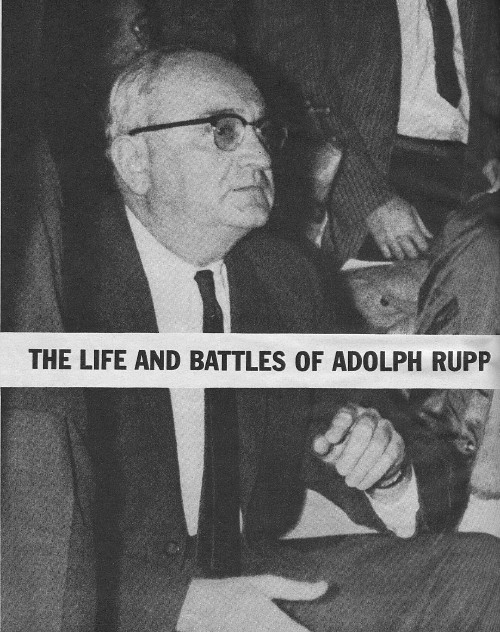 |
| Kentucky's coach since 1930, Rupp has had four national champions, 19 All-Americas, assorted troubles |
by FURMAN BISHER
THE blue and white Oldsmobile bobbed along over the undulations of Russell Cave Road, once upon a time the main highway between Lexington and Cincinnati, but now a quiet, pastoral trail. Elegant Kentucky farms rose up on either side, bright, trim and well-manicured. Most of them were breeding centers, and highly polished shingles that hung along the roadside announced their specialties.
"There's Dixiana Farm," Adolph Rupp said, "one of the most famous racing stables in Kentucky."
A huge mansion, dazzling in its whiteness, stood on a wooded hillock overlooking a small lake. Several horses roamed in a pasture and a foal muzzled his mother in search of a mid-morning snack.
"Not all of these are horse farms," "Rupp said. "Some of them breed cattle and some hogs and sheep. None of them are just farms. This land is too expensive to break even on cultivation alone. I raise some corn on mine, but just enough to feed my stock."
A highway marker suggested that we slow down for Centreville. It was a village in the midst of a deep slumber, serving apparently as a supply station for the farmers who didn't have time to make the 11-mile drive into Lexington.
"My farm is on down the road a-piece," Rupp said. "Actually, I've got three places, altogether about a thousand acres. We're going to the big farm, though."
About five miles farther on, a billboard came into view and Rupp slowed down for his visitor to see. "Adolph Rupp and Son," it read. "Four Leaf Clover Hereford Farm. Home of H. P. Red Husker I and H. P. Zoto Heir 26." These two bovine aristocrats represent the blood lines in which Four Leaf Clover Farm specializes, and it soon became clear that Adolph Rupp is as demanding of his farm force as he is of his basketball teams which have produced championship after championship at the University of Kentucky.
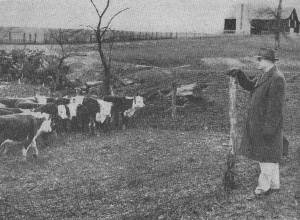 |
| A busy farmer, Rupp has about 1,000 acres. "I'm a coach in the winter but a farmer 12 months of the year," he says. |
"Now where will you ever see a finer looking squad than that ?" he said proudly.
He drove closer to one particularly well-constructed star and the calf turned tail and ran. "Chester," he said, "I never saw a better-looking rump than that. Let's keep our eye on him."
Over in another pasture they got out of the car for a closer look at a sluggish member of the herd. "What's wrong with her, Chester?" Rupp asked.
"She just lays down and coughs all the time," Chester said, "but I can't find a thing wrong with her."
Rupp looked at the heifer with a critical eye. "Get rid of her," he said abruptly. "That heifer is not a credit to the place. She's like a sub sittin' on the bench hollerin' for the other team. Yessir, get rid of her."
Nothing is left to guesswork or haphazard calculation at Four Leaf Clover Farm. In his office at Memorial Coliseum, Rupp broke out an impressive looking file. "Every foot of soil on my farms has been tested in hundred-foot squares," he said. "We know exactly what area needs phosphate, what needs nitrogen, what needs anything in the way of a soil conditioner. Everything we do is planned season by season. It's a science. Some people call it my hobby. It's no hobby. It's a business.
"I'm a basketball coach in the winter but I'm a farmer twelve months of the year."
And just as surely as Adolph Rupp, the farmer, has left little to chance, so has Adolph Rupp, the basketball coach. At least, he has left as little as a basketball coach can possibly leave to the whims of the gods and the rolls of the dice. Since he arrived at Kentucky in 1930, Rupp has poured the same kind of intensive planning and effort into his basketball teams that have produced his championship cattle, and since this is a story of the coach first and the man second, it seems proper to zero in on the Rupp whose name has become synonymous with power in basketball.
Adolph Rupp is the greatest basketball coach of our time. He is perhaps the greatest coach in the entire history of the game, though he still has one last frontier to cross, represented by the formidable figure of his own college coach, Forrest (Phog) Allen of the University of Kansas. Allen is now retired, but in his time this bombastic fellow coached his teams to nearly 800 victories.
Since Rupp arrived at Kentucky as a mere stripling of a coach from Freeport, Ill., High School, his teams have won 584 games and lost only 103 for the highest average in the game, .850. His teams have won four national championships, a record for an individual coach, and 18 and one-half Southeastern Conference championships. (In 1935 the Wildcats had to share the title with Louisiana State.) The All-America and all-conference players he has developed are enough to supply a whole hall of fame. The last census showed 19 All-Americas credited to Kentucky, and several of those were multiple choices. Ralph Beard and Wallace Jones, for instance, were three times All-America.
Of all the championship teams Rupp has produced, though, none had the rich, succulent taste of the 1957-58 dish. It did, indeed, seem to make of Rupp himself a different kind of man, for a warm mellowness settled over him in the pursuit and in the achievement of his most unexpected national triumph. And when it was all over, he basked in an afterglow of national and sectional acclaim which he had never before known in his career.
Widespread popularity, you see, is a condition uncommon to Adolph Rupp. He never gives anything of himself to court it. He is sometimes haughty. He speaks out with blunt and often hurtful opinions. He never plays politics with the public, with opposing coaches, or with the press, and it has often been said that he is his own worst enemy. Yet, beneath that hard-baked crust of his is a carefully disguised Adolph Rupp fully capable of compassion, charity and even tears, proudly dedicated to civic affairs, but deadly fearful that somebody will find out this secret Rupp exists.
The warm applause that sounded so strange to Rupp's ears last year was caused by two things. First, the basketball world understood and appreciated that he had made a magnificent comeback from the most crushing blow he had ever suffered. In 1952-53, the Southeastern Conference had suspended the Kentucky schedule and the NCAA had seconded the motion as punishment for the point-shaving confessions of members of the "Wonder Five" of 1946-49.
Another factor that caused even old enemies to cheer the master's coaching skill was that although the Kentucky squad was composed largely of veterans, there was no individual standout and especially no very large fellow around whom to focus an attack. This type is considered almost an essential to a championship team these days. Rupp's championship team was the first Kentucky squad in the 25 years of the SEC that failed to place a man on the all-conference team.
"I gathered," Rupp said in a whimsical moment, "that since the sportswriters didn't put any of my boys on the All-America or all-conference teams, I must have done one helluva coaching job."
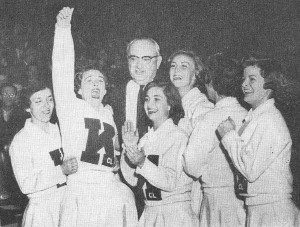 |
| Recent Kentucky successes have mellowed the famous Rupp spit-and-fire, but he is still a thorough-going perfectionist |
The scene was Lexington, on Kentucky's own court, and the Wildcats ran amok. They destroyed Miami of Ohio and reached their peak with an electrifying massacre of Notre Dame, 89-56, ignoring the odds that heavily favored the Irish. That was the one that put it over psychologically. The Wildcats were reasonably sure they couldn't be beaten after that. They took Temple in a thriller, 61-60, in the first round of the finals, and closed out Seattle, led by the renowned Elgin Baylor, 84-72, to nail down the NCAA title in Louisville.
"I got more personal satisfaction out of that team than any I ever coached," Rupp said. "There's nothling that ever happened that welded the Commonwealth of Kentucky together like winning that championship."
"But when you speak of great teams," he was asked, "what about the satisfaction you got out of the 'Wonder Five,' and then the team that went undefeated in '54?"
"That was expected of them," Rupp said. "They were teams of great talent. Just look at the All-Americas and the all-conference players that came off those teams. Why, hell, every time they lost, it was an upset. But every time we won last year, it was an upset.
"These boys of mine just got tired of being left out last year. All you fellows were writing about Bailey Howell of Mississippi State, and Rex Frederick of Auburn, and Jim Henry of Vanderbilt, and Dave Denton of Georgia Tech. Nobody paid our little ole boys any attention, and they just got unhappy and decided to become a basketball team.
"Ordinarily, you never win with a squad that had no more height than ours, and with a center that averages only 5.2 points a game. That was Ed Beck's average. Of course, that doesn't include his rebounds and his great defensive play. But you usually think of your biggest man as your biggest scoring threat.
"Why, hell, they thought so little of us that boys like Vernon Hatton and Johnny Cox couldn't even make the all-conference team. They just seemed to have a lot of togetherness. I've got written evidence that I wasn't the only one that got a lot of satisfaction out of it, by the way."
Rupp opened a tall metal cabinet and pulled out three fat files of correspondence. "Over 350 wires and a thousand letters," he said, "from everyone of the 48 states and several foreign countries. People congratulating us. I got one wireless message from a weather man at the South Pole."
The telephone rang. A man wanted the specifications for a backboard. "I could give it to you by heart," Rupp said, "but the book is right here, so I'll read it out to you just like it's put down."
He read off the measurements for a backboard and hung up. "People call or come here all the time to find out something about basketball," Rupp said. "Last summer the coach of Italy's Olympic basketball team spent a week here. We had trouble understanding each other, but he'd learned something by the time he left here.
"There are three high school coaches right here today. This is sort of a rough time. We're trying to get a new team ready for the season, but I can't turn a fellow down who comes a long way to study basketball at Kentucky. Harry or me, one of us takes a lot of time with them, showing them our style of play and studying their problems."
Harry is Harry Lancaster, who has been Rupp's assistant since 1946. They are like a man and his shadow. What Jim Turner is to Casey Stengel, what beef is to Stroganoff, Lancaster is to Rupp. They have worked so closely together and fought the intense, nerve-wracking battles of the courtside so long that they have come to think and act as one. Lancaster is nothing less' than a chip off the old enamel.
As we talked with him, the opening of another season was upon the Wildcats, and Rupp faced an immediate future even more uncertain than the future he faced a year ago. Cox was back, but the rest of his varsity men were reserves or sophomores. Practice each afternoon consisted of deep periods of concentration and application. Out of these sessions and out of that raw group Rupp had to build a team to defend the national championship.
A Rupp practice is a revelation. In the first place, everything is private. Not even Happy Chandler can get past the sentries without prior notification.
"After all," Rupp says, "teachers don't have people wandering in and out of the classrooms during class. Well, I'm a teacher. I don't like to have people wandering in and out of my classes."
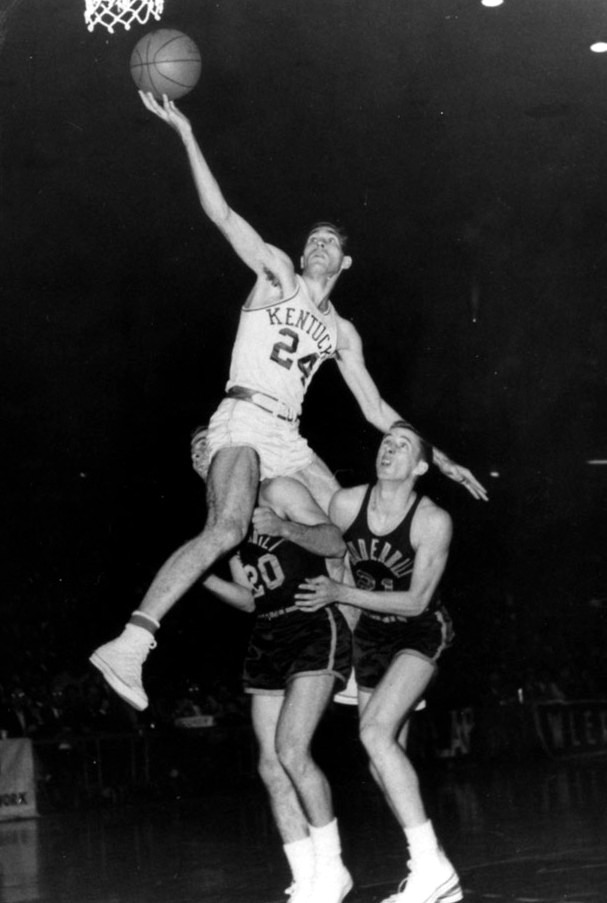 |
| Johnny Cox scores for last year's team which, unexpectedly, won NCAA tourney, gave Adolph his greatest satisfaction |
There was a junior guard named Sid Cohen, who came from Brooklyn by the incongruous route of Kilgore, Tex., where he had been a junior college star. Three times in a row Cohen brought the ball down the court and directed the play to the side opposite Cox, the bellcow. Rupp blew a whistle.
"Whoa!" he said, and the place became as quiet as a tomb, a tomb with 12,000 empty seats. "Sidney, I want you to meet this man down here in the other corner. This is Johnny Cox of Hazard, Kentucky. He won a national championship for us last year. He's a pretty good shot. If we don't get the ball in to him this year, we won't have a chance to win another one."
A few minutes later an eager sophomore bungled a play three times in a row. "That's all right," Rupp said, "You can't make every play perfect. If you did, you'd score a basket every time. But let's work at it a few thousand times."
"What is basketball coaching?" I asked him later, sitting by the court. "It's getting five men and teaching them how to play together and giving them a pattern to play by and practicing that pattern over and over until they know how to meet any situation, with a good coach sitting on the bench to remind them now and then," Rupp said.
"What do you look for in a college prospect ?"
"Nobody would give me credit for this, but the first thing I look at is that academic record," Rupp said. "If you're taking a poor student, you're wasting your time. Next you would like to have size, then you would like to have speed. The desire to compete, you can't measure that. They can look nice on parade, but you can't measure desire except under fire. But it's essential.
"Sometimes you don't know what you're getting, and that's one of the mysteries that keeps this game fascinating. Several years ago I had an old boy named Red Hagan who came to Kentucky on guts alone. He didn't have much talent. He wasn't any relation to Cliff Hagan, who was one of our All-Americas and plays for the St. Louis Hawks now. Red developed on courage alone and was a fine basketball player by the time he left here."
There was another case of supreme achievement. Out of the ungainly, untrained, slope-shouldered frame of Bill Spivey, Rupp constructed his masterpiece. He hewed this huge trunk of a boy into an All-America, and though Spivey later became one of the "fix" tragedies and never was allowed to play NBA ball, Rupp still speaks of the large fellow in more kindly tones than he reserves for the defecting members of the "Wonder Five." There is, in fact, serious doubt around Lexington that Spivey ever had a hand in any point-shaving devilment. He denies it passionately. There is no doubt about the others. They were caught, they confessed. and then they turned ungratefully on the school that had given them their chance at a life with a future.
Spivey came to Kentucky out of a rural high school in south Georgia, where the basketball level was strictly class C. He had scored a lot of points, but mainly because he had such a tremendous height advantage on his opponents. Grace and finesse were foreign to him. In 1951, or three years later, Spivey became an All-America. He never got to play his fourth season because the shadow of the "fix" fell also upon him, but to this day he maintains his innocence.
"He's the boy who came here with the least and went the farthest," Rupp said. "I took him on size alone. He had no shot, no background. He was big, gawky and undernourished. When he came here he weighed 165. By the end of the year he weighed 212. He took coaching well. He knew he didn't know anything and he listened and he applied himself.
"He had the courage and desire to be a good player. He became a great one."
The "Wonder Five" was another story, one of the tragedies of a high pressure period of athletics that struck just after World War II, warped young men's perspectives and reached a rotten peak when a grand total of 56 college and professional basketball players were hauled in as confessed fixers or material witnesses. The tragedy of the "Wonder Five" was that it destroyed one of the great sports legends of our time. There probably never has been a college basketball team to match this Kentucky group. They were such a great team that they won two Helms Foundation national championships in four years in spite of the fact that they admittedly weren't always trying their best.
The core of the team was composed of three men, Ralph Beard, Alex Groza and Wallace (Wah-Wah) Jones. Cliff Barker and Dale Barnstable came into prominence later, but from the early stages of their careers, Beard, Jones and Groza were outstanding. On October 20, 1951, almost a year after the first of the fixes had been exposed, the country was startled by the revelation that Beard and Groza had been arrested in Chicago at an all-star game, and Barnstable had been arrested in Louisville, where he was coaching a high school team, and that all three had confessed to "shaving" points in the Kentucky-Loyola of Chicago game in the National Invitational Tournament at Madison Square Garden on March 14, 1949. They hadn't shaved it fine enough, however. The game had got away from them, and instead of winning at less than the "line" margin, they had lost in an upset of vast proportions, 67-56.
A former Kentucky football scrub named Nick Englisis, an import from New York City, was revealed to be the contact man between the players and the gamblers. Everybody had got in deep and deeper, Englisis later revealed, and Groza had reached such a greedy stage that he had been making second-stage deals for himself behind the backs of Beard and Barnstable.
Rupp was more than stunned. He suffered the deepest wound he had ever known when the news came out and the confessions were confirmed. Intensifying the personal wallop of the thing was a phrase he had delivered before a group in Ohio just a week before, when the subject of fixes came up. "They can't touch my boys with a ten-foot pole," he had said proudly, and he firmly believed it. He had led himself into believing that everyone of his players was as devoted to basketball, to the sporting proposition of winning and to the honor of the university they represented, as he was.
A deep bitterness seized Rupp later when Beard and Groza both turned on their school, their coach and what they called "the system." Beard sank his fangs into Rupp with barbed insinuations. Groza snarled: "When I'm old and grey, I'm going to write a book about how Kentucky got me to go to college."
Rupp and his defected All-Americas never made their peace. He has never spoken to Beard or Groza since. Their pictures do not hang in the niche of Memorial Coliseum reserved for Kentucky's All-Americas. Barnstable did come back to the man they call "The Baron," but what went on behind the closed door only those two know. Barnstable is now in the insurance business in Louisville and has regained public respect. Groza works in his family's restaurant at Martin's Ferry, Ohio. Beard is playing basketball, and earning a pretty good living at it, in the Eastern League, the second largest pro league in the country and 'the only' one which has made the "fixers" welcome.
The other two members of the "Wonder Five," Jones and Barker, never were implicated in the scandal in any way. Jones is still in Lexington. He has served a term as sheriff of Fayette County, of which Lexington is the county seat, and now is in the radio and television business there. "I guess it makes me look pretty stupid," he said, "but I didn't have any idea at all that anything was going on."
"If the boys who were playing on the same court with them didn't know it, how was I to know it ?" Rupp said. "The whole world knows how I feel about gambling on athletic contests. Betting is something people should do on horses."
There was some public inclination to link Rupp with a shady underworld element after the shocking news broke. An alleged gambler from Lexington, Ed Kurd, was reported to be a confidante of Rupp's. Due chiefly to Beard's cutting testimony, Rupp was pictured as an unscrupulous coach with gambling ties of his own who stood before his squad and dictated the point spread that was to be sought.
Judge Saul S. Streit of New York's General Sessions Court, presiding over the trial of a number of the "fixers," including Beard, Groza and Barnstable, laid a heavy lash of blame on Rupp. Charging that basketball at Kentucky was "a highly commercialized enterprise," the judge, famous in legal circles for his austerity and tough-mindedness, let Rupp have it with both barrels. "Covert subsidization of players. . . ruthless exploitation of athletes. . . cribbing at exams. . . matriculation of unqualified students. . . an inordinate desire by the trustees and alumni for prestige and profit from sport," were just some of the judge's indictments against Rupp's basketball operation. Summing up, he leveled this sizzling blast: "The undisputed facts are that he aided and abetted in the immoral subsidization of the players. With his knowledge, the charges in his care were openly exploited, their physical welfare was neglected and he utterly failed to build their characters or instill any morals - if indeed he did not impair them. In view of his conduct, Mr. Rupp's sanctimonious attitude before me becomes ludicrous and comic."
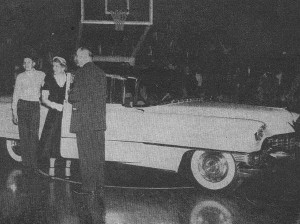 |
| Three years ago, Rupp received surprise gift of a Cadillac, and for the first time publicly he showed deep emotion. |
But when you visit Lexington, Ky., and get near the man, visit and whittle with his friends and neighbors, you hear on all sides that Adolph Rupp was as clean as a hound's tooth. His chief sin is that he has never learned to compromise with defeat, if a sin that be.
"That judge," said Bernie Shively, the athletic director, and a former All-America football player at Illinois, "did his best to put Adolph as far behind the eight-ball as he could. He said that Ed Kurd had picked up a big check for a players' night out at the Copacabana. Well, it just happened that I was along and I paid the bill out of our travel expenses. I've had several photostats made of it and I always carry it around in my wallet." Shively doesn't deny, however, that Kurd was on the scene.
All of this, the scholarships, the cavernous coliseums, the excursions to Madison Square Garden, the fixings and the riggings of unwise, misled young men, was far removed from the idyllic kind of basketball with which Rupp grew up in Kansas.
Few people remember any more that Rupp played for Phog Allen at Kansas. Even fewer are aware that he played on the national championship team of 1922-23 at Kansas, a team that never lost a game.
But this is that side of Rupp, as he told it himself: "I guess I've never known anything but basketball and the farm since I was a boy," he said. "I was born and raised on a farm seven miles from Halstead, Kansas, which is a few miles from Hutchinson. I went to school first in a one-room rural school house. I was the janitor. I got up and got there at 8 o'clock in the morning and got the fire started and swept out. I had to walk a mile and a half to get there, and it can get cold in Kansas on a winter morning. For this I was paid the princely sum of one dollar and fifty cents a month.
"When I got into high school I drove a horse and buggy into Halstead. That's where I first started playing basketball. There was no such thing as a gymnasium there then. We played outdoors on clay courts, and a fellow taking a set shot had to know something about the direction and the velocity of the wind. Every afternoon we either practiced or played a game, so me and my oId horse seldom ever got home before dark.
"My daddy died when I was nine, and the rest of us sort of had to pitch in and make the best of it. There were three brothers older than me, and a brother and a sister younger. We were German. My father and mother came over from the old country.
"Halstead was one of the smallest schools in the state, but back in '09 the team won the state basketball championship. That generated the spirit for basketball in the town, and every boy around there wanted to play on the team.
"The boys would get jobs working in the wheat fields in the summer time to toughen themselves up for basketball, and I was right in there with them. I worked thirteen years in the fields of Kansas, from morning till night. This was before the days of the combine, and it was all manual labor.
"After I got out of high school, I wanted to go to college. Nobody had ever heard of a scholarship in those days, so there was no scout knocking on our door wanting Adolph Rupp to go to. Kansas. I just showed up there on my own, and I kept on working in the wheat fields in the summer and saving my money to pay for college.
"I had to have some work at Kansas to make ends meet, though. I hunted for weeks before I finally found a job working in a restaurant from eight until midnight. I held the same job for four years and I never missed a night-except when I was playing basketball, of course. And in my spare time I managed to make the honor fraternity in commerce school.
"The basketball coach didn't know I was in school until the first day of practice. I just showed up and went out for the team, like everybody else. Of course it was a different type game then. It moved slow, there was very little running, and we played the zone defense. As violent as I am against the zone, I'm almost ashamed to admit it.
"I feel like I grew up with the game there because Dr. James Naismith, who had invented basketball at Springfield College in Massachusetts, was serving on the staff in a sort of advisory capacity to Phog Allen. Actually, he was the head of the physical education department, and a very grand old gentleman.
"Dr. Naismith never dreamed of basketball developing into the game it is today. He originated it not with the idea of creating a new major national sport, but mainly to accommodate football players between seasons. There was no spring practice back then and football players needed some kind of sport to stay in condition. That was the whole idea back of Dr. Naismith and his peach baskets.
"Our Kansas team of 1922-23 was undefeated, champions of the Missouri Valley Conference and national collegiate champions. I was a guard. We had a reunion last summer and all 11 members of the squad were there, all productive in their fields. The captain was a man named Paul Endacott, who is now no less than the president of Phillips Petroleum. That explains to you, I guess, the Phillips Oilers, that great AAU team they put out in Oklahoma. Paul and Tusten Ackerman and Charlie Black were All-America.
"While I was there last May I was presented this plaque." He left his desk and removed a huge mahogany and metal showpiece from the wall of his office. "In recognition of his distinguished service to basketball," the inscription read, "the only member of our team who followed coaching as a career."
Rupp reached into a stack of assembled items on his desk and riffled through them until he came to two pictures. "Look at these," he said, "a picture of our team in 1923 and one taken last May." Only Dr. Naismith was missing.
"What kind of a fellow was Phog Allen as you knew him?" I asked. "Are you on friendly terms since you became competitors as coaches?"
"A grand fellow," Rupp said. "A storm center to some people. He says what he thinks and he fears no one. He used to scrimmage with us whenever he felt the urge. He's never been out of condition. He's in his 70's now, but I'll wager you he's still doing his pushups and deep knee-bends. He looks younger than a lot of us who played for him.
"He's a magnetic personality. I can't say that I was greatly influenced by his coaching technique. I mentioned the zone defense, and he used it extensively until the day he retired.
"I'm not advocating that the zone defense should be banned. It just ought to be thrown out. It should never have been born. "The zone isn't basketball. It belongs to the age in which it was conceived, the age of the clay court and when an indoor gymnasium that seated 2,000 people was called a palace."
"Then, if Allen's style didn't rub off on you, where did you pick up the elementary basis for your own coaching style?"
"I was going to tell you," Rupp' said. "When I graduated from Kansas, there weren't many jobs around. The recession had just set in after World War I. Standard Oil offered me a job in South America at $117.50 a month, but that was a long way from home and that wasn't much money, even in those days.
"I really wanted to go into business, but there was no business, so I turned to teaching and coaching, temporarily, of course. I saw that teachers weren't making much money, but that administrators were, and so I started going to summer school at Columbia University and got a Master's. I coached a year at Marshalltown, Iowa, then went to Freeport, Illinois, and that's where I came in contact with the man who influenced me the most in my coaching technique.
"He was Dr. Walter Meanwell, and he coached then at Wisconsin, about 70 miles from Freeport. I used to drive up there and visit with him frequently. I made an intensive study of his style. He used the man-to-man. He introduced screening to basketball. In fact, I think you can say that Walter Meanwell introduced the modern screening style of play. His idea was that you'd dribble up, pivot, pass off and put the other fellow out of play."
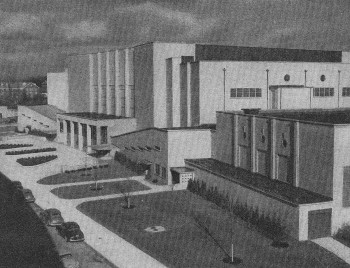 |
| The House That Rupp Built, $4,000,000 Memorial Coliseum on Lexington campus, was built in 1950, seats over 12,000. |
"The job was left open when Johnny Mauer resigned to go to Miami of Ohio," Rupp said. "I got a telegram one day inviting me to come down here for an interview. Somebody here had gotten in touch with Craig Ruby, the coach at Illinois, and asked him about some likely prospects. He must have mentioned me.
"I came down. I was interviewed, by S. A. (Daddy) Boles, who was the athletic director at Kentucky then. I'll tell you honestly, I didn't think much of either the place or the job. The campus was surrounded by a mass of little shanties. I'd seen high school gyms that looked better than the one they had then. And I didn't think much of the town.
"I caught the train home and decided that I didn't care, for the job. Then I got a wire saying I was hired and they gave me 48 hours for an answer. The salary that they offered me was what I was making in Freeport.
"I went downtown in Freeport and talked to several people about what I should do. Everybody wanted me to stay, but one thing one fellow said to me influenced me. 'You can always go to a better job from Kentucky than you can from Freeport. You may never get the chance again.' So I wired them and accepted."
Rupp has not only contributed abundantly to the sporting and entertainment life of Lexington, but he is regarded as an immense civic asset, a side of Rupp seldom ever exposed. He is a member of Big Brothers, a group dedicated to the rehabilitation of warped young lives, and although the work is carried out on an anonymous basis, it is common knowledge that Rupp has helped to pull several youngsters up the ladder.
In 1951 he was potentate of the Shriners' Olekia Temple in Lexington. The year before he had been named one of the ten nationally outstanding Shriners of the year along with a distinguished group that included Capt. Eddie Rickenbacker, Edgar A. Guest, Ty Cobb, Sigmund Romberg, Gen. Claire Chennault, Harry Truman, Gen. Hap Arnold and Happy Chandler.
He is a director of the Central District Warehousing Corp., the world's largest tobacco marketing agency, and he is in his sixth year as president of the Kentucky Hereford Association. Eight or ten times a year he is called upon to address agricultural groups, and last November he was the featured orator at the Iowa State College annual agricultural banquet. Ezra Benson, the secretary of agriculture, was the speaker the year before.
"The fact is," J. B. Faulconer, public relations director of the Kentucky Thoroughbred Breeders Assn. said, "if he wanted to get elected governor, all he'd have to do is say he's running. That's how popular he is in his own state."
There is probably some trace of exaggeration in this, the art of politics being what it is, but it is true that Rupp was seriously approached to run for lieutenant governor with Happy Chandler.
"I looked at it this way, though," Rupp said. "I'm seven years away from retirement, and I can retire at 90 per cent salary. I'm too full of spice and vinegar to crawl in a shell when I'm 65 years old. I'll get my chance to run later. I can't give up all this right now."
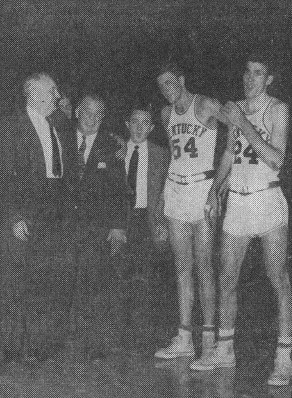 |
| Rupp hugs Kentucky Gov. Happy Chandler after NCAA victory, could get elected himself, he's so popular in state. |
"Daddy Boles asked me what I thought of him after Adolph had come down for an interview," Bernie Shively said. "I told him, 'Daddy, he reminds me of a preacher.'"
Basketball at Kentucky was in no rag-tag state of disrepair when Rupp arrived. On the contrary, the coach he succeeded, Johnny Mauer, who is now at Florida, had won 16 games and lost only three the previous season. He left behind two All-Americas, Paul McBrayer and Carey Spicer. And so in the beginning Kentucky couldn't be sure if Rupp was surviving off Mauer's legacy, or if he had a winning touch of his own.
But the all-stars kept coming. Out of a raw unpolished country boy named Forrest (Aggie) Sale, Rupp molded another All-America in 1932 and 1933. In 1935 a center named LeRoy Edwards was named by the Helms Foundation as the national player of the year, and is still considered by some to be the greatest Kentucky ever had. But the story ended there. Edwards was a one-year sensation. He and classroom work didn't agree, and he never came back to school.
Rupp stoutly refuses to participate in the game of superlatives. He has never named one player as his finest, never picked an all-star team, and never pointed to one squad or another as his greatest. "After all, how can a man who has had as many All-Americas as I've had say one is better than the other?" he said. "You please one and make all I the others mad."
He will, however, identify the greatest player he ever saw. His name is Forrest DiBernardi, who was an All-America in 1921 at little Westminster College in Missouri. "He came to Kansas as a freshman when I was there," Rupp said, "and I can testify first-hand. He could do everything, and on top of that he was a great competitor. He left Kansas, went to Westminster, and today is a very succesful businessman in Tulsa, Oklahoma."
As Rupp built on his success at Kentucky, all other activities seemed to fall in his shadow. The school fared poorly on the football field because it had a reputation as "a basketball school," a condition that existed until Paul (Bear) Bryant took over as head football coach in 1946. Bryant, too, was strong and domineering, and a clash for power between the two of them seemed inevitable. Whether it occurred or not can't be confirmed, but in the absence of established fact, the public with the help of the imaginative press, went ahead and constructed a rivalry to fit the cast of Rupp and Bryant.
"Both liked to be king bee," athletic director Shively said. "No doubt about that. But every time I sat down to talk to them together about a problem, both of them bent over backward to be cooperative."
The idea is ridiculous, Rupp said. "I admire Bryant. He did a great job for Kentucky. He kept the people off my rear end during the football season.
"When I heard he was leaving to go to Texas A&M, I called him in and begged him to stay. I told him how bad we needed him at Kentucky.
"When he left, he came by my office and we shook hands. 'I know there's been a lot of talk about us,' he said. 'You and I have had some great years together. I never did anything to hurt you and you never did anything to hurt me. I've never been jealous of you and I don't think you were jealous of me. I just want you to know I'm sorry to be leaving.'
"You can say I'm Bryant's greatest booster. When I was out in Kansas they asked me what I thought about their football situation. I said, 'You want to win, don't you? Then get Bear Bryant.' He has an aim, he has a plan and he's a tireless worker. That's the secret of his success."
Rupp is a violently impatient man. If he gets aboard a bus or a plane that is due to depart, and it doesn't, he hollers for action. He never holds back a word or thought. When the executive committee of the Southeastern Conference ruled Kentucky out of championship play for the 1952-53 season, he snorted derisively.
"Who the hell cares about taking a bunch of boys on a trip to Starkville, Miss., or Auburn, Ala., or Gainesville, Fla.?" he said. "Now we'll make some money. We'll play the teams we want to play out here, in the Midwest and in the East. They've just done us a favor."
Shortly afterward the NCAA completed the blackout, and Kentucky was ruled off the courts for a year. Rupp was beside himself with fury. "All because three weak boys had no respect for themselves, their families or their institution," he said, "a whole university is forced to pay a price like this. It's a helluva note."
Rupp and his men spent that barren winter in concentrated practice. A series of intra-squad games was scheduled and the townspeople turned out en masse to watch them. Then, when the next season arrived and Kentucky was returned to good standing, the Wildcats simply blew down everything in sight. Rupp will say this only in private, and deny it in public, but he considers his 195354 team his finest, and in so doing turns his back forever on the "Wonder Five."
Cliff Hagan, Frank Ramsey, Lou Tsioropoulos, Bobby Watson, Bill Evans, Shelby Linville and Skippy Whitaker were the chief performers, and they presented Rupp the only unbeaten season he ever had. Kentucky's flirtations with perfection have been numerous under Rupp, a fact handsomely supported by his average of only 3.6 losses per season, but this was the jewel in his crown. His 1954-55 team went seven games into its season before finally losing after a streak of 32, and this defeat left some blood on the moon. It was, indeed, one of the great upsets of recent years in southern athletics.
Kentucky had suffered only eight defeats in Lexington since Rupp had been the coach, but on January 8, 1955, a Georgia Tech team that had won only three games the year before whipped the Wildcats, 59-58. Rupp was left hare-lipped and numbed, although not quite speechless. When he got his players back to the dressing room, he stared through their quivering bodies with his cold eyes of brownish grey. "There have been two great catastrophes in our time, boys," he said with the twang that is unmistakably Ruppian. "One was Pearl Harbor. The other was tonight."
Rupp compromises poorly with defeat. He suffers bitterly through the after-effects. A few years ago Kentucky lost to Vanderbilt in the finals of the conference tournament, a post-season feature since discontinued. Defeat by one of the brethren happened so seldom that Rupp simply wasn't adjusted to it, and he exploded violently that evening when a flippant sportswriter suggested that "the calf had killed the butcher."
"Laugh good, damn you," Rupp stormed. "You all had better enjoy this now, and that goes for the whole damned conference. You won't get a chance again for a long time. Old Adolph will go out and get more players and come back and beat your tail over and over again."
Kentucky came back and stampeded through the NCAA tournament and won the national championship at Minneapolis a few weeks later.
For all of what Ralph Beard and Alex Groza had to say in their embittered moments, Rupp has carefully avoided the pitfalls of illicit recruitment. "Why should he violate the rules," one coach said, "when all he's got to do is whistle and he can get any boy he wants?"
In recent seasons only Lou Tsioropoulos has come from a great distance and become a man of prime value to Kentucky. "And he came down here on a football scholarship," Rupp advised. "He was supposed to have played end, but he decided he wanted to play basketball, and he ended up with us."
Except for Ed Beck, of Georgia, and a sub who seldom got his hair mussed from action, every member of the 1958 champions was a Kentuckian.
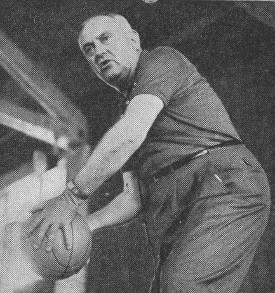 |
| A master clinician, he runs practices in private. "I'm a teacher; I don't want people disturbing my class," he says. |
One afternoon last November, a sophomore of supreme ability failed to show up for practice. Rupp instructed the team manager to call the player's home and inquire as to his whereabouts. The player's wife said he had gone to basketball practice. That was the finish.
"Clean out his locker," Rupp told the manager, "and return his uniform and gear to the equipment man." The gifted sophomore was through with basketball at Kentucky.
"He's a demanding man," Dan Chandler said. Dan is Governor Chandler's son, once a reserve on Rupp's squad and now a graduate student assistant on his coaching staff. "We've got a fine looking sophomore named Howard Dardeen from Terre Haute, Indiana. Well, he hadn't been looking too good in practice the other day, and Coach Rupp called him over.
"'Dardeen,' he said, 'I had a letter from a lady in Terre Haute the other day. She wanted to know if you were going to play any basketball for Kentucky this season. I wrote her right back and I told her it would only cost her four cents. She could write you and find out.'
"We had a boy named Gayle Rose who played while I was here. He had a rough time of it and it seemed like he was always in hot water with the coaches, and they were always on his back. After the last game of the season I remember seeing him walk over toward Coach Rupp. I stopped and looked because he was taking long strides and moving like he had something on his mind. Honestly, I thought he might be going over to punch the coach in the nose.
"Then Rose reached Coach Rupp. He stuck out his hand and said, 'Coach, I want to thank you for making a man out of me.'
"He's rough, but he's no ogre. You can bet that when he criticizes you, you've earned it, and when he praises you, you've also earned that."
In the hours immediately preceding a vital game, Rupp can get as spiritually high as any of his players. Before Kentucky met the Bob Pettit team of Louisiana State in a playoff for the conference championship in 1954, a game built up to incredible proportions by a series of schedule disagreements and other bickering, Rupp had three heart spasms in a row. His favorite challenge to his team used to be, "Let's go out there and leave their guts hanging from the rafters~"
Bernie Shively laughed when he was reminded of Rupp's old battle cry. "Well, I don't think Adolph's quite that vehement now," he said. "He hasn't lost any of his desire for winning, you can bet on that, but I think he has mellowed some. A lot of things have happened that have had a telling effect on him."
One of these, of course, was the magnificent comeback of his Ramsey-Hagan-Watson team after the schedule suspension. This seemed to sate Rupp's appetite for revenge and set him at peace about those he considered his tormentors.
Three years ago all of his former lettermen who could be rounded up gathered in Memorial Coliseum for a game, after which a new Cadillac was wheeled out onto the floor and presented to Rupp. This was the first occasion anyone in Lexington could recall that he had ever publicly showed deep emotion.
"You shouldn't have done this," he said feelingly. "You've already given me all that any man could ask for, the privilege of coaching here."
Basketball has taken a sharp turn upward in the South with the construction of several impressively large on-campus playing facilities. Only Georgia, Auburn and Mississippi of the SEC are left in serious need of indoor palaces. Rupp regards this as a sort of personal vindication, for he has campaigned for years against what he considered the injustices against basketball while the football bedfellow enjoyed all the benefits of an unbalanced favoritism. Kentucky itself was the leader in the construction movement, for in 1950. Memorial Coliseum was completed at a cost of something like $4,000,000. It is an indoor stadium that seats 12,000 and is commonly known as "The House That Rupp Built," for while he didn't lay the bricks or pay the bills, he and his teams certainly forced its construction.
The Coliseum only increased the size of basketball's financial prosperity at the school. "Basketball has always made money at Kentucky, since I can remember," Shively said, "but now we're paying $60,000 a year on the Coliseum and still putting a good deal into our treasury."
On top of this, the University of Kentucky Invitational tournament, a holiday function played in Memorial Coliseum, as Rupp's personal production, has enjoyed six years of rich return. Last year Kentucky paid each of four participating teams, including itself, an $11,750 share.
"That's a big whoop and a holler from what they used to get playing in Madison Square Garden," Rupp said. Since the basketball scandals, Kentucky, like so many other teams in so many other conferences, has stopped coming to Madison Square Garden. The big-city arenas supposedly spawned the evils of the fixes, with gamblers and bookies and the drive for bigger and bigger gate receipts. Playing on the campus is supposed to be safer, saner and more in keeping with the spirit of the game. But Kentucky, in its handsome on-campus fieldhouse, has been drawing more customers and making more money than the Garden has been lately with its college basketball program.
On the family side, the other Rupps have managed to remain in the background, screened out by the dominating figure of the head of the house. Mrs. Rupp, however, is what her husband describes as "a hollering, screaming basketball addict. She's the damnedest fan you ever saw," he said.
They have grown up together in the clash and the clamor and the turmoil of the game. She was Esther Smith of Freeport, Ill., whom Rupp married during his first season at Kentucky. They have one son called Herky, who is about to crash out of family obscurity. He is a likely member of the Kentucky freshman squad this season, a tall, lanky youngster who was teethed on the rim of a basket in the backyard of the family's pleasant home in the residential Chevy Chase section.
There is a streak of the sire in Herky, splendidly exhibited one evening in New Orleans at dinner on a Kentucky road trip. Rupp had taken Herky, then 12 years old, with him, and they were having dinner with the team at Antoine's, a gourmet's delight complete with all-French menus and black-tied waiters. It is still legend at Antoine's how Herky seared the backward management when he ordered a bowl of chili and a big grape and was told he would have to take his business elsewhere.
"I've had a happy life," Rupp said, "from those buggy rides to Halstead to this buggy ride I've had at Kentucky, even though it may not look like I've enjoyed it too much to the people on the outside.
"When you come right down to it, I guess the turning point in my life was when I went downtown to talk to that fellow in Freeport about whether I should leave security and come to Kentucky or not. I often wonder where I'd be today if I hadn't listened to him. Probably a high school principal in Illinois, or a farmer in Kansas."
The chances are, though, he would have been a good one.
Return to Kentucky Basketball page, Kentucky articles, statistics, team schedules, team rosters, opponents, players, coaches, opposing coaches, games, assistance or search this site.