
An unwanted All-America, a misfit in pro ball, this jump-shooting marvel stubbornly faced the challenge and became a hero again
Published in Sport Magazine, March 1959, pp. 39-41, 83-84.
by IRV GOODMAN
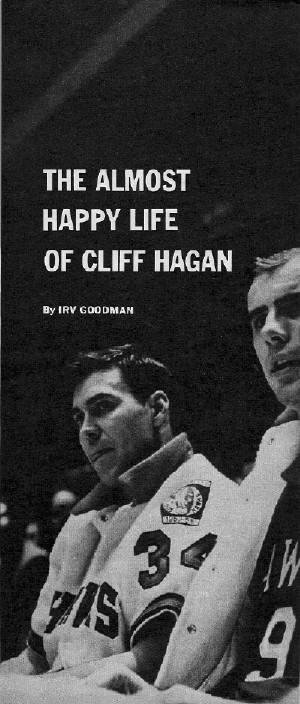 |
| Second banana of the Hawks, Hagan sits with No. 1, Bob Pettit. |
When you add up all the millions of young men playing basketball from three-man ball in the street to the big-time spectacle in Madison Square Garden, nailing down one of these 80 jobs in the NBA is as tough as making Casey Stengel's starting lineup two days in a row. And it should be as gloriously rewarding, too. After all, logic suggests that if you dream of being Mickey Mantle in your boyhood summertime, you should dream of being Bob Cousy in your boyhood wintertime. Don't both of them get their pictures on bubble gum cards?
The point we want to make is that pro basketball isn't always what it seems to be-although it certainly isn't what it used to be, either. A first-baseman makes the majors and after a while he begins to take it for granted, enjoying his hardwon place in the game, living an amply good life. But a corner-man makes the NBA, perhaps an even more exacting task, and he finds it isn't easy to take it for granted. The turnover is terrifying. The elbows in the ribs hurt. The money isn't as good as he thought it would be.
Some college basketball players recognize these facts of life when they get to the NBA, and adjust. Some don't, and disappear. Some, like Cliff Hagan, don't quite do either. They hang stubbornly to their private attitudes and dreams, making a compromise here and a compromise there. Then, in time, they come around, the hard way.
Consider the case of Cliff Hagan. Cliff is the hero of as fascinating a success story as there is in pro basketball. This handsome, broad-shouldered boy from Kentucky, who wasn't regarded as likely to make the NBA in the first place, became a hero suddenly and unexpectedly. Then he proceeded to do what is even harder; he kept it up. Just about two years ago, Cliff was a forgotten former All-America unhappily hanging on by his fingertips with the St. Louis Hawks. He scored some points and his team won its divisional title. The next year he scored a lot more points and his team won everything in sight. Now he is scoring even more points. Nice, huh?
Maybe, but incomplete. For Cliff Hagan's story doesn't end with heroics. It begins with them. It begins with success, too, and the comfort such success gives to a young man. Through his high school years, through turbulent years at the University of Kentucky, Hagan never knew personal defeat. He was the All-American boy. His strong, pleasant face was on magazine covers. His life story was in newspaper columns. He was a Big Man on a campus where basketball mattered greatly. As a sophomore, he starred on a Wildcat team that won the NCAA championship. As a senior, he starred on a team that managed Kentucky's only undefeated season ever. He played varsity basketball for Adolph Rupp for two and a half years (he was a mid-year student) and he made All-America twice. He and his teammates sat out one basketball season, victims of the crimes of other earlier Wildcats, and remained in school an extra 12 months in order to play another time. During the sit-out season, he and his friends played intra-squad games, one of which drew 10,000 customers. And through it all, he was getting away with being a six-foot, four-inch pivot man.
Then came professional ball. The year he was supposed to graduate, Cliff and Frank Ramsey and Lou Tsioropoulos had been drafted by Boston in an unexpected maneuver by Celtic coach Red Auerbach. But he never reported to Boston. He never even heard from Auerbach. Instead, after graduation, he went into the Air Force, where he continued his successful basketball playing.
Some time before his discharge was due, St. Louis found itself in trouble. The team was losing players of its own to the service, and owner Ben Kerner needed personnel He had the draft rights to Bill Russell, but Russell was going to the Olympics that year and wouldn't be available until December, if at all, since the Harlem Globetrotters were making an attractive bid for his services. Kerner felt he couldn't wait and couldn't take chances. He knew he could get Ed Macauley, a popular St. Louis boy, from the Celtics, but he wanted a throw-in. Ben Kerner always wants a throw-in.
"I had seen Hagan in college," Kerner said, "as a 6-4 center. What good could he be? Most people felt he couldn't go in our league. At his size, he couldn't play with his back to the basket and get away with it. And with his lack of experience, how could he learn to play the backcourt? I took him because he was the only one Boston was willing to give away, and I wanted Macauley. So I took Hagan as the extra man. He was a blind item."
Kerner wrote to Cliff, telling him he was now a Hawk - although just barely - and that he should come to St. Louis as soon as he was discharged, to sign his contract. Hagan showed up in July of 1956 and spent two days negotiating with Kerner, who had expected the meeting to take 20 minutes, including the social amenities. Ben talked and Cliff listened. Ben talked some more, and Cliff said no. "This is what I've got to have," he told Kerner, and recited a figure.
"But you haven't made your first point in pro ball yet," Kerner said with some passion, and then plunged into the job of persuading Cliff. He took him to a Cardinal night game and then to dinner at Stan Musial's restaurant. At the end of the second day, his negotiations still unsuccessful, Kerner, drove Hagan to the airport, talking all the way. While Cliff took care of his ticket, Ben talked. While he walked to the plane, Ben walked with him and talked.
"I'll tell you what," Kerner said at what had to be the last moment, "I'll concede a point if you'll concede a point."
Hagan agreed, Kerner took three contracts from his breast pocket (the NBA requires player agreements to be in triplicate) and, on the propeller of the plane, he had Cliff sign. "If they start the plane," Kerner says now, "we're in a hell of a mess."
Unconcerned, or unaware, that he had the shaky makings of a cup-of-coffee kid among the pros, Hagan reported to the Hawks for the 1956-57 season carrying full freight. He came in overweight, something not expected of a hungry rookie. (Rookies in all pro team sports are called hungry, but NBA rookies deserve the title.) And he came in with his family, something not recommended for any rookie, hungry or otherwise. Cliff may have been a 6-4 misfit and ripe for cutting from the squad during a wind sprint, but he was confident. The Hawks had Bob Pettit, Willie Naulls, Jack Coleman, Charlie Share and now Macauley up front, all several inches taller than he was, but he was confident anyway. The coach, Red Holzman, tried him in the back court, where he had never played before, and he was still confident. Then they began to play the game, and Cliff wasn't confident any more. He wrenched his knee in an early exhibition game and missed the remainder of the training period. But it didn't matter much. He was doing poorly.
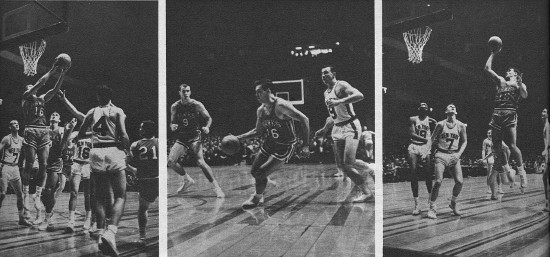 |
| 1.) A tricky man with the ball, Cliff can hook, jump, make fancy shots. 2.) Driving, he has good speed, power for 6-4, can't be played too close 3.) Large, strong hands enable him to hold ball one-handed on jump shot. |
He was able to play again soon after the season started, but every time he was used, he managed to look bad. He was obviously out of position in the back court. Kerner tried to trade him to New York, but the Knicks didn't want him. He tried to deal him to Minneapolis, and the Lakers didn't want him, either. No one wanted him.
Then the Hawks traded Naulls to New York for little Slater Martin and moved Hagan up front. Nothing changed. By now his confidence was cracking badly. He had always had great pride in his strong body. He always believed in it and never doubted that it would carry him wherever he wanted to go. But now that he wasn't making the ball club, he was unsure of his physical armor. This rattled him.
He developed a poor attitude. "When I didn't play," he can say now with remarkable honesty, "I got mad and moody. When I did get a chance to play and then was taken out, I got even nastier. I wasn't much fun to be with." Kerner called him in for a talk one day. "You'll be with us for the rest of the season," Kerner said. "So relax."
It helped Cliff, but it didn't solve anything. Nothing did until Alex Hannum became the coach. Before that, the Hawks had played a slow-down style, and now Hannum was making them run. The speed pattern, more familiar to Cliff, helped him pick up a bit. But he didn't come into his own until Pettit broke his hand late in the season. Now Cliff was needed. He had to play from 30 to 35 minutes a game and, somehow, he did it well. He began to hit on jump shots and hooks from around the pivot, and he was beating taller men off the boards, and he carried the club's offense while Pettit healed. He had become important again, and this bolstered him. In the playoffs,he did more of the same effective work, right up to the second overtime of the final game with the Celtics for the championship, which the Hawks lost.
Last season he played as if there never had been any doubt. He was the seventh highest scorer in the league, averaging 19.9 points per game. He pulled down 707 rebounds, the highest total for players under 6-5. He was particularly effective off the offensive board because he has the good habit of following his shots in, and with his strong shoulders, powerful leap and immense hands, he is able to bring the ball down with one hand while he fends off intruding arms and elbows with the other. Pressure, the Hawks learned, didn't bother him. His scoring was consistent, not 40 points one night and ten the next, but a steady 17 to 25 a game. He had the second best accuracy average in the league as a floor-shooter, hitting on .443 per cent of his field-goal attempts. It was a good record.
In the playoffs, which the Hawks took from the Celtics this time. he was the high scorer, averaging 27.7 points for 11 games. He hit on .502 per cent of his shots. It was an even better record, and this time it was for all the marbles.
When he opened this season at an even higher shooting pace, averaging over 22 points a game, most people forgot that Cliff had ever been unwanted or unimpressive. The All-America was now an All-Pro, and what changes took place to get him from the one pedestal to the other were important to him. Without necessarily liking them, he had come to understand the facts of pro life. And he had come to know himself better.
He had valued the friendly, care-free life of the college athletic hero, and when he failed to find it in the NBA, he was disturbed. He thought there wasn't anything to take its place. "Everybody ignores you," he said, talking about his rookie days but meaning more than that. "I thought a pro team would be one clan. But it isn't. Everybody has his own problems and nobody seems to have time to worry about the other fellows. You have to do it by yourself. I had to learn this lesson."
It disturbed him that when a man was cut there were no good byes. The man was just gone. "Like Murder, Inc.," he said, choosing a strange comparison. "Nobody got upset. This shook me. The fellow who went away wasn't missed. Do you know, no one has talked to Hannum since he left the club last season?"
"Did you call him?"
"No. I thought about it but I never got around to doing it."
Hannum, No. 10 man on the squad at the time, had been made Hawk coach in the middle of the 1956-57 season and carried the team to two titles, being separated from his job only after he had won the NBA championship last April. Hannum had been a cheerleader coach - gruff, stubborn, erratic but a heck of a pep talker.
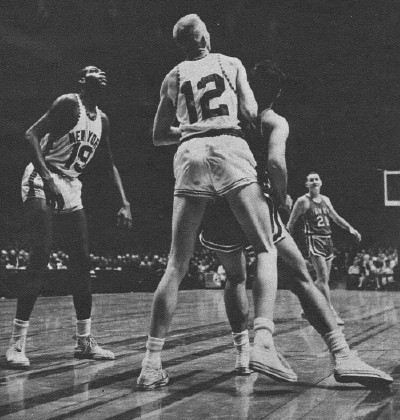 |
| Leaning against Ken Sears under boards, Hagan is an exceptional rebounder, fast enough to get good position n his man, sturdy enough to hold it as he goes up. |
Now it was the afternoon of the seventh game of this season, under new coach Andy Phillip, and there was something wrong with the club. To a visiting interviewer, Hagan was saying, "We lack holler. This has always been a team and now it isn't. I don't know if the other fellows sense it, but I do."
It was, in a way, criticism of coach Phillip. "He keeps us quiet on the bench," Hagan said. "When we yell, he says, what are you, a bunch of kids? Well, we are. You've got to remember that we're really young fellows and we need rah-rah." Then he paused. He is a slow talker, sometimes lapsing into minutes of silence. "You might gather from this that I'm a Hannum man."
Subtle tugs of discord develop even on a championship team. One problem early this season had been with Hagan. In his brief career with the Hawks, Cliff had become the second best rebounder on the team. At the start of this year, Phillip told him he wanted him to box out more, to keep his defensive man away from the boards, and to let the bigger fellows - Pettit and Clyde Lovellette - take down the ball. Cliff did what he was told in the opening games of the season, and soon there were comments in the newspapers that he wasn't rebounding as well as he had before. It bothered Cliff that his coach didn't straighten out the reporters. (He has too much pride to have sought to correct the impression himself.)
"Tonight," he said quietly to the interviewer that afternoon of the seventh game, "I'm going to go up and try to get some rebounds. See what they say then."
The point is that without settling on who was at fault, there apparently was something wrong between the coach and his players, and maybe Ben Kerner knew what he was doing when, a week later, he fired Phillip and ordered Macauley in as coach.
As one of his first official acts, in fact even before he had coached his first game, Macauley was asked to deliver a critique on Hagan. It was a strange scene. Hagan was in the hotel room, listening. Kerner was there, too, talking loudly on the tele- phone. Buddy Blattner, the former baseball player who broadcasts all the Hawk games, was there visiting. And Macauley was speaking:
"Cliff has a big job this season. He'll guard the other team's tough offensive men-Yardley, Arizin, Baylor, Sears. Cliff is quicker than Pettit and he's strong. He can do the job. We expect this defensive load will hurt his scoring." (It is interesting to note that it has not.)
"He looks calm with referees, but let one of them make a bad call when he gets hit, and Cliff will cut them. He doesn't care how hard he gets hit but he wants to hear that whistle when he does. Even in practice he's that way. Yesterday was my first day as coach, we had a scrimmage and I had to referee. On the first play, the ball was tipped to Cliff and he dove in for a layup and got hit. I didn't call a foul. You knew he was mad the way he came running back upcourt. As he passed me, he yelled, 'Call the foul!'
"On the bench he isn't much for rah-rah." (Surprising, in view of Hagan's statements on the subject.) "He's quiet. I hope to change that. I want spirit, and that's something you've got to see and hear. If Hub Reed, his substitute, is in and makes a good play, I want him to get a call for it. From Cliff."
The interviewer glanced at Hagan sitting deep in a club chair. His eyes were on the thick carpeting but he was giving careful attention to his new coach and his head was nodding agreement.
In a private talk that day, Macauley, who was once his roommate, had told Cliff that he could be an excellent passer because of the way he is able to hold the ball so firmly in one hand, the way his reflexes react so quickly, and particularly the way he can shoot and hit if the defense doesn't come to him. So, in his first game for Mac, he got seven assists.
If he lasts long enough as Kerner's coach, Macauley will have considerable influence on Hagan. Cliff respects him, as an able businessman, as a polished personality, as an astute citizen. All of these things have sizable meaning for Cliff, and he sees Mac as a solid example of all three.
A man who knows and likes him says it is important to realize that "in moral fiber, right down to his toes, there is a lot of Southern Baptist in Cliff." Another friend says it is important to realize that "there's quite a bit of Indian blood in Cliff."
Given its worst due, Southern Baptist means a harsh, unbending, limited approach to life. Given its best, it implies a well-fibered, impressive personal discipline. Given its worst, having Indian blood means being a stoic. At its best, it still means being a stoic. Both strains have held a tight grip on the Hagan personality, but he is learning to match them with the world he lives in.
Cliff has always been a loner, ever since childhood, when he was poor and unhappy. When a Hawk teammate used to come up to him in a hotel lobby and say, "You going to the movies?" Cliff would answer, "What are you doing?" The teammate would say, "To the movies?" So Cliff would answer, "I'm going to eat." He is trying to change that habit.
And he is trying to change others, too. A year ago, he avoided parties. Never a drinker or a smoker, he would turn down most invitations. Now, he says, he is trying. This past summer, the few times the team got together for a barbecue or a party, Cliff attended. At the beach, when the call came, "Who's for a dip?" he would be the first to dash into the water, as if making a point. At a recent Hawk party, he led a conga line, an event that amazed some of his friends. At Buddy Blattner's home, he sat down and entertained Buddy's children by picking out a tune on the piano.
All of this has had particular significance for his teammates, who never disliked Cliff but didn't know or quite understand him. Except on the court, they had no real communication with him. But now they were getting a glimpse they could hold on to.
To use an old-fashioned word that was chosen by one of the Hawks, much of Cliff's reserve and hesitation has been due to an attitude he must have developed a long time ago, that he doesn't want to be "beholden" to anyone. He doesn't want sympathy. He doesn't want to be begged to do something. He is uncomfortable when others are solicitous. Because of this, he has had to learn some lessons the long way around.
A special All-Star tour was being set up after the close of last season, and the promoters, shopping around for talent, approached Bob Pettit. They offered hIm $75 a game. Pettit said he would let them know. After consulting with Kerner, who advised him that he could get much more money, Bob returned to the promoters and got much more money. Then the promoters went to Slater Martin, who followed the same procedure and also got more money. Then they went to Hagan, who consulted no one, chose not to be "beholden," signed immediately, and got no more money.
But there is the positive side of this wish for independence, too. Cliff wants to sample what he thinks he has come to recognize as the better things in life, so he reads books like Andersonville and discusses them with Macauley.
Kerner gave his team a dinner party recently at Leone's, a popular restaurant in New York. Every member of the squad ordered steak, except Cliff. He had lobster. Nobody can do his thinking for him-and he is thinking better all the time.
There is much at work in this complex personality who is shaking some old notions, testing some new ones. and selecting what he thinks will work best for him. He wants to improve himself, so he takes courses toward a master's degree at Washington U. of St. Louis. When asked why, he says, "To be qualified to teach."
When asked if he wants to teach, Cliff says, "I have no great desire to, but it's something I'm qualified for, so I'd better prepare myself."
There are still some problems to be handled. The most serious is that he can't sleep. During the season, he spends most nights reading, playing the last ball game over and over, taking pills that don't work, and walkin~ the floor. When there is no basketball, he can sleep for ten hours, though.
Maybe it all has to do with the fact that, somehow, the only game he has ever played is basketball. Maybe he is trying to make this one game be everything for him. He discovered basketball when he was still in grade school and he saw some other youngsters playing in the school gym. He was in the fourth grade at the time and, he says, he had never seen the game before. The first time he tried to dribble, he did it with both hands. But he liked to play, and because of his size - he was husky rather than tall - he did well, and he never again seriously tried any other sport, although he has the fine build, sharp reflexes, exceptional speed and power to have been good at them.
"I'll tell you one thing," he said to the interviewer. "I'm one basketball player who never had a hoop in his backyard. Not even now. I only have daughters (Lisa Ashley, who will be three in August, and Laurie Jean, who was one in January), and I don't fancy them being basketball players. The only hoops around my house are hula hoops."
After he is finished with pro ball, Hagan plans to coach and teach at a small college in a small town. Both he and his wife, Martha, are smalltown folk. "We like the university life," he said. "We think it's a good place to bring up children. I'm not looking to be a big-time coach. I don't want anything where winning is the whole story. I want to go where there's security."
Security. That was the word we'd been looking for to describe what Cliff Hagan is looking for.
Return to Kentucky Basketball page, Kentucky articles, statistics, team schedules, team rosters, opponents, players, coaches, opposing coaches, games, assistance or search this site.