
To learn what University offiicals and coaches think of the charges that resulted in the NCAA ban on their basketball team, SPORT sent a writer to the scandal-ridden school. Hereis his report !
Published in Sport Magazine, March 1953, pp. 12-13, 79-81
by JIMMY BRESLIN
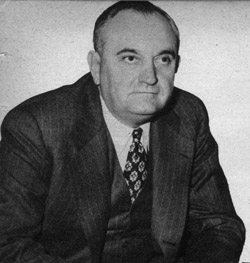 |
One other. Bill Spivey, charged with perjury in connection with the scandal.
Basketball coach Adolph Rupp scored by Judge Saul S. Streit of the Court of General Sessions in New York for consorting with bookmaker Ed Kurd, The school's athletic policies blasted as "the acme of commercialism and over-emphasis" by Streit.
Suspended from league basketball competition for a year by the Southeastern Conference,
Suspended from all basketball competition in the 1952-53 season by the National Collegiate Athletic Association, which found players receiving illegal cash gifts on five occasions,
Two varsity football players this year - All-American candidate Gene Donaldson and Chet Lukowski - declared ineligible when it was found they were being paid by outside sources.
THAT'S the scoreboard on the University of Kentucky's ambitious athletic program, a big-time, high-pressure set-up which has made its basketball teams the best in the nation and has sent its football teams to three bowl games in recent years. It is a program which has been blasted as one of the worst among the colleges participating in intercollegiate sports.
But Kentucky apologizes for nothing!
Far from being chastened or stirred to a revision of its program by these events, Kentucky, from its president, Dr. Herman L. Donovan, right down to the 107th man now in school on an athletic scholarship, gives every indication that it only has one thing to say about the whole affair: "We'll be back stronger than ever in basketball next year!"
While other scandal-ravaged schools, notably the City College of New York and Long Island University, have cut their athletic programs to the bare minimum - City returning to a small-time basketball schedule and suspending coach Nat Holman and two others for their handling of the program and LIU completely dropping basketball - Kentucky has decided to stick by its policies of big teams and big gates. CCNY dropped Holman, his assistant, Bobby Sand and a faculty representative, Dr. Frank Lloyd. Clair Bee left his coaching job at LIU. But at Kentucky, Adolph Rupp, the man who built a basketball empire in the Blue Grass country, remains as strongly entrenched as when his Wildcats were running roughshod over the nation's best basketball teams'. Everywhere in the State of Kentucky, the Baron is sympathized with as a man who was betrayed.
Why? What makes Rupp and Kentucky different from Holman and City College ? How can Kentucky, a state institution, maintain its high-pressure policies which brought the University such disgrace ? How can Kentucky afford to keep Rupp ? With these questions in mind, I visited Lexington, Kentucky, the home of the Wildcats, to get the reaction of the man-on-the-street - and coach Rupp and University people responsible for hiring and firing him.
 | The NCAA suspension of Kentucky's basketball team has left the new four-million dollar coliseum to concerts, other activities |
There are three reasons why the University of Kentucky will not change its athletic policies, and because of them, Wildcat teams figure to be stronger than ever in the seasons to come. It took me less than a day and a half in Lexington to find that out.
The first reason is a concrete one. It is the magnificent, four-million-dollar coliseum which the school erected for basketball. You do not fill a gymnasium like that with average teams and you do not pay off a mortgage on it with gate receipts which average teams draw - and Kentucky is a long way from paying off its debt on the imposing building, which can hold crowds of over 13,000.
The second reason is the Southeastern Conference, of which Kentucky is a member. The SEC is one of the strongest collegiate football leagues and you do not compete in it with a de-emphasized, strictly amateur team. Kentucky has been keeping up with its Southeastern brethren - and then some.
The third driving force behind the Wildcats' "must" status in big-time sports is the State of Kentucky itself. From the governor's mansion at Frankfort right down to the corner druggist in Lexington, the people follow UK, as they call it, just as avidly as any Brooklynite follows the Dodgers.
These sports-minded people - and some of them are considered big people in the state - demand winning teams on Stoll Field or in the Memorial Coliseum or wherever a Kentucky team plays. "And it is these influential people - politicians, wealthy alumni, and businessmen - who have the tools to exert pressure on Maxwell House, where the school president resides. and see to it that policies are established which will assure winning teams at Kentucky.
It is for these reasons that Kentucky will continue to put out strong teams, formed under high pressure, and it is because of them that school administrators will tell you that UK is being made a whipping boy by people whose sins are just as bad - or worse in many instances.
You can plot the rise of Kentucky in the world of sports from the day Dr. Frank McVey retired as president of the school in 1941, after 20 years of distinguished educating. Guy Huguelot, chairman of the school board of trustees and president of Southeastern Greyhound Bus Lines, had a lot to do with the appointment of Dr. Donovan, his old Eastern Kentucky State Teachers classmate. Under President McVey, Wildcat football teams were fairly docile, and it was considered a big day when 12,000 people turned out for a game. Basketball was played in the old fieldhouse which didn't seat a fraction of the crowds which can be fitted into the coliseum. McVey frankly admits there was "pressure" on him to put out stronger teams during his tenure, and on his retirement, the Wildcats suddenly perked up. Under Donovan, coach Rupp, who has been at Lexington for 22 years, swung his already strong basketball program into high gear and Paul (Bear) Bryant was brought in as football coach from Maryland. While this was going on, the "important people" in Kentucky were hard at work. Formation of "Stac" clubs (Cats spelled backwards) became a project with businessmen. Soon better football teams began to draw crowds of 30,000 and the basketball team crashed to the top of the national listings. Promising athletes, like Wah-Wah Jones, Alex Groza and Ralph Beard, were sponsored by people who saw to it the boys never wanted for much of anything. In one case, cage star Wilbur Schu, an orphan, was given a home - right smack in the governor's mansion when Albert (Happy) Chandler was running the state.
Kentucky moved up - right to the top of the athletic world, which suddenly came crashing down on their heads at Lexington. But, today, the debris from the calamity has been cleared away and things are heading back to normal at Kentucky. Next season, the rise will begin again with what shapes up as the longest basketball team in Wildcat history.
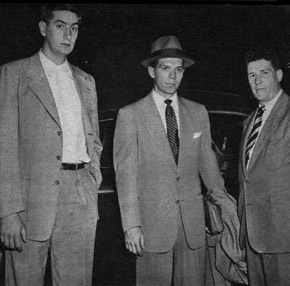 | Kentucky's troubles began when star players, including Alex Groza and Ralph Beard, were found guilty in "fix" scandal. |
And it isn't just the students who think this way. It is nearly everybody in the town of Lexington - and in Kentucky. If you understand how they feel about things you easily understand how the University officials can praise Rupp and damn the NCAA and everybody else who criticizes them. You can get this feeling easily; you can find it out on the two-hour-and-20-minute train ride from Louisville to Lexington. Sitting in the dining car of a Chesapeake and Ohio train rolling across the state, I only had to make one comment on the situation to produce sharp words from six people seated at nearby tables.
"I guess the old Baron is in hot water up to his neck these days," I said to a man seated at the next table.
"Rupp is in no trouble . . . but these people who gave him the business are in for plenty," Vernon Coulee, a Louisville businessman snapped.
"Rupp? Why he's one of the biggest men in the state and he doesn't deserve anything they tried to do to him," added Ed Shinnick, a Lexington salesman.
In the town itself, a visit in the offices of the Lexington Herald-Leader brought the same results. "You want to know if they are going to get rid of Rupp?" a fellow at the sports desk said with amazement. "Why I guess they will. . . when he does something wrong. And he hasn't done a thing wrong yet and we don't expect him to, either."
To someone familiar with the charges leveled at Adolph Rupp, these opinions are surprising. When you get used to hearing them, you want to find out more about Kentucky's side of the story and you want to hear it from more important sources. I put in a call to Rupp, but he wasn't in town. He was out on his farm, the lady answering the phone said. Then I called Dr. Donovan and he readily agreed to an interview.
The sign on the front door at Maxwell House read, "Door Open, Please Come in and Call." The president's house, a big, rambling place, is situated in the middle of Kentucky's large campus. I stepped inside expecting to meet only Dr. Donovan, but instead there were four men sitting in his library - Donovan, Adolph Rupp, Dean Ab Kirwan and Harry Lancaster, Rupp's assistant. Apparently, a couple of phone calls from a writer looking around town for a story on Kentucky produced quick action, because Rupp was dressed in his usual brown suit, tie and shoes and had been called in from the farm in a hurry by his boss.
I sat down with them - these four men who have more to say about which way Kentucky's athletic policies will go than anybody else - and for the next two and a half hours had a cards-on-the-table, no-holds-barred talk about the school.
Dr. Donovan is a mild man with a manner calculated to make you feel at ease. It was clear he was the man who was answering for Kentucky, and the others were along only to fill in on any facts he didn't have at hand. But he was willing to answer any and all questions.
"You ask me why I don't fire coach Rupp," Donovan said in a matter-offact tone. "I'll tell you why, and I've said it many times before. I am keeping coach Rupp because he is an honorable man. After the scandals broke, I conducted my own investigation of coach Rupp's policies and I found them to be letter perfect. Other agencies have seen fit to censure us. We have taken it quietly .. . but I believe we are being very unfairly criticized by people who are trying hard to publicize a cleanup program they are conducting. We have endeavored to follow all the rules and regulations of the Southeastern Conference and the NCAA and along the line we made the mistake of allowing our boys to be paid $50 for three days at a Sugar Bowl Tournament at New Orleans. For that, we have been suspended. We paid the money to the boys because we understood it was allowed by the Southeastern Conference. In fact, the commissioner, Bernie Moore, once paid his football team at Louisiana State University $250 for the same affair and we were since led to believe a school could give a boy from $250 to $500 in special expenses for a bowl trip.
"I do not believe that we have done anything wrong. You can check our records from top to bottom, you can see the courses our athletes are taking - and the majority do not take physical education - and you can look at their grades. I only wish the rest of the school's students could compile the scholastic records our players have been."
Later, I checked the records and found they agreed with Dr. Donovan's statement. They showed that such stars as football player Steve Meilinger was an education major, basketball player Frank Ramsey was in the school of commerce and grid captain John Griggs was in the agricultural school. That was just a sampling - a check showed 26 athletes in the school of engineering, 50 in commerce and only 20 in physical education.
"I am telling you these things in our defense, but we are not crying," Donovan went on. "We are taking this quietly and will, in the future, live up to every rule and regulation of any organization we belong to ... and we feel there are several rules which should be introduced to make things even stricter. There is one thing I want to point out - our entire trouble stems from the fact that five boys took bribes over a three-year period from New York gamblers. Our boys had to go to Madison Square Garden to become involved in this mess. That's where our troubles began. If the City College of New York saw fit to change its entire system, I am not familiar enough with their situation to comment on it. But I will point out to you that there was academic grade fixing at City and as you have seen we have students playing for us and not boys who need to be carried. The first seven men on last year's basketball team maintained a 1.7 quality point average out of a possible 3.0, which the records will show and which you will agree with me is quite high.
"Coach Rupp, coach Lancaster or Mr. Shively (athletic director Bernie Shively) or myself or the general program has nothing to do with the trouble we have. There is no administrative difficulty or failure here. The failure was in the five boys who disgraced coach Rupp and the school. There would have been no trouble here if it were not for that fact."
Then Kirwan and Lancaster and finally Rupp joined in the conversation. They pointed out that Kentucky is not a culprit. They explained that Kentucky is just keeping up with the Joneses and the Joneses make things easier for their players. They cited the easier rules in the Big Ten and Tennessee's use of ineligible football players Tom Haslam and Andy Kozar and the SEC's failure to act on them despite protests from the University of Florida before the teams met.
I was particularly concerned with coach Rupp's comments. He is the man who has been criticized for nearly everything bad which has happened at Kentucky. Some people have gone so far as to claim he knew a lot more about the scandal than he told. Judge Streit said that "in view of the evidence presented, Rupp's sanctimonious air before me is ridiculous." But I heard a lot of things about Rupp which surprised me. Rupp is the grand potentate of the Shriners in Eastern Kentucky and it is a big honor and one that does not usually go to a man who is not considered a person of impeccable integrity and honor.
"How could I believe my boys were doing something wrong ?" he asked. "Look at the record . . . they won 163 games and lost eight. How could anybody suspect them of anything ?"
Rupp's relationship with bookmaker Ed Kurd was explained easily by everyone I asked. "Sure, he knew Kurd," Larry Shropshire, a sportswriter, said. "Why, everybody in town knew Kurd and he was an avid Kentucky fan. When Rupp went to see him, it was for funds for the Shriners and Kurd was a good man to see for things like that."
Rupp made another point which has generally been overlooked by those attacking him and the school. It was the fact that nearly all of the school's basketball players are home-grown, and the football team has limited out-of-state scholarships to a mere six. "Look at some of my boys," Rupp said. "They come from Versailles or Paris or Louisville. It takes a lot of recruiting to get a boy from 20 miles away to come to his own state school, doesn't it ? I think you'll find there aren't any boys in school who come from eight states away because of my grand personality . . . like they do in other schools."
The only player of note on his team who is from outside the state is Lou Tsioropoulos, who comes from Lynn, Massachusetts. Of 15 freshman stars, only two are non-Kentucky residents.
The school has another valid point when it says that all scholarships are strictly given within conference rules. A freshman basketball player, Hugh Coy, from Richmond, Kentucky, told me, "I get room, board, books and tuition and 15 dollars a month pay for my laundry and that's about what laundry costs me. And as for marks, why I have to keep them up or they tell me I'll be out of here and they already dropped two guys who I thought were terrific, Woody Preston and George Cooke. They tell me the two of them thought they were basketball stars and didn't have to pass their subjects. Well, it looks to me like they don't work things that way here."
Rupp speaks with a Southern accent and many people believe he and the school would be better off if he did not speak out as often as he has. Columnists around the country have jumped on his quotes about the scandal and given him a thorough going over. It has been charged that Kurd paid for a party Rupp, Shively and the players had at a New York nite club during a tournament in the city. Ken Kuhn, the school's athletic publicity director, can produce a signed bill showing that it was Shively who paid the check. Kentucky has not made this fact public, despite repeated accusations that bookmaker Kurd entertained the school's coach, athletic director and team.
It would take a pretty good detective to find anything wrong at Kentucky that has not already been publicized. New York Assistant District Attorney Vincent O'Connor spent three days digging into the Kentucky situation and could come up with nothing outside the normal practices of the conference of which Kentucky is a member. Kentucky considers itself just an average Southeastern Conference school - which means it is big-time all the way.
Rupp has helped put Kentucky in a bad light as far as the public is concerned by his statements. He was hit from all angles after making a blast at New York newspapers for their printing of cage odds. He was hit because he left himself open by inquiring of basketball odds himself. Four blocks from the school, a large restaurant had the point odds and the score by periods of 31 major college football games plastered in big white chalk letters on a permanent, blue cardboard scoreboard which hangs over the bar. The night I was there, people were talking money , . . cash won and lost on the day's games. And if you step into any other spot around town you will hear the same talk. "Only reason we didn't bet basketball is because Kentucky always won so easy," a bartender told me.
Kentucky will play big-time sports because the administration and the fans want it and because they have a bigtime athletic plant. Stoll Field seats 36,000 and the big, gleaming Memorial Coliseum on the school's "Avenue of Champions" holds approximately 13,000. The University has to make $150,000 a year to make basketball pay and with a mortgage of some $85,000 a year to pay on the building, opened in 1951, it will have to maintain good teams to pay off.
When asked about the plant, Rupp said, "I've said this to every person who has talked to me about it. That building is not for basketball primarily. It is, above all, a war memorial to the 9,000-odd sons and daughters of Kentucky who gave their lives in the war. When you go there on a Sunday afternoon to show some people around and see a little, old shriveled-up lady looking up and down the lists of war dead hanging in the lobby and then you see her finger stop at Fayette County and point to a name and say, 'That's my son,' why you don't think of it as a basketball court." President Donovan and Kirwan quickly added that the building will be used three or four nights a week with symphonies and other activities. "We've had top philharmonic groups here," Kirwan pointed out.
But when I walked into the huge building, the first thing which I noticed was the ticket office and the prices starting at $4.50 for seats at basketball games. Despite the comments, I came away with only one impression - the place was built to seat more people at UK basketball games.
Then I thought of the statements in the president's home about "New York gamblers" and recalled that one of the fixers who did a lot of "business" with Kentucky - Nick Englisis - was a Kentucky student!
But removing yourself from the battle of words, and looking over the University of Kentucky's system for what it is, you can draw but one conclusion:
It is wrong in the manner in which it pursues policies which have gotten boys into more trouble than anybody cares to think about - but the University of Kentucky is no worse than the schools it associates with in big-time collegiate sports.
As for the powerhouse cage team which the UK was set to field this year, it should back up Rupp's statement that "I won't quit until the fellow who told me I couldn't have a team this year hands me the NCAA championship trophy." The team consisted of All-Americans Cliff Hagan and Frank Ramsey. But a whirlwind frosh team is ready and roaring to go next year - and Hagan and Ramsey will be back, too.
The young players think it is a crime that the Cats won't play this year. Gayle Rose, 20-year-old, six-foot junior, said, "I feel badly about it, but won't let it get me down. I'm sticking with Coach Rupp and will go like all get-out for him next year." You hear that from every player. You hear them say ... and they mean it ... that Rupp is a wonderful coach and is a fine man.
The basketball team is working out under Rupp's watchful eye three times a week this winter. His tremendous freshman team, which is being groomed for the 1956 Olympics, includes six-foot-seven Harold Hurst from Waltersville, Ky., a southpaw bucketman of whom much is expected. When not working out as a team, the boys are tossed into a big intramural program run by coaches Rupp and Lancaster. Ramsey and Hagan are seniors this year, but both boys are said to be dropping credits so that they will not graduate - and will be eligible next year. Under SEC rules a boy must complete his college program in five years and is allowed to play during four of those years.
Kentucky is not apologizing for anything. Instead, the University is looking ahead to bigger and better winning teams. Kentucky wants to avoid trouble but not at the expense of a big-time athletic program.
Return to Kentucky Basketball page, Kentucky articles, statistics, team schedules, team rosters, opponents, players, coaches, opposing coaches, games, assistance or search this site.