
The old debate over the relative talents of a great college five and a pro quintet is being put to actual test at Indianapolis in the NBA this Winter. Can the former members of the Kentucky wonder-team succeed both as players and as club owners ?
Published in Sport Magazine, January 1950, pp. 60-62, 86.
by JIM DAILEY
 |
The Hoosier city is in the very center of the basketball-lovingest state in the Union - Indiana - and when the state's top teams fight it out during that March weekend, the town looks like Mardi Gras, New Year's Eve, and the Fourth of July all rolled into one.
That's Indianapolis, basketball-mad but also basketball-wise, and right now it's the scene of the dizziest basketball experiment yet. It's dizzy even if it works, and there are plenty of people who don't think the experiment has a chance.
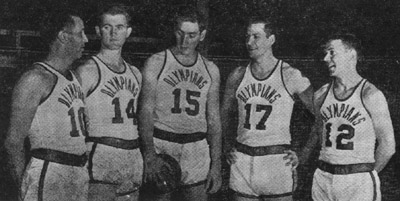
It all revolves around the 1947-'48-'49 Kentucky Wildcats, one of the greatest college basketball teams in history. The team signed as a unit to compete under the name of Indianapolis Olympians in the newly-formed, 17-club National Basketball Association, made up of the finest array of players and teams ever assembled in one league.
The whole idea is daring, not only because they will try to hold their own with the pro veterans, but because the five also own and operate the team.
The bizarre experiment had its beginnings last April when Kentucky fans paid their last respects to the greatest college team ever to represent their University. They staged a "Wildcat Appreciation Day," and thousands turned out to watch the squad that had won almost every trophy it went after during the last three years, ride through the town, each member in his own chauffered convertible, in a mammoth parade.
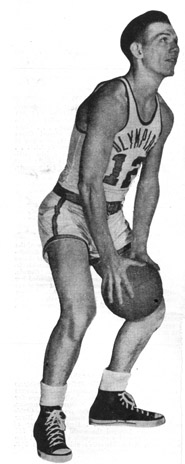
Retiring from collegiate competition were Ralph Beard, twice chosen the most valuable player to perform in Madison Square Garden, and an All-American to boot; Alex Groza, generally conceded to be the best center in college basketball last year and also an All-American; Wah-Wah Jones, another All-American; and Cliff Barker, not publicized like the others and never an All-American, but considered a player's player by those in the know.
The fifth man, who had graduated the year before but was a member of the near-invincible team when it hit its peak in 1947-48 and went to the Olympic games, was Kenny Rollins, who played last season with the Chicago Stags and is still a member of that organization. Taking his place in the Indianapolis quintet is Joe Holland, the squad's number one substitute.
 |
As freshmen, the Kentuckians won the National Invitational Tournament and in 1948, they won the NCAA crown and the collegiate division of the Olympic trials, traveling to Europe as co-competitors with the Phillips Oilers. Last year, the Wildcats were upset in the NIT but had little difficulty repeating their NCAA triumph.
Their five numbered jerseys have been placed in the new $4,000,000 University of Kentucky field house, which probably wouldn't have been built without their great successes.
The boys didn't waste much time basking in their well-earned glory after that parade, but got right on the ball, picking up some ready money while the fans were still enthusing over them. With the help of one J. R. (Babe) Kimbrough, a local newspaperman, they went on a highly successful barnstorming tour of neighboring states.
Kimbrough did a good job of managing and promoting and the five 'Cats cleared a nice piece of change. They liked Kimbrough when he had traveled with them as a representative of a Lexington newspaper and they liked him even more now that they had seen him in action as a businessman. Thus Kimbrough, bald, 40-odd, a shrewd man with a buck and a hard man to cross, began to wield an influence over them that was to contribute mightily toward their entering pro basketball as a unit to represent Indianapolis.
The National Basketball League and the Basketball Association of America at that time were waging a fierce war for college talent, and, of course, the Kentucky boys were prime targets. This Summer, the two leagues merged to form the National Basketball Association and now all is serene, but some lusty swings were taken before that meeting of the minds took place.
Ike Duffey, well-heeled president of the NBL and of the Anderson, Indiana, Packers in that league, was virtually waging war single-handed against the encroaching BAA and doing a fair job of it. He was determined to get the Kentucky Wildcats for his group and, with a meatpacking fortune to back him up, he was prepared to go the limit.
Duffey worked through Kimbrough, and it is reported by Kentucky newspapermen that fast-talking Maurice Podoloff, president of the BAA, was trying to get to the boys by what would seem the most direct route - Coach Adolph Rupp.
But, as it turned out, it wasn't so much a matter of influence as money. Duffey offered them $50,000 and the eventual ownership of the Indianapolis franchise in his league if they would join as a body and play in the Hoosier city. It was an offer that Podoloff, Rupp, or all the BAA club owners put together couldn't match.
The way the "deal" then shaped up, Duffey was to back the club through its first three years, with each of the boys getting a straight $5,000-per-year salary. They were to share the profits, and with them buy out the organization within three years.
 |
At the contract-signing ceremonies, newsmen were shown a check signed by Ike Duffey for $20,000 made out to the new club. And there was a promise of $20,000 more if and when they needed it.
There was one weakness in the setup and the sharp Podoloff spotted it. Alex Groza, the Wildcats' terrific center, was to get no more than an equal share with the rest. Groza, of all the Kentuckians, was a lead-pipe cinch to make the grade as a professional. First of all, he had the physical equipment - a must in a league where most of the better players are six-five or over - and he certainly had the know-how. Judging by the experience of Kenny Rollins, one of Kentucky's top operators in 1947 and 1948 and a captain of the team two years running, there was no guarantee that the team would click in pro ball. Rollins was a second-stringer with the Chicago Stags in the BAA, and they were by no means the top team in the loop. Podoloff was quick to get to Groza and point out that he had made a serious mistake.
The BAA boss told Alex he might have to carry the other four on his shoulders. At least, he'd have to carry one or two, for it was common knowledge that there were boys on the club who couldn't haul the big center's towel out on the floor, to put it politely. And yet, they stood to make as much out of the deal as Groza. On the other hand, if he went on his own he could sign as an individual for at least $10,000 a year and be guaranteed some profit for his season's work.
Podoloff's acquaintance with Groza began as soon as Alex was through with his regular collegiate competition, before he had signed with anybody. It was on a commercial airliner between Seattle, Washington, and New York City. Groza was returning from the NCAA New York City. Groza was returning from the NCAA tourney at Seattle, and Podoloff and Ned Irish, Madison Square Garden impresario, just happened to be on the plane. Groza was on his way to the New York Herald Tribune All Star game and his career with Kentucky had just ended.
After a long conversation, Groza explained that he didn't want to commit himself until he had looked over all his offers, but he did say he would give Podoloff a chance to match the one he chose. At any rate, that's the BAA's version. It wasn't long before Podoloff read in the newspapers of the Kentucky-Indianapolis-Duffey triangle, with Groza in the middle. That seemed to be that.
Later in the Spring, however - neither will admit contacting the other first - Podoloff and Groza met again. By common consent they agreed to meet halfway - at Cincinnati. Groza was to bring the NBL contract he had signed with him so Podoloff could figure out a way to circumvent it. Groza showed up without the contract, saying he couldn't get a copy, which is understandable since it seems to be one of the most protected and concealed documents since the "Purloined Letter." Podoloff signed him anyway as a "jumper," of which the BAA had had many from the NBL. The contract called for a reported $10,000, with a little bonus of "a couple of grand," thrown in, according to a BAA spokesman.
Then Groza returned home and the story broke in the papers. His teammates, along with Kimbrough, Duffey, and one Leo Ferris, owner of the Tri-Cities team, who had been a spokesman and general handyman for Duffey in the transaction, were aghast. They knew full well that they were lost without Groza on the team, and it looked as if Groza had found out. The whole crew took turns talking to Alex and finally persuaded him to return the BAA contract to Podoloff, with the bonus check uncashed. Thus the great experiment was able to go forward. There can be no question that without big Alex, who has been made a vice-president of the firm, it could never have begun. That was the first major crisis to be met - and it was licked.
But the whole thing was washed off the books when the two leagues merged. Podoloff had the last laugh, since the Indianapolis franchise promised to be a money maker for all concerned and he didn't have to foot the bill.
In a move in which Podoloff said, "everybody had to give a little bit," the two warring groups became one, extending from the Atlantic Seaboard to the Rocky Mountains. Podoloff was made president of the newly christened National Basketball Association, Duffey vice-president, and Leo Ferris was named to a board of directors, which included Ned Irish.
It wasn't such a sad blow to Duffey, who had fought the NBL's battles tooth and nail, as many had thought. For one thing, it had practically guaranteed the safety of his investment in the Indianapolis Olympians for at least one year.
The Duffey league had included Anderson, Syracuse, Sheboygan, the Tri-Cities (Moline and Rock Island, Illinois, and Davenport, Iowa), and Denver, not an imposing circuit of cities in which to show the famous ex-Kentucky Wildcats. One time around the league, an excess of losses, and the Olympians would have lost their sheen. There seemed much less risk of financial setbacks in the NBA which includes New York, Minneapolis, Philadelphia, Washington, Chicago, St. Louis, Boston, Baltimore, Rochester, and Ft. Wayne.
Since the new league wouldn't take over the obligation of financing the first days of the Olympians, it was up to Duffey and Ferris to get them organized and, perhaps, get themselves a little off the nut. The battle was over, but somebody had to pick up the pieces.
 |
Thus, an organization meeting was held in Indianapolis in September to get the ball rolling. At a preliminary conference, Kimbrough was elected president and general manager. Beard, Barker, and Groza became vice-presidents, Wallace Jones was named secretary, and Joe Holland, treasurer. The next day, a luncheon was arranged for the business leaders of the town, and Ferris and Duffey tried to sell them some stock in the outfit. Their proposition was this: 30 shares of preferred stock were to be disposed of at $1,000 apiece, no more than two to a customer. The return would be $60 per year per share guaranteed, or the usual six per cent, with an option of the club being able to buy back the shares at any time for $1,160 per share.
After the series of luncheons, Ferris, who by common consent had taken over the job as stock promoter, said they had had "some luck" in their efforts. He indicated he could have sold the $30,000 worth of preferred stock in one piece to a man in Lexington if he had wanted to. When you consider the kind of money there is around Lexington, where as much as $5,000 may be paid for a stud fee without too much eye-batting, it sounds reasonable. He also could have sold the stock piece-meal around that town. But Ferris said he was holding out to spread the stock as much as he could among the business people in the Hoosier city on the theory that "as go the big shots, so goes the town." The stock, according to the best information, was sold, which lets Duffey out to a certain extent. It is thought that both he and Ferris held on to a little preferred stock for themselves.
The boys themselves hold the common, or owning stock, and, after paying off the preferred, will share in the profits. They will all share equally in the purse at the end of the year and, of course, get their regular $5,000 salary. Their payroll is one of the lowest in the league when you consider that George Mikan of the champion Minneapolis Lakers draws nearly $20,000 and several leading players on other teams are in the five-figure bracket.
If one of the boys doesn't hold up in competition, it is understood the others can vote to buy him out. That clause ought to start an argument or two.
Most of the Olympians have apartments in the new Indianapolis development called Meadowbrook, as does Kimbrough. Kimbrough also set himseIf up in a nice little office in the Peoples Bank Building, with the firm name - Indianapolis Olympians, Inc. - on the door.
Ever since the venture started to take shape, there has been considerable speculation as to how well the great Kentucky crew would fare in pro competition. Everyone was sure that Groza would soon become a league standout, but they weren't so certain about the other members of the unit.
Critics agreed that Ralph Beard has the necessary speed and drive and that Wah-Wah Jones always looked like pro material, but a major-league quintet needs a strong bench to survive the tough 67-game NBA schedule.
However, the ex-Wildcats were armed with a few teammates well-schooled in professional basketball. Bruce Hale, a 31-year-old former Santa Clara star, provided an experienced hand in early games. He also gave the Olympians more scoring punch. Floyd Volker, who played his college basketball at Wyoming, is another vet.
From an artistic standpoint, the young Olympians may find the going rough. And, of course, if the losses begin to add up you're apt to get jittery about business matters, especially when you're part-owners.
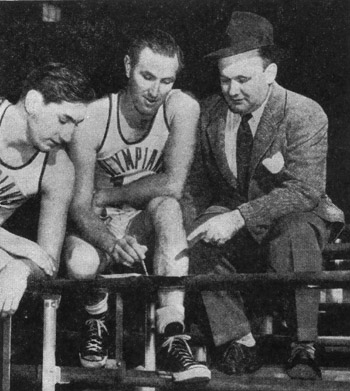
THE boys couldn't afford to hire a top-flight pro coach, so they picked one of the gang to act in that capacity. Cliff Barker, the oldest of the quintet, got the nod. He was considered the "brains and steadying influence" of the aggregation at Lexington, while Beard, Groza, and Jones got the headlines and the trophies. Barker survived a 27,000-foot parachute jump and a subsequent two-year stay in a prisoner-of-war camp, so he's no immature college boy.
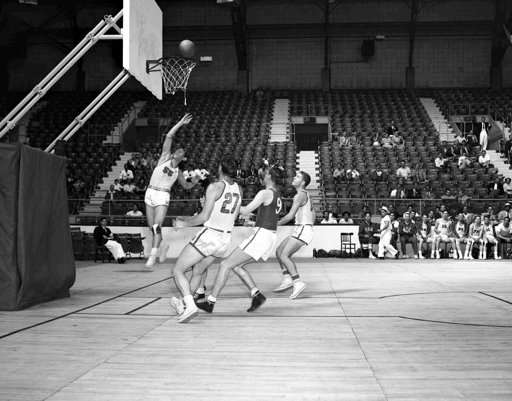
The Olympians were given a tremendous boost in their first and only appearance against the New York Knickerbockers at Madison Square Garden in November. The city's biggest pro hoop crowd - 18,135 - turned out to see the former wonder boys from Kentucky. And Groza and Co. responded with a well-earned 83-79 victory. Alex rolled in 41 points that night.
The win helped Indianapolis get off to a commendable start. The Olympians could only regret that the NBA schedule did not send them back to New York where the fans welcome them as enthusiastically as the home folks.
For better or for worse, then, there is no other way of looking at the prospects of the Indianapolis Olympians but as a long shot. The best guess is that Groza and one or two of the other boys will survive the experiment as professionals and that the league will have to throw them some help of players before another NBA season starts.
But it should be fun to watch, at least in the beginning, for Indianapolis is a great basketball town for a winner and the Kentucky Wildcats have a great reputation - or had.
Return to Kentucky Basketball page, Kentucky articles, statistics, team schedules, team rosters, opponents, players, coaches, opposing coaches, games, assistance or search this site.