
Behind the headlines about "The Toe" and his kid brother Alex is a warm story of an Ohio mill town, a quiet corner travern, and a father called "Big Spot"
Published in Sport Magazine, December 1948, pp. 24-27, 94-95
by Bob Richelson
Lou and Alex Groza of Martins Ferry, Ohio, are two wonderful examples of small-town boys whose love for sports made them national heroes. From their modest, inconspicuous beginnings, they have catapulted to fame on the twin springboards of talent and hard work. Lou made the grade in professional football while Alex go to the top in collegiate basketball.
There's hardly a newspaper sports page in America that hasn't been adorned at least once by a picture of one of the Groza boys. Wherever the two games in which they specialize are played, they are known. But, corny and Hollywoodish though it may sound, they'd both rather chew the rag in their Dad's unpretentious tavern back home than be guests of honor at the most plush banquet in the biggest hotel in America's largest city.
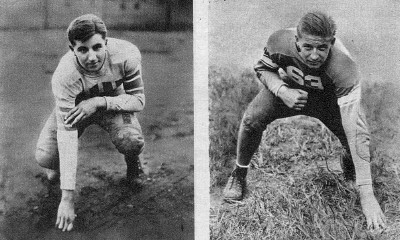 | |
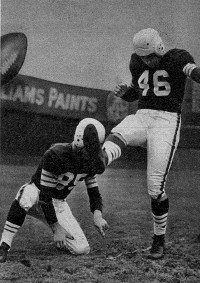
| Oldest of the four Groza boys is John, who was a star in three major sports. | The original place-kicker in the family was Frank, who taught Lou how to do it. |
That's the kind of boys these Grozas are -- Lou who has kicked his way to glory, and Alex, whose fame can truthfully be said to have been gained on the rebound.
While Lou and Alex have gained renown for their respective performances in Cleveland, Ohio and Lexington, Kentucky, with stopovers in other important cities, the actual story of their climb to the top takes place in the heart of the Ohio River valley in the quiet mill town of Martins Ferry. It was from that town of 15,000 located directly across the river from Wheeling, West Virginia, that word of their herculean exploits first rang through the valley loudly enough to attract attention from the outside world.
To most sports fans, there are two Grozas. But everybody in Martins Ferry knows that the story of the Grozas is the story of four brothers. Had they been born 10 years later, it's very likely that older brothers John and Frank would be hired hands on someone's ball club today. As it is, they're content to live quiet lives in the valley, happy in the knowledge that they've played important parts in making their younger brothers famous. For John and Frank, along with their parents, have been the major contributors to the success of Lou and Alex. The coaches who took over from them have merely applied the finishing touches.
The Grozas are as much a part of the valley as the muddy Ohio, which runs on ceaselessly a scant two blocks from their home. They're as much a part of Martins Ferry as the mills, the mines, and the blast furnaces.
Of Hungarian descent, one generation removed from the other side, the Groza boys come from a clan which knows no substitute for hard work and calluses. part of a humble working class, they are simple, down-to-earth people. Yet there is something about their make-up that suggests nobility.
Few athletes are more dearly loved by their home folks than the Grozas in Martins Ferry. To the inhabitants of the town, named after Ebenezer Martin, whose ferryboat aided the Westward migration in the 1830's, they can do no wrong.
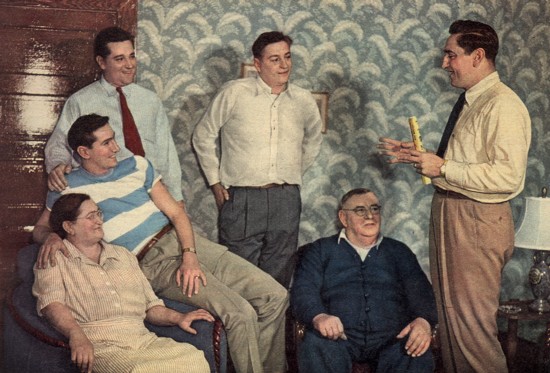 |
| Lou, who is an ardent fisherman, tells about one that got away. Left to right are Ma Groza, Alex, John, Frank, and Pa Groza. A close-knit family, the Groza's see a lot of Lou and Alex, their wandering boys, when they come hom eto enjoy Summer vacations. |
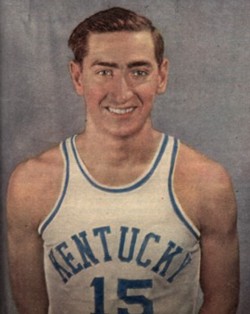 | 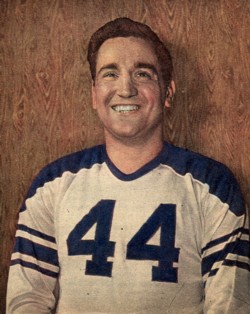 |
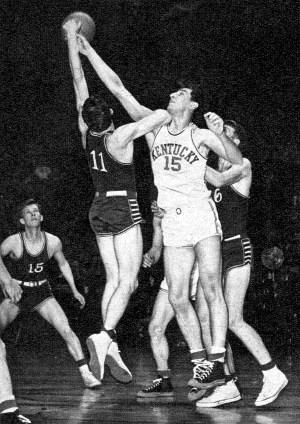
| Alex, center of the powerful University of Kentucky quintet, is the family's leading scholar. He has a B college average. | Lou, tackle and place-kicking specialist of the Cleveland Browns, studied for a degree at Ohio State in off-seasons. |
Known as "The Toe" to the outside world, Lou is called "Chief" by the valley folk. His hometown admirers remember him, not for his booming 50-yard field goals for the Cleveland Browns, but for his inspired play in leading the local high school baskeball team to the state championship in 1942. They remember him not as the leading scorer in the All-America Conference in 1946, but as an awe-inspiring high school kid whose 75-yard kickoffs, some of which sailed over the enemy crossbars, left spectators gaping in astonishment.
 |
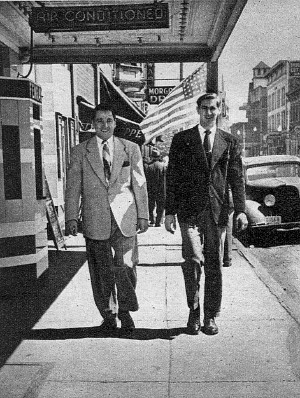 |
Lou and Alex are big-leaguers in more ways than one. Intelligent, courteous an dserious, they can also go along with a gag. Unquestionably the town's most eligible bachelors, they use discretion in their dating. Despite their tender years - Alex is 22, Lou almost 25 - and their rapid rise to stardom, they're completely unaffected. Neither has gone big-time.
To illustrate this point, Alex's buddies like to tell this little story:
It was just after Alex had set a state high school scoring record and Adolph Rupp had snared him fo rhis powerful Kentucky quintet. The idol of the valley at the time, Alex approached a local sportswriter and asked for a particular photograph. It showed a player half his size stealing a rebound from the altitudinous Alex.
"What on earth do you want with that picture?" asked the slightly bewildered writer.
"I want to tack it on my wall at Kentucky," replied the young giant. Then, by way of explanation, he added, "That's just in case I ever get big-headed." Alex never did get big-headed and the same can be said of Lou.
Unlike many prominent athletes, the Grozas asked for and received no special courtesies during the last war. Lou had a chance to enter West Point, but poliely declined. Can you imagine his educated toe teaming up with the already unstoppable Davis-Blanchard-Tucker machine ? Fortunately for the opposing froces, Lou played it straight. As a non-com, he had his anxious moments during the invasions of Leyte and Okinawa. With no attempt at false modesty, Lou doesn't say much about his war experiences. He's glad to forget them.
Drafted late in the war, youthful Alex was not subjected to the real rigors of Army life. Instead, he spent most of his time on the basktball court. Brothers John and Frank also served in the Army in unprivileged capacities, giving the fmaily 100 percent representation.
Alex is the mental, as well as physical, giant of the family. But Lou, whose high school average exceeded 85, never wore a dunce cap. In this respect, as in athletics, they followed in the footsteps of their older brothers.
Lou will graduate from Ohio State next Spring, along with several Cleveland Brown teammates. Alex, a high school honor student who ranked 16th in a class of 177, has a B average at Kentucky, where he is a senior.
Fierce competitors in the heat of battle, the Grozas are perect gentlemen at all times. They seldom swear. They never smoke and they rarely take a drink. For this reason, "Big Spot," as Pop Groza is called, has a soft-drink dispenser in the corner of his tavern. On special occasions, the boys may resort to a beer, but never anything stronger.
The Grozas are Catholics. Alex, vice-president of a campus religious group, is an ardent churchgoer. Lou attends Mass each Sunday, but admits he's not as devout as his younger brother.
On the surface, Lou is the more dignified of the tow. To Alex, as to most college men, an attractive girl is a "slick chick." Alex's favorite slick chick is Mary Louise Belfield, a Martins Ferry girl. If he has a favorite date, Lou is keeping it a secret.
Lou, with his shiny straight teeth, is the more handsome of the two, but Alex is not homely. His nose is large, but certainly not a monstrosity.
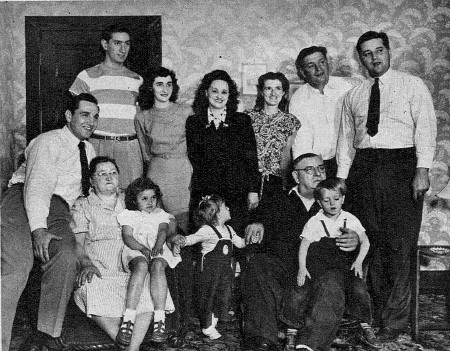 |
| There are four generations of Grozas in Martins Ferry. Three of them are here, only "ringer" being Alex's girl, Mary Louise Belfield, next to him. |
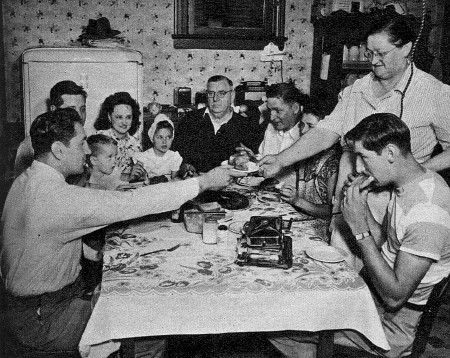 |
| Feeding the Grozas is no easy job, but Ma Groza takes it in stride. Above, she hands Lou a big hunk of his favorite pineapple upside-down cake. |
At Ohio State, Lou is a campus idol along with Brownie teammate Dante Lavelli. Although a fraternity man, Lou prefers the comparative quiet of Hodge Podge Lodge, a boarding house. He rooms with Howard Tiefke, Buckeye varsity center, and Bill Larkin, a friend from Martins Ferry. Lou never played varsity football at college. He went straight from the freshman squad to the professional ranks, with time out in between to don the khaki.
Aex rooms with teammate Dale Barnstable at Kentucky. He is president of the K Club for letter0winners. A jive fan, he prefers Glenn Miller recordings.
If Dr. Gallup were to canvass the people of Martins Ferry on the popularity of the Groza brothers, the response would probably run something like this: "Never knew any boys like them ... Most modest men I ever knew ... Nothing swell-headed abut them ...Never knew one Groza to get the least bit top-heavy ...There must be something wonderful in their ancestry."
All this may sound like a combination Paul Bunyon-Frank Merriwell tale, especially in these days of fixed fights and betting coups, but that's how the Grozas are regarded by those who know them.
The actual story of the Groza family, were it to be presented in play form, would require but on setting. Unless you want to include the uneventful years before Lou and Alex were born, the scene has always been the simple, grey, two-story wooden structure at 701 Main Street, Martins Ferry, a street which, incidentally, isn't the town's main thoroughfare.
It was 25 years ago that "Big Spot" Groza, reformed coal miner and mill hand, invested his life's savings in a corner pool-room., which he later converted into a tavern. He, his wife, and their two sons moved into living quarters directly over the establishment. It's interesting to note that the same pub stands intact today, under Groza management, and the family continues to live in the completely renovated quarters overhead.
 |
 |
The tavern below is not as modern, with its old, oil-soaked flooring, outdated mahongany bar, and square-tiled tables. Enlarged photos of Lou and Alex adorn the walls, which are thirsting for another coat of paint. Trophies won by the boys are on display near the till for the customers to see.
Most of the community's residents are immigrants. A lot of them still speak the language of their native land. If Ma and Pa Groza should decide to speak Hungarian, which they seldom do, only John and Frank would understand them. To Lou and Alex, the conversation would sound like a take-off on Danny Kaye.
Soon after his arrival in Martins Ferry, the cherubic Pa Groza became know as "Big Spot." This wasn't in reference to the establishment he ran, but to a scar on his upper lip, memento of an impact with a mule's hind hoof during his coal-mining days.
The early years at 701 Main Street weren't too eventful. The 220-pound Ma and the 300-pound Pa kept watchful eyes on their sons, disciplined them sternly, and saw to it that the boys did well in their school work. Whenever one of the youngsters engaged in some form of mischief, he was promptly punished. "Big Spot" never held back his over-sized right hand in his efforts to keep his sons in line. And when this hulking giant took his sons over his knee, they knew they'd been tanned.
While Lou (known as the Chief) and Alex were busy with juvenile games, Brother John was carving a brilliant athletic career at the high school. After excelling in each of the three major sports, he went on to play freshman football at West Virginia University. A year later, he transferred to St. Thomas (now Scranton) University, where he became the first Martins Ferry youth to play basketball in Madison Square Garden. Today, he lives with his wife and two children in a neighboring community , and works in a mill.
Frank followed John four years later. By this time, Lou and Alex were old enough to take a keen interest in their brothers' accomplishments. They were proud of brother Frank, who duplicated John's feats in baseball, football and basketball.
The original place-kicker in the family, Frank would often take Lou to nearby Mill Field and teach him the fundamentals of line play. Then, with help from Julius Koteles, an uncle, Frank would drill his husky young brother in the art of placekicking. Lou was a willing student and caught on quickly.
Although colleges weren't offering athletic scholarships with the reckless abandon they show today, Frank was approached by representatives of several institutions. Described by one teacher as "the deepest thinker" of the brothers, he rejected all offers. Instead, he married his childhood sweetheart and played one season of Class D baseball before retiring. He lives with his wife and little girl in a house across the street from "Big Spot's" tavern. He tends bar for his father and co-manages the business affairs.
By the time Frank graduated, the name Groza was known throughout the valley. It became legendary when Lou and Alex, each aspiring to be a civil engineer, entered the musty portals of the local school, an unattractive, two-story brick building situated on the side of a hill.
Lou was built along the lines of his older brothers. He was clean-living and had a fine competitive spirit. Like his brothers he starred in three sports. In his senior year in high school, he became the third Groza to captain the football team. That year (1941) the Purple Riders, as they were known, tied for the state title. They played to a 14-14 deadlock with Toledo Libbey High in the Glass Bowl.
Lou was personally responsible for the victory of Martins Ferry in the state basketball finals in 1941. Always a demon on rebounds, he pulled his team out of an eight-point deficit in the late stages of a tournament game with his superb play off both backboards. He won the contest by sinking a pair of foul shots after the final whistle had been blown. It was in that tournament, incidentally, that Lou met the man who was to play such an important part in his future - Paul Brown, then a high schol football coach at Massillon, Ohio.
An incident that took place within the confines of Martin's Ferry High school gives one an idea of the sort of person Lou was -- and is.
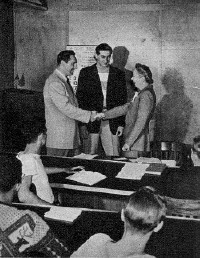
A teacher, who was especially fond of the Chief, left the classroom momentarily one day. When she returned, she was both amazed and dismayed to see the entire class circled about the ordinarily well-behaved and soft-spoken Lou. Disillusioned over the apparent transgression of her model student, the teacher proceeded to give him a complete dressing down. Chief took it without a murmur. Imagine the teacher's humiliation the next day when she learned that Lou had been collecting funds to buy her a birthday present.
That's Lou for you. He has always made people like him. Yet, he's never been one to be pushed around. Once in a hotly contested basketball contest, a rival player took undue liberties with Lou. The latter warned his tormentor, but to no avail. When the game was over, The Chief went after his opponent. A battle royal ensued, with "Big Spot" and brother John sweeping down from the stands like a thundering herd to help Lou, who by this time had the situation well in hand.
Alex followed Lou into high school, ringing down the curtain on the amazing Groza domination of the local sports scene in 1944.
DURING the 1941-'42 basketball season, when the Riders were unsuccessfully defending their state title, Lou and Alex played together for the first, and only, time in their lives.
A comparisonn of their athletic abilitieis in that season alone would be unfair. Lou, a senior was an established performer, the greatest court star in the history of the school Alex was a gangling youth just learning the game. He acquired the necessary polish two years later when he set a state scoring record of 628 points - a mark which still stands.
One summer vacation Alex sprouted three inches and became known as "The Weed," with skinny arms and toothpick legs that bulged at the knees.
Now, a full-fledged Kentucky Colonel, Alex turned down bids from Long Island University, Washington & Jefferson, Ohio State and Michigan State in order to enter the Lexington school. In addition to West Point, Lou was sought by several universities, including Notre Dame.
Lou is still referred to as "The Toe" in professional football, but it is inaccurate to describe him as a specialist who is on the payroll only because of his place-kicking abiity. Paul Brown moved Lou into Ernie Blandi's left-tackle post this Fall, and "The Toe" proved he could block and tackle. Lou set all-time pro records for field goals and points after touchdown in 1946. Both marks were beaten last season, part of which Lou spent on the bench nursing injuries.
Alex has already compiled a list of marks of distinction which makes him one of the biggest names in college basketball today. He was an honorary captain of the All-Ohio high school team, was voted the oustanding service player in the country in 1945, and has been named on a collection of All-America teams in the last two Winters. Last year, he totaled 331 points, six points behind teammate Ralph Beard, and was one of the Wildcat stalwarts who led Kentucky to the NCAA title and into the finals in the Olympic try-outs.
Alex's favorite dish is fried chicken and stuffed cabbage. Lou likes steak and pineapple upside down cake.
Their plans for the future are interesting. Lou hopes he'll eventually be able to go into business for himself, or possibly with Alex. The baby Groza would like to retain his amateur status after he graduates next Spring, which may mean that he'll join the ranks fo the Phillips Oilers. He's openly admitted he'd like to.
But wherever they go, or whatever courses they pursue, Lou and Alex will always carry with them thoughts of the Ohio River, the mines, the mills and the blast furnaces. They'll rememer the school on the side of the hill, their hundreds of friends, and those unforgettable days at Martins Ferry High. Most of all, they'll remeember their family and the quiet corner tavern, under Groza management. For this is a part and parcel of them, their characters, and their lives.
Return to Kentucky Basketball page, Kentucky articles, statistics, team schedules, team rosters, opponents, players, coaches, opposing coaches, games, assistance or search this site.