
Famed for its women, horses, and mint juleps, the Blue Grass State also produces top basketball teams. This year's squad is one of the greatest. They prove that city slickers have no monopoly on the game
Published in Sport Magazine, March 1947, pp. 18-21, 78-79
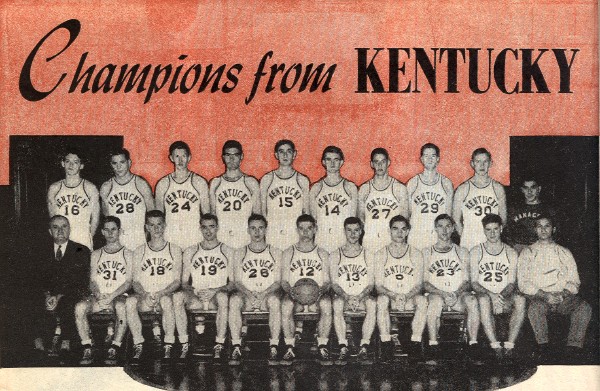 |
| Rupp in a dilemma! The U. of K.'s coach (at left) has an unusual worry -- too many first-string stars ! |
by FRED RUSSELL
THE University of Kentucky Wildcats - like their colorful, ebullient coach, Adolph Rupp - are "just a bunch of small-town boys."
Currently recognized as one of the nation's top college basketball units, the athletes from the Bluegrass are, as affable Adolph says, "just some kids from down the road."
When an aggregation like the 1946-'47 Kentucky squad is collected and put into action, most observers agree privately that this must be the direct result of an intensive recruiting program - with perhaps a few greenbacks shot into the side pocket.
"That's not true for one second !" proclaims Rupp, rebelliously. "The Man in the Brown Suit," The Baron of Basketball" (you may call him by any of his nicknames) is just a country boy himself. He hails from little Halstead, Kansas.
"Look at our starting lineup," Rupp says. "Joe Holland and Jack Tingle have been my starting forwards. Holland is from Benton, Kentucky, a village of about 200 persons. Tingle is from Bedford, Kentucky, and I know there's not more than 250 people in that town.
"I've used three centers this season - Alex Groza, Bob Brannum, and Wah-Wah Jones. Jones is from the biggest town, Harlan, Kentucky, about 8,000. Groza from Martin's Ferry, Ohio. Brannum is from Winfield, Kansas. None of those places is what you could call overpopulated. I guess Ralph Beard, one of our starting guards, is from the biggest town Louisville, but he was raised at nearby Lewisport. Kenny Rollins the other starting guard, is from little Wickcliffe, Kentucky, a community of only 250 even on the Sundays when the traveling elder conducts church services.
"In the face of these facts, how can people accuse me of traveling all over the United States to gather basketball material?"
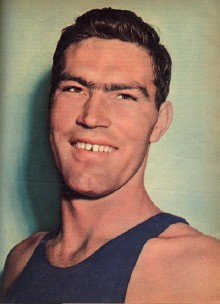 |
| Bob Brannum stands six-five and is a rough-and-tough power player |
Jim Jordan left the University of North Carolina after twice making All-America there as a forward during the war years. Jordan played at North Carolina under the Navy ROTC program. Rupp was watching the final game of the NCAA tournament at Madison Square Garden last Spring when an usher handed him an anonymous note informing him that Jordan planned to leave North Carolina for some other school.
"Well, it's not our policy to encourage players to leave other schools in order to attend Kentucky," Rupp says. "So I just forgot the matter for the time being.
"Then last Spring I was talking about the incident to our trainer, Phil Hudson, who comes from over in North Carolina. He made a few trips home and on one of those visits, he met Jordan, who said he would like to come to Kentucky and play basketball. That's all there was to that story." And Rupp doesn't even smile when he tells it.
But Jordan, twice All-American forward, at N. C., didn't immediately find his place in the Rupp scheme. The well-knit, six-foot three-inch freshman from Chester, West Virginia, was shifted to a guard position where he ran into unexpected difficulties adjusting himself to the Wildcats' fastbreaking style of play.
"The first time I heard about Alex Groza," Rupp will inform you, "was in a clipping cut out of an Ohio newspaper. Groza was then a senior at Martins Ferry, and his hometown paper quoted him as saying he was coming to Kentucky to play basketball. Several weeks later, the high school principal there invited me to speak at their basketball banquet, and that's all the business we've ever talked about."
The brief and innocent transaction has paid enormous dividends. Bob Brannum, Rupp's 1944 All-America pivot man, was relegated to a non-starting role, along with Wah-Wah Jones, All-Southeastern Conference center from last year's championship five.
A giant standing six feet, seven inches and weighing 210, Groza possesses huge hands, the size of country-hams. Unlike most centers who have better than average reach, Groza isn't awkward or top-heavy. He's extremely well-coordinated, and uses his height to its greatest advantage.
In one game this season, Alex managed to get every single rebound from the opponents backboard in the first half in an unplanned exhibition of his agility and aggressiveness. Unlike most pivot men, Groza will drive under the basket for layup shots with as much ease and poise as chunky Ralph Beard, the sensational speed-merchant guardsman. A tireless worker and team performer, Alex's most valuable assets, next to his elongated chassis are his sensitive hands. He's a surgeon with that leather.
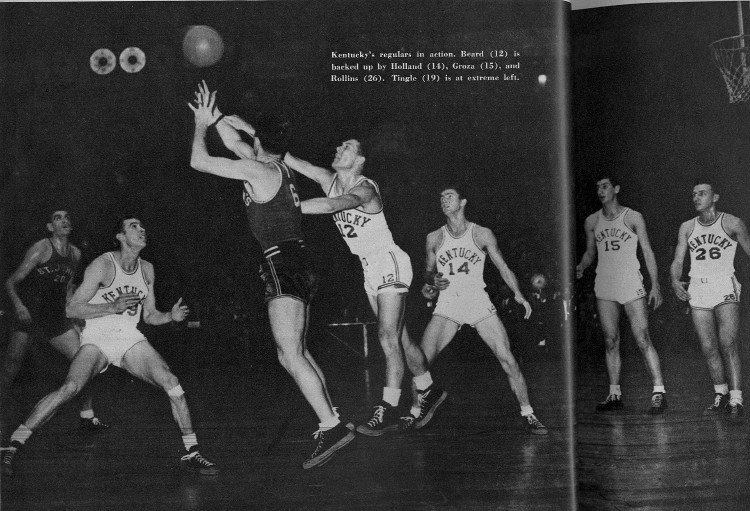 |
| Kentucky's regulars in action. Beard (12) is backed up by Holland (14), Groza (15), and Rollins (26). Tingle (19) is at extreme left. |
BRANNUM, the '44 All-American center, is a big fellow, too, measuring six-five and weighing 205. He's more of a power-player than either Groza or Jones, a rough-and-tough, elbowing battler who can loosen up the opposition's defense. Brannum's greatest forte is his precision timing. On rebounds he always seems to be highest in the air at the exact split-second to grab the ball. And he's rugged enough to come up with the ball in a scramble.
"There's a psychological spot in every game for Groza, Brannum, and Jones, Coach Rupp declared over and over early in the season, obviously hoping to de-emphasize his strange predicament of having too much talent. Another maneuver to preserve harmony was his designation of three "first" teams, the idea being to give each a share in whipping down all rivals. That operated satisfactorily only against the less dangerous foes.
A re-injury to Wah-Wah Jones' ankle served to ease the pressure at center. One of the greatest athletes ever to enroll at Kentucky, and extremely popular on the campus, the quiet lad from feuding Harlan County is a typical Rupp player - a steady, never-tiring, ever-hustling wheelhorse, inspiring in a solid way, conscientious in that he never makes the same mistake twice. An All-Conference end in football, he still considers the hardwood his favorite playground and, but for his injury, it's a referee's tossup that he might have made Groza and Brannum more unhappily familiar with bench-sitting.
Off the floor, the Wildcat squad is just like any group you might find around any college dormitory. They're average. There isn't a Phi Beta Kappa in the crowd, but there are no goons, either. They manage to do all right in the class room. Their academic interest is varied, with some majoring in commerce and some in physical education. All of them adhere to Coach Rupp's advice: "You're only here at Kentucky to do two things - get an education and play basketball. And if you flunk in either one, you have to go home." Rupp is a guy who likes to win.
Perhaps that sounds harsh, but in developing, rather quickly, a winning basketball tradition at Kentucky, Rupp has set a terrific pace. No college town in America is more cage-conscious than Lexington. There was a time when Man O'War and the leading thoroughbred breeding farms in America monopolized visitors' interest, but now, from December to March, even they run second to the famed Wildcats who, since 1930, haven't lost as many as ten games on their home court.
So heavy was the demand for tickets this year that Kentucky had to ration them. Five games were played for students only. The remainder of the schedule, open to the public, could have averaged an attendance of 8,000 but for the limited seating capacity of 3,000. Rupp was the first Southern coach to make basketball a paying sport and construction plans call for a gymnasium seating 12,000 to be built before next season.
Rupp is more eager than ever to continue the production of winning teams. At present, for the first time in his coaching tenure, football is challenging for the spotlight. A campaign to shoo the Wildcats from the gridiron doormat of the Southeastern Conference resulted in the hiring of an able, ambitious young coach in Paul (Bear) Bryant, who in his first season won seven games while losing only three, and has all Lexington talking about championships and Bowl games.
I would welcome a Bowl football team here," Rupp tells the doubters. "Then, when everybody starting asking about our basketball team in January, they wouldn't realize that we had been practicing two months."
Rupp is a "good-humor man." Some of his quotations have become Southern classics. So far as I am aware, no coach of any sport comes up with Biblical quotations as often as Adolph. Once, when drilling a freshman group in fighting for the ball under the basket, he exhorted them: "Beat the other fellow to the charge. Hit hard. Remember, the Bible says, 'It is better to give than to receive'."
"But, Coach," countered one of the players, "I always thought the Bible said: 'Love thine enemies'."
"That's the old version of it," Rupp snapped back. "But the rules committee changed it!"
The 1935 Kentucky team, with big LeRoy Edwards starring, was one of the nation's best. Undefeated, it traveled to New York and lost to unbeaten NYU, 22-23, in the last seconds via a foul called on Edwards for screening. Rupp complained bitterly about the officiating. On his return to Lexington, a newspaperman asked him to explain what happened. "I really don't know," Adolph said. "Riding back yesterday I turned on the radio. A broadcast came on from one of the churches in New York. The minister used as his text, 'He was a Stranger, and They Took Him In.' That's all I know about what happened."
ONE of the few occasions when Rupp has been on the losing end of anything was one evening when he took a 6-foot, 8-inch gorilla-like highschool basketball prospect home for dinner. When the boy sat down at the table, his arms were so long his hands touched the floor. He picked up a splinter in his finger and it required the combined efforts of the household to remove it. The boy was so embarrassed that the next morning he disappeared completely.
As for the present team, Rupp's own description, in his Kansas twang, is the best. "They're just like a covey of quail," he says. "Somebody shoots, and they scatter."
To match the changing personnel in recent years, Kentucky has changed its style of basketball. Before the war, the Wildcats employed set plays, always timed and executed to perfection. Now it's first come, first to shoot the ball. It's a hell-for-leather crew firing from any direction at any time.
"You can't be bashful and keep up with these kids," Rupp says. "If you don't shoot, you just don't get any points; and if you don't get any points, you go scoreless."
And to go scoreless on a Rupp-coached team means simply one thing -- you're retired from playing.
Mulford (Muff) Davis aptly points out Kentucky's change in tactics. A regular in 1943, he returned midway of the 1945 season, and was lost out on the floor. "Every time a guy got the ball, he shot," Muff moaned. "They don't even bother to run plays any more."
KENTUCKY'S guards no longer linger back to play a defensive game. Ralph Beard, the little gum-chewing sophomore who won the National Invitation tourney, 46-45, over Rhode Island State with a last minute free throw, is one of the squad's top scorers: A typical situation will have Groza rebounding the ball from the basket, passing to Beard, and Ralph bursting down the floor with phenomenal speed for a lay-up shot before the defense is even set. Beard, with his dashing, fiery play, is a top favorite with fans, and is rated by many critics as one of the country's finest guards. A "midget" of 5-10 1/2 compared to some of his giant teammates, Beard isn't expected to jump up and shove in a follow shot, but he does - and the Kentucky fans love him for it.
With only two apparent interests, basketball and gum chewing, Beard is a target for ribbing by other players, And by Rupp, too, when he feels a little psychology is needed.
BEARD has his counterpart on the present squad in Al Cummins, from Brooksville, Kentucky, a catlike little hustler himself. In an early-season scrimmage, Cummins caught Beard napping several times, managing to steal the ball and go for easy lay-up shots. Suddenly Rupp stopped practice.
"Cummins is a nice player, isn't he, Ralph?" Rupp asked, sarcastically. "And you know what, Ralph ? Cummins is only a freshman. He'll be here for four long years. Whaddya think about that, Ralph?"
From that moment on: Beard stayed closer to Cummins than his skin.
On another occasion Kentucky was playing a team which had a freshman ace whom Rupp had wanted to enroll. Adolph was anxious for this young man to be boxed and crated. He wanted the boy to look especially bad. Two weeks before the game, Rupp began to drop casual hints to Beard, warning him of how this boy would work on him. "I won't be surprised if he scored as many as 20 points," he concluded, in coachly resignation.
So pumped up was Beard that, in the first half, the singled-out rival didn't get a shot. In the second half, he took one shot and missed it. His scoring for the evening amounted to one free throw.
If ever the Wildcats themselves voted for their most underrated all-round player, it might be Kenny Rollins, not a showman in any sense, but a brilliant clutch come-througher. His finesse in handling the ball, his ever-accurate passing, and his ability to move the ball down the floor make him a key man, perhaps the key man. While not the sensational scoring threat that Beard is, Rollins and Beard form a twosome probably unexcelled in college cage circles for expressing the leather down the floor. They pass it back and forth until across the line, then one will block for the other momentarily and - it's two points.
Rollins played for Kentucky in 1942 and the next season was with the war-famous Great Lakes quintet. Joe Holland is another service veteran who tallied 225 points for the Iowa Seahawks in 1945. Holland is one of Coach Rupp's prime favorites, a player upon whom the master-mind places considerable reliance. A Navy veteran, Joe is twenty-one years old, and a junior.
TINGLE, only senior among the starters, is an unconscious shooter. When he's hot, he's super, but when he's cold, Rupp might as well take him out, which he usually does. Jack is one of those rare marksmen whose shooting is almost on a straight line. He doesn't arch the ball. It goes like a bullet to the backboard, then snaps through the net.
No college team in the nation has the reserve strength Kentucky boasts. Against Texas A. & M., early in the season, the Wildcats built up a tremendous early lead, and Rupp sent in his substitutes, figuring that would hold down the score. What happened ? Jim Line, an unheard-of freshman from Akron, Ohio, shot twelve times and collected eight field goals to capture scoring honors for the night. That's the way it is up and down the line. For every man there's not one capable replacement, but two at least.
"The basketball game I'd rather see than the finals of any championship tournament in the country would be an honest-to-goodness intra-squad scrap between this Kentucky bunch - about eight on a side - for high stakes," remarked one Lexington gym habitue. "Basketball just isn't played any better in college than they play it."
Appetite for action among the reserves is sated to some extent by scrimmages, every day and Sunday, too, when there isn't a game. Rupp has no strict training rules, figuring that a boy able to stand up under this schedue has no explaining to do.
In tournament competition, however, the basketeers receive more careful attention than Whirlaway on Derby Day. They are awakened by a gentle rap on the door and then are served breakfast in bed - half grapefruit, bran flakes, and coffee. The big meal is at noon - medium-rare roast beef, boiled potatoes, green beans, and garden salad. After the afternoon game they are given a two-minute shower, an alcohol rubdown, and then put to bed. When completely relaxed, they are fed a supper of soup, soft-boiled eggs, toast, and coffee before the evening game.
Rupp follows that diet as religiously as the wearing of his brown suit and a personal luck piece - his only superstitions. He sees that the boys at Kentucky get the best in food, equipment, and general care. If they have the physical and mental know-how, he'll take the responsibility of building the teamwork and confidence.
That he has done pretty well is evidenced by the record. After the Wildcats scored their 24th consecutive victory - over a two-year span - at the expense of St. John's of Brooklyn at New York's Madison Square Garden last December, they were roundly complimented by Joe Lapchick, famous St. John's coach. The ex-Original Celtic said, "That's the best college basketball team I have ever seen."
Baron Rupp himself feels he's a pretty good coach. In a recent game he got excited and began yelling information to his boys. Finally the referee tacked a technical foul on him for coaching from the bench. After the game he was asked what he thought of the official's action against him.
"Hell," said Rupp, "my coaching is worth a technical foul any time." That's all, brother.
Return to Kentucky Basketball page, Kentucky articles, statistics, team schedules, team rosters, opponents, players, coaches, opposing coaches, games, assistance or search this site.