
Beard, Jones, Groza and company have left college fame behind and are fortune-hunting with the pros.
Published in Sir! Magazine December, 1949 , pp. 26-27, 70-71.
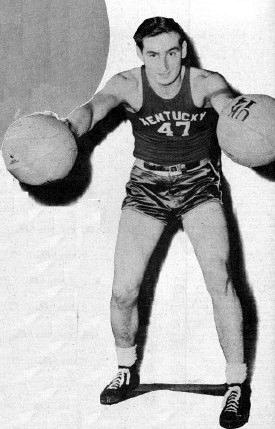 |
| Big Alex Groza, ex-mainstay of the "Wildcat" attack |
More important -- will the same turnstile magnetism which zoomed the Wildcats in their undergrduate days to new attendance records from coast to coast remain with Ralph Beard, Alex Groza and company now that these stars have become entrepreneurs in their own right, as inhabitants of the Butler University fieldhouse under the banner of the Indianapolis Olympians ?
These intriguing questions, which have added fuel to the running argument of whether a championship basketball team from college ranks can topple the best in the pro field, have served to stimulate and increase interest in the play-for-pay game tremendously because of the manner in which the "pore country boys from Old Kaintuck" embarked on this new career.
Virtually every star upon receiving his sheepskin signs up with one pro outfit or another. But leave it to Kentucky's great cagers to do things differently. They decided to join up as a single unit in Indianapolis, a seething metropolis rated as one of the nation's best basketball centers. Never ones to let the blue grass grow under their feet, the Wildcats no longer have as their goal the National Collegiate or National Invitation or Olympic honors. This time their battles involve storming the gates of the cage mint where fortune, not fame, awaits them.
When Beard and Groza, along with Wah-Wah Jones, Cliff Barker and Joe Holland, set themselves up in business they didn't exactly set a precedent. Some 20 years ago the truly great St. John's Wonder Five of Brooklyn, after earning national honors, entered the American Basketball League under the guise of the New York Jewels with Ed Wilde as their promoter.
However, the Kentucky boys went the city slickers from Brooklyn one better. Whereas the Wonder Five, who incidentally duplicated their feats in pro ball as in college competition, received approximately $3,000 each for their year's services, the Olympians from Kentucky are strictly on a share-and-share alike basis with their boss, Babe Kimbrough, and all indications point to each player's getting at least $15,000 for the season's work. Not bad for a bunch of hillbillies, eh wot ?
You may ask: how come ? knowing that the limit for a first year player in the league is $5,000. Well, these Kaintuck boys may come from small country towns and back hills, but when it comes to business acumen they're every bit as shrewd and calculating as Wall Street manipulaters.
Knowing that their presence on the court in a single unit is certain to attract capacity crowds in arenas all over the country - at least the first time around - the Olympians made their demand and got it. What's more, they were even given $50,000 to begin operations with. Whew !
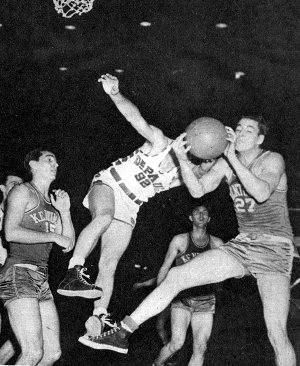 |
| DePaul forward (92) tries to take ball from Jones (27) |
Take, for instance, their own court, the Butler fieldhouse, that can accomodate 14,000 spectators. This gym will turn them away all winter and every time a cash customer drops a buck into the gates, the Olympians are getting their half of it - after taxes are deducted. So they're counting the house and the points, too. Not bad considering the fact that when the great collegians were playing for alma Mater they each received a maximum athletic scholarship of $10 mnthly for expenses, with laundry, books and tuition tossed in for good measure.
Inevitably, the question arises - why are the Olympians so much more money-minded than their colleagues ? And the answer comes right back - these boys are married and some of them are fathers who've been fighting the battle of the budget for a long time and they've finally come to the conclusion they're in basketball not for fun, but for the do-re-me.
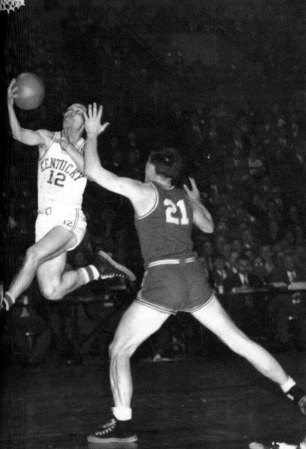 |
| Ralph Beard goes in for a lay-up against Holy Cross |
But what happened ? The boys would stroll around to Coach Adolph Rupp's headquarters about 7:30 and say, "How about another workout, boss ?"
That was the sum and substance of their philosophy. Always read and eager to lern and improve their game, the Wildcats were cage conscious 24 hours a day. But the boys from the Kaintuck hills started to learn lessons out of class -- when they found out that Alma Mater received as much as $12,000 for a single college contest.
Yet success at the gate and success on the court must go hand-in-hand. These all-conquering blitz boys of the boards who could loop the oval through the mesh as no other college team had ever done, face an entirely different proposition in bumping up against the mastadons of the pro field - the fabulous Gorgeous George Mikan, the gigantic Ed Sadowski, the eagle-eyed Joe Fulks, the shifty Max Zaslofsky.
Opinion appears evenly divided among cage observers. some are positive that Kentucky's graduates, with their tremendous drive, speed and vitality, will romp over Chicago, Minneapolis, Rochester and the other N.B.A. rivals. The more cynical experts point out that a tough schedule, involving four games a week will sap the Olympians' strength, create havoc with the reserves and wear down that great fighting spirit.
But don't sell the Indianapolis unit short. They're tough, hardened and ever read to make good. Typical of the gang is Beard, the gum-chewing boy of whom it has been said has ice in his blood. An explosive bundle of energy, who never even stops moving around during time out periods, Beard is the game's whirling dervish.
Determined to become pro basketball's top star despite the fact that he is only five feet 10 inches, Beard had another reason to hit hte headlines. Recently married, Ralph has joined the Boston Braves' baseball organization and he ralizes full well that if he can make good in the hoop-meshing business, it will help him in subsequent dealings as a baseball star because of his gate-appeal.
While Beard does more shooting from outside than any other Olympian, he never makes the mistake of hogging the ball. An expert at stealing it away from the opposition, a key man in the defensive strategy, Ralph is the team's acknowledged sparkplug.
The very opposite of the Beardless-Beard is big Groza, the boy whose job it is to get the points and stop the other team's big men from doing likewise. Possessed with excetionally long arms and uncanny shooting ability under the boards, Groza the Great is inclined to be moody and aloof.
The records show that whenever Groza went on a scoring spree and tied up the opposition as wll, Kentucky invariably came out on top. Against St. Louis int he great Sugar Bowl Classic, Alex was hogtied by Ed Macauley and Kentucky lost. That point bears out the contention that more burden of respnsibility rest on his pwerful sholders than upon any of the others.
The stalwart Wah-Wah Jones could easily be called the most remarkable member of the cast. Rated as Kentucky's greatest all-around athlete, Wah-Wah earned all-America honors as a footballend, as a baseball pitcher and as a basketball guard.
No swifties by any means, Jones makes most of his pints from the corners. His ability to coorinate his six feet and four inches of bone and muscle with Groza, under the boards, gives the Olympians a one-two punch on the offense and defense alike.
Most important of all, Jones is known to be a player's player. A man who comes through in the clutch, Jones is ever a fighter and pacemaker. He breeds confidence in his own team and instills awe in the foe. Barker, oldest of all the players at 28 is the quietest one of the gang, possibly because he spent 16 months in a German prison camp after seeing B-17 gunner service. His role is that of a counselor for his younger mates, a sort of balancing influence.
Possessed with a great pair of hands and able to control the ball better than virtually every player in the land, Cliff is the clever feeder whose tactics invariably ease the strain pt on the others and help them relax n a tight pinch.
The least known member of the squad of ex-Kentucky stars is Joe Holland and that's because he graduated one year ahead of the others. However, Holland long ago proved his merit and worth as a consistent scorer and excellent team worker.
There is no dobut that as the Olympians advance along their pro career, other stars from Kentucky will join their ranks and step into the headlines as pro aces. Jim Line and Dale Barnstable, as well as Jimmy Jordan will someday wear the spangle of the Indianapolis combine. and wouldn't it be funny if the Alma Mater at Louisville (sic) should some day become sort of a farm club for the Indianapolis Olypians ?
Return to Kentucky Basketball page, Kentucky articles, statistics, team schedules, team rosters, opponents, players, coaches, opposing coaches, games, assistance or search this site.