
A little-known but active group of talent scouts has reversed a famed escape route. They 'liberate' Bronx and Brooklyn stars and channel them south
Published in Sports Illustrated Magazine, February 4, 1957, pp. 8-11, 13-14.
by RICHARD J. SCHAAP
This week, as the 1956-57 college basketball season passed the halfway point, the only major unbeaten team left, North Carolina, was ranked first in the nation. Led by Brooklynites Lennie Robsenbluth, Pete Brennan and Joe Quigg, nine of the 12 varsity players were from metropolitan New York. Here is the hitherto untold story of a group of New York athletic "consultants" and the methods they employ to channel many of the best prospects south to Coach Frank McGuire's North Carolina Tarheels.
IN a cramped Bronx apartment not far from the Yankee Stadium, a short, balding gentleman in his 70s dipped a thin hand into his inside coat pocket and pulled out a neat business card. In the center of it was printed his name, William F. Kenney, and in the lower left corner appeared the legend, "Consultant on Outstanding Athletes; Baseball, Basketball, Football, Track and Swimming."
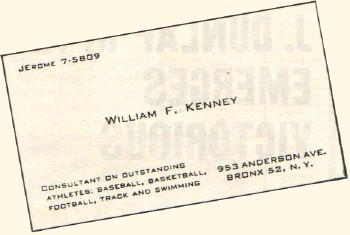 |
| A SCOUT'S CARD plainly states his business, handed to coaches, players or anyone who asks for one. |
"I been at this business longer than anyone else," he said. "Over 30 years, and personally I'm responsible for over a couple hundred boys in college." Among those Kenney claims as satisfied clients: Villanova, Fordham, Manhattan, St. Anselm's of New Hampshire, St. John's of Brooklyn, St. Michael's of Vermont, the U.S. Naval Academy and, more recently, North Carolina. When challenged about his reference to the academy, Kenney bragged that Basketball Coach Ben Carnevale "is one of my closest friends."
Only a week earlier a special-delivery letter from Kenney, delivered in the fresh hours of the morning at a two-story white frame house about 25 miles outside of New York, had dragged a high school basketball coach from bed.
"I just received an urgent request from my good friend Head Coach John W. Bach, Fordham University, for a man over six feet four inches for immediate delivery." Kenney wrote. "He could enter on a full athletic scholarship this Feb. term. He is desperate and has not got a good scouting staff.
"You mentioned in a recent conversation that I had with you during the Xmas holiday about a good ballplayer getting out [of high school this semester ending Jan. 30th 1956. I will recommend him to Coach Bach on your full approval..."
The coach carefully reread the letter, shrugged and staggered back to his bed. By that time he was used to receiving odd requests at all hours from curious men who described themselves as "basketball talent hunters."
With the midseason examination period behind the players, New York's free-lance scouts now are girding for their crucial season of the year. By Kansas standards, where an entire community combined forces to bring Wilt Chamberlain to the Lawrence campus, their free-enterprise methods seem quaintly old-fashioned. An All-State Texas high school football player, used to broken-field running among the blandishments of civic leaders, oil and cattle men, might consider New York's scouts low-pressure and slightly ineffectual. But they are a colorful, fast-speaking and independent lot who enjoy the intimacy of the big talk that surrounds big-time athletics. Generally, they are lone wolves who hang around bandbox high school gymnasiums, looking, and no doubt feeling, like movie versions of swift operators. This is their distinctive New York way, neither better nor worse than recruiting elsewhere in the country and, judging by the results, just as effective. Above all else, they take themselves seriously. The cynics who think that all there is to spotting a basketball player is a yardstick are fair game for their most withering contempt.
"You should use only a yardstick!" Harry Gotkin, a New York garmet manufacturer, counters. "You'll get murdered. It takes good judgement to scout basketball players. The whole business is a rat race."
Gotkin should know. He doesn't possess either Kenney's epistolary or athletic versatility, but around New York he is the uncrowned czar of recruiting. Gotkin sees all and knows all.
A man in his middle 50s, "Uncle Harry" Gotkin stood one night last winter in an antiquated YMCA gymnasium in Flushing, an outlying district of New York. His beefy hands were stuffed into the pockets of his brown overcoat. He needed a shave, and his heavy jowls lent an angry expression to his furrowed face. This was the site of one of the biggest postseason schoolboy tourneys. Jess Brown, the tournament director, bluntly stated its purpose. "It's strictly a showcase for the college scouts. These teams don't play together all the time. They're a bunch of all-stars. Last year, at least 11 boys got scholarships just from this tournament."
Gotkin was flanked by two especially attentive listeners. One was his cousin, Hy Gotkin, who had been captain of St. John's (Brooklyn) University in the early 1940s. The other was white-haired "Buck" Freeman, once coach of the St. John's Wonder Five and now the astute assistant to Basketball Coach Frank McGuire at the University of North Carolina.
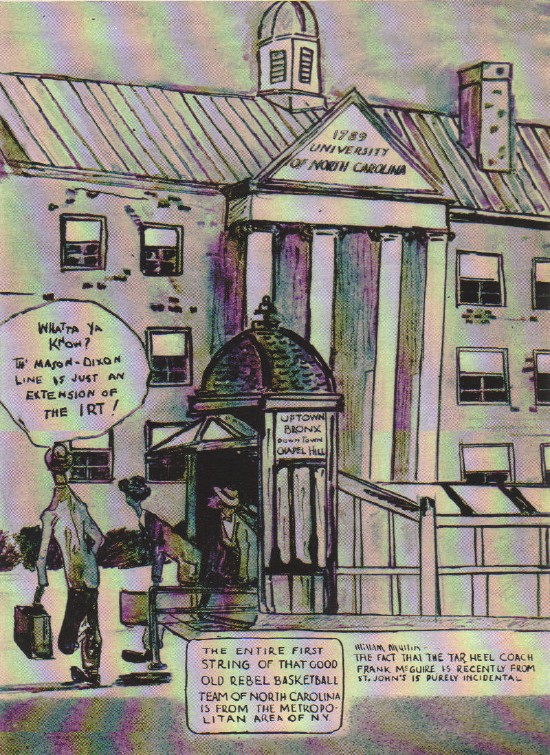 |
| CHAPEL HILL STATION of New York subway is satirized in this copy of a Willard Mullin New York World Telegram and Sun cartoon which hangs in Coach McGuire's office. |
Off to one side, a scouting subordinate of Gotkin's patiently awaited his orders. Suddenly Gotkin pointed to the opposite side of the court at a husky youngster who had been named to the All-New York City high school team. "You tell him Frank McGuire wants to see him," Gotkin barked at his aide. "You fix up an appointment with Frank for tomorrow."
Then Gotkin turned to his cousin Hy and added, "You go talk to that boy later. You tell him all you know about Frank."
Across the court, Gotkin's first emissary was nearing his target. He tapped the boy gently on the shoulder and started to whisper into his ear. The youngster nodded gravely, and in five minutes the interview had ended.
"I told the kid," Gotkin's messenger reported, "that Frank was glad he made up his mind to go to Carolina. I told him, 'Now, listen, Jack. I know you can get a better deal from Louisville or Seton Hall, but take my advice and go to North Carolina. Frank McGuire's been a very good friend of mine for a long time and I know he'll take real good care of you.'"
McGuire, a native New Yorker whose tact and friendly personality have made him a favorite with Broadway regulars, sees nothing surprising in the Yankee infiltration at North Caroina. "I use five or six scholarships each year," he once said. "I make sure the kids receiving them are topnotchers. If they come from New York, well, they come from New York."
Another time, McGuire's explanation was more facetious. "New York is my personal territory," he claimed. "Duke can scout in Philadelphia and North Carolina State can have the whole country. But if anybody wants to move into New York, they need a passport from me."
"McGuires's right," said Gotkin. "North Carolina owns New York now. None of the kids Frank wants get away because I feed them a good line."
A good line is an occupational necessity for a basketball scout, whether he recruits on one of Kentucky's backwoods courts or at an Indiana state tournament. But a slick tongue is most essential in New York, where the competition is fast, tough and expensive.
"New York," Gotkins insists, "is the center of basketball. Sure, there's recruiting going on in Philly and in Indiana. That's small stuff. This is the big town."
There may be a touch of braggadocio in Gotkin's words, but there is also an element of truth. For four decades New York has been among the first two or three truly fertile sources for basketball players in the U.S. The densely populated city is blessed with numerous gyms. More high school talent is available than the major local colleges (NYU, St. John's, St. Frnacis, Hofstra, Seton Hall, Fordham, Manhattan, Iona and Columbia) can or are willing to accomodate. So many outstanding players are available that not even the most ambitious out-of-town college has the time or the facilities to pursue more than a handful.
This is where the free-lance scouts, Gotkins and his contemporaries, come in. Each scout makes it a personal project to know coaches and referees, and especially players, sometimes when they are barely out of grammar school.
John Lee of Yale (SI, Jan. 21), the Ivy League's leading scorer as a sophomore last year, is one player whom several scouts, including Gotkin, spotted in a junior high school gym long before he became a star. The following year Lee was a freshman at Erasmus, which had a good basketball team, even though his home was only a city block from a different high school. Three years later, when Lee, an honor student, decided upon Yale over North Carolina, Gotkin was disconsolate.
But another early prospect did not slip away from Gotkin and North Carolina. Len Rosenbluth, an All-America last year, first caught Gotkin's eye as a high school sophomore. Uncle Harry followed the boy carefully as a junior and senior, nursed him through prep school, and then delivered him in a neat, ready-to-use package to Frank McGuire.
Once a scout ines up a prospect, the procedure is relatively simple. Gotkin's system is typical: "Look, I just speak to a kid. I talk North Carolina to him. I arrange for the kid to see Carolina's campus at Chapel Hill. I see that he meets some players. Somebody takes him over to Raleigh to see North Carolina State's campus with the railroad running through it. That makes up the kid's mind. He sticks with us."
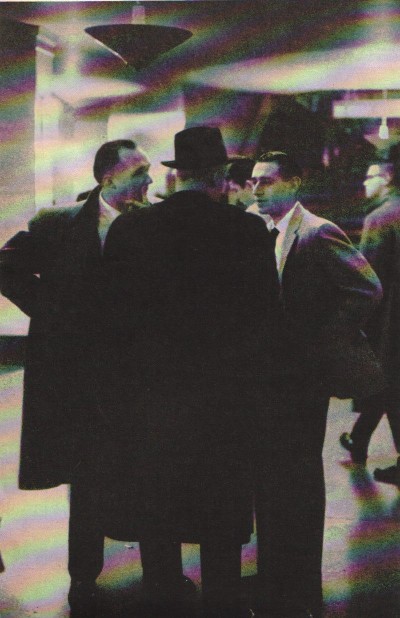 |
| LOBBYING AT GARDEN, North Carolina State Recruiter Howie Garfinkel (at right) talks basketball during intermission. |
With all these colleges bumping heads and wallets in rather narrow confines, there is bound to be friction. Gotkin poses one theory: "There used to be only gentleman sportsmen in this scouting racket. Now there's a lot of bums around."
"Gotkin hates me," said one young recruiter named Howie Garfinkel, "and I hate him."
Garfinkel, verbally at least, is Gotkin's No. 1 competitor. The bitter Dixie feud between North Carolina and North Carolina State is carried on in miniature, but with no less emotion, between Gotkin and Garfinkel.
Of Garfinkel, Gotkin says, "You know what he did? He sent a letter to Frank McGuire telling him that I was no good. Frank didn't even read the letter. He just threw it away."
Of Gotkin, Garfinkel says, "You know what he did? He sent a letter to Everett Case telling him that I was no good. Case didn't even read the letter. He just threw it away."
The rationale for Garfinkel's involvement is somewhat obscure. He claims no personal friendship with Case, the North Carolina State coach. He spent his college years far from Raleigh at Syracuse University, which Garfinkel says he attended on a baseball scholarship, graduating in 1951.
Like most of the talent hunters, Garfinkel claims no basketball proficiency, but derives vicarious pleasure from feats of his proteges. He lives by himself in what he desrbies as "the worst apartment" in New York, but he prefers to discuss recruiting in his parents' impressive Park Avenue suite. Two original paintings hang on one wall, a gigantic color television set nestles comfortably in a corner, a bar backed by a picture mirror extends across one full side of the living room, a Sophie Tucker record album reclines casually on the bar - all a far cry from the outmoded gyms, concrete playgrounds and high school youngsters in dungarees.
"I scout for N.C. State," Garfinkel confides, "but I don't get paid for it. Far as I know, Gotkin's the only scout who gets paid. I don't know why the hell anyone pays him.
"I work for my father's garment company and I spend my own money to scout kids. You must think I'm crazy. I'd think anybody else would be crazy to do it. That's why I don't live at home. My parents can't understand this racket."
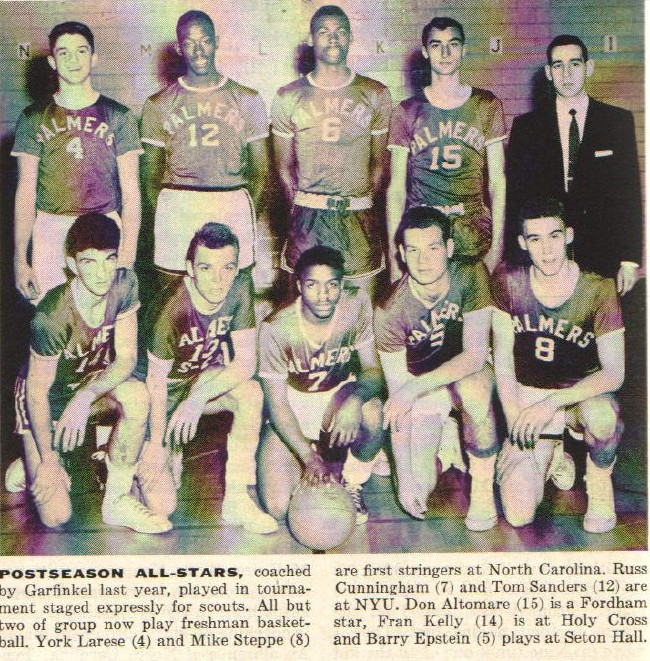
Last year Garfinkel picked out one boy as his prize prospect - a youngster named York Larese. Garfinkel watched over Larese like an expectant hen; he catered tot he boy's every whim. This year Larese is rated a top college freshman player - for McGuire at North Carolina.
"I'll do anything I can," Garfinkel says acidly, "to get even with the Carolina crowd."
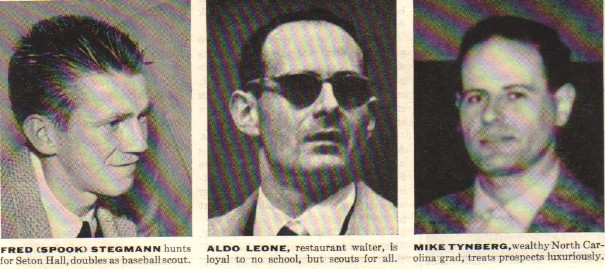
Spook Stegmann is usually at odds with Gotkin too. Stegmann is the only talent hunter who admits frankly that he is looking for financial rewards. "Why not?" he asks. "I spend a little. I get good players for lots of schools. Naturally, I deserve something."
More than any other recruiter, the crew-cut Stegmann seems at home in the gymnasium and playground atmosphere. He wears black "Ivy League" jeans which often pass for charcoal flannels, multicolored sports shirts and an ill-fitting jacket. "I been in this racket five years, since I was 18," Stegmann explained not long ago. "It's a full-time job for me. I scout for Honey Russell [Seton Hall's basketball coach and baseball expert. I do basketball in the winter and baseball in summer."
Stegmann was especialy busy at the Flushing tournament, scouting for both Seton Hall and Providence. First, he rounded up a group of prospects for a Providence tryout session, held on Long Island on April 3. Then he brought the same boys over to New Jersey for a once-over by the Seton Hall powers on April 21. Both schools collared a couple of Stegmann's proteges.
Stegmann is the leading exponent of a familiar recruiting guise. He is a name-dropper of the first order, perhaps to satisfy his own ego, certainly to impress high school prospects. "I know at least 50 college coaches to speak to," he sometimes says. "About six - at Seton Hall, Fordham, Iowa State, NYU, Providence and San Francisco - are personal friends of mine."
Of Gotkin, Stegmann has said, "What does he know about this racket? He don't know the game. I know it." Clutching his copy of Howard Hobson's Scientific Basketball, Stegmann added, "Those other guys toss their own money around. But they don't know nothing about the game."
Gotkin sweepingly dismissed both Garfinkel and Stegmann: "These men are not gentleman sportsmen."
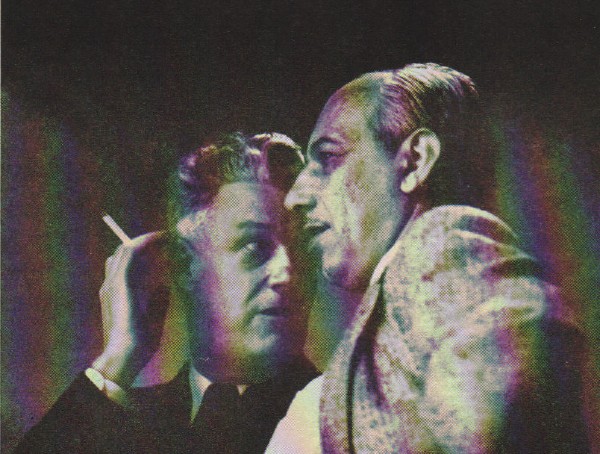 |
| WORKING ON FATHER of 1956-57 all-scholastic star Doug Moe, "Uncle Harry" Gotkin (right) describes for Gunar Moe the advantages in an education at North Carolina. |
While the scouts step on each other's psyches competing for athletes, all is not sweetness and light for the players. "The whole thing is out of hand," Garfinkel sums up. "The kids have been lost sight of."
"At first, it's all real nice," said Tom Sanders, a top prospect last year who is now a freshman at NYU. "Everybody wants to talk to you. They want to see that you have a good time. But then too many people try to give their opinions. You get all balled up. The scouts start demanding answers. After a while you just wish they'd leave you alone and go away."
Not all players are quite so anxious to be left alone. "Sure, I don't like being bothered all the time," one youngster said. "But I wouldn't trade it for anything. Guys take me to lunch. They take me to dinner. They buy me a beer when I want it. And they don't give me a funny look. If I need a couple of bucks for a date, there's always some scout who'll give it to me."
"Most of these scouts are nut," another boy insisted. "They go running around like a gang of little kids, making wild promises and always bragging. Take Spook. He says he had a line on Wilt Chamberlain before Wilt went to Kansas. That's a helluva note. He had a line on Chamberlain like I had a line on Chamberlain! We both saw him play once. The other day Spook said he could get me a scholarship to New York Military Academy. That's great - I already have a scholarship there."
"One advantage which I have over the other scouts," Gotkin confides, "is that I don't pester kids all hours of the night. Garfinkel does that. I let the others do their talking first. Then I move in. Nine times out of 10 the kid winds up where I want him."
Why does Gotkin, who seems to have a comfortable income as a manufacturer of baby bonnets, spend so many spare hours hanging around high school playgrounds and gymnasiums and Madison Square Garden? What keeps him in the recruiting business?
"I do it just for Frank McGuire," is Gotkin's prompt reply. "Frank treats players like they were his own sons. He's a wonderful man."
But Gotkin has other reasons. "My brother Java played at St. John's in 1934," he says. "Later my cousin Hy played at St. John's We had a real athletic family.
"See, I was a good athlete, too. I used to play third base in baseball. Nobody ever hit a grounder past me. I stopped them with my chest. I was tough. I played sandlot football, too. And I fooled around with basketball. But I never got to college. When I was 10 I had to start working to help the family. See, Hy and Java were star athletes in college. I wasn't. Now, I help kids get to college.
"Frank McGuire played with my brother Java at St. John's. Sometimes a player on the other team would make a crack about Java's being Jewish. That's when Frank would step in. He'd say, 'You want to make cracks about him? Make them to me first, and then fight me first.'"
Bill Kenney and Mike Tynberg are two other recruiters who swear by McGuire. While Kenney recruits primarily from his apartment, Tynberg keeps busy in the gymnasiums, usually coaching all-star tournament teams. An alumnus of North Carolina, Tynberg claims that he has been a Tarheel scout since his graduation 16 years ago.
"I'm on the North Carolina payroll," Tynberg says. "So is Uncle Harry. We're listed as assistant coaches." This is news to the treasurer's office at the University of North Carolina. Neither Tynberg nor Gotkin is included in the operating budget. Neither scout is mentioned as a coach, assistant or otherwise, in North Carolina's basketball brochure.
McGuire personally denies that the University of North Carolina pays or even has "official" scouts. "I do my own scouting," he said last week. "All the people in New York are my friends. No one gets paid, but everbody looks out for me. The whole police department looks for players for me. So do the high school coaches and so do the Brothers at the Catholic schools. Even the waterfront looks out for me. No one gets paid. Gotkin doesn't get paid. He looks out for me because he's a friend of mine. Why shouldn't I get the New York players? After all, that's my home territory."
Without actually challenging McGuire, Tynberg is quietly insistent that he does get paid. "This stuff isn't very profitable," he says. "I get paid only abut $40 for every $50 I shell out. It can really cost you. You invite a kid to a game at the Garden. He brings his mother, his father, his sister and his girl friend. You have to take them to dinner and then to the game. You roll up a $65 bill for the night. I get $50 from Carolina. I'm out $15 maybe, but it's worth it."
Tynberg can afford to have a stoic philosophy about the expense. According to Gotkin and Kenney, Tynberg inherited a great sum of money recently and spends as much as he desires on recruiting. In the Flushing tournament, Tynberg entered an all-star team and promised each member of the squad a $50 uniform. He provided 1956 station wagons to transport the players to each game and then threw in two handsome valuable-player trophies which were much admired.
 |
"You don't mind spending the money," Tynberg said, "when the boy ends up at Carolina. But when they go somewhere else, you don't like it at all. These kids are funny. They're not very loyal. Most of them have their hand out all the time."
Gotkin is more philosophical. "You know," he said recently. "I see more than 300 basketball games a year. In the Garden. In high school gyms. Everywhere. I really work hard at it. But people appreciate it. Look at this card I got. See, it says I'm in the Durham (N.C.) Tarheel Club. Pretty soon I'll be in all the Tarheel clubs all over Carolina. I should be. I get the best ballplayers in the country for Frank McGuire.
"You want to know what I did two years ago? That was when Paul Likins who played for Frank at Carolina won a Rhodes scholarship. I like Paul a lot, see. So I gave him a Sherlock Holmes cap and pipe. You know, I wanted him to feel at home in England."
 |
Few scouts are that magnanimous. A truer picture of recruiting motives was shown after the last game of the Flushing tournament. Garinkel, touting North Carolina State, and Alper were sitting with a particularly bright prospect.
"Lookit," Alper asked the player, "what do I care where you go to school? What does it mean to me? Nothing. But I don't want to see you throw four years of your life down the drain."
After a slight pause he added, "Why don't you go to William and Mary or to Richmond? Listen, I spent the happiest four years of my life at William and Mary. No? All right, then, how about Richmond? Tell you what I'll do. I'll put $5,000 in the bank in your name. If Richmond doesn't give you everything they promise, the $5,000 is yours. No strings attached. I'll have my lawyer draw it up in writing. That a deal?"
The prospect laughed. He was used to fabulous offers that were rarely backed up. "Why don't you guys lay off me? I've made up my mind to go to North Carolina. Now, why don't you leave me alone for a while?"
For a moment no one spoke. Then Garfinkel slowly pulled a fountain pen out of his inside pocket, possibly to cross the boy's name off his list of prospects. The boy watched him.
"Hey, that's a nice-looking pen, Howie," the boy said.
"You want it?"
"How does it close?"
"Like this, see. You want it? Take it."
"Thanks, Howie."
"That's O.K., kid. Anything for a basketball player."
Return to Kentucky Basketball page, Kentucky articles, statistics, team schedules, team rosters, opponents, players, coaches, opposing coaches, games, assistance or search this site.