
Published in Sports Illustrated February 1949 , pp. 34-36, 72.
 |
by LARRY SHROPSHIRE
They're blitz boys in basketball those Kentucky wonders romping over college courts of the nation again this year. But they're'no sideshow freaks, no cloud-scraping beanpoles good for little except standing under a basket as goal-tender or shoving a ball through the mesh periodically--no, not these Wildcats. Wait until after the tournaments are over and they issue a challenge in some other sport at your own risk.
Six members of the squad of twelve now campaigning for another national cage championship were regulars on the Kentucky baseball team last spring and will be back there again as soon as the 1949 basketball season has ended. Another member will abruptly drop dribblers and pivots and begin to step over the hurdles for the university's track team. He stands ready also to shoot in the 70's in varsity golf competition. Ten of the twelve have had experience in football and could ring in one soccer-wise sophomore member to provide a worthy exhibition of football on anybody's field.
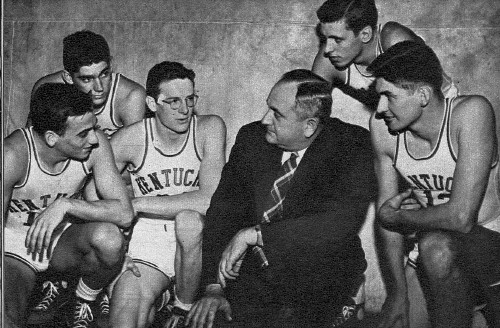
The last transition is easiest of all for Wah-Wah Jones, one of the greatest all-around athletes ever produced in the South. He joined basketball practice late, last fall, having first to complete his fourth straight season as a regular end on the football team. Now Jones and rapid Ralph Beard; the latter a one-man court conflagration who has been on everybody's All-American team the last two seasons, are driving together toward berths for the fourth consecutive year on the AII-Southeastern Conference basketball team, under guidance of the colorful Adolph Rupp, long ago appropriately dubbed The Baron of Basketball. Rupp took his team to undisputed top college rank last season, then onto London last summer to help win the Olympic championships.
The Wildcat basketeers are youngsters who have entered Kentucky direct from high schools mostly located in small towns. If they are cocky over schoolboy laurels when they arrive, they are soon deflated by'the tough competition they must survive to earn a place on one of Rupp's squads. How do they happen to get to Kentucky? Take the example of Johnny Stough, slender bespectacled six-footer from Alabama who looks almost small among his huskier' mates.
"When I was a kid," says Stough (who rhymes with plow), "I used to dream' about playing in Madison Square Garden. While I was in high school, Kentucky was about the only team from the South that ever played in the Garden. So I decided I wanted to go to University of Kentucky."
 |
Two years ago a Hollywood camera crew visited the university and made a movie short of the basketball team -in action. The players saw a "world premiere" in Lexington, but have never missed an opportunity to look at themselves again whenever they have come across the film while traveling to other cities for games.
Rupp related after the Olympic junket that the Wildcats saw the picture billed on a theater marquee in London, and took time out to see it again. Later, when they were treated to a few days in Paris before returning home, they found a movie in that city also showing the film. Again all went in and sat through the picture another time-even though the dialogue was in French. This shows, thinks The Baron, they're "still a' bunch of country kids," possibly fully aware and properly proud of their accomplishments, but still sufficiently modest and unspoiled to be thrilled by seeing themselves in motion pictures.
Typical of the gang in modesty is stubby-haired Ralph Beard, flashiest of the lot and the most publicized. He takes a lot of ribbing from teammates and his coach about his clippings, of which he has collected great boxfuls - thanks in part to New York writers who went into great ecstasies and dusted off choice adjectives after rapid Ralph in a sensational performance tallied 23 points against the Phillips Oilers in the finals of the Olympic trials (compared with 20 by seven-foot Bob Kurland).
Beard is the Fireball Feeney of the outfit, a nervous, explosive, driving ballhawk, never whipped and apparently never exhausted -- at least never run down to the point that he quits whirling among bigger opponents or drops the chomp-meter under 120 r.p.m. as he handles his big wad of chewing gum. Fairly obsessed. with basketball, this Louisville boy is driven by a burning ambition to be the best in the game and by a fierce determination to carry through college days and into professional ranks the high rating he achieved as a freshman.
Along with rapid-fire chewing and the grimaces of his fighting face when the' action is hot, Beard is marked by a habit, whenever there's a pause in play, of lifting first one knee and then the other to balance on one foot while tugging violently at his socks. With fast starts and stops and whirling pivots, he literally races out of both socks and shoes, and has to keep grabbing to keep the socks pulled tight over his heels.
The little All-America shoots with either hand, and from almost any position, and hits a high percentage of shots despite his fast and furious bombardment. While he shoots more than any of the other Wildcats, he's not hogging the ball. He intercepts more enemy passes, steals the ball from their hands and breaks for the basket ahead of mates and rivals alike, and that, plus the fact that he's the key man in speed in Rupp's effective guard offense, puts him in shooting range faster and more often.
Yet the little blitzer, who always uses "sir" and "mister," even when talking with writers and radiomen he has known for years, rates with all of them as an honest unspoiled kid, unsophisticated. and unaffected. He enthusiastically accepts any invitation, from small church group to neighborhood club, to "sit around and just talk basketball" but no speeches, please.
"Omigosh, I-I-I couldn't make a speech," he protests in his sputter-stutter distinctive manner of talking.
As a matter of fact it is virtually impossible to get any of the Wildcats to attempt oratory. They'll jaw with a bunch of kids, a grade-school gym class or a playground group, talking for hours about basketball and other sports, but it's a bashful "No, I just couldn't," when requests come for more formal addresses.
Only exception in this respect is tall. Alex Groza, AlI-America center and winner of the outstanding player award in the N.C.A.A. tournament last year. The six-foot-seven pivotman, a brother of Lou (The Toe) Groza, place-kicking specialist of the professional football Cleveland Browns, has had pushed onto him the job of unofficial spokesman for the Kentucky team. It's become his duty to make the squad's response at student pep rallies and to speak from train steps at all spots where crowds gather in Kentucky to cheer the Wildcats as they travel to and from engagements.
There's no star among stars on the championship squad, however. Off the court they are close buddies, and most of those who live in dormitories have teamed up as roommates. They have no leader other than the team captain. The last two seasons they elected Kenny Rollins, a Navy veteran from the hamlet of Wickliffe in Western Kentucky, as their captain, and he was the leader in combat, a steadying influence throughout hard campaigns. Rollins was graduated last summer and has entered professional basketball with the Chicago Stags, but his departure didn't leave the squad without seasoned performers.
 |
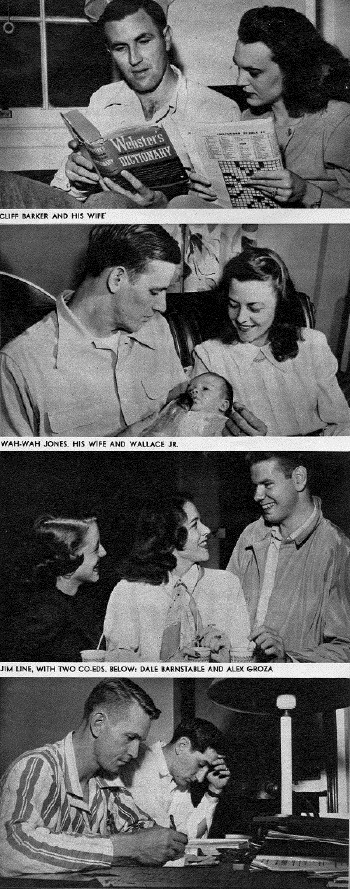
Oldest of the four seniors is Cliff Barker, now twenty-seven, putting in his third season as a regular since his five years and his own support for even longer, he is a sort of counselor for his younger mates, a balance wheel.
Known best for a great pair of hands and remarkable ball-handling, Cliff has oh-ed and ah-ed fans all over the Eastern half of the United States with his palming of the big sphere as if it were a tennis ball, and with his sharp passing, sometimes behind his back or over a shoulder or between his legs, but rarely off target. Seldom the top man in scoring, he is an accurate and clever feeder who deceptively whips the ball to a mate suddenly breaking into position for an easy goal. And his antics on court usually serve to break tension, ease the strain and relax a taut ball club.
Another who helps keep the squad from tightening is Al Groza, although he's a deadly serious operator from the opening tip in a game. Inclined to be moody, and much more mature than during the portion of one season he spent at Kentucky before serving a year in the Army, the big boy from the little town of Martins Ferry, Ohio, is at his lightest and best when the squad is traveling-chattering, kidding, joking. On the campus Groza (the name goes with Rosa) appears to carry himself aloof, but he responds as quickly as the next to attention from schoolmates. He takes his duties conscientiously as spokesman for the team, and his personal popularity is attested by his election last year to presidency of the K Club, organization of varsity lettermen -- those who know him best.
Big AI, although the squad's leading scorer the last two seasons, is a team player all the way. At the pivot spot, surprisingly agile for a fellow of his size, he is a sharp ball-handler, feeding the leather to fast-breaking mates whizzing by on either side, his passes accurate and quick but "soft" and easy to handle for those driving in for lay-ups. Not a brilliant marksman from out on the floor and boasting no tricky hook shot of fatal accuracy in the fashion of a few other outstanding centers, Groza gets in his best scoring work as a tip-in rebounder under the hoop. There he's a hard man to bump out of position or to outjump. At either end he is leaping and reaching until the ball is batted into the netting or safely into the hands of a teammate.
Almost the antithesis of darting, dashing Ralph Beard is the stalwart Wah-Wah Jones, who entered the university from Harlan, in the Eastern Kentucky coal fields, preceded by a great and glowing reputation gained as a high school athlete. Wah-Wah, nicknamed as a kid by a baby sister's attempts to say Wallace, was rated one of Kentucky's greatest schoolboy stars who almost alone made championship contenders of the football and basketball teams on which he had played. In high school he twice tallied more than 800 points a season in basketball, and for four seasons at Harlan he had an aggregate of 2,398 points, called a national high school scoring record.
Less then a month after he arrived on the Kentucky campus as a freshman he had a job as regular end on the football team. He stayed there four seasons. Chosen on numerous all-opponent teams and given many votes each year in All-Southeastern Conference balloting, Jones might have won All-America honors in football if he had concentrated on it and if he had not been on the sidelines the last part of his junior season with a foot injury.
The injury and an emergency appendectomy, which became necessary about the same time, gave him a late start in basketball last season, but in the latter half of the campaign he was again one of the most effective performers on the Rupp squad. Not a swiftie by any gauge, Jones gets most of his points with a deadly set shot from the comers and along the sidelines at greater range, plus a big share of tip-ins. Working well with Groza in rebounding grabs off both back boards, he coems out of any scramble with the ball more times than not.
 |
Kenny 'Rollins' departure from the championship quintet of last, year left a big gap to be filled, but Rupp had good experienced talent to battle for the privilege of appearing in the lineup along with Jones, Barker, Groza and Beard.
He selected three juniors, all more or less seasoned in collegiate play, and five promising sophomores to round out his squad of twelve-the smallest squad, incidentally, that Rupp has ever taken into a campaign and possibly the smallest representing any college competing in big-time basketball.
In the forefront is Dale Barnstable, a lanky, six-three sharpshooter from Antioch, Ill., who works at both guard and forward and was in the starting lineup a number of times last season. Jim Line, a particularly tough offensive operator, is a scholastic star (second in his high school graduating class of 250 back in Akron, Ohio; three terms an all-A student in a mechanical engineering course at Kentucky, and a southpaw with amazing accuracy on his unusual one-handed push shot. Sparkling defensive. skill is supplied by Stough, lithe Alabama blond, a Kentucky regular as a freshman before he left school for military service.
Leading the sophomore contingent is cocky, confident, nineteen-year-old Walt Hirsch, a growing, six-three sniper from Dayton, Ohio, who can wheel at forward or shift to the pivot to relieve Groza,
Other sophs are Roger Day, six-two, from Frostburg, Md., also a school-boy star in soccer (his high school didn't have football); Bob Henne, six-one, from Bremen, Ind., and two homegrown Kentuckians-Garland (Spec) Townes, a solid six-footer from Hazard, and bespectacled Joe Hall, slim six-footer who was a basketball and football player at Cynthiana High. Hall was brought up from last season's reserve squad; the others all saw some measure of duty with the varsity last year as freshmen.
Stough, who hit .365 in fair company in semi-pro baseball last summer in Georgia, will lead the shift to the diamond when the basketball season ends. A short-stop, he teams at the keystone with Beard, vho at Louisville Male High School participated in football, baseball and track as well as basketball.
Walt Hirsch is a first baseman and left-handed pitcher. Cliff Barker pitches and plays the outfield and is the team's top slugger. Henne has outfield duty, and Jones, righthanded pitcher of the Kentucky nine the last two springs despite relatively limited- experience, will be back on the mound.
All the boys, however, will have shot a lot more "buckets" for The Baron this year before turning to other sports.
Return to Kentucky Basketball page, Kentucky articles, statistics, team schedules, team rosters, opponents, players, coaches, opposing coaches, games, assistance or search this site.