
Published in Scholastic Coach December 1951, pg. 7, 41.
By Adolph Rupp
DURING the past five years, the fast break has provoked a lot of controversy among the coaching fraternity. At one time, it represented the chief scoring threat and practically the only offensive maneuver that most teams had. Then came the era of the slower, or deliberate, type offense. At times this game became so mechanical that the opportunity to fast break never was exploited.
The fast break became practically an obsolete weapon. But, like Lazarus, it has arisen from the dead. And today the fast break is easily the most popular attacking pattern in the game. Thanks tot he enormously accelerated tempo of play, scoring has increased tremendously.
The advocates of the fast break claim that it is a desirable weapon because basketball is essentially a game of action and people like that type of play. There are three schools of thought on this.
First, there are those who contend that the more deliberate the offense, the sounder it is. Their reasoning is simple. They point out that the fast break tends to promote ball-handling errors and militates against careful planning of the attack.
Another school of thought maintains that the fast break is the easiest way to score and should be employed whenever the opportunity presents itself. Some teams, of course, depend entirely upon the fast break; and when it fails they mill around until a shot can be obtained.
A third school believes that an ideal mixture of the two - fast break and deliberate - produces the best results. In other words, if you have a good fast break opportunity, use it. But, if a good scoring chance doesn't present itself, don't throw the ball away carelessly; bring it back out again and go into a deliberate pattern of play. That's the way we operate at Kentucky.
In teaching the fast break, don't become discourages if at first looks ragged and disorganized. Once the players learn exactly what's expected of them, the break will take definite shape. It will develop into a potent beautiful-to-wach attack.
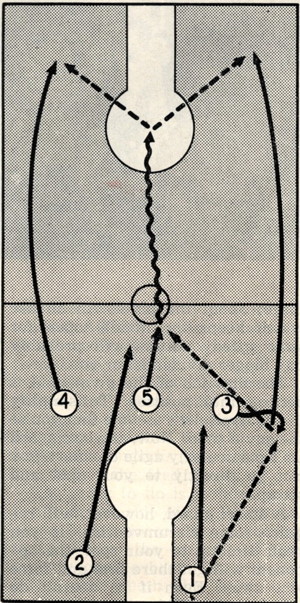
Diag. 1 shows how the fast break may be worked off a zone defense. Let's assume in this case that it's a 3-2 zone. Suppose the shot has been taken by the opponents and that player 1 has taken the ball off the board.
It is now up to the three players in the front line to carefully check to see where the outlet pass will go. If possible, we get the pass to the center man and let him advance the ball from there by means of a dribble.
However, if we cannot get the ball to the center man, we like to have the men go to the sidelines, receive the pass, and work it to the center man as fast as possible. In this particular illustration (Diag. 1), the ball is thrown from 1 to 3, who turns and passes to the center man, 5, for the break.
 | 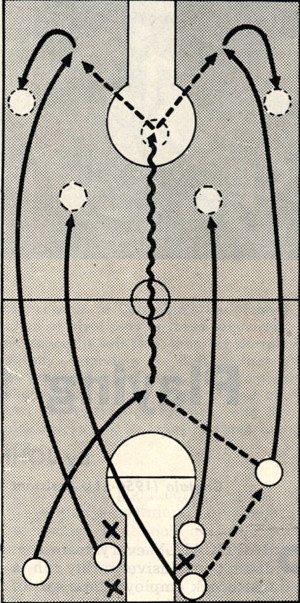 |
Diag. 2 outlines the fast break from a defensive setup for a free throw. The same pattern prevails whether the toss is made or missed.
Again we try to get the ball out to the side and then bring it to the center.
Should the fast break prove fruitless, we bring the ball out and set up in the pattern we use for all our set plays, with the two guards out and the big center near the pivot line in our single-post offense.
Note, in our basic setup for a free throw, that we keep all five men fairly close to the basket area. Some coaches prefer to keep at least one player farther up-court to offer a greater scoring threat once possession is obtained. We like to line up as shown because we believe it better enables our out-men to pick up loose balls for positive ball-control.
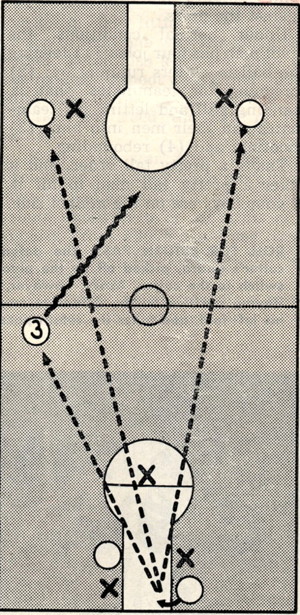 |
By dropping player 3 almost as far out as the center line, you'll tend to worry the free thrower inasmuch as he'll be forced to get back to cover his man. Once the pass gets out to 3, he'll be in excellent position to dribble toward the basket and force a three-on-two situation. However, many teams prefer to throw the length of the floor to one of the two down-court men.
As you see, it's necessary to keep two defensive men back in this situation. Should the opponents try to defend by putting one man on 3 and the other between the two down-court players, you can use one of the latter as the outlet man; this will immediately give you a two-on-one situation.
Return to Kentucky Basketball page, Kentucky articles, statistics, team schedules, team rosters, opponents, players, coaches, opposing coaches, games, assistance or search this site.