
Published in Scholastic Coach November 1950, pg. 8-9, 60.
By Adolph Rupp
MOST modern attacking systems make extensive use of one or two pivot men, and "playing the pivot" has become one of the crowning arts of the game.
Wherever you find a Mikan, Kurland, Groza, Schnittker, Arizin, or Schayes on the pivot line, you will invariably find a winning team.
The pivot man has four duties: (1) feeding the ball to cutters, (2) screening, (3) shooting, and (4) recovering rebounds. This is a tall order, and it usually takes a tall man to fill it. That's why the tallest man on the team, the center, is usually given this assignment.
While height is a vital prerequisite, it isn't everything, however. A pivot man must have other attributes - good hands, maneuverability, aggressiveness, coolness, intelligence, and strength.
The ideal type is a boy 6-5 or better who weighs approximately 200 pounds. The reason we want weight is for stability. We don't want the boy easily moved away from the basket either on offense or defense.
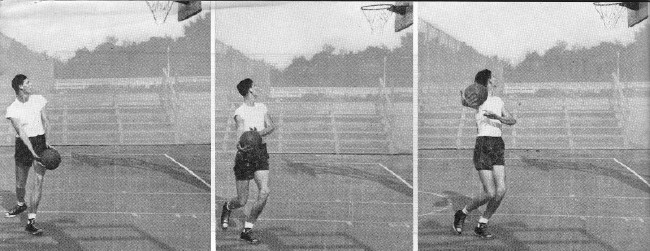 |
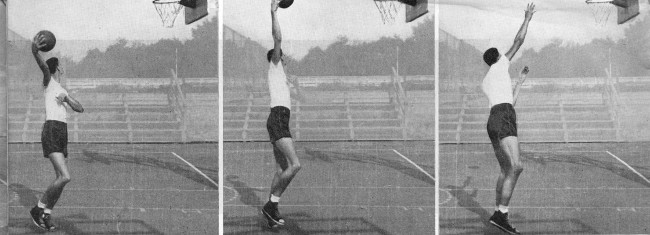
| HOOK BY BILL SPIVEY - Kentucky's 7-foot center, while not a paragon of grace, most certainly is not a "goon." He can run, move facilely, and handle the ball nicely. Though primarily a feeder, he can shoot whenever necessary. The above sequence shows him tossing up a hook - a type of shot which Coach Rupp encourages his big men to master. Spivey steps out with his left foot, brings the ball far back, and hooks it up with a straight arm. The ball is perfectly protected by the body and the extended arm, and is released way up overhead. The shot is practically impossible to block. |
 |
The mechanics of playing the pivot vary. I would say that a pivot man should adapt himself to the defense that has been set up against him. In some games, his guard will not give him much trouble. In that case, he may set up in front of the free-throw line and handle the ball without interference.
However, most defensive men will play him strongly to the side or out in front of him (unless the pivot sets up at least 12 feet from the basket). The front- or side-playing guard poses a problem. How is the pivot man to receive the passes from outside?
Intelligence and proper footwork is the answer. The pivot man may be able to step in front of his guard and cut in to meet the pass. Or he may set up under the basket, then cut out and toward the side to meet the ball.
When a great deal of opposition is met, we tell our pivot man to time his move so that he arrives at or slightly in front of the free-throw line, with the defensive man to the side or rear.
No good defensive man will dare play in front of the pivot at the free-throw line. He would leave himself wide open for a floating pass under the hoop.
We believe that the important thing is to get the ball to the pivot just as he arrives at his position. In other words, it is useless for a pivot man to fight his way into position, establish an excellent post, then not get the ball.
If the ball is not passed at precisely the right time, the guard will be able to maneuver into a position to start bothering the pivot man again. You will then have exactly the same situation which you tried to counter by having the pivot man move back to the end line and then come out. By synchronizing the passes with the pivot's movements, you can greatly expedite his play.
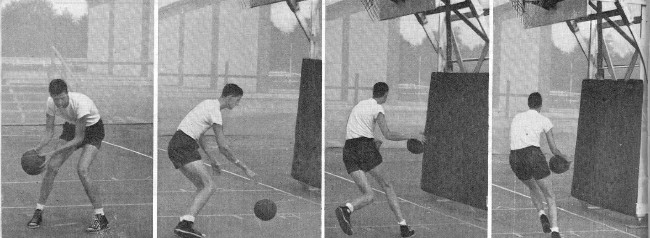 |
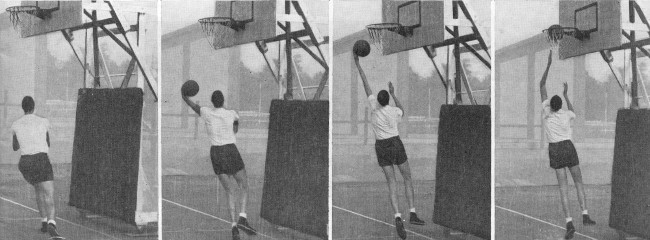
| DRIBBLE AND LAY-UP - When pressed closely from behind on the pivot line, Spivey often makes effective use of this weapon. He fakes to the right and reverses with a pivot off his left foot. He takes a single dribble as his right leg comes around, then, as the right foot hits the floor, takes a long step with his left foot. He switches the ball to his left hand and curls up the lay-up as his body comes forward. This is a particularly fine stunt for a big man who can cover all this ground with a single step. |
 |
Sometimes it may be necessary for the pivot man to move down the side of the floor, reverse his man, and go to the free-throw line. It is impossible to establish a definite pattern for this. Every defensive man plays differently, and your pivot must play to his weaknesses. These weaknesses will best tell him how to establish his position.
A good pivot man should also be light on his feet. He should be able to control both boards, tapping in rebounds on the offensive board and taking the ball off the defensive board and passing it out quickly and accurately to fast-breaking teammates.
A keen sense of judgment is exceptionally valuable in pivot play. The boy should know when to pass and when to withhold the ball, when to reverse and go in for the basket and when to step out for a shot.
There are various types of basic stances. Some men like to stand with their feet together, legs straight, body slightly bent, head up, and arms out. This presents an extremely good target for the passer, and also gives the pivot man protection, since the guard will not be able to reach the ball as easily as he could if the pivot were crouched.
Some players prefer to keep one foot ahead of the other, bend over as far as possible, and reach for the ball. In the former position, the pivot is usually fed with a high pass. In the latter, a floor bounce is used.
When feeding the pivot from in front, we like to employ a floor bounce. It is seldom deflected or intercepted. From the side of the floor, we use a quick baseball pass or a one-handed underhand pass.
Our pivot man stands with his arms outstretched and his hands presenting a target. Upon receiving the ball, he can thus pass quickly and accurately with a slight wrist flip.
If he does not pass immediately, he should bring the ball directly in front of his body. Then, as he sees a teammate cutting for the basket, he should use a one-handed underhand pass or a floor bounce to get the ball to him.
At Kentucky, we like to play a mechanical game. We attempt to free a man by a screen or a series of screens. By running through our plays thousands of times a season, our pivot man knows exactly when and to whom to pass.
We instruct our boys never to feed the ball to the pivot unless they are ready to cut off him. I tell them, "Don't worry the pivot man with the ball unless you see that it is to our advantage." In short, don't feed the pivot unless something definite is to develop.
If the pivot is unable to pass the ball to a man cutting by, he has two other options: (1) a pass out so that the play can be reorganized and run again, or (2) try to score.
Essentially, however, our pivot man is a feeder. But we also want him to be a scoring threat. He needs this versatility to keep the defense honest.
Our emphasis on the essentiality of feeding had an amusing repercussion some years ago. In our first several games, our pivot man scored only a few points. It seemed peculiar to have a big boy who was not getting his share of points. We consulted our shot chart and found that he was taking only three or four shots a game, and that his baskets were being scored only on tip-ins.
After discussing this with him, I advised him to go to the side and practice a lot of jump shots, hook shots, and step in and out shots. I told him, "You are going to have to shoot more in a game." He replied, "I am essentially a feeder." After we explained that this was exactly what we wanted but that he would have to develop a shot to increase his versatility, he not only became the leading scorer on the team but wound up on the AllAmerican for two straight years. (Ed note: This must be Alex Groza to whom Rupp is referring.)
In shooting, our pivot man has the option of taking a dribble to the weak side of his guard and using a lay-up or he may employ a slide dribble to score. That is, he may go back to the basket and instead of taking a one-step pivot jump shot, he may slide both feet and then take off with the foot nearer the basket.
He may also employ a jump shot by leaping in the air, turning, and letting go with both hands; or he may take a dribble to one side and take a one-handed or two-handed shot from there. The shot he takes is again determined by the way his man plays him.
Summing up, then, a good pivot man should be cool under fire, aggressive, and have a keen sense of judgment and should be able to handle the ball under pressure.
We like to think that as the pivot man goes, so goes the team.
Return to Kentucky Basketball page, Kentucky articles, statistics, team schedules, team rosters, opponents, players, coaches, opposing coaches, games, assistance or search this site.