
Our sports editor moderates the year's hottest discussion of big-time college basketball and its problems
Published in Saturday Evening Post Magazine, January 20, 1962, pp. 44-47
by FRANK GARDNER and ADOLPH RUPP with Harry T. Paxton
In the sports world there sometimes are deep-seated controversies that go beyond the question of who is going to win tomorrow's game. So it is at present in big-time college basketball.
During 1961, for the second time in ten years, it was revealed that some of the players on major-college teams had been taking money from gambling fixers to rig the scores of games. Was this just a case of there being a few rotten apples in the barrel - a passing phase in the growth of the sport? Or did it signify that the whole underpinning of the game is shaky and that the big-time basketball schools are operating on an unhealthy basis?
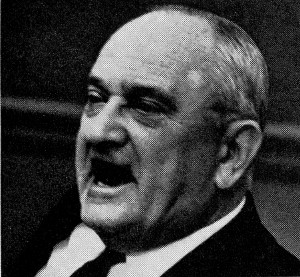 |
| Coach Rupp of Kentucky |
Sixty-year-old Adolph Rupp is home-spun, shrewd and forceful. A native of Kansas, he has become a favorite adopted son of Kentucky. In the past thirty-one years Kentucky under Rupp has won nearly 85 percent of its basketball games - 645 out of 767. His teams have taken nineteen Southeastern Conference titles, four N.C.A.A. tournament championships and one National Invitation Tournament crown. Several of his players were involved in the 1951 basketball scandals, but no suspicion was attached to any Kentucky boys during the 1961 "fix" revelations, in which more than thirty players from two dozen schools were implicated in varying degrees.
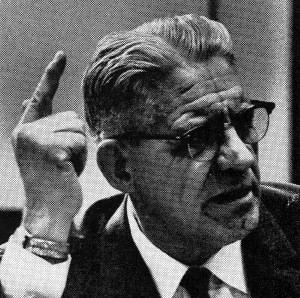 |
| N.C.A.A. watchdog Gardner |
These are the men The Post brought together to state the opposing viewpoints on big-time college basketball. The procedures for the debate were simple. Each man in turn delivered an opening statement, a rebuttal and a closing summation. The opening remarks had been prepared in advance: from there on things were completely extemporaneous.
In line with established debating procedure, Adolph Rupp led off for the affirmative. He also had the option of delivering. his closing statement last, but he waived this and allowed Frank Gardner to have the final words.
A tape recorder took down everything. It was agreed that if the transcript of the tape was too lengthy to print in full-which turned out to be the case-then the moderator of the debate, Post sports editor Harry T. Paxton would condense it to article size. In doing this he undertook not only to give each man equal space, but also to preserve all his most important and effective statements.
Who won the argument? Every reader will have to decide that for himself. Here is how the debate went.
Adolph Rupp's Opening Statement
In every institution where athletics are properly conducted, student life, faculty life and community life are certainly far richer. Athletics bring togetherness in a community and in a state in a way no other activity of the university is able to do. In 1958, when just an average group of boys - all of them fine students - represented the University of Kentucky on a basketball team that went on to win the N.C.A.A. title, this did more to tie the citizens of the Commonwealth of Kentucky to its university than any other recent activity. When little Centre College of Kentucky in the early 1920's went back East and beat Harvard in football, the pride of the entire state was centered on this little institution.
Our national leaders deplore the fact that American youth is not physically fit. Schools today more than ever need to develop the physical qualities of the entire student body, because our boys and girls do not get the benefit of outdoor activity the way they did forty years ago.
We can do one of three things: first, maintain the system of sports the way we have it and encourage and improve it; second, de-emphasize it and put it on an intramural basis; or third, abolish it. If we abolish our present sports program, it will cause us to suffer in body and spirit. If we put it on an intramural basis, it will not be sufficiently competitive. We should make our sports as competitive as possible, in order that every individual who participates in them gives the maximum of his ability. As has been said many times, you cannot profit by losing unless you have extended yourself to the utmost to win.
There have been - in the early '50's, and again recently - some scandals in connection with basketball. The first time it was understandable, because no one was looking for it. The second time it came as a shock, as everyone felt that we had benefited from the first experience.
But the "fix" scandals, deplorable as they are, should not detract from the worthiness of the game of basketball. If one player in 10,000 is involved, it certainly should not reflect on the remainder of the students who participate in the games and who receive the benefits of this participation.
The case histories of the individuals who were involved show that a number were risks. Every institution should avoid admitting students who are not qualified to realize the moral and intellectual goals of education. All schools are becoming crowded, and students who do not have the proper background may legitimately be eliminated by the admission committees.
Let's refer for a moment to the game of baseball and the Black Sox scandal of 1919. Baseball eliminated those who were involved and has had no difficulty since. Careful supervision and the horrible example made of the participants in the scandal has been a controlling factor since that time.
When Federal, state and city govermnemnts sometimes become corrupt, we don't abolish the governments. When a bank cashier embezzles money, we don't abolish banks. Are scandals in athletics an indication that something is wrong in that area alone, or do they have a much greater significance'? Do they reflect perhaps the moral tone of the nation?
There are rules that govern the society of man, and we must live within these rules. Those who do not should be eliminated from the competitions and punished accordingly.
Big-time basketball has become big-time because people demand it. The students, the faculty and the people of the Commonwealth of Kentucky demanded that we build a huge Memorial Coliseum so that they could see the university teams participate against the finest in the nation.
Our sports program today is one of the too few vestiges of genuine free enterprise we have left. Our schools can do much to keep it alive. A boy learns two things from the sports program that he cannot learn elsewhere - first, that he must to a large extent make his way through life by his own efforts, and second, that he must be part of an organization to do so.
I have seen our boys on many occasions, late in the game, stand at the free-throw line and before 12,000 people, with tremendous pressure on them, make the free throw that has brought victory. Often I have seen a boy in the closing seconds of a game take the ball and by his individual effort secure a basket that has enabled us to win.
Life itself is competition. It is the responsibility of those of us in the educational field to see that we teach participation in life's activities successfully.
Frank Gardner's Opening Statement
Although this discussion centers about the worthwhileness of big-time basketball under prevailing conditions, the indictment I am making of modern big-time basketball is only part and parcel of a general indictment of intercollegiate athletics as now carried on by our colleges. The whole system which is conducive to preparing an athlete's mind for making a "quick buck" via a gambling payoff includes football and even minor sports to some degree. Let's take a look at the picture as a whole and use basketball as a point of emphasis.
Ten years ago the N.C.A.A. in its annual convention voted to inaugurate a far-reaching program of rules enforcement. Prior to this meeting the N.C.A.A. had been largely a group which discussed, advised and attempted to persuade. The association had experimented briefly with a "sanity code," but this ended abruptly when the persons responsible for the enforcement of the code took their jobs seriously and began to enforce it! Yet right after the repeal of the old "sanity code" a deluge of scandals and flagrant events broke upon the intercollegiate athletic world. In basketball New York authorities found that players had been in collusion with gamblers and had received bribes for shaving points and otherwise tampering with the normal play of games. Those most directly concerned with college sports and directly responsible for its conduct tives-faced a situation in which college presidents, regional accrediting associations or other bodies might move in and take over control of athletics. So the people in athletics chose to try to do the job themselves. As the saying went at the time, the N.C.A.A. went into the enforcement business.
Last fall, ten years later, a meeting of the N.C.A.A. Council was given over largely to considering what penalties to inflict upon members who had violated rules, and what to do about a new crisis in college basketball brought about by New York authorities again finding collusion between basketball players and professional gamblers. After ten years of strenuous effort, we are seemingly right back where we started.
When students enter into collusion with professional gamblers, something must be wrong. When representatives of educational institutions continue year after year to make illegal offers of financial aid to prospective athletes-when they violate all sorts of recruiting rules to get the "blue-chip" athlete they desperately need at a certain position; and when the general conception about the whole business is that what is wrong is getting caught-then something is terribly wrong with intercollegiate athletics.
The true public image of colleges and universities has been lost. The American public has largely come to view them as sources of entertainment. Most Americans, when colleges and universities are named, immediately think of the sports achievements of these institutions. Rarely do they have an image of their academic standing. If the university needs a new physics laboratory, most Americans never hear about it-or if they do, they yawn. But if they are prevented from seeing the state or regional sports hero on television, all hell hath no fury like a viewer scorned!
Instead of stoutly affirming and emphasizing the only reason for their existence-namely, the pursuit and transmission of truth and knowledge - colleges and universities have followed the will-o-the-wisp of what is called good public relations. In the language of the athletic fraternity, this phrase translated means, "Let's get a helluva good football or basketball team." There is a widespread belief among coaches that this can't be done without cheating at some or many points.
I shall never forget a statement made by an athletic director of one of our universities several years ago before the committee on infractions of the N.C.A.A. After several attempted explanations he finally confessed that, when he was hired as athletic director, the president of the university - obviously under pressure from fanatical alumni, both bona fide and "sidewalk"- gave him these instructions: "I will give you three years to produce a championship team - but I don't want to know how you did it."
For many years the attitude of win-at-all-costs has caused coaches, athletic directors, alumni, friends and even college and university presidents to stretch the rules "a little" here and there. A listing of the educational institutions across the country which have been penalized by the N.C.A.A. during the past ten years sounds like a blue book of big-time college athletics. It includes many of the big-time basketball schools.
Is big-time basketball worth its present cost to the young athletes, recruited under pressure, and to the institutions which have suffered penalties? Is it worth the loss of an understanding of the real purpose of education? I do not believe so.
For persons who think almost altogether in money values, it is not even worth what it costs financially at many institutions. Two years ago a survey was made by a special N.C.A.A. committee to find out what member institutions were spending for recruiting and financial aid. Not all replied; presumably some would have been embarrassed. However, schools of 4000 and over that did reply reported spending an average of more than $135,000 a year on financial aid to athletes. Their recruiting costs came to an average of $273 for each boy recruited.
Athletic scholarships actually are looked upon by many coaches as pay for play. If the boy does not produce, his grant will not be renewed. Some universities have even limited the period of an athletic award to one semester.
The proper solution is for our colleges to provide sports opportunities for all students who enroll. The more efficient may be chosen to participate in intercollegiate contests. Coaches should receive the same tenure and salaries as other members of the teaching staff. The coach's job should not be jeopardized because he has a losing season. The athletic budget should be a part of the general budget of the college or university and should not be entirely dependent upon gate receipts. Coaches should cease to be recruiters, and universities should let admissions officers handle all prospective students-and treat them as prospective students, not as prospective athletes.
I doubt that the colleges and universities will do this before economic attrition forces them to do so. Unfortunately, some colleges, finding the economic attrition already too much to bear, have abandoned some sports, rather than give strenuous effort to reversing the whole modern trend toward professionalism in college athletics.
Rupp Rebuttal
In regard to the athletic-scholarship program that Mr. Gardner mentioned and the terrific costs of these scholarships, I would like to say this: that the scholarship program in most of the larger institutions is based on scholarship to begin with. If a boy does not meet certain academic requirements, he is not permitted to come to school. In our particular case at Kentucky he must be in the upper 50 percent of his high school class. Just because a boy is on an athletic scholarship, it does not necessarily mean that he is not a good scholar.
A goodly number of boys today who are participating in sports would not be able to get a college education unless they got financial help of some kind. The schools everywhere are so difficult that a boy who takes the time to participate in sports has very little chance to work his way through college, the way many of us did thirty and more years ago.
I agree that athletic scholarships should not be canceled because of the failure of a boy to produce. I believe that, as is true at Kentucky, the only way a scholarship should be canceled is for scholastic deficiencies.
As for college athletics being a source of entertainment, I think that to a large extent this is true. It allows the student body to let off steam, as we say, and develops student togetherness. About the only time that our students have a chance to meet together and have a common interest is at a football game or at a basketball game or at some other athletic competition.
The N.C.A.A. today does a very fine job of supervising athletics. Certainly some of the big schools have been punished by the N.C.A.A. But this doesn't disturb me a great deal, because I think that whenever a school is successful, immediately everyone says, "Well, there must be something wrong, because they're winning." But there isn't anything wrong in life in being successfu1.
This gambling thing, of course, is deplorable. We should possibly supervise our boys better than we have. But I would just like to read a report of the N.C.A.A. that recently came off the press. It says as follows, and I quote: "First, society and the world of education must condemn the young men who yielded to temptation. They are adults and should be able to distinguish clearly between honesty and dishonesty. Too often modern liberal thought condemns social institutions and holds the individual blameless. In our judgment the first line of defense against corruption must rest with the individua1."
Mr. Gardner said that some people believe that only cheating can produce championships. Now I wouldn't say that's exactly right, because we've had many outstanding and fine teams that have made wonderful records in sports that were just as honest as the day is long. I just want to mention again the fine team we had in '58 that won the national title, where we had just an average bunch of boys-good students at the university - that finally got together and decided that they wanted to be successfu1.
Now then, as to money spent on athletics and not on the chemistry building. At the University of Kentucky the athletic program is kept separate from the rest of the university funds. We do not depend on one cent of the taxpayers' money to finance our athletic program.
But I believe that by having good athletic teams we get some of the members of our state legislature a little more enthusiastic about the university, so that they will provide funds for a chemistry building in case we should require it. And I am glad to say that we are building a new $5,500,000 chemistry building at the present time.
Big-time athletics not only enables the University of Kentucky to give scholarships to approximately 140 young men-twenty-five of them basketball players-and partial scholarships to boys in other sports, but it helps with the intramural program, the public-speaking program and the band fund. And athletics provide revenue to help with other university projects.
Gardner Rebuttal
Mr. Rupp, I certainly would agree that there are many values in intercollegiate athletics. I would be the last to deny that, as an athlete myself, I learned much in the way of cooperation with other men and to subordinate my interests to the interests of the group. And I learned the values of competition.
Furthermore, I believe in winning. We ought to try to win. But even more important than winning, I believe, is winning within the rules. And it is this last value which has been so ignored in recent years that the other values in intercollegiate athletics have been jeopardized or lost.
As far as grants-in-aid and scholarships are concerned, I am quite willing to admit that many a boy has been helped through school when otherwise it would not have been possible for him to go through college. But may I point out that I know of many institutions which allow athletes to keep awards of various kinds and to stay in school on only passing grades, which in many instances means only a D, although these same institutions require a C average to graduate.
I agree that individual athletes should accept responsibility for their actions, whether in dealing with gamblers or otherwise, as the N.C.A.A. has said in the announcement that you read. However, many of the individual athletes who in the past ten years have violated all sorts of rules and accepted all sorts of illegal aid have learned to be dishonest and subversive from the very men who recruited them. Recruiters have assured them that the aid they were offering, although it was in violation of the rules, was something which would never be known, and that, after all, this was going on everywhere. This gives the athlete the idea that educational institutions themselves engage in dishonesty and hypocrisy. And I do not believe that colleges and universities can escape responsibility by trying to shift it onto the athlete.
This is not to say that there are not many honest coaches, many honest athletic directors. I know there are. But the overwhelming tendency, as I said a few minutes ago, is for coaches to say, when they let their hair down, that nobody wins a championship in big-time basketball or football unless they stretch the rules here and there. Now this may not be true, but this is the way the college coaches talk.
While it is true that some physical preparedness is a by-product of intercollegiate athletics, this is not its main purpose. The relatively few who are thus aided is inconsequential compared to the numbers in the total student body.
I am glad to hear that the University of Kentucky is erecting a new chemistry building. I do regret Mr. Rupp's implication that the governing board was impelled to do so because of their gratification over the basketball team's winning the 1958 national college tournament. If correct, this corroborates my indictment that even governing boards have lost the true perspective in which higher education must be seen.
Rupp Closing Statement
Mr. Gardner, I appreciate your philosophy of athletics. We're not too far apart, and I think after this discussion possibly we'll see the problems alike.
I think that we're getting within the rules as far as athletics are concerned. In fact, the N.C.A.A. just in the last ten years has had sufficient funds to properly police the job that it was supposed to do. And I would say we're just getting out of the woods as far as compliance is concerned.
I know of no school today that is trying to violate the spirit of the N.C.A.A. rules. I believe they're all trying to do the right thing.
I would like to make this suggestion in closing. I believe we have allowed the boys that are seeking these athletic scholarships to become shoppers. In other words, they know that they'll get five or ten good offers from schools all over the country, and they like to spend their time running back and forth and visiting these schools with all expenses paid.
I would recommend that each boy be permitted to visit only three schools; that a deadline be set after which he cannot visit any additional schools; that after he has signed a scholarship application at one school, he may not take a scholarship at another school unless for some exceptional reason.
And then I would suggest that we check more carefully on these boys before they come to the university, and check on the families from which they come, because the background of a boy has a lot to do with this. And I would also suggest, as you have, that every athlete be required to maintain progress in his academic work up to the standards of his class.
There is only one thing wrong with big-time basketball, and that is that there is not enough of it. There is no evil in being big. In fact, this is sometimes a source of strength in trying times.
The evil that has crept into big-time basketball is no reason to destroy it. You do not improve a boy's character by locking the gym door. His chances of growing morally stronger are enhanced when he is subjected to competition.
As I said before, sports teach free enterprise and independence, co-operation and teamwork - qualities that we certainly need today. Free enterprise and all the qualities taught by sports are fast fading from the American scene. The time has come when we must place greater emphasis on our entire sports program to keep alive those qualities that have made America great in the past.
Gardner Closing Statement
I would certainly agree, Mr. Rupp, that in the last ten years the N.C.A.A. has made some progress. But my whole point is that the progress has not been sufficient.
In 1959, more than seven years after our program of enforcement began, the colleges replied to the questionnaire of the special committee on recruiting and financial aid and listed as the top three problems - No.1, excessive recruitment, entertainment and aid; No.2, unethical recruiting practices; and finally, that the program was too expensive.
And they listed among unethical practices the influencing of prospects to break commitments to other institutions; the informing of prospects and parents that institutions offered courses, when in fact they were not even in the curriculum; the promising of summer jobs for prospects and jobs for families.
And these are still the worst problems of intercollegiate athletics. To me this means that we are betting on the wrong horse, and it's time for another trend to begin in intercollegiate athletics.
Mr. Rupp remarked that he believes he and I are not so far apart, after all. I regret that I cannot concur. We are as far apart as two poles can get.
Mr. Rupp affirms that the present situation in big-time basketball and intercollegiate athletics, in general, is in a pretty good state, and that all that is needed is to keep on enforcing. present rules.
I contend that the state of big-time basketball and intercollegiate athletics as a whole is in a sorry shape, and has been for many years, in spite of tremendous efforts at enforcement, and that it is high time that our colleges and universities take a new look at our athletic programs in the light of our total educational purposes and begin to take a new direction.
Return to Kentucky Basketball page, Kentucky articles, statistics, team schedules, team rosters, opponents, players, coaches, opposing coaches, games, assistance or search this site.