
For the past two seasons Oscar Robertson of the University of Cincinnati has been anmed the country's No. 1 college player. but off the court he still encounters problems.
Published in Saturday Evening Post Magazine, December 26, 1959, pp. 19, 60-62
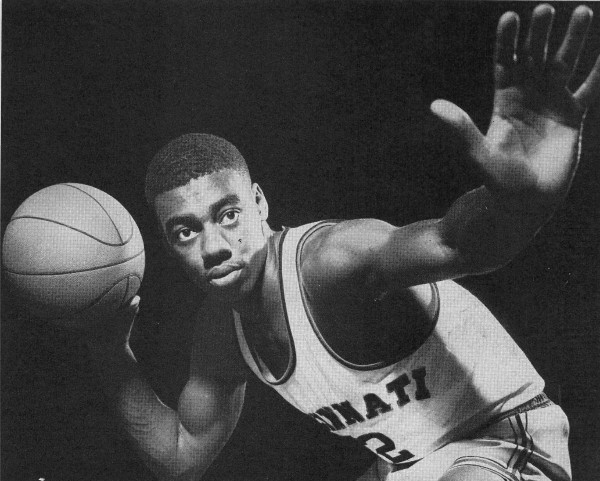 |
| "I like to win at anything I play, whether it's basketball or table tennis," says Robertson. He may become the first player to win the national scoring title and to be named No. 1 college player three years in succession. |
by MILTON GROSS
Shortly before the start of the basketball season two years ago George Smith, the University of Cincinnati coach, summoned his players to a special meeting. One man was not invited. This was Oscar Robertson, a phenomenal sophomore about to begin varsity competition.
"I want you fellows to understand something and I don't want Oscar to hear what I have to say," Smith told the squad. "You were a good team before, but with Robertson you're, going to be a better one, maybe a great one. He'll get all the headlines and all the publicity. You might as well make up your minds to that. But if you'll play with him, he'll take you farther than you've ever gone before."
If anything, Smith's forecast turned out to be conservative. Oscar Robertson quickly became the biggest name in college basketball. Both as a sophomore and as a junior he led the nation in scoring and virtually cornered the market on All-American and Player-of-the-Year awards. As for the Cincinnati Bearcats, they hit new highs in victories and attendance. Expectations were that "The Big 0" and company would make out fully as well this year.
In the light of all these things it might be assumed that the Oscar Robertson era in Cincinnati basketball has been a happy one for everybody concerned. This is not the case. Oscar has frequently been discontented and at times disheartened. Once last season he quit school for four days, finally being persuaded by friends to return. This year Coach Smith and college authorities weren't sure until classes opened in September that Robertson would come back for his senior season. They suspected he might follow the 1958 example of Wilt (The Stilt) Chamberlain, who left the University of Kansas after his junior year for a big-money deal with the Harlem Globetrotters.
There have been various reasons for this strained situation, including the fact that Oscar Robertson is a highly sensitive individual. Little of this shows on the surface. A visit to Robertson's home in Indianapolis is an essential first step toward understanding this quiet young man of twenty-one whose face is bland and unrevealing, except for the cynical smile that occasionally plays around his lips.
The Robertson house is a frame dwelling in need of improvement. It is located on the north side of the city at 3453 Boulevard Place, directly across the street from the Crown Hill Cemetery. Oscar's mother, Mrs. Mazell Robertson, lives there with twenty-three-year-old Henry, another of her three sons. The other, twenty-five-year-old Bailey, is with the Army in Germany.
The boys' father, from whom Mrs. Robertson was divorced in 1949, also lives in Indianapolis. He has the distinction of being the grandson of Marshall Collier, who died five years ago at the age of 116, the oldest person in the United States at the time of his death. Collier was born into slavery in 1838 and was sold several times on the auction block.
Mrs. Robertson is a beautician by trade, a gospel singer by avocation. She belongs to a choral group known as the Beck Jubilee Singers, has written original religious music and has made several television appearances as a singer of spirituals.
Speaking of her youngest boy, Mrs. Robertson observed recently, "There's a lot going on inside Oscar that I don't know. There's a lot I do know, but only because I'm his mother, not because he tells me. His coach doesn't know him and hasn't tried to know him. His teammates don't know him. They know his shots. They know his moves, but they don't know what he's thinking."
Said his brother Henry, "Oz is sort of a reticent person. He lives a lot inside himself. He doesn't trust too many people. I know what to talk to him about and what he doesn't want to discuss. There are things inside Oscar he doesn't discuss, even with his own family."
Some of the things that have been preying on his mind in Cincinnati are obvious. Although Robertson stays away from movies for the sake of his eyes and from alcoholic beverages for the sake of his reflexes, it has bothered him that as a Negro he is not welcome at a movie theater near the campus or at a bar-and-grill that is something of a student hangout.
He was acutely distressed two winters ago at being given segregated accommodations when the team played in Houston. A newspaperman asked him how it felt to be the star, yet be forced to live away from his teammates. Oscar replied, "How would you feel if you were me?"
Upon his return from Texas, Robertson confided to his friend Arthur Hall, "If it happens again, I'll be on the bus back home to Indianapolis." Last winter the team stayed together in Houston - on the university campus, rather than in a hotel.
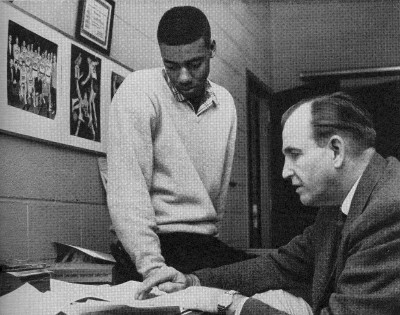 |
| Cincinnati Coach George Smith with his star. He wanted Oscar from the moment he first saw him play. |
A Negro himself, Hall is a Cincinnati alumnus now employed at the Cincinnati Gas and Electric Company, where Oscar worked until last summer under the university's co-operative on-the-job training program for students.
Most of Robertson's free time is spent with Hall. "When I'm off the court," Oscar says, "I like to be treated as Oscar Robertson the person, not Oscar Robertson the basketball player." At Hall's home he listens to music on the hi-fi and talks about subjects other than basketball. Aside from this, about the only social activity he has in Cincinnati is an occasional trip across the river to Covington, Kentucky, to date a schoolteacher.
Of course, Oscar is out of town a good bit of the time. He is forever being called upon to receive awards at sports banquets - he attended sixty-four of these functions after his sophomore season - and his regular traveling with the Cincinnati basketball squad is extensive in itself.
During the past two seasons the Bearcats covered more than 25,000 miles and played before 505,721 people. At New York's Madison Square Garden last winter a crowd of 14,587, the largest regular-season turnout there in nearly six years, watched Robertson score forty-five points in an 88-67 victory over New York University. At that, some of the spectators were disappointed. They had been hoping that Oscar would break the Garden record of fifty-six points he had set the previous winter against Seton Hall.
In the N.C.A.A. semifinals at Louisville last March, Robertson and Cincinnati helped attract 18,619 spectators, the biggest crowd of the tournament. The Bearcats bowed by a six-point margin to California, the eventual winner.
At home the attendance pattern has been much the same. Cincinnati traditionally is apathetic toward basketball, but tickets for Bearcat games now are bootlegged at premium prices. Five years ago the university built a new field house seating 7700, which at the time seemed more than adequate. When Oscar was a freshman and ineligible for varsity competition, home attendance averaged only 4321. With Oscar playing as a sophomore, the figure jumped to 6396. Last year it was 7466. This season, according to publicity man Tom Eicher, all eleven home games were sold out last summer.
After the New York University game last season, a reporter suggested to the N.Y.U. coach Lou Rossini, who is one of the true scholars of basketball, that Robertson didn't bear down as hard as be might on defense.
"You want him to play defense too ?" Rossini demanded.
Robertson's offensive skills are such that early in his college career it became standard practice for Cincinnati's opponents to rig up defenses designed specifically to stop him. They have seldom succeeded. Oscar and his fellow Bearcats edged out Bradley for the Missouri Valley Conference crown two years in a row and compiled tremendous overall records - twenty-five wins and three iosses in the 1957-58 season, and twenty-six and four in 1958-59. Each year Cincinnati finished among the top five teams in both the Associated Press and United Press International rating polls.
However, just as Oscar has had his grievances, so there are indications that these triumphant seasons have had their drawbacks as far as those associated with Robertson are concerned. For example, his teammates have been operating in virtual anonymity. They must look closely to find their names in the small type of the box scores. When television people set up their cameras, the unblinking red eye focuses on Robertson. When radio sportscasters bring their tape recorders into the dressing room, they wait in line to interview Robertson. When basketball writers talk at all to the other players, it usually is only to elicit some comment on Oscar's performance.
Last season the other boys contrived their own private jokes about the situation. Whenever the plane carrying the team to a game landed, somebody invariably would pipe up with a wisecrack like, "Let me carry your bag, Oscar. Maybe I'll get in the picture."
It was tomfoolery of the sort college kids often indulge in, but they weren't entirely kidding. Several times there were visible signs of annoyance. One occasion was before a game last January with Drake, which had nearly upset the Bearcats in a 74-72 battle the year before.
On the eve of the game Coach Smith took the unusual step of putting his squad through a heavy nighttime workout. However, Oscar Robertson wasn't there. He had gone off to Columbus with publicist Tom Eicher to pick up an award. His teammates clearly felt that if they had to take extra practice, Oscar should have been required to do it too. They were mollified the following night when The Big 0 scored forty points to pace them to a 97-60 victory.
Against a weak Temple team in Philadelphia later in the year, Robertson gave one of his worst performances of the season, although he contributed twenty-one points to an 80-60 win. "I was just plain terrible," Oscar said afterward, offering no excuses. Coach George Smith admitted, "He wasn't so good tonight, was he? But this has been four games in a week for hi. He's been in a kind of a slump, off and on."
Nevertheless, Coach Smith did not substitute for Robertson as frequently that night as he did for Mike Mendenhall, a senior and the team's third-highest scorer. Nor did he "get on" Robertson the way he appeared to do with Mendenhall. Each time Mendenhall was removed from the game, Smith had some excited comment to make to him. Mike could not hide his exasperation. Once he made an angry retort from the floor to something the coach shouted to him from the bench.
Typically, nobody at the press table could hear what was said. If there has been any real discord at Cincinnati, it has stayed in the family. The players present a united front when questioned by reporters, denying that there is friction between Robertson and the rest of the squad.
Says Mendenhall, "There never was a bit of jealousy existing. It's so much fun playing with Oscar,that I even enjoyed practicing with him."
This is echoed by Ralph Davis, the No.2 scorer at Cincinnati last year, who says, "Oscar's just great. He can do anything. He made our team."
Coach Smith insists that the other players consider themselves fortunate to be playing alongside a man like Robertson. One lad who corroborates this is Paul Hogue, a six-foot, nine-inch, 235-pound sophomore from Knoxville, Tennessee, who now rooms with Oscar in the dormitory.
"I came here because of Oz," Hogue said not long ago. "Getting to know an AlI-American is something to dream about, but getting a chance to room with him, that's really something."
"What is it like to room with him?" I asked Hogue. "Oz is kind of moody once in awhile," he said. "Sometimes he's as grouchy as a bear - like on planes sometimes. He wants nobody to sit with him. Other times he's laughing and joking with the fellows."
Nobody knew whether Oscar was joking last spring when he reported as a candidate for the Cincinnati baseball team, but nobody was taking any chances either. The baseball department reported to the basketball department, and Smith came running to find out what sort of nonsense his meal ticket was up to.
"I just want to try out for the team," said Oscar, who had played Police Athletic League baseball as a shortstop and pitched briefly as a senior at Crispus Attucks High School in Indianapolis.
"What position are you trying out for?" Smith asked.
"First base," Oscar said.
"Why don't you go out for the outfield, where you can't, get hurt?" said Smith.
As it turned out, Smith didn't have long to worry. When Oscar reported to the equipment room for spiked shoes, there were none to fit his size 14-D feet. He was told they'd order a pair for him, but long after the baseball season started the shoes still had not arrived. Robertson was certain Smith had recommended that the order be buried-and Oscar's adventure in baseball along with it.
"Why the heck would he want to go out fot baseball?" said publicity man Eicher in disclosing the story to me. "Why doesn't he just let well enough alone? Basketball's the big thing here, and Oz is the greatest at it. But you know, he isn't the easiest guy in the world to get along with. I'll tell you the truth - I'll be glad when he's gone. It'll be easier on me. Once I said to him, 'Why don't you give instead of always taking?' He's always asking for tickets or pictures. You'd think this office was being run just for him."
This is one way of looking at it. Back in Indianapolis, Oscar's mother says, "Sometimes the people in the college act like they think they own my boy. They don't. I didn't sell him. If I had, would I still be working in a beauty shop? Oscar's his own man. He likes to make his own decisions, and long ago I decided to let him find his own way."
For Oscar's part, he tends to feel that on broader matters, such as racial discrimination, the college hasn't done all for him that it might. "They just don't stand up for you when you need them," he has said.
By his own unsolicited admission Robertson has lost most of his interest in the business-administration courses he has been taking at Cincinnati. His career ambitions now center around becoming a well-paid professional basketball player.
Last spring his mother was seriously ill. It distressed Oscar that 'upon her recovery she had to go back to work instead of taking things easy.
"Someday," Oscar told her, "I'll get all these bills paid and sit you down and make you stay there and not work any more."
Adding all these factors together, it is hardly surprising that a lot 'of people expected Oscar to go for the big money this year with the Harlem Globetrotters. He seemed to be just the sort of attraction the Globetrotters needed to replace Wilt Chamberlain, who signed up with the Philadelphia Warriors of the National Basketball Association last May.
Significantly, soon after Chamberlain left the Globetrotters, Robertson was hired as a trainee by the prosperous Thomas E. Wood Insurance Company in Cincinnati. Tom Wood is the major stockholder of the Cincinnati Royals of the N.B.A., who have territorial rights to Robertson when he becomes eligible for the pro draft next year. One reason the Royals have hung on through several lean years in Cincinnati is that they expect Oscarultimately to revitalize them in the standings and at the gate.
There are other considerations which undoubtedly entered into Oscar's decision to return to college this year. One is that he has yet to play on a national championship team. In the 1958 N.C.A.A. tournament Cincinnati was eliminated in the second round in an overtime game with Kansas State. In 1959 the Bearcats got as ar as the semifinals before bowing to California's ball-control style of play in a low-scoring game, 64-58. Robertson himself was limited to nineteen points.
"The only thing I've got to look forward to now is that championship," he says. Actually he has other honors to shoot for - a new all-time individual scoring record and an unprecedented third straight year of being recognized as the country's No. I college player. On the latter count, one of his chief rivals figured to be Jerry West, of West Virginia, who was voted the top performer in last year's N.C.A.A. tournament.
Years of unceasing effort have gone into making Oscar the basketball marvel he is today. "I've never seen a boy who worked so hard to become great," says Tony Hinkle, coach of Butler University, who has known Oscar since high school.
In more academic terms, Dr. Kenneth Wilson, dean of Cincinnati's college of business administration, declares, "PeopIe like Oscar have a great driving desire to be a champion. Some would call it aggressiveness. I'd rather think of it as maturity and poise. He's had to develop remarkable maturity to withstand the assaults of his publicity."
Oscar Robertson's beginnings were humble indeed. He spent his infancy in Dickson County, Tennessee, in a shack owned by Early Bell, his maternal grandfather, who today is still farming his own piece of land at seventy-seven.
The Robertsons moved to Indianapolis when Oscar was four. The mother, father, three boys and an aunt lived at first in what was little more than a hovel on the northwest side of the city. A tar-paper roof protected them from the rain.
"There were crap games going on in that neighborhood all the time," says Mrs. Robertson. "People were doing all kinds of wrong things, and I had to tell my children why they had to be different."
As soon as the boys were old enough, the Robertsons got, Y.M.C.A. cards for them. Their sports interest was born in the Senate Avenue "Y" and nurtured in "the Dust Bowl" - a vacant lot where the kids played pick-up games.
Bailey, the eldest, was the first to gain athletic recognition. He made the team at Crispus Attucks. Henry did too. Bailey went on to Indiana Central College where he set a state collegiate scoring record with 2268 points in four years. Before going into the Army he played briefly with a unit of the Globetrotters. Henry entered Pittsburg Teachers in Kansas, but soon dropped out.
Meanwhile Oscar had taken up basketball in the fourth grade. "My brothers wouldn't let me play with them," he recalls. "I promised myself I'd get good enough so they'd have to let me play and I practiced all the time."
Practice is drudgery to most players. With Robertson it is almost a ritual. It is not unusual to see him walking around the university campus today with ball in hand, fingering it in the various positions he uses to shoot, pass or dribble. At other times Oscar can be found in the gym alone, shooting by the hour. This dates 'back to his high-school days, when coach Ray Crowe gave Robertson a key to the gym so that he could work out daily during vacations.
"I like to win at anything I play," Oscar says. "Once I went over to the Lincoln Center in Cincinnati with a friend named Harold Trotter. He wanted to play me table tennis. He knew he was going to beat me, but I wasn't going to let him. I played him almost all night until I beat him.
"In every game you pick up a little something. That's the way basketball is with me. It's a year-round thing, and the tougher the competition the more I put out. Let's say I'm playing against somebody, and he blocks my shot. I say to myself, You won't do it again. I figure the next time I'll know. how he'll react and be ready for him."
Before a basketball game at Cincinnati, Robertson generally can be found in his room in French Hall, listening to the record player with his eyes closed. It is a cluttered room with a double-decker bunk, sneakers tossed haphazardly under a desk, and basketballs and empty soft-drink bottles littering the floor. Half a dozen trophies are on the desk and they seem to overshadow his books.
The records drone on. Perhaps "drone" is the wrong word, for Robertson is a rock-'n'-roll fan. This kind of-music relaxes him, and Oscar is a great one for relaxing before a ball game. To get his muscles loose he does a sort of shrugging exercise.
En route to the arena on a midwinter evening he wears dark glasses. "They keep the wind from bothering my eyes," he explains.
He is lean of waist, broad of shoulder and remarkably graceful. As a high-school freshman Oscar Robertson was five feet, eight inches tall and weighed 160 pounds. By his sophomore year he had added four inches and fifteen pounds.
Today, standing a fraction less than six five, he weighs around 197 pounds. His hands envelop a basketball as if it were a grapefuit. There is a ten-inch spread from the tip of his middle finger to the heel of his hand, and a nine inch span between his little finger and his thumb. When he jumps, his head rises well above the rim of the ten-foot-high basket. Most coaches who have watched him say they have never seen such quick and accurate reflexes.
This has been apparent from his earliest competitive years. In high school Oscar's average rose from twelve points per game as a sophomore to 21.7 as a junior and to twenty-six as a senior. He led Crispus Attucks to a pair of state tournament championships, the first ever won by an all-Negro school in Indiana. In the annual Indiana-Kentucky all-star competition, he was voted the "Star of Stars" award. It was here, Robertson remembers, that Adolph Rupp, the University of Kentucky coach, first saw Oscar and offered him the chance to become Kentucky's first Negro player.
Long before then, however, other college recruiters were pursuing Robertson. Cincinnati's George Smith got on the trail back in 1954. By the time Oscar was ready to be graduated in 1956, some forty schools had contacted him. Specific offers came from eighteen of them - including Indiana, Purdue, Butler, Notre Dame, Illinois, Duquesne, Kansas and Dayton.
According to a Duquesne scout, Robertson was virtually pledged to them; and when Oscar announced Cincinnati as his choice, he was berated by Ray Crowe, the coach at Crispus Attucks, for breaking his word. Crowe has denied this story.
As is usually the case when a college snares a widely sought athlete, there were rumors that Oscar had been given a $250 watch, a new car and a wardrobe of clothes. During the height of the recruiting competition a FOR SALE sign appeared on the Robertson home in Indianapolis, but it was taken down soon afterward. At any rate, the N.C.A.A. has never found evidence of violations in the Robertson case.
During his first three years at Cincinnati he alternately attended classes for seven weeks and then worked seven weeks under the university's co-op plan. The N.C.A.A. decided last spring without reference to Robertson - that this gave the school an unfair advantage in subsidizing athletes. Oscar now has switched to an accelerated no-job program; but while he was on the old basis he earned $1.80 an hour for a forty-hour week approximately twenty-six weeks out of every year. He operated a calculator in the plant-accounting section of the treasury department of the Cincinnati Gas and Electric Company.
As a basketball player Oscar also has what is euphemistically known as a "sponsor" - Walter Paul, owner of the Queen City Barrel Company. Paul provides such niceties as a car and chauffeur for Oscar's mother on her rare trips to Cincinnati for games. This touch of luxury, however, has not entirely compensated in Mrs. Robertson's eyes for other aspects of her visits. She speaks testily of the way some university officials ignore her presence.
Both she and Oscar's brother Henry were angered at something that happened in the Dixie Classic at Raleigh, North Carolina, last year. In one game Dave Budd of Wake Forest worked Robertson over, and Oscar wound up with a cut eye. Henry says that when he remonstrated later with certain members of the Cincinnati athletic department they told him bluntly that he had no business being there to see his brother play.
Because of Oscar's talent and reputation, he has become the target for every overenthusiastic opponent who feels the battle will be half won if he can knock Robertson on his back. All in all, Oscar comes in for more than a normal share of physical and verbal abuse.
"Some of it," he says, "you've got to expect. Some of it there's no excuse for, and I'm learning to give back as much as I get."
Robertson also throws a number of remarks and stricken looks in the direction of referees. This has brought him criticism as a crybaby who must have things go his way.
"He can't be such a superman if he whines so much," said one referee, who understandably did not wish to be named.
Oscar maintains. "Most of the time when I look mad, it's not anybody else I'm mad at, just myself. I know I should be doing better."
Oscar Robertson will never stop trying to do better. Few opponents, however, have been able to see much room for improvement. as far as they're concerned, Oscar is already much too good the way he is right now.
Return to Kentucky Basketball page, Kentucky articles, statistics, team schedules, team rosters, opponents, players, coaches, opposing coaches, games, assistance or search this site.
Oscar Robertson is not a physical freak, but a well-proportioned and superbly co-ordinated athlete of six feet, four and three-quarters inches. He has a great variety of shots and is exceptionally accurate with all of them - he sinks more than 50 per cent of his field-goal attempts. However, he is considerably more than just a hot scorer. He also is Cincinnati's top man in rebounds and assists.
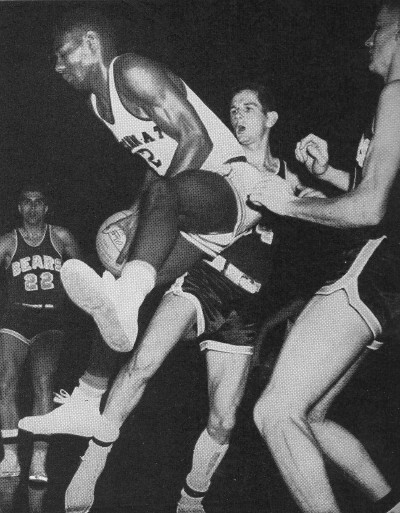
"The Big O" snaring a reboind against California in the semifinal round of the N.C.A.A. tournament last March at Louisville, Kentucky. Robertson was "limited" to 19 points, and Cincinnati lost, 64-58.