
Known in the South as "the most hated coach in Dixie," Adolph Rupp has nevertheless, piloted his squirel-shooting Kentuckians to the top of the basketball heap.
Published in Saturday Evening Post Magazine, February 15 1947, pp. 23, 141-142
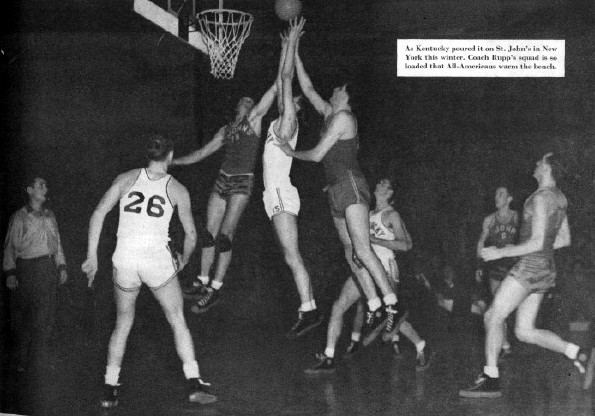 |
| As Kentucky poured it on St. John's in New York this winter, Coach Rupp's squad is so loaded that All-Americans warm the bench. |
by COLLIE SMALL
MR. ADOLPH RUPP, the crafty professor of basketball at the University of Kentucky, is was sitting in his cubbyhole office in Alumni Gymnasium late last November, amusing himself by slowly counting off his list of prospective victims for the 1946-47 season. As the professor sat there, scratching his long, pointed nose and savoring each potential disaster to Kentucky opponents, he was suddenly startled by the realization that he had left the night of December sixteenth open in the Kentucky schedule.
Professor Rupp quickly pulled himself together and set about laying plans for luring some unsuspecting team into playing Kentucky's "poor little mountain boys" on that date. To this end, he dispatched, forthwith, telegrams to every coach he could find with an open date on December sixteenth.
Most of the replies arrived on the afternoon of November thirtieth, and virtually all the deponents signified great pleasure at being invited to play Kentucky.
"We are," they said, "at this very moment making arrangements with our athletic associations."
That same evening, while they were still making arrangements, Kentucky humiliated Tulane, 64 to 35. The next morning the coaches who had been invited into Professor Rupp's deadly web took one startled look at the shattered remains of Tulane and immediately suspended arrangements to play Kentucky.
"Thanks just the same," they wired hastily. "Maybe next year."
This deep distrust of Adolph Rupp is nothing new. It is, in fact, the sort of thing he has brought on himself by consistently turning out powerhouse basketball teams at Kentucky that habitually make monkeys of the opposition. Hoist by his own success, Rupp already is known throughout the South , as "the most-hated coach in Dixie," and if his reputation continues to deteriorate, he stands an excellent chance of becoming the most unpopular coach in the entire country.
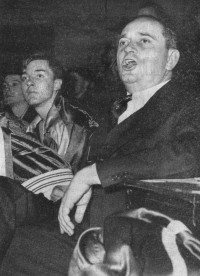 |
| Rupp and men. His talent dragnet reaches to the remotest Kentucky hills, and sometimes beyond |
In sixteen years at Kentucky -- not including 1946-47, which is also a vintage year for the old professor -- Rupp's teams have won 283 games and lost 64, and Rupp is still demanding recounts on most of the sixty-four defeats. Over one five-year period, Kentucky won forty-five straight conference games, a feat which made old men of the other coaches in the Southeastern Conference long before their time. Nor has Rupp been content with disrupting things only in the Southeastern Conference by winning nine championships in sixteen years. No, indeed. Kentucky has caused no end of panic farther afield. Last year, they waltzed away with the National Invitational Tournament at Madison Square Garden, and the situation could well obtain again this year.
There isn't much anyone can do about Rupp and his deadly squirrel shooters. The Southeastern Conference is stuck with him and the Big Nine wants no part of him. No university in that august cradle of basketball would get close to Kentucky this year, and Rupp was so bemused with this superior treatment that he sarcastically offered to play his second string against one of this year's top Big Nine teams. Whatever else they may be in the Big Nine, they are not fools, and, since Kentucky's second string this year is no less devastating than the first string, the offer was wisely ignored.
It is doubtful if Rupp and the Big Nine will ever be friends again. Rupp, whose own Southeastern Conference long ago decided to come out in the open with its subsidization of athletes, is fiercely resentful of the Big Nine's claim of righteousness, and he makes no bones about it.
Not long ago the professor was accused by a Big Nine coach of raiding the North for basketball players. In his denunciation of Rupp, the Big Nine coach included an old Southern expression, "carpetbagging." A short time later, Rupp was invited to speak at a banquet in Ohio, deep in Big Nine territory, and the banquet chairman, anxious to have Rupp's name printed on the program, asked him what his subject would be.
"My text," the professor replied, "will be: A Carpetbagger in the Holy Land."
Rupp frequently finds it convenient to refer to the Bible in explaining the state of basketball at Kentucky. Once, when he was being twitted about his success with mountain boys, he leaned back in his chair and nodded agreement.
"I will lift up mine eyes unto the hills, form whence cometh my help," Rupp said gratefully.
The professor wasn't kidding. Many of his players actually are mountain boys. Against the University of Idaho's Pacific Coast Conference champions last December, Rupp's starting five was composed of Jack Tingle of Bedford, Kentucky (pop. 387); Joe Holland, of Benton, Kentucky (pop. 1906); Ralph Beard, of Lewisport, Kentucky (pop. under 200); Kenneth Rollins, of Barlow, Kentucky (pop. 584); and Wah-Wah Jones, a city slicker from Harlan, Kentucky (pop. 5122).
Some years ago an angular young man named LeRoy Edwards appeared at the university and was promptly hustled out to the basketball floor, where he proceeded eventually to become an All-American center. Edwards at the time was not intimately acquainted with the ways of the outside world and he came a cropper almost immediately when he was thrust into a sleeping car for an overnight trip to Birmingham, Alabama. Nonplused by the rows of upper and lower berths, Edwards finally went to Rupp as the train rattled southward and allowed as how he thought he would just sit up all night.
"Ain't sleepy, anyway," he said. Rupp gathered immediately that Edwards was in difficulty. On the theory that he might grasp the idea if he were to watch the other players go to bed, Rupp suggested to Edwards that he sit up until he got sleepy.
Several hours later, with Rupp slumbering peacefully, a long arm reached into his berth and shook him. Rupp rolled over and looked up into the beaming face of Edwards.
"Think I got 'er now, coach," he said, and went happily off to bed.
Edwards, now with the professional Oshkosh All-Stars, was the third of Rupp's All-Americans at Kentucky. In addition to a number of other All-Americans -- the exact number being difficult to determine because of the vague way in which basketball All-Americans are selected -- Rupp has had at least several million All-Conference players.
This year he is actually embarrassed. Kentucky can put two great teams on the floor, and then come up with still a third that would, in all probability, win the conference championship. Bob Brannum and Jim Jordan, both All-Americans, have been sitting on the bench much of the season. In the matter of centers, for example, Rupp has Alex Groza, voted the outstanding service player in the country last year; Brannum, the All-American; and Wah-Wah Jones, who was only good enough to be All-Conference last year. In addition to being embarrassed, Rupp also is worried over the effect the situation will have on the players. It is not a healthy thing to have All-Americans pining away on the bench.
Rupp's championship basketball teams obviously do not come wandering out of the hills and onto the Kentucky campus with nobody leading them.
Rupp has a grapevine that reaches into every hamlet in the state, and occasionally, to the dismay of other coaches, into adjoining states. But by and large, the main source of Rupp's basketball talent is the state of Kentucky itself, which rivals Indiana in encouraging schoolboy basketball.
In Kentucky high schools, basketball is often a year-round sport -- an obsession which frequently entails playing in the snow on outdoor courts. By the time Rupp sees them, his players are already expert ball handlers.
A few years ago, Carr Creek High School, which had never been effete enough to worry about gymnasiums, sent its team to the state tournament in Lexington clad in overalls with the legs cut off. Unfortunately, Carr Creek lost the championship in four overtime periods to Ashland, but they were impressive enough to be invited to the Stagg Invitational Tournament in Chicago, and a group of fans chipped in and bought them real, honest-to-goodness basketball suits for the trip.
Until only recently, one of the powerful contenders in schoolboy circles was Kavanaugh High School, a tiny school tucked away in the mountains and run under the watchful eye of Mrs. Kavanaugh, an elderly lady who founded the school. Mrs. Kavanaugh produced winning teams by the simple expedient of standing under one basket and whacking the backsides of her players with an old umbrella whenever they made a mistake.
When Sharpe High School won the state championship, tournament officials were momentarily stumped to find there were no telephones in Sharpe to receive the news. In Kentucky they have a way of solving these small dilemmas, and they simply telephoned to the nearest town, where a man on horseback picked up the news. He rode to a swollen river and yelled the word down to a man in a boat, who rowed across the river and told another man on horseback, who obligingly galloped off and over the hills to Sharpe, carrying the good news from Lexington.
Because he is literally surrounded with this sort of talent, Rupp sits back and lets it come to him. As many as 100 choice high-school prospects convene each spring in Lexington and perform for the master, after which he tells a handful to come back in the fall. Rupp says that not one in ten is good enough to play basketball for Kentucky, and his method of selection is a mystery to everyone but himself. Rupp simply points to the top of his office door -- six feet, two inches high -- and says, "If they don't bump their heads when they come in, I don't even shake hands."
At Kentucky each athlete gets his room, board, tuition, books, laundry and ten dollars a month, all according to conference rules. It is not unreasonable to suppose that some players squeeze out a little extra cash, but even confessing to ten dollars represents an honest step forward if the ultimate goal of college athletics is rank professionalism, as it appears to be. Rupp is allotted fifteen athletic scholarships a year for his basketball team. The football team takes the sixty left out of a total conference allocation of seventy-five. Over the past few years, the Kentucky football team has needed its full sixty, too, but Rupp has had no appreciable difficulty in getting along on a mere fifteen.
Although the Big Nine and other conferene turn up their noses at the commercialism of the Southeastern Conference, Kentucky probably bestows less on its athletes than most schools. While the reformers from conferences all over the country were yelling "Thief!" at the Southeastern Conference several years ago, the University of Washington in the Pacific Coast conference, was busily transplanting a football team from Chicago. Likewise, the University of Southern California, which is located right where its name implies, managed to sort out a highly respectable basketball team a few years ago when a mysterious plague of Midwestern hoop artists suddenly descended on the U. S. C. campus.
Still, no matter what they pay, they can't seem to beat the old professor. The University of Kentucky is so indebted to Rupp that they have made him one of the highest-paid basketball coaches in the country at $8500 a year. Doug Mills, at Illinois, is also rumored to be in the $8500 class -- an astronomical figure for basketball coaches -- but Illinois makes Mills serve as athletic director too.
Rupp, at an imposing 200 pounds, has the appearance of a successful businessman, which is only right and proper, since he is firmly established as a leading citizen of Lexington. They can fire him tomorrow and the professor still will have a 200-acre farm twelve miles from Lexington, a thriving insurance business, and a substantial block of stock in the $2,500,000 Central District Warehousing Corporation, a tobacco warehousing corporation that bills itself as the largest in the world. Four different colleges made eyes at Rupp last fall, but he likes it where he is. George Hukle, the mail carrier, keeps his shot charts; Whit Hall, the banker, drops in every afternoon for practice; and Elmer Rix, the oil man, is always around to blow up the basketballs and otherwise take care of minor details.
Rupp firmly believes that his game is the best game of all, and he has spread the gospel so well that Kentucky is probably the most basketball-minded state in the Union. Jimmy Cannon, a veteran New York sports writer who is not easily surprised, was left standing popeyed at Churchill Downs last spring when a gentleman sidled up to him as the horses were going to the post for the Derby, and asked him, "Do you know anybody that can get me tickets for the Kentucky basketball games next winter?"
The demand for tickets to Kentucky games is so disproportionate to facilities that the university has been forced to adopt a system under which only a third of the games are open to any one group of ticket holders. Alumni Gymnasium seats only 2800 and there is a student body of some 6600 at Kentucky. Consequently, for seventeen home games, one group of students is permitted to see six; another group a second series of six; and the public the remaining five. Even Dr. Herman L. Donovan, president of the university, can't sneak into games he isn't ticketed for, but the situation will be alleviated in a year or two when the university completes its $2,000,000 field house that will seat 12,000 persons and permit Doctor Donovan to come as often as he pleases.
Rupp's frequent verbal assaults on officials and rival coaches, and his agonized antics on the bench have en- deared him to countless fans. These same antics, on the other hand, have embittered countless others. Rupp and his traveling "hillbillies" are a sandard popular attraction at Madison Square Garden, but in Knoxville, Tennessee, they are hooted out of town. The University of Tennessee sponsors an informal booing section which sets up operations directly behind Rupp and blisters him with good Southern insults for entire ball games.
Rupp is variously known as "The Baron" "Old Rupp and Ready" and "The Man in the Brown Suit," the latter sobriquet stemming from his mania for brown. While he was still coaching high-school basketball teams, the professor discovered that his teams lost when he wore blue suits, and he has been wearing brown ever since.
When Rupp arrived at the University of Kentucky, he was greeted somewhat less than enthusiastically. Originally a Kansan, he had played under Dr. Phog Allen, the distinguished osteopath, after a schoolboy career in his native Halstead. At the University of Kansas, Rupp was a guard, but contrary to the impression gained from various Rupp eulogies, he was not a very good guard, although Doctor Allen let him play frequently to keep up his morale. In the early '20's, when Rupp was at K. U., basketball was played largely by ear, though Allen had introduced a fairly refined zone defense, and Rupp, like so many other students of Doctor Allen, completely abandoned Allen's teachings when he, himself, took up coaching.
Rupp's first job, in 1923, was at Marshalltown, Iowa, a position he accepted under the illusion that he was to be basketball coach. It developed, to his complete consternation, that he had been hired as wrestling coach, and Rupp, mortified but resolute, grimly piloted his boy grapplers to a state championship his first year.
The professor migrated to Freeport, Illinois, from Marshalltown, this time as a basketball coach, and his record at Freeport was such that Kentucky invited him to Lexington.
From the outset, in 1930, Rupp made the opposition play his kind of basketball. Kentucky, like the other Southern schools of the era, played a slow-break, waltz-me-around-again-Willie type of basketball known as the Illinois system, and Rupp immediately announced that he intended to install a fast break. This revolutionary announcement caused considerable apprehension on the Kentucky campus and, as the student paper, the Kernel, said at the time, was "rather dubiously accepted by basketball fans."
The sports editor of the Kernel, a young lady named Virginia Dougherty, was so awed by the "speed and energy" of Rupp's fast break that she expressed her doubt that it would ever work.
"They have been accustomed to moving so slowly and calculatingly while using the Illinois system," she said, "that when they finally get under fire the first game of the year, they are likely to be as terrified of their own speed as their opponents."
There is no record of anyone's being terror-stricken at his first glimpse of the fast break, and at the end of the first season, the skeptics were completely sold when Kentucky went to the finals of the old Southern Conference tournament, losing a heart-breaker to Maryland in the last forty seconds, 29 to 27.
The college sports writers wept copiously upon hearing the bad news, but they dried their tears in time to pen what was probably one of the worst tributes ever written. "They fought -- that team of Adolph Rupp's -- fought for all that they had," the Kernel sobbed. "There was not a man who was clad in Blue and White who did not do his duty and do it well, entitling him to hold his head high even in defeat."
Rupp, now forty-five, has had to slow down since an injury to his spine almost paralyzed him in 1937. At one time, Rupp's massive back was so twisted he used his right hand to take money out of his left-hand trousers pocket, but an operation by Dr. Glenn Spurling -- who was flown to Europe to operate on the late Gen. George Patton after the latter's fatal automobile accident -- helped restore Rupp. Rupp wore a steel-and-leather corset for some time and coached from a chair, but he is now almost as active as ever.
As a coach, Rupp is an acknowledged master. Kentucky teams play an inside screening offense that is considerably less helter-skelter than the Rhode Island State system of fire-wagon basketball, but they still move around faster than most teams, and they always know where they are going. In the matter of defense, Rupp gave up the zone years ago in favor of the man-to-man, on the theory that you can't win with a zone defense when the chips are down and you are behind.
"They'll handle the ball out in front of you, pull you wide and then go in on you," Rupp says. "You can't win basketball games that way."
Rupp is, however, a confirmed worrier. Recently, he went to Louisville to scout Texas A. & M. against Morehead, and he was downright discouraged to find that the Aggies had such a weak team. Driving home to Lexington after the game, he badgered Harry Lancaster, his assistant coach, to try to get Lancaster to say Texas A. & M. should be feared. Lancaster finally conceded, "Well, they handled the ball pretty well before the game."
"Darn right they did!" Rupp exclaimed happily. "Yes, sir. Harry, they're going to be dangerous." Kentucky beat Texas A. & M., 83 to 18.
Rupp is particularly proud of the fact that he has lost only one player for failing grades. The Southeastern Conference has been accused, in the past, of taking special precautions with mentally arrested athletes, but there is no particular evidence that they were thinking of Kentucky in that connection.
Rupp, however, does teach a course in "advanced basketball," which appears to be a likely refuge from the arts and sciences, but he insists that the course is invaluable for athletes who intend to become coaches, as most of them do. Moreover, he modestly proclaims himself the best professor in the university because all his students get A's. "What kind of professor gives failing grades?" Rupp once asked. "It just proves he didn't teach his students anything."
In the matter of grades, Rupp recently encountered something of a dilemma, which he solved with typical ingenuity. All his students except one had attended "advanced basketball" faithfully, and thus, under the Rupp system, were entitled to A's. The one exception, however, had missed a class. Rupp asked Lancaster what he should do. " Well," Lancaster said, "the reason he missed class that day was because he broke his leg."
"Broke his leg, eh?" Rupp mused. "In that case, he will have to be satisfied with an A minus."
Rupp regularly takes visiting teams on long tours of the lush farms near Lexington, and he has been accused of malice aforethought by some coaches who suspected he was attempting to tire their players out before game time. Rupp steadfastly denies that he has anything but the cultural advancement of the boys at heart, but when the University of Idaho team recently paid a visit to Lexington, the professor instructed Mrs. Rupp, in charge of that day's tour, to give Idaho the full treatment. "Take them out to Calumet Farm, Idle Hour and Dixiana," the professor said. "Then drive down to the Kentucky River, have a flat tire and get them back here at ten minutes to eight."
The Idaho team was back long before ten minutes to eight. But in the waning minutes of the ball game, Rupp turned to one of his players and said, "She didn't keep them out long enough. That Idaho team has scored thirty-five points on us."
What the professor didn't mention was that Kentucky had scored sixty-five.
Return to Kentucky Basketball page, Kentucky articles, statistics, team schedules, team rosters, opponents, players, coaches, opposing coaches, games, assistance or search this site.