
Published in Pathfinder Magazine February 23, 1949 , pp. 32, 34, 36-37.
What Lou Boudreau is to baseball, Adolph Rupp is to college basketball. Here, after inspecting Kentucky's high-flying team at home and on the road, Sports Editor Watson Fenimore tells why.
by WATSON FENIMORE
 |
This distinction was made possible by a grateful Commonwealth one day last March when the team returned to Lexington from New York's Madison Square Garden with the National Collegiate Athletic Association's 1948 championship and, consequently, the national college basketball title in tow.
Lexington's Mayor Tom G. Mooney declared it "Wildcat Day" and had Main St. roped off for several blocks before Union Station. Lt. Gov. Lawrence Weatherby presented the colonels' commissions for Gov. Earle Clements. And the whole team rode off to the campus on the city's newest and biggest fire truck.
Still Hot. Last week Kentucky again was in the forefront of college basketball ranks. It was No. 1 in the weekly Associated Press top-team poll and the fire engine was hopefully being kept ready for use.
The Wildcats still had four of the five men they had placed on the U.S. squad which won the Olympic basketball title in London last summer. They had bowled over nearly a score of topflight 1948-49 opponents, including Holy Cross, Tennessee and Notre Dame. Their one loss was a 42-40 defeat by St. Louis University in New Orlean's Sugar Bowl Dec. 30. And any Kentuckian will tell you that the boys from Lexington would take the Billikens any time, any place if the two should meet once more.
Next month, in fact, the two probably will meet again, either in the NCAA's 1949 college tournament in New York or, more likely, in Madison Souare Garden's National Invitation meet - the two most important basketball tourneys in the country. Kentucky supporters hope developments then will prove the St. Louis incident was all a horrible mistake. Primarily responsible for basketball's happy state in Kentucky is a husky, 47-year-old transplanted Kansan-coach Adolph F. Rupp, variously known as the Baron of Basketball, Old Rupp and Ready, and, because he will wear no other coIor during a game, the Man in the Brown Suit.
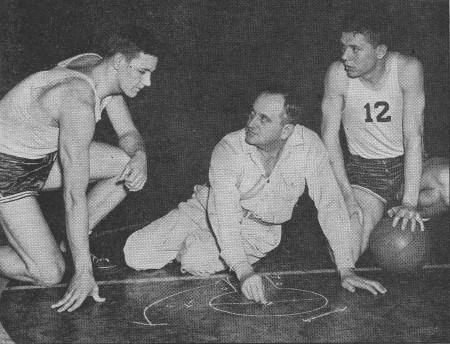 |
Counting this one, it's 19 seasons since Adolph took charge of University of Kentucky teams. In those 19 years - and up to. press time - Rupp's squads have a phenomenal record of 369 wins to 71 losses, have won the Southeastern CoIlege Conference championship 11 times and in the past five years have played in five national tournaments.
The most freouently told tale about Rupp, whose personality is the kind which generates tales, concerns his first trip with a Kentucky team to Madison Souare Garden. There, in 1935, he played New York University, another perennial basketball power. It was a nip-and-tuck, and exceedingly rough, affair with the officials freouently penalizing the Wildcats for screen plays (in which offensive players attempt to keep the defense from reaching the man with the ball). Rupp insisted the plays were legal, but the referee said they constituted blocking. Finally-in the last eight seconds - NYU pulled the game out 23-22 by virtue of another screening foul. Rupp's protests could be heard in the Bronx.
The next day when the team reached Lexington, sports writers descended on the Baron asking what had happened.
"I really don't know," said the still-ruffled Rupp. "But riding back yesterday I turned on the radio and got a church broadcast from New York. The minister used as his text: 'He was a stranger and they took him in'."
As in the case of every leading coach, Rupp's success is built, first, upon fanatical attention to fundamentals: ball-handling, dribbling, footwork and, of course, shooting.
Rupp has the ball passed to the receiver waist-high - not head or shoulderhigh, where he'll need extra time and energy to catch and adjust it. Nobody dribbles when he can pass. Feet are used for faking opponents out of position, as well as for running. Players awarded a free throw bounce the ball four times at the foul line before shooting. (It relieves tension).
Woe to the Kentucky player, star or sub, who forgets such fine points.
No Fooling. In the second game of the current season, for instance, Kentucky was playing DePaul University of Chicago at Louisville. At guard for the Wildcats was gum-chewing, 175-pound Ralph Beard, for whom most college coaches would trade any three regulars. Kentucky led at the half, 20-13, but Rupp was not satisfied. In the dressing room he eyed Beard coldly.
"Beard," he said, "last year you were a Helms Foundation All-American, True Magazine's player of the year and you played in the Olympics. But Monday morning I want you to meet me in my office and pay me $2.50 for a ticket for the privilege of seeing this game."
In the second half Kentucky ran DePaul off its feet and won, 67-36. An impression that basketball is a game played by five men - running wildly up and down the floor is dispelled by a look at the Rupp system. It's true that Kentucky teams use the so-called fast-break: i.e., get the ball and go with it before the defense can organize itself. But if the defense closes in too quickly, the Wildcats drop the fire-wagon stuff.
Strategy. In such a situation, one of the Kentucky guards - guards correspond to football quarterbacks on the Baron's teams - signals a play. Rupp has 10 such floor plays, workable from either side. The center moves to the foul line under the opponent's basket and acts as pivot man for receiving and making passes.
"Of course we like to fast-break when we can," says Rupp, "but if that doesn't work we stop and set up a pattern. We like a pattern where we know what's going on. In that way we can hold a man accountable if we fail to score.
"There's nothing more pathetic than a team that doesn't know what to do with the ball once it gets it."
Three more cardinal principles distinguish Rupp's coaching:
First, he holds that the fundamental shot in basketball is the long shot. Kentucky guards, who often outscore the forwards, must be adept in these. Ability to shoot accurately from far out on the court, says the coach, keeps the opposition from ganging up under the basket.
Second, every play calls for inside screening: i.e., Kentucky men must screen out their opponents from the play by keeping between them and the goal.
Third, defense is just as important as offense. Rupp teams fight vigorously to take the ball off the backboards and play a tight man-for-man defense.
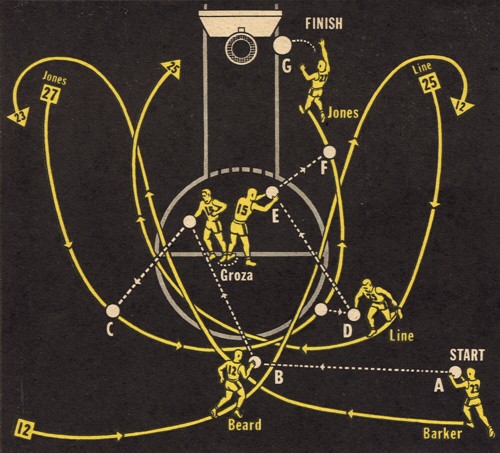 | Kentucky's "Double 5 Play
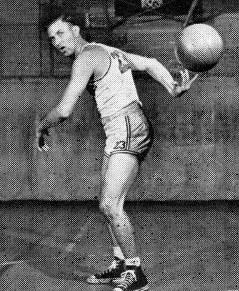
A: Play starts as guard Barker (23) passes to opposite guard, Beard (12), cutting toward him. Barker continues across floor to screen out Beard's opponent, circle to assume rebound position. |
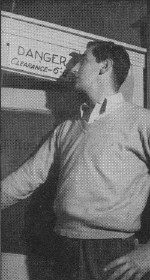
Although such coaching admittedly is the No. 1 reason for Kentucky's basketball ascendancy, there is, naturally, the matter of material. And in picking this, the Baron excels. He likes, for example, tall players-the taller, the better-and gets them, using as measuring stick the door to his office' in rickety Alumni Gymnasium. The door is exactly 6 feet, 1-1/4 inches high and candidates pass through it when they call on the coach.
"If they don't have to stoop when they come in," says Rupp, "I don't even bother to shake hands."
Actually, this isn't quite true, since the redoubtable Beard, second highest scorer on the team, is only 5 feet, 10-1/2 inches, and clears the doorway nicely.
But beginning with 6-foot, 7-inch center Alex Groza, brother of place-kicking Lou Groza of the pro fooball Cleveland Browns, the other regulars must bend or bump when entering the Rupp sanctum.
Hawk-eye. Rupp's close watch over prospective college stars, incidentally, is a source of concern to his rivals, especially those coaching in the Midwest's Big 9, for whom the Baron's affections are something less than deathless. Once a Big 9 official, while insisting that his own league's operations were above re-proach, called Adolph a "basketball carpetbagger," and accused him of raiding the North for basketball talent.
Invited some time later to speak at a banquet in Ohio, deep in Big 9 territory, Rupp was asked to forward the title of his talk. "My subject," said Rupp, "will be: 'A Carpetbagger in Holy Land.'"
 |  |
Rupp admittedly does have first call on most of the top grade schoolboy players in Kentucky and many nearby states. He makes a paint of knowing all the high school coaches and promising youngsters in his region and the latter stream to Kentucky like football players do to Notre Dame.
Frequently, however, Old Rupp and Ready gets prospects who are lured from farther away by the court reputation he and Kentucky have built up.
One was 7 foot Bill Spivey, a high school graduate who thumbed rides from his home in Georgia to Lexington last spring. Although Spivey's stoop, as he ducked through Rupp's doorway, was most gratifying, the Baron was not impressed. Spivey weighed only 176 pounds - much too little for his great height. "Son," said Rupp, "you'd have to weigh 220 pounds to play for us."
"Well, Mr. Rupp," said Spivey, "I think I could gain weight - if only I could get enough to eat."
Trial. Rupp sent him back home, but that wasn't the last he heard of him. Spivey kept telephoning until the coach gave in, accepted the call and let him come to Kentucky for summer practice.
Rupp thereupon had to leave for London and the Olympics, but he arranged that Spivey should be fed all he could eat and instructed assistant coach Harry Lancaster to keep him informed on the boy's progress. Spivey piled enthusiastically into the food.
Lancaster, whose scouting reports on Kentucky opponents are miracles of ex-actness and perception, followed orders faithfully. He gave Rupp a week-by-week summary of the weight charts as the Spivey avoirdupois moved from 176 to 180, to 189, to 195 pounds and up.
Rupp mentally calculated the number of steaks that were disappearing. Finally he sent Lancaster an urgent message. "I know he can eat," Rupp wrote, "but can he play basketball?"
Spivey now is on the freshman team. Probably he won't be ready for the varsity next winter, but under Rupp's careful tutelage he may blossom out in his junior and senior years. Rupp is a magician with practically any kind of material and, besides, a 7-foot center doesn't come along every day in the week.
Mainstays among all the Kentucky gold braid are the four ex-Olympians - Cols. Alex Groza (team captain), Ralph Beard, Wallace (Wah Wah) J ones and Clifford Barker, seniors all.
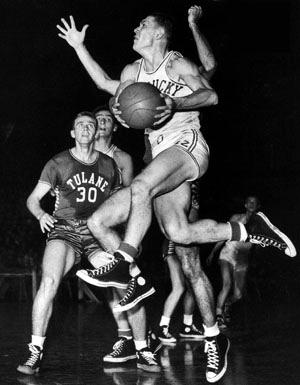
All-Americans. Groza, who comes from Martin's Ferry, Ohio, is the kind of center coaches dream about. High point man and key to the Kentucky attack, he's the boy who takes the ball off the backboards. He's also the one who takes the pivot position, passing to teammates as they flash toward the basket, or faking, turning and shooting the ball in himself. He was an All-American in his sophomore year and last season won virtually every other basketball honor there was.
 |
Jones is a letter man in football and baseball as well as in basketball. He's a forward and alternate center to Groza and an expert shot from anywhere on the court. He's also No.1 in popularity among the citizens of Kentucky's Harlan County, where the inhabitants organize "We-want-Jones" cheering sections for Kentucky games and think that maybe the Presidency would not be too much reward for Wah Wah - sometime after graduation.
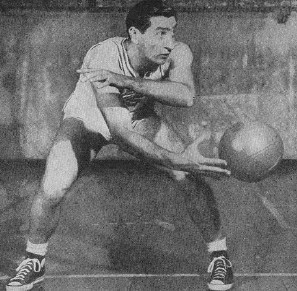
Barker, from Yorktown, Ind., alternates at forward and guard and is the Wildcats' backhand, ball-handling specialist. Barker served in the AAF during the war and was shot down over Germany where he spent 16 months in a Nazi prison camp. He used his time to such athletic advantage, however - practicing passing with a voIleybaIl - that he can pass the opposition flat-footed with his unorthodox flips.
Dale Barnstable of Antioch, Ill, James Line of Akron, Ohio, and Johnny Stough of Montgomery, Ala. - aIl juniors and all good - complete the varsity line-up.
State Interest. Rupp and his boys keep Kentucky in a continual basketball fever from November to March. Residents in even the remotest sections know both players and Rupp by sight and write in when the team needs encouragement.
After the Sugar Bowl loss to St. Louis, for example, the entire Commonwealth went into mourning. Among sympathizers was 77-year-old Mrs. Etta Smith of Cynthiana, who asked that the team win its next game (against Bowling Green) for her. "Just remember," she wrote, "that an old lady will be listening." Kentucky won, 63 to 61.
In response to interest like this, the university is completing a $3.5 million field house and auditorium which will seat 12,000 spectators a year from now. The present Alumni Gymnasium, seating only 2,80Q, can house less than half of the 7,863 students, to say nothing of Lexington's basketball-wild population.
Rupp, who thinks the South now dominates the court game, has had plenty of offers to take his talents' elsewhere, but is accepting none of them. He now is a prosperous Lexington businessman as well as a coach. He also teaches a university class in "Advanced Basketball" and, not too surprisingly, members of the Wildcat squad are among hIs pupils. Not too surprisingly, either, none of them gets less than "A".
"What kind of professor," asks Rupp "would give failing grades? It would just prove that he couldn't teach his students anything."
What's Ahead? Next year, with Groza, Jones, Beard and Barker gone (and possibly playing pro hasketball), things may be different. In fact, a lot of colleges which haven't been too anxious to play the Wildcats recently are now knocking at the door, figuring they can take Kentucky and win prestige.
But this doesn't worry' the- Baron unduly.
"You may say," he said, "that we will have a team next year. Yes, I definitely think we will be able to scare up somebody to play."
Those who know Rupp are quite sure of this. They think he'Il not only scare up a few players who'Il be able to totter through 40 minutes of playing time, but will blast into basketball oblivion anybody who takes his team lightly.
Return to Kentucky Basketball page, Kentucky articles, statistics, team schedules, team rosters, opponents, players, coaches, opposing coaches, games, assistance or search this site.