
Cagey cage-fans watch for these eight crucial moments in any basketball game. A famous coach shows how to evaluate them
Published in Pageant Magazine, January 1949, pp. 135-142
by Adolph Rupp
"The trouble with basketball," I'm told at least once a week, "is that everything happens too fast. The fans never get a chance to dope things out in advance, the way they do at a baseball game."
I agree. The technique of watching a basketball game is certainly distinctive. The canny fan rarely looks for special plays; he doesn't try to predict that John, 12 feet from the basket, will toss the ball to Joe, six feet from the basket, at a given moment.
Instead, he looks for trends in the game; he watches for hints and signs and omens. And to make things as easy as possible for his brain and his blood-pressure, he concentrates on eight important moments - the eight "big" moments of a game.
If you know those moments, and how to judge their meaning, basketball becomes a game in which psychology is the biggest factor of all.
But some folks don't give themselves a chance to see the human element. They don't even bother to learn the names, numbers and records of the players. And they don't watch the boys when they first run out on the court; they eat pop-corn instead.
My 1945 Kentucky team might have lost an important game if I'd crunched corn while the opposition team practiced. I was a little frightened by the skill that one of these players showed: I watched Tom warming up on the court, cool and calm and confident. His shots slipped neatly through the hoop; he looked good. He was "on."
But I saw that Tom turned towards the stands to smile at a wide-eyed brunette after every practice toss. "Who's the girl?" I asked a reporter. "His bride," the newspaperman answered. "They were married last month."
I called my players over. "Boys," I said, "don't worry about anybody but Tom for the first few minutes. Make him look silly. Especially when he's in mid-court."
It took less than three minutes of play to prove that the scheme had worked. Tom was cocky at the start; he wanted to put on a good show for his bride. But instead he seemed to be the only one on the court making blunders. Tom began to press, take chances and show that he was angry. His mood was contagious. His teammates caught it. And before they settled down, Kentucky had a comfortable lead.
So prepare for the first big moment of a game by watching the practice carefully; match the men on the court with the statistics in the program. And then you're ready for the first of the eight key moments.
(1) The opening tap-off:
When the referee tosses the ball above and between the two opposing centers, there's more at stake than just possession of the ball.
The team that wins the tap-off feels a real lift and surge of morale; they're on the offensive. Simultaneously, the team that has losses mentally blames its center; the players lose a fraction of their confidence. Because basketball is a highly-geared team sport, the disappointment of a club in its center drives an important wedge into their vital feeling of solidarity.
Sheer height, incidentally, hasn't ever been a guarantee that the tap-off will be won. It's a matter of leg "springiness," too; and if you see a shorter player out-jump the rival center, you can tell in that first moment of play that he will probably out-jump him consistently in the all-important leaps for rebounds off the backboards. The tap-off is exciting for any spectator; but for the spectator who is watching the "big moments" carefully -- the tap-off is a tip-off.
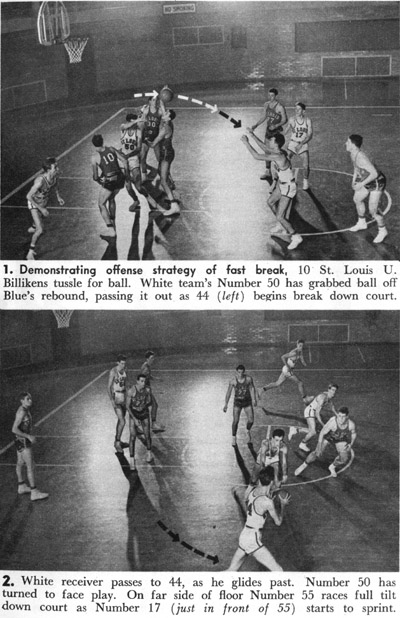
(2) The first time a team tries to penetrate the defense:
The first plays of a basketball game are searching plays; one team is testing the other, trying to find weaknesses. The first definite, offensive play may be a "fast break," designed to score early, draw first blood, overwhelm the other team and shake its poise. It may be a series of tricky passes and switches, designed to proclaim a cocky confidence. Whatever it is -- if it goes through, it establishes a real sense of security for the five men who have made it click. The first score may be important -- not so much for the initial two points as for the psychological advantage it gives the scoring team.
(3) When the ball goes up on the board but does NOT fall into the basket:
This is going to happen in the first moments of the game; watch for it, because it will be a token of things to come. Basketball is a game of possession, and the vital changes of possession occur on rebounds.
The ball is teetering on the edge of the hoop. If it doesn't go in, will the offensive team be able to tip the ball in on the rebound? Will the offensive team control the ball, or is the recoverer immediately smothered by his opponents, so that the referee is forced to call it a "held-ball"? If the opposition wins control of the rebound, will it show courage by long passes and fast breaks?
If those possibilities had been fixed in your mind, and if you had been one of the 18,000 spectators at the National Invitational Championships at Madison Square Garden in 1944, you'd have been one of the few who could tell right from the start that underdog St. John's had an excellent chance that night against the favored DePaul University five. For in the very first rebound play, DePaul's George Mikan (one of the country's greatest all-around players in the last few years) saw his usual backboard monopoly broken by St. John's young center, Irv Summer.
Here's what happened -- and here's why the first rebound is a clue to the final score:
Joe Lapchick, St. John's clever coach, realized that six-foot-nine Mikan's big hands and fine timing enabled him to slap in rebounds from almost every angle. So he assigned his spirited freshman pivot, near-sighted Summer, to a monkey-wrench job. "Play between Mikan and the basket," were Summer's orders. "Jump with him on every rebound play, but never try to catch the ball." The job of snatching the ball from the big DePaul star was assigned to two other St. John's men.
Summer did his job well. Mikan, a game player, tried again and again to get out of the trap; but somehow Summer was always occupying space between him and the ball. Blame DePaul's loss on that one tactic, for lose they did, 47-39. It was all there to predict the first moment the ball didn't go through the hoop.
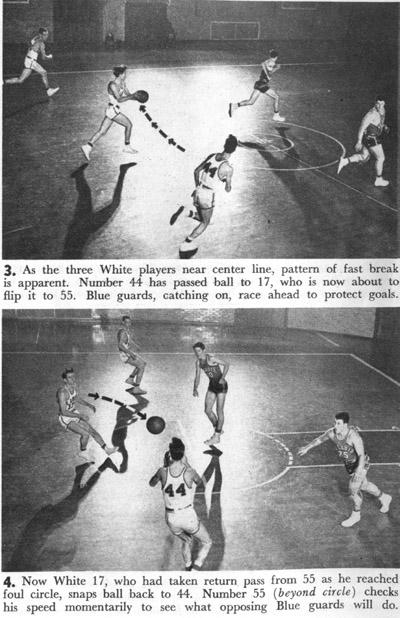
(4) When the defending team gets the ball for the first time:
When you watch a basketball game, you're probably prejudiced. You're all in favor of Old Siwash. But don't keep your eyes riveted on your favorites. Before the game begins, study the opposing players' heights and weights. If the team lacks tall men, for example, it will generally rely on sprints and long passes -- the "fast break." Bigger teams use shorter passes and wait for their tall men to go into a double-pivot position, where they'll act as the hub for passwork that continues until a third man can sneak close to the basket. Then it's simply a matter of a "feed" shot and a lay-up.
The first time the defending team has the ball, you'll learn whether or not they plan to keep to this logical pattern. Perhaps they'll be frightened into new methods; perhaps this will show that the logical method works. Either is important. Equally important -- here, for the first time, you see the defense put up by the team that won the tap-off. Now you can make your comparisons -- and weigh your team's chances.
(5) The first time-out:
The one vital question is this: which team was forced to call for a breather? The team that asks for a resting spell confesses that it can't keep pace with the enemy -- and any such admission, however slight, is harmful in sports. A player is often just as good as he thinks he is. A team -- likewise. Supreme assurance characterizes the champ.
On the other hand, a captain may judiciously decide to sacrifice this psychological advantage in order to huddle with his mates and possibly change their style of play. It's important for you to notice how a team reorganizes after a time-out, to see if it has been reinforced in spirit and tactics as well as in "wind."
(6) The beginning of the second half:
Unable to speak to his team throughout the first half, the acknowledged brain-truster -- the coach -- can finally get to his club in the locker-room during the 15-minute intermission.
The words he speaks then (and how we coaches realize this!) are often the words that decide the contest.
You can't get in the locker-room, of course; but just watch the boys during the first half-minute of play when the game is resumed! You'll quickly see whether the team was told to try a new approach -- and what effect this may have on the opponents.
An example: In a crucial game for the professional Basketball Association of America championship last spring, the Baltimore Bullets were 21 points behind the defending champion Philadelphia Warriors at half time.
But the underdog Baltimore five came back for the second half with a verve so strong it seemed to send out waves of electricity. In the second half they climbed from behind to trim the Warriors, 66-63.
I wanted to learn the words of the magic pep-talk that Player-Coach Buddy Jeannette had used. I thought they might be useful in my own locker-room on some future occasion. And last month I found out what they were.
"Boys," Jeannette had said, "go out there and win. If you don't -- every one of you is fired!"
| ADOLPH RUPP
. . .co-coach of the championship Olympic Team of '48, has been guiding University of Kentucky basketball teams to victories since 1930. His teams have chalked up 317 wins to 67 losses, so Prentice-Hall's title for his new book seems particularly apt: Rupp's Championship Basketball. |
(7) When the first man on the court shows he has tired:
Basketball's probably the fastest game of them all. We coaches dread the moment when we see one of our boys weaken and falter. If he stays in, his opponent will core. If he goes out, a substitute must try to mesh with the team -- and usually substitutes aren't as' good as starters. The first sign of weakness is a tip-off to you, to the man's team-mates and, most important of all, to the opponent. Watch for signs of weakness.
(8) The last three minutes:
Basketball is a game that's good to the last drop -- of the ball. And especially in a close game, the pressure becomes tremendous in the last three minutes of play. This is the period in which all out-of-bounds balls, fouls and other "dead balls" stop the clock, so that a maximum of action is crammed into the crucial session. Some teams have shown superb poise and ballhandling skill for 37 minutes -- and then, in the last three, have gone wild. Some teams that have been pressing all the way suddenly retreat behind a paltry four-point lead in the final minutes.
Somehow, those last 180 seconds always produce at least one amazing play that makes people rush to buy the next day's papers for corroboration. Certainly the most sensational of all such turn-the-tide plays was the last-second heave made by Ernie Calverley, the Rhode Island ace.
From 55 feet out, Calverley's underhand throw arched up near the Madison Square Garden rafters and came down through the netting without even touching the rim, even as the buzzer was sounding. That tied the score at 74-all; but after such a display, not a single fan was surprised when Rhode Island went on to win in overtime, 82-79.
Incidentally, that triumph moved Rhode Island into the finals of the National Invitational Tournament of 1946-7, and our University of Kentucky team had one tough evening nosing them out by the score of 46-45 to win the title . . .
You've heard the lecture, now, on what to watch. But let me warn you: never put too much trust in any guess, no matter how well-informed it may be.
With five seconds to go in a game played in Idaho, one of the players gained possession of the ball. His team's lead of 35-34 was too slim to suit him, so instead of freezing the ball he tossed it at the hoop. The ball went in, clean and smooth -- but it went through the wrong basket! Instead of winning by one point, the team lost by one point: 36-35.
"That's the trouble with basketball," some folks say. "It's so fast a game you can never figure it out!"
Return to Kentucky Basketball page, Kentucky articles, statistics, team schedules, team rosters, opponents, players, coaches, opposing coaches, games, assistance or search this site.