
Written for Maple Street Press Wildcat Tip-Off 2011-12 (Never published)
by JON SCOTT
Introduction
When John Calipari became the coach of the University of Kentucky, he ushered in a new era of players leaving the school early for the promised riches of the NBA. Calipari's first UK squad (2009-10) saw freshmen Eric Bledsoe, DeMarcus Cousins, John Wall and Daniel Orton along with junior Patrick Patterson all leave school with eligibility remaining. All were drafted in the first round, a record. The 2010-11 team saw freshman guard Brandon Knight and junior DeAndre Liggins enter their names in the draft where they were picked 8th and 53rd respectively.
 |
The situation is fueled by powerful player agents and NBA teams looking to sign the next superstar. The current one-year rule was put in place in 2006 partially to avoid costly mistakes when NBA general managers couldn't stop themselves from drafting unproven talent. Prior to the rule, an increasing number of high school players were opting to skip college completely. The rule hasn't stopped this progression, only delayed it. While John Calipari has publicly stated his opposition to the rule, he and other college coaches have been able to adapt and benefit from it.
The decision to forego collegiate eligibility and place your name in the draft can be a complex decision based on numerous factors. While some fans only consider the effect players leaving has on team's chance to contend for a national title (which can be monumental), to the player it goes further than simply staying loyal to the program. It's a balance between loyalty to the school and loyalty to himself and his family's needs.
Oftentimes it's a decision driven by raw financial need, while in other cases it's a business decision based on expected draft position in the current draft as compared to the following year's draft (which in part depends on how much one can improve his game in college as compared to the pros.) The intricacies of the NBA rookie pay scale and free agent rules serve as a backdrop. Added to the complexity are the non-basketball factors such as the emotional and social maturity in leaving the college atmosphere to live on your own and eventually succeed (or flounder) at the professional level.
A Very Early-Early Entrant
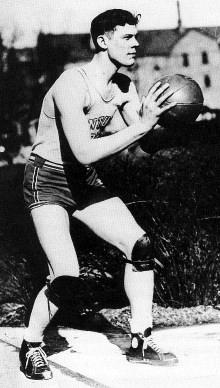 |
After his sophomore season, Edwards returned to his hometown of Indianapolis, IN where he had been offered a job working for the US Tire Company and playing on the company basketball team, which participated in a Midwest Basketball industrial league.
Despite being in the depths of the Great Depression, it was unusual for players to leave college early for the pros. Most professionals at the time either stayed in college until they graduated or never went to college to begin with. According to Adolph Rupp, Edwards was offered $2,400 to turn pro, which was good money at the time, especially considering that Rupp himself was only making $2,800 as UK's head coach.
In 1937 Edwards signed with the Oshkosh (WI) All-Stars of the National Basketball League where he became a perennial NBL all-star and the league's leading scorer numerous times.
During the very first National Professional Basketball Tournament in Chicago in 1939 (a tournament Edwards and the Oshkosh All-Stars lost to the New York Rens in the championship game) Edwards met up with his former coach Rupp and joked "If me and you had stuck together, we'd have went places."
Other Hardship Cases
In 1971, the NBA began to allow college players to leave school early under the "Hardship" clause. This came about in response to a lawsuit filed against the league by Spencer Haywood who left college after two seasons and was subsequently blackballed. Under this new rule, players could enter the NBA early if they could demonstrate a financial need. Such players were not entered into the regular draft, instead they were chosen from a supplemental pool. A team making such a pick forfeited a corresponding pick the following year. This rule was later amended in 1976 to allow early entries into the regular draft, regardless of need.
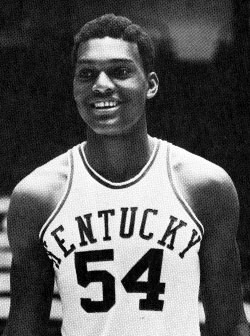 |
Payne would not return for his junior season however. Recently losing his father and with a young family to support, Payne made himself eligible for the Hardship draft. He was the second player picked by the Atlanta Hawks.
The following season Kentucky was short on players, with the loss of Payne being felt most severely. Complained Rupp to Dean Eagle of The Louisville Courier-Journal, "If we still had Tom Payne, we would be undefeated".
In 2005, Kelenna Azubuike declared for the NBA draft after his junior year and signed with an agent in order to help pay legal bills and restitution for his father, Kenneth Azubuike. The elder had been found guilty of fraud and sentenced to four years in jail and required to pay back more than $330,000.
Many believed that Azubuike was making a mistake and that he left school before he was ready. Apparently NBA scouts agreed since he went undrafted and didn't catch on with a team as a free agent. Rather than starring for Kentucky as a senior, he found himself playing two seasons in the D-league. It was the D-league where he finally started to turn heads. Through hard work and perseverance, eventually Azubuike did catch on with the Golden State Warriors. "I knew I was going to get there eventually, it was just a matter of time," said Azubuike at the time.
Other Trailblazers
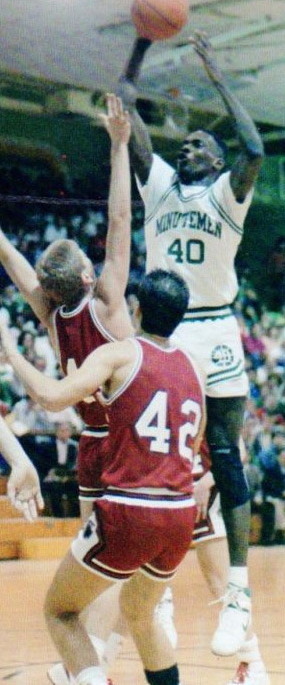 |
That spring Kemp entered the NBA draft without playing basketball at the college level; which at the time was very unusual. He was drafted 17th by the Seattle Supersonics and even then, many questioned the pick given his lack of experience. As it turned out, Kemp proved to be a steal as he quickly became a budding superstar.
The example of Shawn Kemp was one of a number of pivotal turning points in how NBA executives and scouts approached the NBA draft. After Kemp, teams were much more willing to put a premium on talent and Ôupside' at the expense of collegiate experience. This trend was only hastened in following years by the success of high school players including Kevin Garnett and Kobe Bryant.
In 1994 the NCAA passed a resolution intended to retain talented players in college for longer times. The resolution allowed players who entered their names into the draft pool to withdraw and still return to school with their eligibility intact. The idea was for players to participate in workouts and get direct feedback from NBA scouts in order to make an informed decision, rather than rely on questionable sources. Some Kentucky players have done just that, including Jamaal Magloire, Tayshaun Prince, Keith Bogans and most recently Terrence Jones who all tested the system before returning to school. The system is not without its risk though. In 1995 Rodrick Rhodes announced his intention to enter the draft after his junior year at Kentucky. By the time he realized his draft position wasn't what he expected, Kentucky had already filled the scholarship spot with incoming freshman Ron Mercer. Rhodes transferred to Southern California for his senior year.
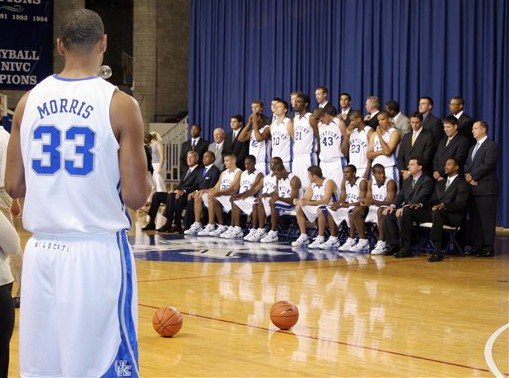
UK center Randolph Morris took the process to its limit and beyond. After his freshman year in 2004-05, Morris faxed his decision to test the waters (while still intending to maintain his amateur status) into the UK office. This incited some to criticize him for his impersonal method or informing the UK coaching staff. His decision also surprised many given his mediocre season in Lexington. Despite lackluster workouts and advice to return to UK, Morris remained in the draft but failed to be drafted by any NBA team.
Generally when a player enters the draft with little chance of being chosen, it's a sign that his intention to return to college is moot, whether due to a need to make money immediately or academic deficiencies. Beyond that, they typically hire an agent, making them automatically ineligible. In Morris' case, these were not factors and he petitioned to be reinstated at Kentucky. This left the NCAA in uncharted waters. After much delay and a significant amount of documentation provided by the school (including the infamous fax), Morris was eventually reinstated to the team although he sat out the non-conference portion of his sophomore year as punishment.
Morris returned once again to Lexington for a productive junior year, and once again made himself available for the pros after the season was complete. Since he had gone undrafted two years previously, he was no longer draft eligible. After Kentucky's schedule was finished, the New York Knicks picked him up late in the pro season as a free-agent where he saw spot minutes in a handful of games. This makes Morris one of only a few players in NBA history to play both collegiately and in the pros during the same season.
 |
Another player who never played for UK but was on the team and eventually left early for the pros was Enes Kanter. Kanter came to Kentucky from Turkey after winding his way through various American prep schools. The NCAA had specifically enacted a rule which allowed players who played for professionally-run club teams to still play collegiately, as long as they had not received a salary (although cost of living benefits were permitted) and maintained their amateur status. Kanter, who always maintained his desire to continue his education while honing his basketball skills, took advantage and signed with UK in the spring of 2010 after earlier verbally committing to Washington.
While Kanter's family took great pains to document and account for any benefits he received as part of the Fenerbahce club team, the NCAA eventually ruled that the benefits were excessive, and ruled him "permanently ineligible". To his credit, Kanter remained at UK and finished his coursework rather than immediately bolt for a pro contract, which directly contradicted numerous critics who assumed he was only interested in a paycheck.
Before the NCAA's decision, Kanter had expressed a willingness in returning to UK the following year even if he had to sit out his entire freshman season. With the NCAA closing the door to someone looking to further his education along with preparing for a career in sports, Kanter was left with no other realistic option but to declare for the NBA draft. He was chosen with the third pick in the 2011 draft by the Utah Jazz.
Nothing Left to Prove
Most UK players who chose to leave UK early did so after reaching their potential collegiately, and were ready to take on a bigger challenge in the NBA.
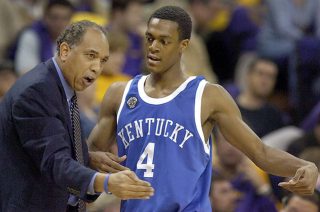 |
Others who realized their potential at UK included Jamal Mashburn and Ron Mercer. They each attained consensus first team All-American status and had nothing left to prove at the college level when they entered their names into the draft. Mashburn is credited with being a major factor behind Kentucky's resurgence after probation in the late 1980's while Mercer as a freshman led the team in the 1996 national title game against Syracuse and came within an overtime of repeating in 1997.
Antoine Walker (1996) and Nazr Mohammed (1998) also played important roles in Kentucky winning national championships. They could have returned and played even larger roles the following seasons, but chose to follow their NBA dreams.
Conclusion
While it may seem that players leaving early are a recent phenomenon, it is something that Kentucky has experienced for many years, and even decades. It's a phenomenon that is closely tied to the rules and drafting habits of the NBA.
As long as John Calipari and Kentucky recruits at the level they've been for the past few years (and as long as the NBA allows it) there will continue to be early departures from the campus on a continual basis. It's the nature of big-time college athletics in the modern era. Kentucky fans may not like it, but they should at least become accustomed to it.
Return to Kentucky Basketball page, Kentucky articles, statistics, team schedules, team rosters, opponents, players, coaches, opposing coaches, games, assistance or search this site.