
Published in Maple Street Press Wildcat Tip-Off, 2009-10, pp. 113-116.
by JON SCOTT
Sometime during midseason of the 2009-10 collegiate basketball schedule, a milestone will be reached when for the first time in college basketball history a program will record their 2,000th victory.
For many years it looked like the University of Kentucky would be a shoo-in for the honor, given the significant lead in all-time wins they had amassed since the mid-90's. Last year the UK Athletic Department launched a webpage dedicated to the event (http://www.ukathletics.com/w2k/ ), and lined up sponsorships for it during a time when Kentucky still enjoyed a comfortable lead, even though the Universities of North Carolina and Kansas had made up significant ground in recent years.
Kentucky looked to have the race in a delicate but manageable position early in the 2008-09 season but a late-season swoon has put the cushion in jeopardy just as the 2,000-win mark is coming into sight. Missing out on an NCAA bid for the first time since the early 90's, Kentucky received a gift when they accepted a NIT bid and turned that into two extra post-season victories. Meanwhile after the North Carolina Tar Heels won the 2009 National Championship game, they stood only 4-games behind Kentucky in all-time victories 1988 to 1984. Kansas is also relatively close with 1970 victories to their credit.
 |
Many Wildcat fans may have grown accustomed to Kentucky being the all-time leader in victories. Kentucky after-all has led for most years since 1968-69, with the only lapse occurring during the early 1990s. This was a time when UK was digging out from probation and the North Carolina Tar Heels overtook them for six years (only to see the Wildcats take back the #1 position later in the decade when Kentucky beat a Tim Duncan-led Wake Forest team in the 1996 NCAA Tournament). But it hasn't always been that way.
In the early part of the century, the leaders in wins came primarily from Eastern schools. There were some exceptions as talented coaches of the new sport began to fan out across the country and build powerful programs in their own regions. The Eastern influence should not be surprising given that these schools generally started playing the game earlier and also placed an emphasis on the game as compared to many other regions of the country at the time.
Temple University was likely the first school to assume a commanding lead in wins as they racked up a significant number of victories in the 1890's, a time when the sport of basketball had recently been invented and most schools (including Kentucky) had yet to field a team. The Owls held the lead until Yale overtook them in 1905.
According to Gary Johnson, head NCAA statistician of NCAA Division I basketball, Fordham overtook the all-time wins lead from Yale in 1925 followed by the University of Pennsylvania in 1934. The Penn Quakers were the first to hit the 500 victory milestone in 1936 and continued to hold the all-time win record until 1942 when Fordham briefly retook the lead only to be eclipsed by the University of Kansas the following season (1943).
From that point on, Kansas and Oregon State leap-frogged each other for the top spot over the course of 25 years only to be joined by Kentucky in the mid-1960's.
For their part, Kentucky was a relative late-comer to the upper echelon of college basketball powers in terms of all-time results. The first decade worth of seasons, the Cadets (as they were called then) had no coach and followed a schedule set up by the team manager. Predictably their record was uninspiring, as they had only one winning season prior to 1912 (a year coach Edwin R. Sweetland led the team to a perfect 9-0 mark).
Thereafter the program always had a basketball coach, even though they typically performed double duty as an assistant for the football program and at times the job duties were handed off to a graduate assistant. Even after a full-time basketball coach was installed, the Wildcat program's fortunes were a mixed bag until the late 1920's after John Mauer, and more significantly Adolph Rupp assumed the head coaching position. It was under Rupp that Kentucky became a national power and consequently their place in the all-time wins order rose out of obscurity.
According to currently accepted records, the Wildcats entered the top-10 in all-time victories in 1949, the same season Rupp and Kentucky were celebrating their second NCAA Championship. Coincidentally tied with them for tenth place was the University of North Carolina.
(The Tar Heels had started playing the sport in 1911, eight years after Kentucky did so and after most other schools along the East Coast. Despite the late start, UNC quickly made up ground, primarily in the 1920s when they boasted a number of highly regarded squads. By 1924, North Carolina had passed Kentucky in all-time wins as they were en route to a perfect 26-0 record and Southern Conference championship.)
Kentucky continued to win under Rupp and streaked up the all-time charts. By the 1960s they were vying for the top spot alongside Kansas and Oregon State. When the 1968-69 season was ready to begin, all three schools were within striking distance of the 1,000 victory milestone. This was much like today's race to 2,000 victories but even tighter, with all three schools within 4 victories of each other under the accepted victory totals at the time (although the actual win totals have since changed).
The quest for 1,000 victories quickly became a two-team race as Oregon State lost eight of their first 13 games and dropped out of contention. Meanwhile both Kentucky and Kansas were streaking toward the mark with UK dropping two games early on and KU dropping only one. But just as the goal within reach at 997 victories, Kansas inexplicably dropped two straight games, one to an Iowa State team they had beaten previously by 33 points. To make matters worse, they had loaded up their schedule early on (playing three more games than Kentucky had) and were due for some downtime. The Jayhawks could only sit idly by and watch Kentucky claim the crown in January of 1969.
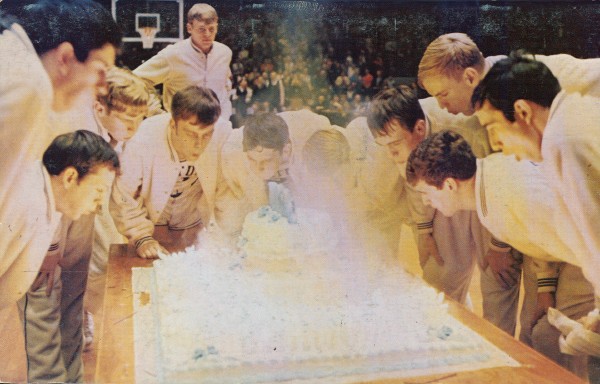
The Wildcats celebrated their achievement by wheeling a cake adorned with 1,000 candles onto the court. When the candles were lit the heat was so intense that the team members had to rush the court and blow them out before the icing melted. Former lettermen representing all previous decades were invited to the celebration, along with other dignitaries.
 |
The quest to 1,000 victories was not without its controversy at the time. Kentucky had actually claimed the record five games earlier as they had counted five victories in international games they had won during a tournament in Israel in the summer of 1966. The NCAA refused to count these as official games even though it was the organization that invited Kentucky to participate in the tournament. Rupp reportedly commented about the games "If they weren't important enough to count, why did they send us?" As it turned out, the NCAA's stance was advantageous to UK as Oregon State had also won a significant number of international exhibitions, games the NCAA also refused to count.
 |
Another issue at the time was that just as the mark came into focus, Kentucky finally got serious about critically looking back at their historical record. It was just a few seasons before that the school had thought the first basketball season at the school was in 1905, when in fact they had begun earlier in 1903.
A large part of the problem was that documentation of early games was incomplete and media coverage hard to find. For example in an article from January 1969 Lexington Leader, Wylie Wendt who had been a team manager for the 1906 squad admitted that he had failed to include all the games Kentucky had played in the school yearbook. Upon inspection, twenty games had originally been scheduled for that season but records for only 12 could be found. This was not atypical of the quality of early records. To make matters worse, if there was a record of early games, they likely were washed away during the flood of 1928 when the UK basketball office (located in the basement of Alumni Gymnasium) was flooded.
 |
It is worth noting that adjustments to the official won-lost records of schools is commonplace. NCAA head statistician Gary Johnson mentioned that he receives adjustments to school's all-time records 'every couple of weeks', a practice that he encourages. Of all the schools vying for the top mark at the time and today, each one has had their record adjusted at some point as record-keeping gets better and basic research into the early years of programs is completed.
Unfortunately for Kentucky and Mr. Rice, it only becomes news when one of the leaders makes an adjustment, such as during the race for 1,000 victories when Kentucky was criticized for updating their results. Similarly, news was made in July 1990 when Kentucky adjusted their record to account for a game in 1914 against the University of Louisville that pulled them into a tie with North Carolina for the all-time record. A year later after conducting basic research of their history, the University of North Carolina adjusted their record to include five victories and one defeat not previously recorded.
 |
As the 2009-10 season progresses and the mark comes into sight, it will be interesting to see if the race tightens along with how much media attention it will receive. In all likelihood, the national media attention will be inversely proportional to the margin between Kentucky and North Carolina. That is the closer the two schools are to each other as the mark approaches, the more media exposure will be generated. Conversely, if the margin remains the same or widens in favor of UK, then the less national interest will be shown.
Some will question the importance of being first to reach the 2,000-victory milestone. While it doesn't compare to a championship or even being the all-time wins leader, what sets the mark apart from many other achievements is that it can only happen once in history by one school. Most Kentucky fans would rather have UK set the mark, rather than see a rival such as North Carolina sneak by and beat them to it. Especially since it serves as a book-end to Kentucky's 1,000-victory milestone.
If history is any guide, it's clear that fortunes change as the years progress. Judging from results of the past 50 years and considering each program's current status, Kentucky, North Carolina, Kansas (and potentially Duke) all will be vying for the overall wins lead for decades to come. It wouldn't be unusual to see the lead change hands numerous times over the coming years. It's the shifting nature of this never-ending race which gives significance to a permanent mark such as reaching 2,000 victories.
Let's just hope that if Kentucky does indeed reach the milestone, they think long and hard before lighting a cake topped with 2,000 candles!
 |
Return to Kentucky Basketball page, Kentucky articles, statistics, team schedules, team rosters, opponents, players, coaches, opposing coaches, games, assistance or search this site.