
There are two rules: First, most high-school stars have a price; second, after you've closed the deal, hide the player, because he may be stolen before you enroll him. Or even afterwards
Published in Look Magazine, January 29, 1952, pp. 58, 60-61
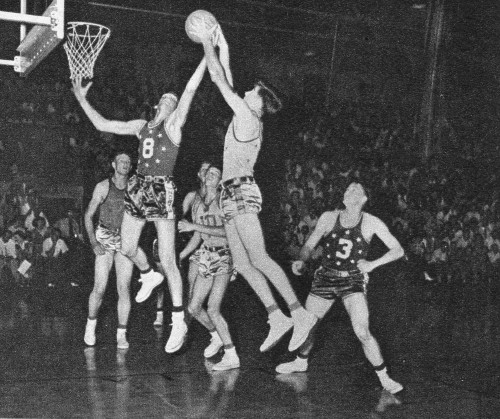 |
| Mecca for basketball recruiters: Annual North-South game at Murray, Ky., each June brings together nation's top high-school players. |
by TIM COHANE
RALPH Beard. Alex Groza and Dale Barnstable, former Kentucky basketball stars, will stand trial soon, charged with selling out to gamblers. One of the games they allegedly threw was Kentucky's "upset" by Loyola of Chicago in the 1949 National Invitation Tournament at Madison Square Garden.
In June, 1950, over a year after that game was played and over a year before it was declared venal, Kentucky coach Adolph Rupp's assistant, Harry Lancaster, attended the coaching school which used to accompany the North-South all-star high-school basketball game held each June at Murray State College, Murray, Ky. Also at Murray clinic was Clair Bee, who used to coach a team at Long Island University.
At the time, neither Lancaster nor Bee knew Kentucky players would be charged with throwing the Loyola game. They were blissfully unaware of the wholesale basketball scandals to come, that would also involve some of Bee's LIU players. Therefore, what passed between Bee and Lancaster at the Murray clinic was, among other things, ironic. Bee got up to speak. "I have seen some examples of crazy coaching in my day," he began, "but one situation in particular comes to my mind. In the Inyitation last year, a big guy named Jack Kerris of Loyola was running wild against some ball club - I can't exactly remember the name. Anyway, the coach of this team thinks one man should stop another all the time. He kept playing his center, Alex Groza, behind Kerris, who possesses a fine windmill shot.
"Despite Groza's efforts, Kerris continued to score. He could have been stopped, if the coach of Groza's team had had sense enough to change his defense. But he didn't. He had the best ball club in the world-but he proved himself the worst coach.
"Somehow," laughed Bee, "his name escapes me."
The clinic laughed 'heartily with Bee. But Lancaster did not join in. He rose.
"Mr. Bee," he said, "we bow to your efforts. Now, will you explain to us why Mr. Rupp, by your admission the world's worst coach, manages to lose only once or twice each season, while your genius finds your own team losing eleven times last season?"
"That's easy," snapped back Bee. "We haven't the money to buy the horses!"
The clinic went into an uproar. Class was out for the day.
Talk of "money" and "buying the horses" in college basketball is not the least apocryphal. Consider the case of David Gotkin. Gotkin, a Brooklynite, was courted by a score of schools, including St. John's, Navy, North Carolina State and Kentucky. Kentucky offered Gotkin everything except a half interest in Rupp's prize breeding bull, Domino.
A Textile Job for Gotkin
"You're wasting your time, Adolph," said Frank McGuire, St. John's coach. "Gotkin wants to go to Navy. He can't be had."
Rupp drew himself up in baronial hauteur. He reached into his pocket, extracted a couple of greenbacks and brandished them. "Anybody can be had," boomed Adolph, "if they are shown enough of this stuff!"
Rupp and McGuire both were wrong about Gotkin. He didn't go to Kentucky or Navy. He's a freshman at North Carolina State, coached by Everett Case, whose assistant Carl '(Butter) Anderson is a nice recruiter indeed.
In choosing N. C. State, Gotkin shopped wisely. He was promised, among other things, a job after graduation in the textile industry in New York.
Another interesting case is that of B. H. Born, 6-feet-8 citizen of Medicine Lodge, Kan. Born plays for the University of Kansas, coached by Dr. Forrest C. (Phog) Allen. In prescribing cures for basketball's sores, Dr. Phog is the very epitome of windy piety.
Born's choice of Kansas astonished Eddie Hickey, the busy little barrister who coaches the University of St. Louis. Hickey corresponded regularly with Born. B. H. came down from Medicine Lodge to visit St. Louis. He was permitted to drive Hickey's sleek black convertible in downtown traffic. But B. H. is enrolled at Kansas, and it is perhaps only coincidental that his mother was at the time employed by the state.
Dr. Phog's legates also make it very attractive for out-of-staters. His 6-feet-9 center, Clyde Lovellette, appropriately comes from Terre Haute (French for high ground), Ind. Chuck Hoag, a star forward, is from Oak Park, Ill. Dr. Phog does not, however, corral them all. Even good Kansas stock occasionally eludes him. Clay Gray, from Newton, Kan., 6 feet 7, 220 and an honor student (there are some honor students playing basketball), succumbed to the attractions of the University of California's alumni.
The loss of B. H. Born to Kansas did not kill basketball at St. Louis U. Hickey used to stay close to home; his 1948 champs did not include anybody outside greater St. Louis. But since dropping football, this Jesuit school has extended its basketball recruiting through Missouri, Illinois, Wisconsin, Nebraska, the Dakotas and even Kentucky. Any time a school has more than 30 players on basketball scholarships, it should produce a winning team.
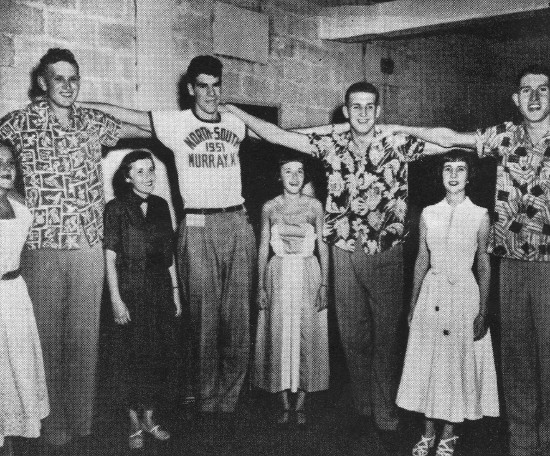 |
| At the 1951 Murray North-South games, high-school stars included Don Dalton, Friendship, Okla.; Bill Simonovich, Gilbert, Minn.; Charles McCullough, Baltimore, Md.; Keith Lane, Borger, Texas. Simonovich is 6 feet 9 1/2; the others 6 feet 6 or more. The girls are coeds at Murray State. |
Hatfield-McCoy feudin' swirled around Tom Marshall, a 6-feet-4, 200-pounder from Mt. Juliet, Tenn. Tom shopped for offers. He signed a Southeastern Conference grant-in-aid agreement for Coach Bob Polk of Vanderbilt. This meant that no other SEC school could touch him, not even Kentucky. To get Marshall away from Vanderbilt, "Der Baron" Rupp worked openly to see that Tom got better offers from schools outside the SEC. Tom got them.
Finalists for the services of Marshall were two powers of the basketball-rugged Ohio Valley Conference: Western Kentucky State College of Bowling Green, Ky., and Murray State College. Western Kentucky is coached by Ed Diddle, Murray by Harlon Hodges. Western has achieved national recognition by participation in the Invitation Tournament in New York. Murray would like to. They are bitter rivals.
In the summer of '50, Marshall went to work in Bowling Green. Murray businessmen, using a Nashville newspaperman as agent, brought Marshall to Murray and wooed him over a week end. Tom remained true to Western Kentucky. Presumably, Murray couldn't top what he reportedly gets at W. K.: the full ride-board, room, tuition and books, that is - plus a more-than-nominal monthly stipend.
Diddle's Didoes
Western K.'s Coach Diddle, in excitable moments, is notorious for flinging towels into the air in front of his bench like a demented steam-bath attendant. When Diddle heard about Murray's trying to filch Marshall, he tossed seven linen closets full of Turkish towels over the moon. He also chewed them.
This season, Diddle. more than got even with Murray. Lynn Cole, all-stater from Paducah, Ky., worked at Murray all summer. Three days before enrollment, he was spirited to W. K. and is a freshman there now. He gets, by his own admission, the same as other frosh basketeers: the full ride plus $30 a month.
Diddle doesn't always get his man. Joe Fulks, now a Philadelphia Warriors star, was coached at Kuttawa, Ky., High by a Western Kentucky grad and appeared headed for W. K. Two weeks before enrollment, he vanished from Bowling Green. By the time Diddle.found him, he was registered at Murray.
Rupp Barged In
Diddle also lost Ralph Beard and Wallace (Wah Wah) Jones to Kentucky. Rupp was closeted with Beard and Wah Wah in an Indianapolis hotel room after midnight. They were in Indianapolis for a Kentucky vs. Indiana All Star game. The Kentucky All Stars, in this game and in a similar one against Ohio, are coached by Diddle every year. Naturally, he was galled at losing Beard and Wah Wah.
"They were supposed to be sleeping, storing up strength for the game next day," says Diddle, "but that didn't stop Rupp. He barged right in."
Despite its high-powered recruiting and subsidizing, Kentucky actually lost a star once by misplacing a letter. A friend wrote Harry Lancaster about a boy named Bill Mlkvy. The letter got inadvertently pushed into the space between the back of Lancaster's desk and the wall. By the time Lancaster located and answered it, Mlkvy had decided to go to Temple. Mlkvy is a star with the Owls. They call him The Owl Without the Vowel.
"I wanted to go to Kentucky," Mlkvy told Lancaster, "but when I didn't get an answer, I thought you weren't interested in me."
A Mlkvy incident happens only once in a lifetime. No tricks were missed by 49 colleges, actual count, in going after Tom Gola, an ace at La Salle College High School in Philadelphia. Forty of the 49 offers were better than La Salle College tendered. But Tom decided to stay near home and he's a freshman with the Explorers this season.
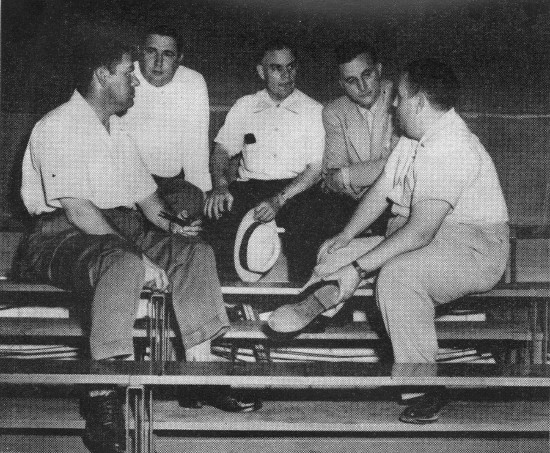 |
| Among college coaches seen at Murray games: Bernard (Peck) Hickman, U. of Louisville; Carl (Butter) Anderson, North Carolina State assistant; Eddie Hickey, St. Louis University; Clair Bee, Long Island U. Man on right: Edd Kellow, chairman of hte North-South selections committee |
Good Play, No Study
Over 20 schools solicited Ed Petrie, a whiz at F. E. Bellows High, Mamaroneck, N. Y. He finally chose Villanova. Petrie has a good mind and learns rapidly, but he was interested in nothing at high school except basketball and wouldn't study. Villanova still managed to fit him into a business administration course. He got board, room, tuition, books and spending money. But Petrie didn't care for the business course. He wants to become a coach. After three weeks, he left Villanova. He may enter Seton Hall at midyear.
Max Hooper, 6 feet 5, fast, from Mt. Vernon, Ill., was the subject of an all-out struggle between the University of Illinois and Bradley University of Peoria. Hooper played in the 1950 North-South game at Murray. Forrest (Forddy) Anderson, Bradley coach, and sundry Peoria businessmen flew to Murray in a chartered plane.
Anderson talked to Hooper, but himself made no offers. Those were made by the Peoria businessmen. Nevertheless, two weeks after the Murray game in June, Hooper was working at the University of Illinois. Western Conference rules prevent their coaches from attending all-star high-school games, but not their alumni.
Bradley's commandos didn't return from Murray empty-handed. They speared Pat Dunn, star from St. Patrick's Academy, Chicago. Forddy Anderson and the Bradley Boosters arranged the full treatment for Pat: money for his father, tuition, room, books, a $16-a-week meal ticket when he made the varsity squad, and $125 a month. Deductible from the $125 would be any amounts Pat earned as night watchman at the Peoria dog pound. A Bradley Booster also gave Pat the down payment on an automobile.
Pat's curriculum included elementary typing, advanced basketball, softball, swimming, track and field, community hygiene, personal hygiene~ recreational activity and English composition. He passed every subject but English composition, and made that up in summer school.
Last fall, Bradley modified Dunn's deal to room, tuition, books, the $16-a-week meal ticket, $15 a month and no job. Later, the Boosters got him his job back in the dog pound at $51 every two weeks. But in mid-November, Pat's paychecks stopped coming through. So he left Bradley, along with teammates Don Anielak and Dick Pikrone, who'd also lost some previous benefits. These boys will try to enroll elsewhere this month.
The Bard of Paducah
Bard Sullenger, Paducah, Ky., ace, left De Paul University of Chicago, mainly because his father thought that his board, room, tuition, books and job deal wasn't enough. N. C. State, which originally offered a sportswriter $100 to deliver Sullenger, is making eyes at him again.
Multiply by infinity these examples of rampant recruiting and subsidizing and you have the picture of big-time basketball.
Perhaps the college presidents will clean it up.
Perhaps
Return to Kentucky Basketball page, Kentucky articles, statistics, team schedules, team rosters, opponents, players, coaches, opposing coaches, games, assistance or search this site.