
Adolph Rupp's Kentucky Wildcats have won about everything in college basketball. But Adolph has been disqualified in popularity contests for not trying
Published in Look Magazine, March 1951, pp. 64-67
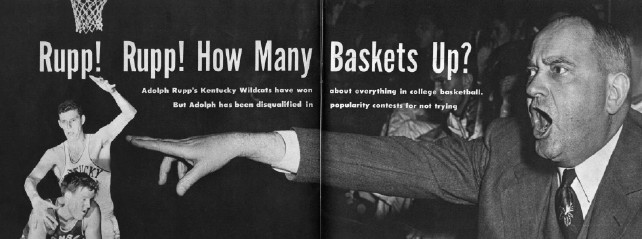 |
| "Dammit, don't go gettin' a foolish foul called," Coach Adolph Rupp warns Bill Spivey, his seven-foot star Kentucky center. Bill is guarding Clyde Lovellette of Kansas, who stands a comparatively diminutive six feet nine. |
by TIM COHANE
ONE-THIRTY a.m., yet lights glowed in at least half the homes in Kentucky. The sight, to the pilot of a plane flying over the state, was phenomenal. But the explanation was simple. Kentuckians were listening to a broadcast -- two hours' time difference -- from Seattle, Washington, of' the National Collegiate Athletic Association basketball finals between Oklahoma A.&M. and the University of Kentucky. The Blue Grass stay-up-lates went to bed happy because Kentucky won. Kentucky usually does.
Good bourbon hasn't more stamina, thoroughbred horses more speed and drive, comely women more points than basketball at Kentucky. Practically unbroken Southern dominance, national tournament titles, Olympic honors, a multitude of All Americans and a beautiful, new $4,000,000 Memorial Coliseum that can seat 13,500 all describe the expansive vitality of the sport at the institution in Lexington, 77 miles southeast of Louisville.
This success story has been written mainly by the Kentucky coach for 21 seasons, a large, blustering, balding Dutchman out of the Central Kansas wheat fields named Adolph Frederick Rupp. In a business as acutely competitive as coaching, personal popularity is about as useful as a second head. Although a second head is something the more intractable of Rupp's battalion of enemies believe would ride suitably atop Adolph, he actually has only the usual number. But he has never bothered to handicap himself in his profession by trying to exude an aura of good-fellowship.
Rupp goes around in a perpetual state of bellicose excitement -- sometimes assumed because he knows that by now it's expected of him. He has a genius for antagonizing officials, opponents, newspapermen, his own players and, it seems at times, even himself. To perpetrate a pun perhaps unworthy of Adolph, he Rupps people the wrong way.
Many coaches can be ungracious in defeat. Rupp occasionally manages it in victory. After Kentucky beat St. John's in New York this winter, Adolph publicly scorned the Redmen's slow-down tactics,' declaring such stuff would ruin basketball by killing off interest.
After the latest New York basketball scandal, Rupp announced that Kentucky's arch rival, Tennessee, .would play no more in Madison Square Garden. Apprised of this gratuitous bulletin, Tennessee's Coach Emmett Lowery said it wasn't so. He probably added: "What business is it of Rupp's anyhow?"
Rupp has a chronic impatience with time. From a sackful of watches, part of a 25-year trophy hoard, he wears a wrist piece that ,can function as a stop watch. If a trip is scheduled for 2:30, 2:28 finds Adolph clamoring for the take-off.
Following a defeat at Notre Dame, where Kentucky never has been able to win, Rupp and the players waited in their bus for an accompanying Lexington newspaperman to finish his copy. The defeat, his natural impatience and the need for making connections with a train were whipping Adolph into a froth. He loudly hectored the driver to get going. The writer barely made the bus and got his coat caught in the door slam. When the driver reopened the door, Rupp exploded. So did the writer. He refused to travel with the team again and his long-time friendship was lost to Adolph.
Kentucky travels mostly by plane; train berths pose problems for such high-altitude stars as seven-foot Bill Spivey. Approaching La Guardia Field recently, the pilots were forced by an overcast to keep circling and wait for a breakthrough. Rupp stalked up to the cabin.
"What's the matter?" he roared. "You fellers lost ? Why can't we go down ? We been goin' 'round and 'round ! Liable to land in Canada ! Or in the sea ! Git this dam' thing down on the ground !"
When he is not up in the air figuratively, Adolph can dispense a charm that drips saccharine, especially on a known enemy. In such golden moments, he fits his nickname, "The Baron." This sweetness is not always spurious. Adolph does harbor a deep, if sequestered, well of sentiment.
Asked for a raise, he will bristle, yet he delights to hand one out unexpectedly. Adolph played basketball for Dr. Forrest (Phog) Allen at the University of Kansas 26 years ago. To pay his way through school, he worked in a restaurant, and Allen recalls no lackpurse student went hungry while Adolph was behind the counter.
Rupp dotes on his 11-year-old boy, Adolph Jr. He is active in local Shrine Hospital work and genuinely disturbed when crowded bed space delays the entrance of a child needing care. Unusually severe with his players, he can develop a positive fondness for some of them. Currently, he beams about Cliff Hagan, a sophomore. That Cliff is a dazzling prospect -- six feet four, 210, smooth -- doesn't hurt.
Adolph revels in a platonic friendship with probably his most prized possession, a complacent, benign, but thoroughly competent white-faced Hereford bull named M. W. Domino 65. The most violent eruption in Rupp's volcanic career came when Adolph bit at a gag involving Domino. The coach was luxuriating in a victory away from home when his assistant. Harry Lancaster, gravely informed him of a wire from Lexington that said Domino had caught his posterior elements in a wire fence.
Before the St. John's game, Rupp was typically restless.
"Horry," he moaned to Lancaster, "must be easier ways of makin' a livin'. I wished I was back in Lexington. I jes' know ole' Domino would be glad to see me."
A mixture of native Kansas nasal twang and an acquired Southern drawl gives a strange flavor to Rupp's talk. An authentic sense of humor, an acquisitive memory and an ease in delivery make him a sought-after public speaker. He intermingles homespun expressions, mild cussing and Biblical allusions. Referring to a well-deserved reputation for recruiting tall mountain boys, he intones:
"I will lift up mine eyes unto the hills from whence cometh my help." After a defeat on the road:
"We were in distant lands and a stranger took us in."
In Big Ten territory, where he is unpopular for his talent raids:
"My text for this evening will be: 'A Carpetbagger in The Holy Land.'"
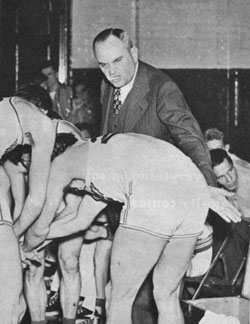 |
| "Goin' to show 'em your clippins again this half ?" Coach Rupp asks his Kentucky team. "Or are you goin' to get your toes out of the wringer !" |
"Mighty tough travelin' durin' the last war," he says. "Had to go to Buffalo in a mail car. When the train pulled up, I said to the team:
'O.K., you fellers better put your shoes on now.' The mail car was full of empty sacks and coffins. 'Take your shoes off again now, fellers, if you want,' I told them. 'Sacks there are sleepin' berths, all lowers. Each of you can have one. For you tall fellers,' I pointed to the coffins, 'there are those special benches.' When we got to Buffalo, I said: 'Mighty cold up here this time of year. You fellers better put your shoes back on'."
One of Rupp's favorites concerns the rules discussion before the 1948 basketball Olympics. Adolph coached the victorious American team, composed of Kentucky and Phillips Oilers players. Naturally, when it was suggested there be a limit on heights of players he rebelled. He received winning support from the Russians, who offered an unexpected argument. They said that limiting heights would be undemocratic.
The very tall, very talented Kentucky players are carefully screened in high school by Harry Lancaster, sometimes to a degree that irks Adolph.
"Horry," he'll say, "you just waste time foolin' with that stuff. Dammit, just read the papers and find out who's makin' the most shots. Then get to that town and take the boy out. Buy him a big steak. Three inches thick, a foot long. Make it the best you can get. Then sit back and watch him eat. If he tears into it and gets it chawed up quick, sign him right there. But if he paws and pecks, pay for the steak but let somebody else get him. He's no good."
The Big Boys Skip Rope
Rupp's material rates consistently strong but he knows what to do with it. He develops co-ordination in tall men by having them skip rope. He makes rebound practice continuous and tougher by putting a cover over the basket to keep the ball out. He has shooting statistics and charts kept of practice scrimmages as well as games.
He has opponents carefully scouted. Before a big tournament game with a powerful Holy Cross team, he edited some films of the Crusaders to show them at their worst, so the Kentucky boys wouldn't be overawed at their job. It helped Kentucky win. He demands that a player build the physical condition necessary to run the four miles he'll average in a modern, fast-break game. He is a perfectionist, who wasn't altogether kidding the time Kentucky led Arkansas State at the half, 47-3. Number 16 on Arkansas made the three points.
"Who's on sixteen?" Rupp asked. "I am, Coach," a player piped up. "Then. dammit, get on him,"
Rupp yelled. 'He's runnin' wild!"
Kentucky players practice seriously, silently. Only The Baron makes the cracks. Some of his players have been known to hate him, but that's what he's after. He feels that they'll take it out on an opponent. After graduation, Rupp's players admit he's got something.
His mainspring is an invincible belief in himself and an ability to translate it to his teams by bullying them toward constant improvement. A very few extreme critics have tried to insinuate that he lacks real coaching skill, has leaned heavily on his assistants. To prove the point himself, a critic attended a Kentucky practice.
"You DO IT!"
The varsity was rehearsing a play under the immediate supervision of an assistant. Rupp stood off watching. The execution of the play didn't satisfy him. He let them know it. As Adolph ranted and raged, the assistant called the players back and patiently wont over the assignments. "Hah," the skeptic said. "As I thought. There's the real coach." The players tried again. Again they failed. Now Rupp moved in on them and really went into a tirade.
"I'm sick and tired of this," he exclaimed. "I've told you the main trouble is you're not try in'! Now, dammit, you do it right this time, you hear! I want no excuses from you fellows this time! You DO IT!"
On the next try, they did it. The skeptic saw clearly who the coach was and why.
Rupp tunes in adeptly on the moods of his team. Before an important championship game, he realized that his Fabulous Five of 1948-'49, probably his greatest, was too tense. Adolph wanted his players serious, yet relaxed.
"Listen," he said, "you fellers know what to do. When Alex Groza's open, feed him! You know where the forwards are and what they can do! You know Jim Line can hit with his one-handers! And Beard can hit from the outside!"
Barker Was Willin'
Now he threw the change-of pace. In an earlier game. Cliff Barker, a fine guard but a mediocre shot, had beaten the half-time buzzer with a 65-foot long shot from deep in his own backcourt. Rupp recalled this now.
" 'Course," he said, "we always got Barker, too. He can hit from anywheres!"
That tickled the players. Their laughter broke the strain. They hit the floor purposeful but relaxed, and they paid Rupp off.
During a game, Rupp suffers excruciatingly. He pulls up his brown socks -- part of the brown ensemble he has affected as a good-luck charm since his high-school coaching days at Freeport, Illinois. He buries his head in his hands, is ready to concede when Kentucky's lead is shaved from 12 points to 10.
His concentration becomes a sort of cataleptic St. Vitus's dance. He keeps jumping up. Each time he jumped up at Michigan State one night, an irate woman spectator slammed him on the head with her umbrella. Adolph was aware of it only as of a bee buzzing. The woman could have gone on belaboring him, had Lancaster not threatened her with removal.
But even Adolph's wild concentration is not proof against the fans' uproar when Kentucky plays Tennessee at Knoxville. Tennessee students gather behind the Kentucky bench and keep shouting: "Sit down, Rupp!"
"Why, dammit," Adolph warns the team before leaving for Tennessee, "the only reason they buy uniforms is for our game! They turn 'em right in after our game ! I'm a-warnin' you fellers. They'll spit on you o ver there ! If the ball goes in the stands, they won't even give it back to you! Don't look for the sun to shine in Knoxville !"
Adolph takes his revenge on Tennessee in frequent victories there, followed by a courtly thumbing of the nose.
The utter realism that drives Rupp took root in his childhood. Born in Halstead, Kansas, September 1, 1901, he was nine when his German immigrant father died at 48. The hard-working, thrifty parent had his 160-acre farm paid for, but the six children, oldest 16, had to work hard. Adolph got up at six o'clock, milked cows and did other chores. After breakfast, he walked a mile and a half to school. In the eighth grade, he worked as school janitor for $1.25 a month. For 13 years, including college summers, he worked in the wheat fields.
He's Had His Troubles
It may have been this work that caused the racking backaches that cut down Rupp in 1935 after he had been at Kentucky five years. An operation removed two discs. He lay in the hospital 35 days, another eight weeks at home. He wore a reinforced corset nine months and couldn't move around too well for another six. He had a lot of time to worry about his future. He was more determined than ever to achieve financial security. •
Today, his holdings are estimated at $250,000. He gets about $9,000 for coaching, but innate shrewdness has helped him accumulate three farms, where he grows tobacco and raises sheep and cattle. He is also the third largest stockholder in a tobacco-warehouse co-operative.
Adolph and TVA
Recently, Rupp has talked of retiring. It's doubtful he would. The excitement of coaching is now too big a part of him. But if he ever does become a full-time farmer, he will find true kinship with the earth. It has always been close to him, has steered his economic beliefs. He voted for Roosevelt once, but the Tennessee Valley Authority, among other things, upset him. He couldn't abide good soil being put under water.
One day, the bus carrying the team to another sunless visit at Knoxville passed over a TVA dam. Muff Davis, a substitute, looked out the window.
"Roosevelt's folly," he murmured.
"Dammit, Davis," Adolph roared, "I'm a-startin' you tonight !"
Return to Kentucky Basketball page, Kentucky articles, statistics, team schedules, team rosters, opponents, players, coaches, opposing coaches, games, assistance or search this site.