
By using tricks which the fans rarely see, clever basketballers try to outsmart official and force opponents into fouls.
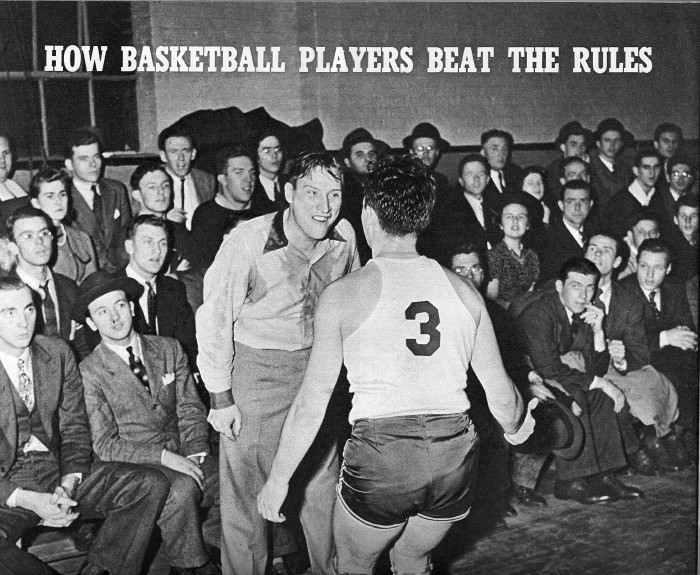 |
| THE FINE EDGE of Referee Kennedy's wit is felt by Co-Captain Kravetz of Manhattan College, who disagreed with one of Kennedy's decisions during a recent game. Famed for his good humor and wild gestures, 32-year-old Pat Kennedy of Hoboken, N. J., is basketball's most popular, most colorful and most explosive official. Since he started refereeing basketball in 1924, Kennedy has officiated more than 2,500 games, averaging seven assignments a week during the season. He has worked in Madison Square Garden every night it has been lit for basketbaJl since his antics convulsed the house on basketball's opening night at the Garden in 1934. Kennedy's refereeing axiom is: Make it clear, visible, audible. To do this he toots his whistle until you think he'll explode. He motions with his arms like an excited octopus. And he makes basketball games fast, thrilling and fair. On the next two pages he tells, in type and pictures, of some of his job's headaches. |
Published in Look Magazine, February 11, 1941, pp. 56-58.
by PAT KENNEDY as told to JACK MAHON
I'll never forget the N.Y.U.-Kentucky game back in 1935, our first season of basketball in Madison Square Garden. Kentucky had come on the court a decided underdog but had paralyzed the crowd by playing a great N.Y.U. team to a standstill. With only six seconds to go the score was tied.
The play moved swiftly down the court. The audience was tense and the great Garden was silent. Suddenly the referee's whistle shrieked.
To the crowd it looked as if Gross of N.Y.U. had fouled a Kentucky player by bumping into him. Actually, it was the other way around. The Kentucky player had tried to pull a fast one by moving so as to force Gross to bump into him -- a favorite way of trying to beat the rules. The referee saw it and gave the free shot to Gross, who sank it to give N.Y.U. the winning point.
This is just one of the rule beating tricks used by basketball players to get the little advantages that often mean victory in a close game. These tricks are not confined to any team or section and, of course, they are not taught to the boys; the lads pick them up from each other.
Referees are wise to all the dodges but the fans don't always see them and then they get the idea that officials just love to blow whistles.
In the six pictures on this page I was assisted by N.Y.U. stars in demonstrating the most common attempts to. beat the rules. If you watch closely you'll see them next time you go to a game.
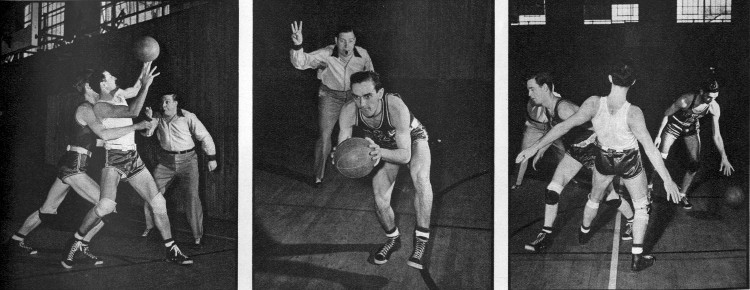 | ||
| IN THE REBOUND PLAY under the basket, players find a temptation to try to beat the rules. Here, the defense man (light shirt) looks as if he were being pushed around by his opponent. Actually, he is committing the foul by trying to shove the opposing player away from the basket instead of concentrating on the ball. | THE THREE-SECOND RULE provides that a man with one or both feet inside the foul line can hold the ball only three seconds. The purpose is to speed up the game. Often we find "smart" players trying to gain time by straddling the line and holding the inside foot in the air. If the referee isn't alert it may work. | HERE IT LOOKS as if the defense man (light shirt) was being fouled by his charging opponent and when we call the foul on the defense man the crowd always boos. Actually, the defense man has tried to beat the rules by stepping forward into his opponent and trying to make it look as if the opponent is charging into him. |
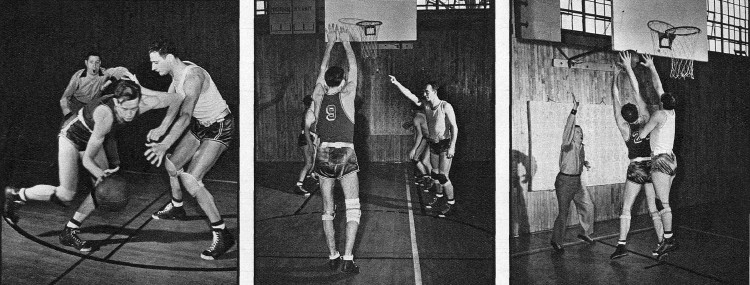 | ||
| BECAUSE OF THE SPEED of the game this trick is rarely noticed by the spectators. Attempting to get past the defense man (light shirt), the dribbler "gives him the elbow"-a violation of the rules. And how the fans howl when the dribbler goes ahead to make a basket and we call the play back because of the foul! | THIS IS A CLEVER STUNT pulled by some players in an effort to distract the attention of the man shooting a foul shot so that his aim is spoiled. Just as the shooter is letting the ball go, his clever opponent (light shirt) waves his arm in the air, pretending to give some instruction to a teammate up the court. | THIS IS THE PET TRICK of the little fellows. In a scramble for a ball rebounding from the basket, small players frequently try to compensate for their short stature by climbing up on the shoulders of their taller opponent. A clever player does this under the pretext of trying a follow-up shot. |
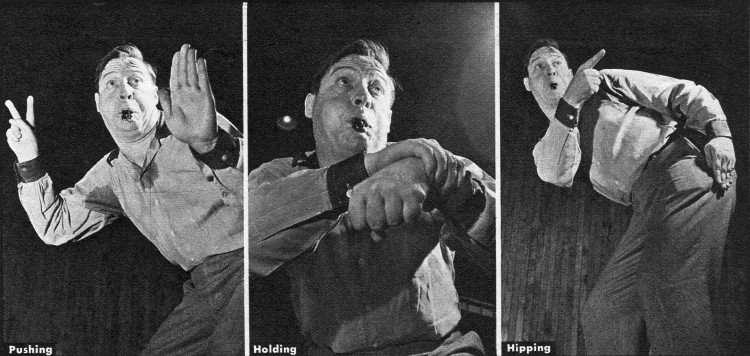 |
| TO MAKE OURSELVES CLEAR above the din we use a set of signals describing the fouls we call and other decisions we make. Three of these signals are shown in these pictures. The one on the left says a man has pushed his opponent who therefore gets two free shots. The one in the center is for holding, the one at the right for illegal blocking with the hips. Other signals in common use include: blocking - both hands on hips; running with ball -- clenched fists revolved in circular motion; hacking -- striking arm with edge of palm; kicking ball -- forward and backward motion of leg; charging -- forward movement of stomach; time out -- scissors-like crossing of arms. |
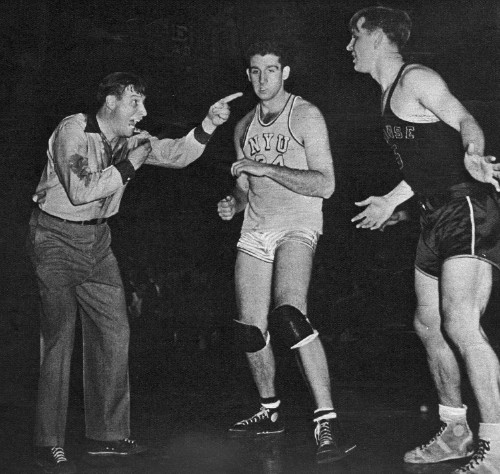 |
| THE SYRACUSE PLAYER at whom I am pointing here was guilty of pushing his N.Y.U. opponent but, like any smart basketball player, he put up a strong show of innocence. Basketball players today are as good as any I have ever seen but if I had to pick my all-time, all-college team it would be: forwards - Luisetti of Stanford and Moir of Notre Dame; center - Bennett of Westminster; guards - Kinsbrunner of St. John's of Brooklyn and Nash of Columbia. The explosive tactics I use don't usually get me into trouble but I have had my share of punches from irate partisans. After one professional game I had to spend three hours in a guarded locker room while feelings cooled. |
Return to Kentucky Basketball page, Kentucky articles, statistics, team schedules, team rosters, opponents, players, coaches, opposing coaches, games, assistance or search this site.