
The editors of the Dell Sports Album magazine made their picks for the best of college and pro basketball. Among the categories were best college team, best all 'round, best short man, best tall man etc. Below are included the categories where Kentucky players and coaches were considered.
Published in Dell Sports Album Magazine, Winter 1950-51, pp. 10-13, 18
by the Editors of Dell Sports Album
300 coaches can't be wrong !
It's a difficult task to select sixteen individual basketball players and five teams from the nation at large and say, "These will be the best during the 1950-51 season." And the editor has made no attempt to do it alone. He is grateful to several hundred college coaches around the country who forwarded their opinions of their own players and of the outstanding members of the opposition clubs. Boiling down the studied judgment of all the best basketball minds it was possible to probe, he arrived at the conclusions contained in the following pages. No attempt was made to pick an All-American team. Rather were the players selected for their special talents in various departments of the game of basketball. Their skills were thoroughly dissected, their weaknesses as well as their strong points were highlighted. In addition to the outstanding collegiate stars, accolades are given the two foremost coaches and the best pair of professionals that money can buy. In the case of George Mikan, it costs the Minneapolis Lakers $15,000 a season to purchase his efforts. Of the top five college quintets, City College, Bradley, Western Kentucky and North Carolina State will be generally ranked near the head of the list, but we believe we have a "sleeper" in DePaul.
best small man: watson or melchiorre ?
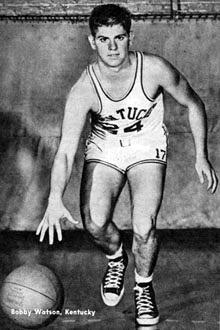 |
| Bobby Watson, Kentucky |
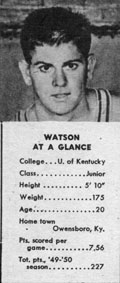
Over his old office door, Kentucky coach Adolph Rupp used to have a sign informing visitors that clearance was six feet, two inches. The Baron would say, "If they don't bump their heads when they come in, I don't even bother to shake hands." Bobby Watson refused to take the hint. The Baron maintained his disregard for the little man through Bobby's freshman year, but he reluctantly gave him an opportunity last season,' and before the campaign was over, the five-foot, ten-inch lad from Owensboro came to be known as Kentucky's special type of atom bomb. He makes up for lack of size by grim determination, fight, and best of all, a burst of speed that leaves foes far behind. The Wildcats compare him with their three-time All-American, Ralph Beard, also a basketball "shorty." His best shot is an exceptionally accurate long toss from any position, the way Beard used to do it. If he can see the basket, he can hit it, which means he's capable of firing from any point on the court. An innocent-looking mite, compared to the giants who surround him, his speed makes it almost impossible to stop him when he's driving for the basket, and in 30 games last year, he piled up 227 points.
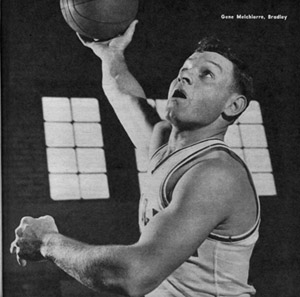 |
| Gene Melchoirre, Bradley |
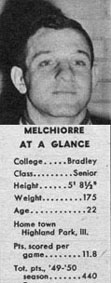
Big hands can make this little man a great basketball player. In this age of the seven-foot court star, Bradley University's Gene Melchiorre, a five-foot, eight and a half-inch "midget" rates as a phenomenon. But he can do as many tricks with a basketball as any of the collegians who tower over him. He has all the shots—hooks with either hand, pivots and set shots. With 175 pounds of solid beef wrapped around his small frame, he's difficult to stop when he's driving in, and on the defense, he's a ball hawk who constantly harrows the opposition. Squeaky, as the Peorians call him, is the deadpan type of player, all business with no time for emotions. But there was one occasion when he relaxed long enough to smile briefly. In the game with Wichita at Peoria a year ago, with the score tied and two seconds of the first half remaining, Melchiorre took-A quick look at the scoreboard and cut loose with a 62-loot shot, by actual measurement. Gene himself was as amazed as everyone else when the ball dropped in, for he said later that he felt silly when he let it go, not believing for an instant that it would come close.
Editor's choice: Melchiorre
Melchiorre's 28 points against Western Kentucky two years ago, a record for a National Invitation Tournament game, established him as one of the great little men in current intercollegiate ranks, and thus far, Watson hasn't quite measured up.
 |  |
best tall man: freiberger or spivey ?
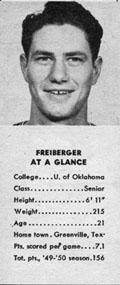 |  |
Under the offense taught by Coach Bruce Drake at the University of Oklahoma, there are few outstanding individuals. With an intricate passing attack, all members of the team take their turns at cutting and no one runs wild. Nevertheless, you can't keep a good man down, particularly "when he's a good big man like Marcus Freiberger. The all-round performance of the 6-foot, 11-inch guard stamps him as one of the topnotch oversized men in intercollegiate court circles. His best shot is the one-handed set-shot from far out on the floor. Offensively, his only weakness is difficulty in trying to shoot as he moves through crowded traffic under the hoop. When he's on defense, the opposition finds that trying to get past him is like attempting to throw the ball through a tree. Marcus is good on rebounds, an excellent passer and, despite his size, he breaks swiftly. He engages in no other sport, is majoring in business administration.
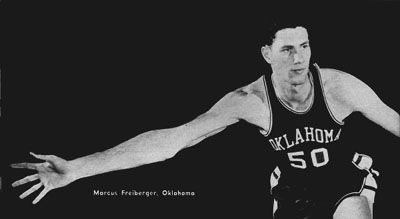 |
| Marcus Freiberger, Oklahoma |
Spivey's fast for a 7-foofer.
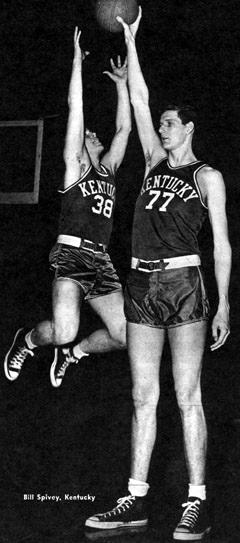 |
| Bill Spivey, Kentucky |
Editor's choice: Spivey
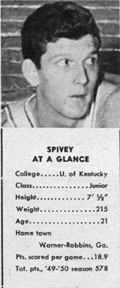
On the record, it's difficult to select anyone over Spivey. Basketball experts around the country are of the opinion that the tall Kentuckian is capable of becoming the nations outstanding pivot man during the 1950-51 season.
best coach: holman or rupp ?
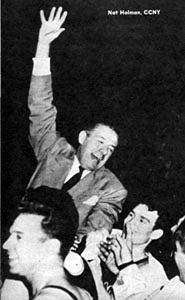 |
| Nat Holman, CCNY |
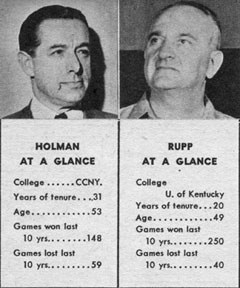
Often called the world's greatest basketball player when he was a member of the Original Celtics, Nat Holman has become the "old master" in the coaching profession. Over a 30-year period, his City College of New York teams have won 383 games while losing 132, have been outstanding in Metropolitan and Eastern ranks many times, and reached a peak last season with triumphs in both the NCAA and the National Invitation Tournaments, the nation's two major college court classics. There is no stereotyped play by a quintet tutored by Holman. His teams vary their offense and defense to meet the weaknesses in the opposition.
Rupp has an amazing record.
 |
Editor's choice: Holman
Their records are somewhat similar, but in assaying the material at Kentucky and CCNY, Rupp has a distinct advantage over Holman. The basketball players flock to Kentucky, with the inducement of an occasional scholarship, while Holman must make the most of what little material he gets.
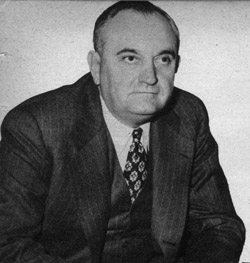 |
| Adolph Rupp, Kentucky |
Return to Kentucky Basketball page, Kentucky articles, statistics, team schedules, team rosters, opponents, players, coaches, opposing coaches, games, assistance or search this site.