
Published in The Courier-Journal Magazine, January 8, 1961 , pp. 10-12.
By Gerald Griffin
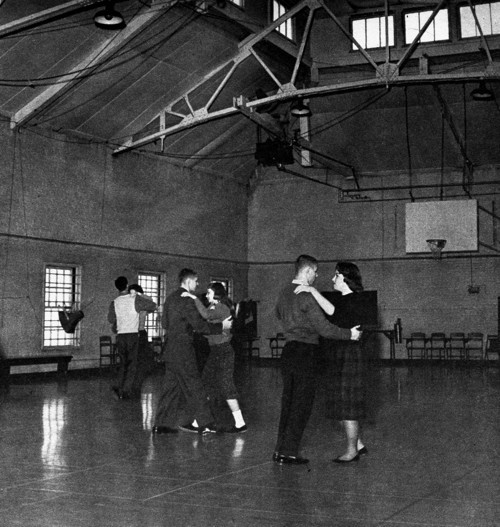 |
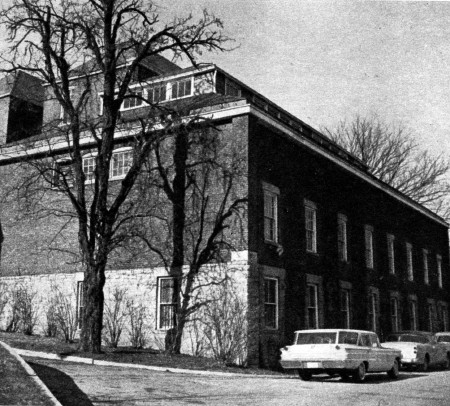
THIS century was an infant when the University of Kentucky, then known as Kentucky State College, annoyed the taxpayers by building its first gymnasium on the Lexington campus.
It wasn't much by modern standards, but it provided shelter for a few athletic young men eager to work off steam during the long dry season between football and baseball. So they formed a basketball team.
That carefree decision, in 1902, could be called the birth of the Big Blue. Dr. E. Cronley Elliott, a retired Lexington dentist, was a member of that hardy crew which played for fun, without coach, captain or athletic scholarships.
The game of basketball still was in its swaddling clothes six years later when the team's center was a gangling youth named H. H. Downing, now a retired University of Kentucky astronomy professor. The team then wasn't known as the Wildcats or Big Blue. Old newspaper reports referred to the players as the Cadets.
The game, which now fires the enthusiasm of most Kentuckians, began to approach maturity during the first World War when S. A. "Daddy" Boles coached the U. K. team to nine victories, two defeats and, strangely enough, one tie. Boles later became athletic director. Now he is retired. Dr. Elliott, Dr. Downing and Boles, all of whom still live in Lexington, get together once in a while to talk over old-time athletics at the university.
Players in the old days didn't have fancy uniforms. In Dr. Elliott's time they wore gym suits which they bought themselves. But the school generously provided them with a ball and hung iron hoops at each end of the gym. The college loosened up a little in Dr. Downing's day, providing long stockings for the players. By the time that Boles came along the university paid for complete uniforms as well as two basketballs.
The hoops then were not as high as they are now, Dr. Elliott recalls. Neither were the players. And the ball was a laced affair larger than the type used now.
 |
Dr. Downing counted the house at one game and came up with 25.
Basketball was a strange new sport with little spectator interest in the playing days of Dr. Elliott and Dr. Downing. Dr. James Naismith had invented it in 1891 at Springfield, Mass.
The team didn't even have a schedule the year Dr. Elliott played, although that fore-runner of the celebrated Wildcats of recent years did play a couple of games with a team representing the Lexington Y.M.C.A.
It has been 58 years since Dr. Elliott played on the first basketball team at old State College. But the game had been played in Kentucky prior to that time. Kentucky University, now Transylvania College, and Central University, now Centre College, had organized basketball teams in 1901.
The veteran dentist was an all-around athlete. Besides playing forward on the basketball team, he was quarterback on the football team and third baseman on the baseball team, winning letters in football and baseball. He recalled with a chuckle that the letters were his only reward for playing. The college didn't even give him sweaters to go with the letters.
Even by the time that Dr. Downing played there was but little student and no off-campus interest in basketball at the university. At least not in the boys' team. But the girls had a basketball team which would have attracted crowds except that the boys were not allowed to attend, despite the fact the girls were clad in voluminous bloomers and long-sleeved shirts.
A male student got himself suspended one time, Dr. Downing said, when he was caught in female garb attending a girls' game. The girl players provided the outfit for him. By Boles's time the girls were playing regular schedules open to the public. They were still wearing bloomers.
When Dr. Downing was "jumping center" in 1908 the team had a coach, W. H. Mustaine. But he was coach in name only. Mustaine was the physical-education director. "He came in to see us practice twice during the season," Dr. Downing said, "and remained a few minutes each time."
The game hasn't changed much since Dr. Downing's playing days. Of course, in 1908 the team didn't bother with set plays. And there was no need for signals. The opposing centers jumped after each field goal and there was no limit to the number of fouls a player could make. Furthermore, the team captain designated the foul shooter to the officials before each game. And that man did the foul shooting, no matter which man was fouled. A player fouled in the act of shooting was automatically awarded one point with an additional free throw.
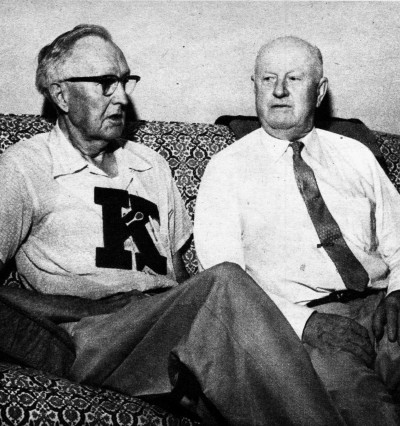 |
Dr. Downing remembers one trip when only five players took off for Louisville to play an independent team. Before the game was over one of the State players became ill. The game was delayed while the student manager changed into the stricken player's uniform and completed the game.
The college liberally gave Dr. Downing a letter and a sweater for his 1908 basketball efforts. But he made the mistake of washing the sweater and it shrunk so badly that he gave it away.
Basketball was Dr. Downing's only sport in college although he later coached some excellent tennis teams at the university. One of his best teams was composed entirely of Phi Beta Kappas.
He recalls that although his basketball team played in a modest gym, when he went to Danville to play the Xentral University five the game was played in a skating rink. And the Colonels, by winning that game, also won the state championship.
The early U. K. teams hardly set the world on fire. The 1903 team, for instance, lost to Transylvania by 42 to 2 and to Georgetown College by 32 to 1.
In the light of modern U. K. records, that seems almost unbelievable, but the 1911 team suffered an even greater ignominy when it lost a regularly scheduled game to Lexington's Morton High School by 36 to 29. However, that year the Wildcats managed to beat Bethany, Georgetown, Butler and Transylvania.
It was not until 1921 that a U. K. basketball team won fame. The Wildcats that year, coached by George C. Buchheit, won the Southern Intercollegiate Athletic Association tournament at Atlanta. Bill King, who still lives in Lexington, made good a foul shot after the final gun to give Kentucky a 20-19 victory over the University of Georgia.
After that there was a slump until Adolph Rupp became Wildcat basketball coach in 1930. Then U. K. became famous as a basketball power, winning an amazing number of titles, including four'National Collegiate Athletic Association championships. And the old 300-capacity gym has given way to a magnificent coliseum, seating 12,000.
But of the hundreds of basketball games Kentucky teams have played since Dr. Elliott's day, only that game in World War I days ended in a tie. It was a 21-21 deadlock with Kentucky Wesleyan at Winchester. Boles was the Wildcat coach. It wouldn't have ended that way except for a scorer's error. By his count, Wesleyan was ahead by one point when the game ended. But a check of the score book next day revealed his mistake. Wesleyan wasn't ahead. Neither was Kentucky.
And so it remained in the record books as possibly the only tie game in the history of intercollegiate basketball.
 |
Return to Kentucky Basketball page, Kentucky articles, statistics, team schedules, team rosters, opponents, players, coaches, opposing coaches, games, assistance or search this site.