
Published in Coach & Athlete December 1969, pg. 12, 20.
By Adolph Rupp (Head Basketball Coach) and Joe Hall (Asst. Coach, University of Kentucky)
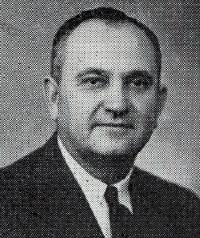 |
| Adolph Rupp: Coach Adolph Rupp needs no introduction to basketball coaches and fans. His name is synonymous with the game as he has contributed so much to its advancement and popularity. He played under Phog Allen at Kansas and followIng his graduation in 1923 he coached one year at Marshalltown, Iowa and four seasons at Freeport, III. before going to Kentucky in 1930. He is the nation's winningest coach with a 812-175 won-loss record.
He has received every honor available to a coach, including induction into the Helm's Athletic Hall of Fame. If records were kept he probably holds the record for number of lectures and clinic appearances. |
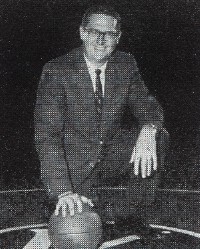 |
| Joe Hall: Joe B. Hall was a guard on Rupp's 1949 team and entered the coaching profession in 1955. He coached two years at Shepardsville High School earning Coach of the Year honors in 1958. He then went to Regis College in Denver, Colo., where he was freshman coach for one year and head coach five vears, posting a 57-49 record. He then went to Central Missouri in 1964 where he left a record of 19-6. He returned to Kentucky as freshman coach in 1965 with an overall record of 126-75.
Hall moved up as number one assistant to Coach Rupp when Harry Lancaster was named athletic director in February 1969. |
Defensive Set-up:
Our guards will meet their men at the 10 second line with pressure. Our object will be to drive the dribbler to the sideline and then turn him back to the middle at the free throw line extended. We will play all other men who are one pass away (logical receivers) with pressure on the ball side. We will discourage movement of the ball. Weakside men will take a sag position depending upon their relationship to the ball and the basket. A man in sag position should be able, by using split vision, see both his man and the ball. If his man maneuvers in a way that makes it impossible to cover both, he should concentrate on his man, but adjust his position as soon as possible so that he can see both the ball and his man.
Handling the Screen:
The combination of a simple screen and a good jump shooter is a tough defensive problem. This situation calls for the defense to go "over the top" of all screens in the scoring area.
Most plays and patterns employ only two or three men. Seldom does the offense have all five men occupied. Hence, there are always defensive men who can help out on a screen situation. Back-court defenses and guard around situations can be handled by sliding through. On a press, however, the help or jump switch on a cross or screen causes the offense to look for the "roll out man" and allows an alert sag man to intercept. The jump switch can also cause a violation or offensive foul.
Help on the "helper's man:
Back up support by the sag man in case he is needed when his man is not directly involved in a play. Covering a cutter going away from ball:
The defense will stay on the ball side of a cutter going away from the ball. If he is breaking toward the basket and face guarding is necessary, the arms should be raised to block the lob passing lane or to discourage the pass.
Covering a cutter going to the ball in scoring area: The area from the free throw line to the baseline and three feet each side of the lane is a high percentage scoring area. This is a "Prevent Area". Any cutter through this area must be defensed on the ball side and must not be allowed to receive a pass in this area.
Situations:
Base-line Drive:
Permitting a baseline drive is a cardinal sin. The man-to-man defense is really a team defense. By allowing your man to drive the baseline, the possibility for team help is practically eliminated and the pressure of having to stop a shot after the offensive man has gained that position increases the chance to foul. By forcing the man toward the middle, the other defensive men can see the position of the ball and help without completely losing their own men. A baseline drive causes the defensive helpers to turn to the ball, away from the middle, in order to help. The helper is forced to turn his back on his man, thus opening up an easy pass situation or an offensive rebound.
Reaching for the ball and leaving the feet:
These two errors cause 90% of our defensive fouls. We don't feel that we can steal the ball from an opponent in a one-on-one situation unless he is much weaker. When the two men are fairly evenly matched, which is usually the case, reaching for the ball can prove disastrous. It nearly always brings the guard's weight forward, a fundamental defensive error, which a good offensive man will encourage with fakes and feints.
The guard's awkward stance can easily cause him to foul. While a slap up at the ball doesn't cause the body weight to shift, a slap down tends to push the body forward.
The jump off the floor can be just as fatal. It, too, will cause many fouls, result in two-on-one situations around the basket, and prevent us from "blocking out" the shooter.
Blocking out:
The defense must prevent the offense from getting inside position on the boards. When a shot is taken by the opponents you must respond in one of four ways to prevent your man from getting the offensive rebound:
In blocking out you shou1d hold your position until angle of rebound is determined then release and go after the ball. Timing will depend upon individual's ability to judge rebounds.
Return to Kentucky Basketball page, Kentucky articles, statistics, team schedules, team rosters, opponents, players, coaches, opposing coaches, games, assistance or search this site.