
Published in Coach & Athlete November 1953, pg. 16-17.
By Adolph Rupp
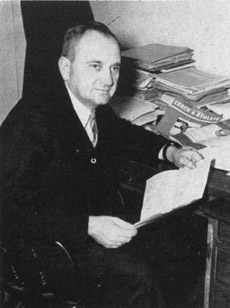 |
This excellent article by Coach Rupp outlines the fundamental principles upon which he builds his defense. The Kentucky Wildcats are renowned as an offensive power, but they are also capable of throwing up a tight dfense against the opponents' attack. |
Basketball players today from an offensive standpoint are far superior to the players of fifteen years ago. I do not mean that they are better -- for had the boys of fifteen years ago had the advantage of the knowledge being given to our boys today, they would have been equally as great.
To anyone who believes that defensive basketball is not sound today I would like to ask him these questions:
How do you instruct your defensive men to guard against the hook shot?
How do you instruct your defensive men to guard the pivot man on the step in-step out hook shot?
How do you instruct a defensive man to guard the running jump shot?
How do you instruct your guard to stop the dribble stop-jump shot?
I believe after you have thought of these things you will come to the same conclusion I have, and that is that the techniques of offensive basketball have simply outrun our defensive techniques.
Smallness of scores of several years ago does not necessarily indicate that better defense was employed. Far from that. Smallness of score in a basketball game today does not necessarily mean that the game being played is a great defensive game. It may have lacked offensive skills.
How many shots were taken?
How long did it take the team to set up a play?
Was ball control permitted?
Was an attempt made to deliberately withhold the ball from play?
The answers to these questions may be the answers to the lowness of score. Scores have continued to go up, but I think this is primarily due to the fact that so many more boys today are playing basketball due to the far greater facilities, and this enables boys to learn to play the game better than boys of years ago.
I believe that in defensive play we have seven cardinal principles of play. Whenever your team has played a game it would be well for you to check to see if you have made any mistakes in these principles. Defensive play is not appreciated by too many spectators and coaches today. It is unspectacular and therefore disregarded. Let me say this. I believe if you will check the outstanding team in the nation that have been that way year after year you will find that soundness of defensive play is responsible in a large measure for their success. These coaches know that on an evening when the offense is not clicking they can still save the game if they have good defense, but if they haven't good defense the ball game is lost.
It is not difficult for us to teach our boys defense. They realize its importance. Our boys are convinced without a doubt that our defense will save us on the nights when our offense isn't working. A boy must be taught to realize the importance of defensive play, individual as well as team play. We possibly spend one-half the time defensively that we spend offensively. Few teams spend anywhere near that much time teaching defensive play. That is the reason I mention this. Last year I watched a high school game in which one team had scored over one hundred points on nine different occasions. They played a team in the second round of tournament play that was a good defensive team, but not a great one. The first team took a humiliating defeat, showing up at the end of the first half with only three field goals. Their opponents completely demoralized them defensively. Everyone was dumbfounded after the game, but this fact was evident -- the superior defense of the one team turned the tide into a rout.
Let's consider the seven cardinal principles.
1. Cut down the number of shots -- You've always heard the saying -- "Make enough shots and the percentage will take care of you." That may be true, so the first thing to do is to cut down the number of shots you give the other team. In going back over our shot charts for a period of five years we have found a very reliable trend on the number of shots taken. The first thing to do in defensive play is not to give the opponents a shot at the basket. They still must shoot to score. If you can eliminate by aggressive defensive play the number of scoring opportunities that the other team will get you will eliminate the danger of a high score.
2. Cut down the percentage of shots -- We tell our boys to be aggressive at all times. It's hard, tough work, but a lot of boys like to play that kind of ball. It's a good thing to have one of your boys come up to you and ask to be assigned to guard the outstanding play- er on the opposing team.
Several years ago we had such a boy. He wasn't interested in how many points he scored, but he liked to take a player on the other side who had a twenty-point average and whittle him down to seven or eight. The smile of satisfaction on his face after a game was always a complimentary reward, and usually before he left the dressing room he would come and ask, "Have I got Smith Saturday night?" -- Smith being the star on the opposing team.
If you can force a team to take hurried, off balance, inaccurate shots you will destroy the percentage shooting that this team has been playing, and that is entirely the difference between aggressive defense and defense that permits a team to get good shots. When a coach comes up after a game and says: "We couldn't hit tonight," maybe there was a reason.
3. Cut down everything under eighteen feet -- I like to put this in, as it fits well into the philosophy of collapsing or floating defenses. It certainly is in their favor. If you will draw a circle eighteen feet on the floor out from the basket and attempt to cut down everything in that area, getting all the rebounds, you'll have a foolproof defense. I realize this is impossible, but the fact still remains -- don't give them a shot close in to the basket!
These defensive assignments are goals toward which you should work, and if you can imprint upon the minds of the boys that they must not give the opponents these close-in shots, they will get the idea and work toward this goal.
4. Cut down the second shots -- A good defense should not permit a team to get the second and third shots at the basket. It is true that it is at times difficult to get the rebound, but the first thing on defensive play after a shot has been taken is to see that your individual opponent does not get the rebound. You should block out these players and then, after you have them out of play, go for the rebound yourself. If you permit the second shot and possibly the third shot, one of these is apt to fall, and a good tough rebounding team will not permit these additional shots after the initial attempt has been taken.
5. Cut down the cheap baskets -- How many times in a game will you see a good, well-played game, and then see a cheap interception, with the boys going all the way and scoring? Did you ever see a jump ball on your own free throw line with the opponents slapping the ball over the head of your defensive player and going all the way to score? How many times have you seen a pass in under the opponent's basket intercepted and laid in for an easy basket? How many times have you seen a ball fall aimlessly to the floor and the opponent throw it in for an easy basket? How many times have you seen an opponent rebound and get an easy basket after a missed free throw? These are just examples of cheap baskets that teams sometimes get with the minimum of effort. Some are due to carelessness, some are due to bad judgment, but in a well-played game with opponents of equal ability the deciding factor is sometimes a cheap basket at the critical time.
6. Point the ball on all long shots -- As the ball is maneuvered on the outside of the defense, the defensive man playing the man with the ball should always be tight. Two of the cardinal principles are to cut down on the number of shots and the good shots. If you will allow good long shooters to get set unmolested they'll ruin you from out on the floor. Therefore, the man with the ball should always be "pointed." This is true even in floating defenses. In strict tight man-to-man defensive play this should always be true.
7. Prevent the ball from going to the pivot -- I believe that most teams feel exactly as we do. Never let the ball go in to the pivot man. If you do, their screens can be set without worrying about handling the ball. We permit the ball to go to the side of the floor, but always play to prevent the ball from going to the pivot man. As soon as the pivot man has the ball you have a dangerous offensive center. If the pivot man should be a big husky fellow he can take a hook shot, jump shot, or jump flip shot. He can fake on one side and go to the other. He can pass to a cutting teammate that has been freed by a screen. The ball is in extremely dangerous position when it is held by the man playing what is normally called the pivot position. The greatest percentage of attempts at the basket are made from this position.
It has merely been my attempt to give you the results of our experience down through the years. On those long nights that are sure to come during the basketball season it is well to check on these seven cardinal principles and see if any of them might prove helpful to your team. It is merely a series of checks that you can rigidly apply, and somewhere along the way you will find your difficulty. Even if your team is going well, that is the time to check. Apply it not only to your plays but apply it individually. The star of your team offensively may not be the star of your team after all. His defensive ability may be so indifferent that it is causing your team to lose ball games, in spite of the offensive contributions that he is making.
Bear this in mind, for I repeat it thousands of times to my boys each year -- Your defense will save you on the nights when your offense isn't working.
Return to Kentucky Basketball page, Kentucky articles, statistics, team schedules, team rosters, opponents, players, coaches, opposing coaches, games, assistance or search this site.