
McLendon Has All the Credentials: All He Needs Is a Major College
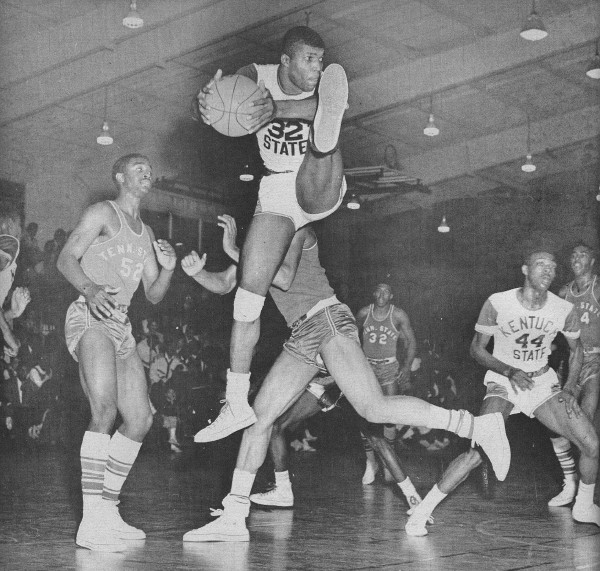 |
| Coach John Mclendon has turned out top teams everywhere he has coached. Here, Jim Robertson of his Kentucky State team, grabs rebound against Tennessee State. McLendon's boys put on a strong effort, winning 104-85. |
Published in Clair Bee's Basketball, 1965, pp. 48-50.
by John McLendon
DREAMERS of the big dream don't settle for a climb halfway up Mt. Everest when they want to go to the top. They don't settle for a second-place finish when they want first. They don't settle for a double when they want a home run.
My big dream is an NCAA basketball championship.
It's an ultimate goal I established when as a youngster of six I saw my first basketball game in Kansas City, Missouri.
I was so engulfed by it that I went against my father's wishes to enroll in the Department of Physical Education at the University of Kansas instead of Pre-Med as he desired. At the time, I was well aware the financial remuneration in coaching would never match that of the medical profession, but I felt I would be otherwise compensated. I certainly think I have been.
Still, I'll never feel my coaching career has been complete until I have the NCAA title and so far I haven't even had a team that has been eligible. In order to get a team into the NCAA tournament I'll have to break the color line in major college coaching ranks.
For Negro athletes in America, this is the golden era. Today, more Negroes are playing American games as Americans - and as athletes first, and Negroes second - than ever before in the history of sports. The democratic ideal in this country is never more apparent than in the field of athletics.
Before I went to Kentucky State College in 1963 I applied at several different schools. I came close to getting the head coaching job at the University of Pacific. They paid my plane fare out there for an interview and indicated I was a top candidate. But somebody else got the job. I don't hold a grudge. I just feel there was a more qualified candidate.
However, it was a discouraging experience and it was one of those times when I was willing to forget all about fulfilling my boyhood ambition. But always the urge comes back again. It's not that I'm unhappy at Kentucky State. It's an excellent school, and, in addition to being basketball coach, I'm the head of the Physical Education Department. I like the idea of building a strong basketball program at a small school.
Still the burning desire for an NCAA championship is there. It's a flame that just won't be extingiushed.
My ambition to get to the top began when I was in high school. I said then that I wanted to learn my basketball from the man who I felt knew the game best, Dr. James Naismith at Springfield, Mass. College. After all, he had invented the game.
The cost of going to school in Massachusetts was prohibitive. I knew I would have to go closer to home. Then the summer after I graduated Dr. Naismith left Springfield to go to the University of Kansas as a physical education professor so I enrolled there.
I was aware I wouldn't be able to play basketball at Kansas. The school's athletic program wasn't integrated then. But I wanted to learn basketball from the one man I felt could teach me the most.
Dr. Naismith was a remarkable man. He was way ahead of his time as far as coaching philosophies were concerned. He believed in the ultimate game - with the fast break and the full court press -- in an era when 50 points in a basketball game was almost unheard of.
He taught me a lot about the game of basketball and about people.
When I was a junior at Kansas, Dr. Naismith helped in getting me a job as an assistant coach at Lawrence Memorial High School in Lawrence, Kansas where the university is located. Then, in 1936, I was named head coach, although still only a senior at Kansas. At this point there wasn't a single doubt in my mind in what direction I wanted to go, and, when my first team at Lawrence won the Kansas-Missouri Athletic Conference Championship, it just whetted my appetite.
After graduating from Kansas in 1936 as the first Negro to get a degree in Physical Education at the school, I went to Iowa University for my Master's degree. This was followed by three years as an assistant at North Carolina College at Durham, N. C., and then 12 years as a head coach there. Sam Jones, currrently with the Boston Celtics, was one of my proteges at North Carolina College. After that I spent a year as head coach at Hampton Institute.
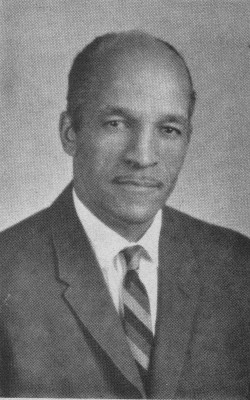 |
| With a coaching record second to none, John McLendon, a negro, still has one goal -- an NCAA Championship |
With personnel like this we had considerable success, winning 149 games and losing only 20 between 1954 and 1959. During that period we made the National Association of Intercollegiate Athletics' National Tournament five times, winning the championship three straight years. This was a distinct honor for me because no other coach in the country had won three national championships.
The biggest break, and most surprising turn of events. in my career came in 1959 when out of the blue I was offered the job as head coach of the Cleveland Pipers, a new entry in the National Industrial Basketball League.
I got the job because of my college record. I was in my fifth year at Tennessee State and had the second best career percentage in college coaching. Adolph Rupp at Kentucky was No.1, and Ed Sweeny of the Pipers offered him the job first. Rupp didn't want to leave Kentucky.
So, Sweeny came down from Cleveland to talk to me when my club was playing Villa Madonna at Covington, Ky. First he said: "I didn't know you were a Negro." Then he added quickly: "But I want you to know it doesn't make any difference. The job is yours if you want it." He didn't have to ask me twice.
The Pipers were an integrated team with more white players than Negroes. Having a Negro coach was a break-through in race relations, but in sports the Negroes presence is so natural and normal that hardly anyone ever comments on the basis of race and color.
I was still relatively unknown to much of the country and had to prove myself as a basketball coach all over again. My first Piper team finished fourth in the NIBL and capped a successful season by handing the U.S. Olympic team of 1960 their only defeat.
In 1961 the Pipers won the National AAU title and the team formed the nucleus of a U.S. All-Star team which toured Europe and Russia. I was named coach.
Russia and other countries in the world hadn't advanced as far in basketball then as they have now. We won all eight games with little difficulty.
This year, after coaching the NAIA All-Stars in the Olympic Trials, I was selected to again coach an All-Star team on a European tour which again included games with Russia.
The Russians have made remarkable progress in basketball and they're taking a do-or-die attitude towards winning the Olympic title from the United States in Tokyo in October.
This year we won only six of the 12 games on the European tour. There were three basic reasons. One, the rest of the world is geting stronger in basketball. Two, I don't think the United States team had adequate time to prepare for the tour. And, three, because of conflicts, we didn't have the best players in the country.
The NCAA divorced itself from the international tour and thereby caused some of our Olympic players to stay home. We'd hoped to tour with the Olympic team but wound up with only five players . . . and three of them already had the international experience we had hoped to give the others.
We can't take a ho-hum attitude just because this country has never been beaten in Olympic competition.
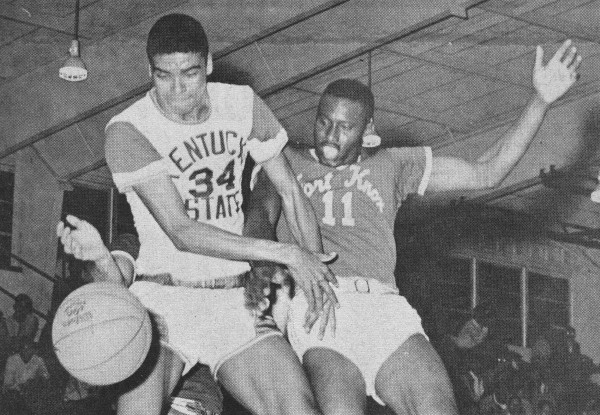 |
| Kentucky State's Bob Campbell (34) blocks out Ft. Knox player as McLendon's men win again. |
When I took the team to Russia in 1961 they didn't have a jump shot. Now they shoot it like we do and it's practically indefensible. There isn't a jump. shooter in the United States the Russians haven't imitated. They're also playing more pattern basketball. They ran patterns in the 1960 Olympics, ones a good scouting report could pick apart. This isn't the case now.
Russia had cameras on our team at all times during the tour this year. They wanted to pick up any little thing that might help them in the Olympic games.
Seven of the players on the Russian squad have been playing together since 1958. Their average age is in the late 20s. They'll be too old for the 1968 games so they want to win it all this year.
Our own Olympic teams have undergone some drastic changes since 1960. Then they were made up mostly of amateur and post-graduate players. Now it's largely collegians, sorely lacking in international experience.
Our people just don't have the least idea of the tremendous political influence the foreign countries put on the losses we sustain.
My career with the amateur Pipers was short-lived. In 1961 they joined the professional American Basketball League and I went along as the first Negro coach in pro basketball.
We won the Eastern Division title the first half of the season and then I was made vice-president in charge of player personnel and we went on to win the league championship.
After the 1962 season I left the Pipers and became an American Basketball Specialist to South East Asia where I had some remarkable experience teaching and coaching basketball in Malaya. I was also a consultant in 1962 at the Asian Games in Diakarta, Indonesia.
Another high-point in my career came in 1962 when I was inducted into the Helms Basketball Hall of Fame, alongside such noted coaches as Henry Iba, Ward Lambert,Branch McCracken, Adolph Rupp, Tony Hinkle, Everett Dean, Forest Allen, Clair Bee and Ed Diddle.
Then in 1963 I got back into college coaching again at Kentucky State College. That revived my dream, and some day, I intend to make it come true.
Return to Kentucky Basketball page, Kentucky articles, statistics, team schedules, team rosters, opponents, players, coaches, opposing coaches, games, assistance or search this site.