
A Fabulously Successful College Coach Discussed One of the Most Exciting, And Intangible, qualities of Sport
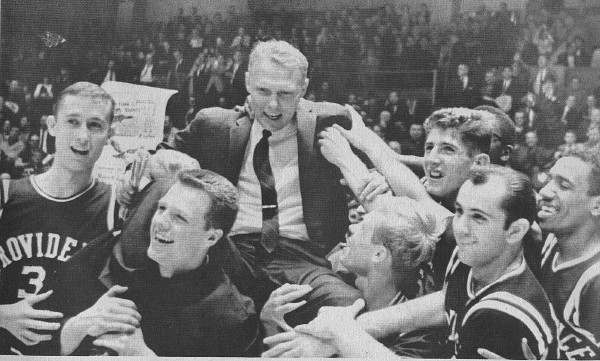 |
| EMOTION, which author Rupp finds key to basketball success, is mirrored on the faces of happy Providence players, coach after 1963 NIT win. |
Published in Clair Bee's Basketball, 1965, pp. 43-47.
by Adolph Rupp
THE coaching of basketball is not confined to teaching boys fundamental skills and teamplay. If championship teams are to be molded, and that is the objective at the University of Kentucky, the coach must take into consideration not only the many complexities of the game, but the mental conditioning of his players.
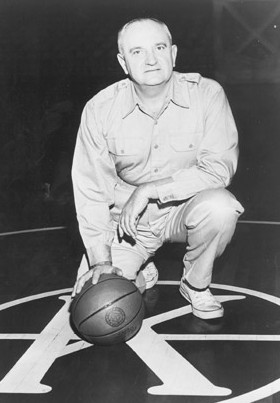 |
There is nothing much new in player and team techniques in basketball. And, there are not many tactics or strategies which the winning coach has not used or been exposed to during his years in the game. However, the individual emotional capacities of players differ greatly. So, in addition to the game skills, physical training, and team offenses and defenses, the coach must be concerned with the mental conditioning of his players.
Player-talent, bench strength, team experience and other things being equal, we, feel that the emotional commitments of the players to the game have a tremendous effect upon our success. Indeed, the role emotion plays in basketball is sometimes such that even when the above conditions are heavily weighted in favor of one team, emotion can be, and has been, the great equalizer. There are numerous examples of this, but before going into them. I would like to discuss briefty a few of the more important emotional qualities.
The greatest of the emotional qualities is desire. It is the big thing in an athlete's innermost drive. Desire is a compulsive urge which makes an athlete want to succeed (win) no matter what the cost in time, hours of work, or personal sacrifices. The coach cannot instill desire, but he can certainly inspire it.
The spirit of those players who have an implacable determination to win is contagious and spreads to every player on the team. Spirit enables the real athlete to reach a higher performance-level than his physical capabilities, warrant.
Courage is one of the intangibles which contribute to the victory spirit. A truly courageous player gives to the "whole" of the game, plays defense as well as offense. When I think of courageous players, I always recall Ken Rollins.
Ken was a member of our great 1947-1948 team. He was fast, aggressive, an excellent ball handler and a boy with tremendous pride. He knew that I had complete confidence in his defensive ability and that his teammates also believed in him. This confidence placed a great responsibility on him and, at the same time, gave him confidence. I always assigned him to guard our opponents' outstanding offensive player. And, as far as Ken was concerned, for someone to out-wit him and score against him was a serious offense.
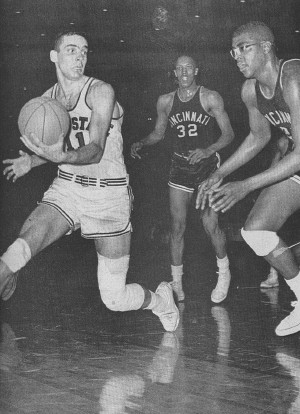 |
| JERRY Lucas-led Ohio St. powerhouse was upset two years in row in NCAA by Cincinnati. |
Aggressiveness is psychological as well as physical and is a must! Our entire system of play, offensively and defensively, is based on aggressiveness. This means our players are expected to fight through screens, leave their feet for loose balls, play the boards tough-and their opponents tight. Defensively, we like to take chances. That was the spirit of our pioneer forefathers, and at Kentucky, we feel that no other style of play will bring championships.
Self-confidence comes with experience and success. Great athletes KNOW they can do it. With confidence, comes respect for themselves and faith in the coach, his coaching, and his style of play.
I can think of scores of instances when unheralded teams engineered great upsets purely on emotional drive. For example, San Francisco, with a won-lost record of 13 and 11 was invited to participate in the 1949 NIT in Madison Square Garden. This was a tournament of "powerhouses."
The seeded teams were Kentucky, St. Louis, Utah, and Western Kentucky. All the seeded teams lost in the first round and unseeded University of San Francisco surprised the basketball world by defeating Manhattan, Utah, Bowling Green, and Loyola to win the tournament championship.
In 1961, Cincinnati upset Ohio State for the NCAA championship in Kansas City. The teams had not met since 1922 and there was intense rivalry between the representatives of the Buckeye State. Ohio State, featuring a devastating fast break and a 31-game winning streak, was led by two great all-American players, Jerry Lucas and John Havlicek. The Bearcats showed mental control by playing a point-by-point, ball-control game and with the score tied at 61-61 and a minute left to play, stalled out the last minute of play for a one-shot play. The shot was unsuccessful but Cincinnati won in overtime, 70-65. The two teams played a repeat performance in 1962 and again Cincinnati won, 71-59.
Loyola University of Chicago, with limited reserves but unlimited courage, won the 1963 NCAA championship, defeating Cincinnati, 60-58, in overtime. Before entering the tournament, Loyola downed the champs of the Ohio Valley, the Southeast Conference, the Big Ten, and the Atlantic Coast Conference-all in a 13-day period.
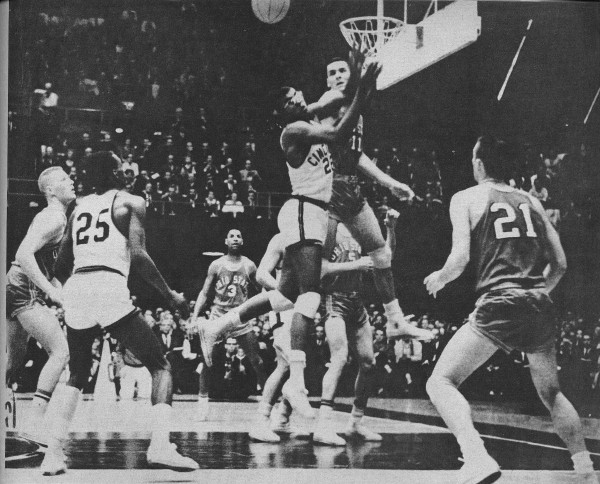 |
| LUCAS blocked Paul Hogue's shot in 1961, but hopped-up Bearcats perservered, went on to end the Buckeyes' 31-game win streak and win title. |
West Virginia University, with a record of 16 and 4, was the last team invited to participate in the 1941-1942 NIT in Madison Square Garden. Clair Bee, a native of West Virginia, was chairman of the selection committee and insisted that the Mountaineers belonged in the tournament. His persistence won out. West Virginia was invited and seeded last.
By an ironic twist of the draw, Bee's Blackbirds (tournament favorites) drew West Virginia in the first round. Nine points down with nine minutes to go, the fighting West Virginians rallied to tie the score just as the game ended, and won in overtime, 58-49. That was just the beginning! The Mountaineers caught fire and went on to win the championship.
A year previous to the game, the Mountaineers' star quarterback, Scotty Hamilton, a resident of Bee's home town in West Virginia (Grafton), wanted to transfer to LIU from West Virginia University, Clair talked him out of it, saying the Mountaineer fans would never forgive him, (The LlU fans never forgave either of them!)
There have been many individual examples of courage, determination and aggressiveness against great odds, Two of these come to mind although there are hundreds of such outstanding deeds,
In the 1946 NIT, Rhode Island State was playing Bowling Green in the quarter finals. Rhode Island, behind the aggressive leadership of Ernie Calverley, who is now head coach there, had put up a tremendous fight against a taller Bowling Green team (Calverley, 5-11, jumped center against Don Otten, 6-11), With two seconds left and his team traiIng by two points, Ernie heaved a 55-foot, two-hand, set-shot which dropped in to send the game into overtime. Rhode Island won, only to lose to Kentucky in the championship game by a score of 46-45.
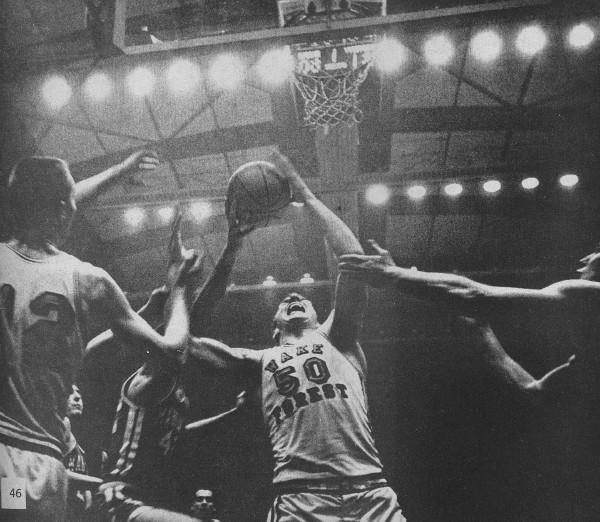 |
| "THE greatest of emotional qualities is desire," says Rupp. It is necessary ingredient in such things as grabbing rebounds off the boards. |
BilI Green of Colorado State put on a phenomenal shooting exhibition in the 1962 NIT, when he made all of his shots (14) from the floor and 9 of 11 free throws for a total of 37 points in his team's loss to Holy Cross by a score of 72-71.
The successful coach creates a climate of mutual respect, loyalty, and common dedication to the task of building a winning team. He has a great opportunity to be a leader, to combine the development of first class citizens as well as ballplayers. It is up to him to inspire his boys so they may achieve and succeed.
The imaginative coach accords his players respect and responsibility. He gives credit where credit is due and treats all players alike. He stresses that the greatest opportunity is offered to those who are prepared; who study and make top grades.
At Kentucky, we are not interested in the boy who just wants to "get by." He will play basketball the same way. We want the boy who realizes he must "fight" his way to the top and knows that there are no short cuts.
Many coaches apply the sum total of their mental conditioning to locker room talks before important games and between the halves. In these talks, they resort to blood and thunder melodramatics and their pleas are tear provoking.
I don't want tears in the eyes of my players. I want baskets! You are matching wits with a capable opponent and the time should be spent in planning ways and means ot defeaing them.
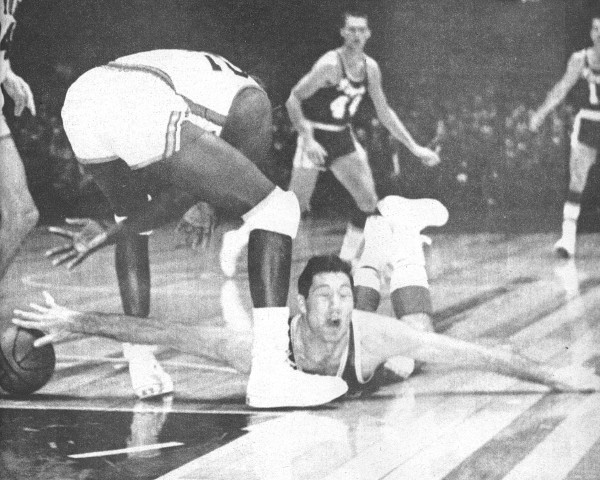 |
| DESIRE is not the sole property of college boys. Here Rudy La Russo of Los Angeles Lakers goes all out to grab loose ball against the Knicks. |
In closing, I should like to draw attention to the spirit of a sensational distance-running teenager. Gerry Lindgren, who was graduated from Rogers High School in Spokane, Washington, last June, epitomizes the "desire" which has been stressed in this article.
Standing 5-5 and weighing. but 117 pounds, this youngster possibly could break every record from one to 25 miles. He has been running five or ten miles every day for years ("No one ever told me I wasn't supposed to run so much!" he has said.)
Perhaps Gerry Lindgren will have made the Olympic team by the time this is read. When interviewed after his greatest success (beating Russia's best 10,000 meter runner) Lindgren said: "I'll just have to work harder, because my goals are so much greater. If I keep working, I may be good enough for the 1976 Olympics!"
That's desire! It makes champions in all sports, including basketball!
Return to Kentucky Basketball page, Kentucky articles, statistics, team schedules, team rosters, opponents, players, coaches, opposing coaches, games, assistance or search this site.