
One high school star was offered a house, another $10,000 while a third won his brother a job as athletic director of a prison. And the bidding is getting hotter.
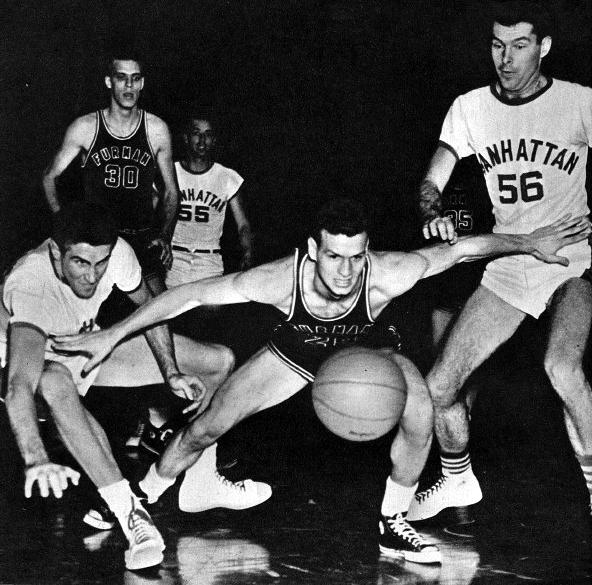 |
| Furman College's 1954 team featuring Frank Selvy (center) was typical of clubs that jump to spotlight from nowhere. |
Published in Cavalier Magazine, March 1955, pp. 30-33, 64.
by Milton Gross
FOUR years ago college basketball was rocked by a series of "fix" scandals that almost ruined the game. Now, with the game seemingly on the road to recovery, more scandals are due. In fact, they're overdue. For college basketball is now dealing in a traffic of athletic flesh that makes the football recruiting of the thirties look like an amateur operation.
Typical of the bidding, dealing and double-dealing now going on is the recruiting that goes on at Murray, Kentucky every June. Here an event called the North-South All-Star High School Game is held under the sponsorship of Murray State Teachers College. What this fiasco really is is a monstrous auction where the merchandise first is displayed, then put up for sale.
It was here that Tom Gola, La Salle College's two-time All-America, was tendered 62 offers of "scholarships." One was for $10,000 to be put into the bank,and paid to Gola after four years at a southern college. Another was for $250 a month, in addition to regular - Board, Room, Tuition. The offer was made by an Indiana alumnus of another southern university.
It is here, too, where the variety of pressures, inducements, blandishments and promises, which go far beyond N.C.A.A. regulations, are considered merely normal medium of exchange. Private planes are put at the players' disposal for expense-free visits to campuses. The boys are wined, dined and dated. Typical courses are laid out for them to show that the rigors of education will not be any obstacle to playing basketball. A selection of any number of snap courses are offered. Promises of future employment in steel, textile, farming and oil industries are made. There was even one case of an athletic directorship job in the penal institution of one state being created to take care of a brother of a player who had already been promised his own eventual job in textiles.
The genius of the recruiters in inventing new lures is almost without limit. The N.C.A.A.'s committee on eligibility found it necessary to investigate a report that Ronnie Shavlik had been induced to come to North Carolina State by free, frequent trips between the college campus at Raleigh and his home in Denver and a golf-playing country club membership. Seton HalI College of South Orange, N. J., was called on the N.C.A.A. carpet last winter for conducting tryout workouts, in the fashion of professional auditions, at various points around the country while its team toured on its schedule. North Carolina State and Miami soon joined them and now Miami is barred from participation in the 1955 N.C.A.A. tournaments. MichIgan State, which had tried out five prospects and had been caught, was put on probation'for a little more than a year.
A few years ago, in Murray, Ky., Clair Bee, who then coached Long Island University, and Ed Hickey, coach of St. Louis, both admired a 6' 8" boy named B. H. Born, out of Medicine Lodge, Kan. Hickey warned Bee to save himself the effort. "You can't get him. Phog's got him," Hickey said. "His mother works in the social welfare department for the state of Kansas," As events proved, Hickey was a realist. He had been corresponding regularly with Born. Born had even accepted Hickey's invitation to visit St. Louis, through whose broad streets the coach allowed the boy to drive his dreamy convertible. But when it came to registration time, Phog Allen got Born to play at Kansas and there he remained his four years.
Some coaches, of course, are not as fortunate as Allen, who is a sort of witch doctor of basketball diagnosing and prescribing for the game's ills and managing somehow always to come out on top. It can be done if you have somebody like Clyde Lovellette a 6' 10" center who magically appeared at Kansas and played there for a full varsity career after being little more than a signature away from enrolling at the University of Indiana.
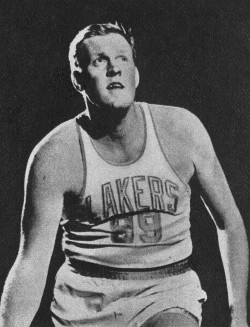 |
| Clyde Lovellette, now with pro Lakers, was center of hot recruiting war won by Kansas |
Since McCracken was so unbelievingly naive not to have known the medical dangers that awaited Lovellette at Indiana, he undoubtedly was unaware that Adolph Rupp, the prominent coach and player procurer of Kentucky, who once was one of Allen's boys, and Phog had several discussions about where Lovellette would play.
This ignorance, too, is understandable, since on successive weeks in New York, Kansas' advance press agent and Allen himself told contradictory stories about the bagging of the 6' 10" bruiser who eventually won the national championship for Kansas. Allen had related how he had talked to Rupp about Lovellette. "You can get him if you want him," were Allen's own words. "You have better sponsorship."
But Rupp, said Allen, said to Clyde: "Boy, go to Kansas. You'll be happy there."
Such magnanimity was matched only in the substance of the story Kansas' advance man had related when, with tears near his eyes, he recalled how Allen had pleaded with Adolph that Kentucky had so many players secreted in the hills it would never miss just this one, and won't you do it for your old coach, old boy?
Of course, all of this never took into consideration how North Carolina State felt about the matter. Possibly Coach Everett Case should have been included in the giveaway conversations. Lovellette did get a free plane trip to look over State's campus while he was still a Terre Haute high school sensation. But everybody knows North Carolina winters are hell on asthma.
Losing a player who is not chained to the bed post has become commonplace by this time, however, even though it is still not accepted in good grace. A recent N.C.A.A. investigation was started when one coach blew the whistle on a rival who was fishing in the same recruiting waters.
A prospect worked out at two Southern campuses, choosing the first over the second. In addition to signing the boy, thc first coach convinced him to sign an affadavit that Coach Number Two had violated N.C.A.A. tryout regulations. He then turned the affidavit over to the N.C.A.A. committee.
This merely indicates how ruthless recruiting has become. Once one coach never blew the whistle on another -- he merely went out and tried to steal a player in return.
The case of Tom Marshall, who last season finished his varsity career at Western Kentucky, offers a fine example. Marshall, a bruising 200-pounder, now a freshman in the National Basketball Association, went shopping for offers after his high school days at Mt. Juliet, Tenn. He signed a grant-in-aid agreement at Vanderbilt. Under Southeastern Conference rules, that meant no other S.E.C. college could touch him. Naturally, this included Kentucky, which feels it has a vested interest in hot basketball players. But if Rupp couldn't have him, he didn't want him in the S.E.C. either. Altruistic Adolph started an open campaign to see that Marshall got more than Vanderbilt could give him.
Bidding came down to Western Kentucky and Murray State College, bitter rivals on a somewhat lower plane than Rupp's Kentucky, which is the state's top dog. In the summer of 1950, Marshall went to Western Kentucky.
Murray businessmen, enlisting a Nashville newspaperman as their business agent, brought Marshall to Murray. Tom held firm and returned to Coach Ed Diddle at Western Kentucky.
Diddle not only got his player back, but two years later got his revenge. He sent his own raiding party to pick up Lynn Cale, who had been All-State at Paducah and worked at Murray all summer. Three days before he was to enroll officially at Murray State, he registered at Western Kentucky.
Diddle, however, was not as fortunate in the case of Ralph Beard and Wah Wah Jones, a pair of Kentucky high school youngsters who played for him as the coach of a Kentucky all-star high school team against a similar team of Indiana high school stars.
The night before the game Diddle tucked his athletes in their beds and assumed they stayed there. But after midnight Rupp gained admission to their Indianapolis hotel room and glib-tongued them into a promise to come to Kentucky.
"They were supposed to be sleeping, storing up energy for the next day," Diddle later said sourly, "but that didn't stop Rupp. He just barged right in and didn't even let the boys get their rest."
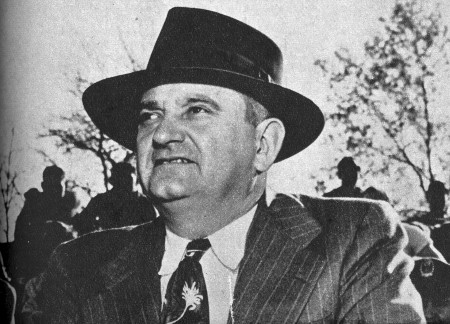 |
| Kentucky's Adolph Rupp, most controversial coach in game, is also one of top talent scouts. |
Since Diddle is a man who watches a basketball game while he throws and chews on large red Turkish towels, it was difficult to ascertain if his coachly solicitude for the athletes was expressed with tongue in cheek. If the picture cannot be put into proper perspective with Diddle, possibly Jack Gardner, formerly Kansas State's coach and now the coach at Utah, may clear it.
Some seasons ago Gardner had a player named Clarence Brannum, who is not to be confused with his brother, Bob Brannum, an out-and-out pro with the Boston Celtics of the National Basketball Association. Clarence appeared to be dividing his time between Kansas State and the Kansas City MNO Smokies, a team which played in the semi professional tournament loosely known as the A.A.U.
Just before the tournament, Brannum dropped out of K-State, played with the Smokies and just after it he came back again. Now for the coachly solicitude. Gardner blithely rationalized the strange hop, step and jump from academic halls to A.A.U. by explaining that Brannum was a married man and a father. In order to return to college Brannum needed some money to support his family. So he went out and earned it playing basketball and, having cared for his progeny, returned with his eligibility unimpaired.
Now, here is Gardner at Utah and the chances are there will be a definite pickup in its recently-riddled basketball record if for no other reason than Gardner has a sentimental attachment for those he left behind.
The fact is,that before Gardner had coached his first game in the Rockies, he tried to recruit some of his former players from Kansas State. Scarcely. was Gardner at Utah when Cary Bergen; a sophomore forward at K-State, followed him, Art Bunte, Colorado's high scoring sophomore in 1952-53, also succumbed to the Pied Piper tune Gardner whistled, Jerry Jung, a 6' 11" center for Gardner's former team, also was made a "scholarship" offer to desert, but Jung felt he had it better where he was and disdained the bid. Then he really cut it by revealing how Gardner was operating. "We were supposed to work here at Kansas State all summer and then transfer to Utah at the last minute," Jung said. He also disclosed that he had received a letter from the president of Utah verifying the offer.
How far the tentacles of the recruiters will reach is best illustrated by the case of Wilton Chamberlain, a 7' 1" boy presently playing in his senior year at Overbrook High School in Philadelphia. For more than a year the door of Chamberlain's modest home has had to be barred and bolted against the persistent rapping of coaches or their representatives wooing this youngster to their campuses.
Not a day goes by that Chamberlain doesn't get a phone call, letter or visit offering money for matriculation, Excluding the usual feelers of B.R.T. (Board, Room, Tuition, which is legal under N.C.A.A, regulations), Wilton has had over 100 offers, which range from modest expense money to the purchase of a house for his family, by a Big Ten alumni group, Wilton can have his pick of colleges which will conjure a convertible for his driving pleasure, or he can have a tidy bank account set up for him in escrow as a bond for his good faith and ultimate allegiance to another midwestern basketball foundry.
Last summer Chamberlain worked on the athletic staff of the Kutsher's Country Club at Monticello, N.Y. where he was able to play daily against another staff member, Neil Johnston of the Philadelphia Warriors, leading scorer for the past two seasons of the professional National Basketball Association.
In this job Chamberlain picked up considerable basketball experience, but if he had chosen otherwise he could have picked up considerably more dough than his modest summer's salary. Before he went to Kutsher's, this boy, who had another year of high school ahead of him, was offered a $1OO-a-week summer job by another midwestern college. "Your hardest work will be to pick up the check," Chamberlain was told by the bird dog who offered him the job.
Last summer Jerry Dupont, a 6' 11" boy from Nashua, N. H., worked during his vacation on Dayton University's campus. When registration time arrived, Dupont was missing. Perhaps it was just coincidence that prior to Dupont's disappearance, an assistant coach of the University of Louisville, was seen on campus.
A Dayton newspaperman put in a call to Peck Hickman, Louisville's coach, and asked if Dupont was registering at Louisville. "I don't know anything about a boy by that name," Hickman said, "but they tell me there's been a big kid floating around our campus the last few days."
Under existing market conditions a kid can do a lot of floating. No longer is it necessary to shop among the larger colleges or just in the East or Midwest as it once was necessary to do. The boundaries are only the consciences of the colleges and how high they will go to get a boy and reduce the collegiate subsidizations regulations to a joke. In practice most colleges are clean. In spirit they continue to befoul a sport whose very existence was threatened by the bribery and fix scandals of 1951.
Before New York District Attorneys Hogan and O'Connor closed their books on the scandals a fantastic skein of corruption was tied to the practice of collegiate officials closing their eyes as alumni and "sponsors" weakened the fabric of decency by their more antiseptic form of bribery. Thirty players from seven colleges collected an admitted $72,950 in bribes to fix 90 games played over four seasons. Eleven different groups of fixers operated in 23 cities in 17 states and 15 of the bribers went to jail. There were at least two threats of murder, three attempts at blackmail and one kidnaping.
Possibly the fixers no longer are active, but those who were responsible for planting the seed from which the scandals developed haven't slowed down. If anything, they've stepped up their recruiting pace by lowering academic standards and raising the dough to get the high school players.
The reason for this hard and dirty work can be reduced to simple arithmetic. In football perhaps two dozen teams have the crack at the profitable TV programs and bowl games. Year after year they come from the same colleges. In basketball it is possible for any school, no matter its size, financial condition or scholastic standing to crack the big dough. This is why little outfits like Murray State, La Salle, Furman and such can suddenly spring into prominence while in football big names like Georgetown and St. Mary's go by the board.
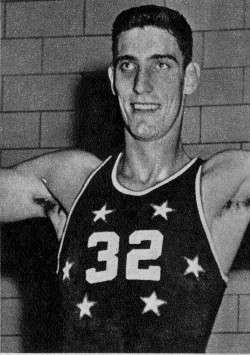 |
| Bevo Francis saved Rio Grande College from financial failure while still a high school senior. |
For a good football team to be molded to profitable calibre at least 30 top performers must be recruited. A season's schedule runs no more than eight or nine games. The outstanding team draws 40,000 to 60,000 spectators at top prices, but expenses for training, equipment, and travel eat into so much of the revenue.
A profitable basketball team requires no more than eight good players and a schedule can run as high as 25 games, plus the post-season tournament payoffs. Expenses, compared to football's, are nil, however. On one trip four or five checks may be picked up for games with strategicallly located opponents. If, as in the case of Kentucky, the college also owns its own coliseum, the profits can be fabulous. In 1951 Kentucky's gross income from basketball was $194,076.73.
Consequently there is no ceiling to the siren song of the recruiters and no cellar below which they will stoop.
As the situation now stands, the only thing that can stop the recruiters is exposure followed by action from the collegiate authorities. But that really won't stop them any more than it stopped the football recruiters. It will only curb them, So long as there is big money in college basketball, or any other college sport, there will be flesh peddlers. They are inseparable.
Return to Kentucky Basketball page, Kentucky articles, statistics, team schedules, team rosters, opponents, players, coaches, opposing coaches, games, assistance or search this site.