
Published in Boys' Life Magazine, March 1950, pp. 14, 50-51
Basket shooting is important but it's also necessary to know when not to try to make a goal according to this famous court coach
By Adolph F. Rupp
 |
Good goal shooting requires constant practice, above everything else, in order to bring about perfect judgment of distance. As an illustration of the importance of practice, I want to tell you about Ralph Beard, who had been selected as the outstanding basketball player in the nation in 1947. On the way home from the National Invitation Tournament, he came to me and asked what he could do to improve his game. Here was the most valuable player in the nation asking for advice, which only goes to show the qualities that make him such an outstanding athlete.
"Ralph," I said, "Next year, everyone will be pointing for you bccause you have been singled out for honors this year. You will have to be a twenty-five per cent better shooter, you will have to learn to shoot long from the floor, and that means changing your entire technique on the two-handed push shots from the floor."
Ralph had a flaw in his long shots and, once it was pointed out to him, he set to work practicing at least three times a week by taking five hundred or more shots a day.
Again, he made every all-America team next year and was voted the outstanding player in the nation. He actually did improve twenty-five per cent in that year. You can do the same by conscientious practice on the proper fundamental techniques of the game.
To Shoot Or Not To Shoot
But, shooting is not the whole story. Knowing when not to shoot is just as important as knowing when to shoot. You should never shoot except in the last desperate final seconds of a losing contest when you are off balance, or unreasonably far away from the basket, or when your teammates are not in a good position to follow up your shot in case of a miss.
It may surprise you to learn that many a dub spends as much time practicing at basketball as a great star does. The difference is generally in the way they practice. The star uses his time to the maximum advantage, does not "fool around," practices shots which he can actually use in a real game, picks out spots on the floor from which he knows he will get shots because of the type of plays which his coach has designed.
Scoring On Set Shots
At Kentucky, we believe that the fundamental shot in basketball is the long one. Our theory is that, if the players can hit with a third of their shots from the positions indicated by our system of play, the opponents cannot afford to playa deep zone, or sinking defense game against us, but must come but to play man-for-man.
Once that happens, we can set up our screening plays. However, a failure to hit on the long ones will encourage the defense to stay back and you will never get in for your short ones.
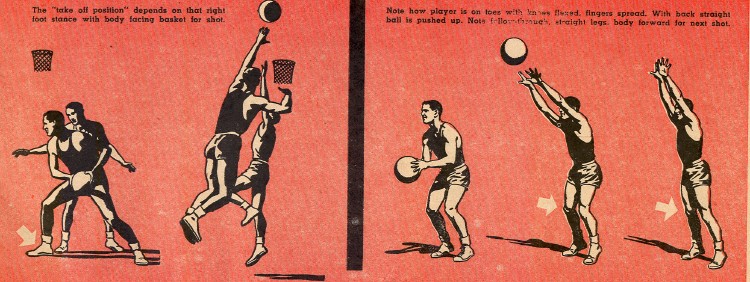
Despite the great hullaballoo which has been made about one-hand shots from the floor, the two-handed push shot is still the most accurate and the most commonly used, even today. At Kentucky we like to use a stance in which the left foot is slightly ahead of the right foot because we believe that it furnishes a more natural, more flexible, and more comfortable position. The body is crouched, with the knees bent, hips low, and head up. From this body position you can shoot, dribble, pass, or pivot without changing the position of your feet. It is apparent that such a position has the advantage over the stance in which both feet are kept together on the same line.
In making the throw, the ball should be held with the elbows in close to the body directly in front of the body at the chest. It should be held by the finger tips, not the palms or heels of the hand. It is brought down to the waist line, then up along the abdomen and chest and released with a snap when it reaches a height above the eyes. The hands should be rotated so that the finish of the shot leaves the thumbs close together and the palms directed toward the basket. The index fingers will be the last to leave the ball. This shot will give the ball the proper amount of spin, so don't try to put any extra "English" on it.
Concentrate on the shot. Look at the basket, fix it in your mind and concentrate on it until after the ball is away and you have completed your follow-through. Then, look for the ball and get into position for a possible rebound. Keep the arch of your shots medium high-not exaggerated. Even though the shot misses, if properly executed it may still result in a basket off the backboard. Furthermore, a shot with good arch is easier to handle on the rebound.
 |
Getting The One-Pointers
All but one of the boys on our 1949 National Championship team used the two-handed underhand shot at the free throw line. Our average for the season on free throws was 67.9 per cent, in one of the most difficult schedules we have had.
The stance at the free throw line varies, according to coaching preference, in the same way as that of the two-handed push shot. Some coaches prefer that both feet be on the foul line and about a foot apart. I think that it is more comfortable to have the left foot placed right behind the line and the right foot eight or ten inches back of it. It is my conviction that the body bends more naturally in this fundamental position, for it allows a player to be on his toes, his knees bent, his hips down, his back straight, and his head up. It is the natural and easy way to shoot the underhand shot.
To relieve any tenseness, our boys bounce the ball on the floor three or four times and are told not to look at the basket until they are ready to make the shot. This helps to bring complete relaxation at a time when the boy may be tightened up because he comes to the free throw line at a critical point in the game. Actually, however, every free throw is a critical one because it takes two points to beat it.
To make the shot, place the fingers on the sides of the ball, keeping your palms off the ball. The fingers should be spread, pointing slightly downward, while the thumbs should be pointed forward. The ball should be held with both hands at waist level.
In executing the shot, the knees will bend into a comfortable position, the arms will bend, too, but remain close to the sides of the body. The ball is raised forward and upward with full extension of the arms and a complete follow-through. Try to achieve such uniformity that the shots become absolutely mechanical.
Free throwing is so important that some coaches require their players to shoot fifty or a hundred free throws per day. At Kentucky we finish practice sessions with a ten minute free-throw shooting session. Players are more apt to take their time and be more deliberate when the time element is involved. Knowing that you have to shoot fifty shots to wind up a practice session, you are apt to start popping them carelessly, thus wasting your practice time entirely.
Two-handed Overhead Shots
The two-handed overhead shot is a kind of specialty shot. It is usually employed by tall men after a rebound has been taken, or a high pass received. It is most effective at medium distances, where it should be used.
In executing the shot, the ball is held directly above the head, elbows slightly bent, with thumbs below and to the rear of the ball. The knees are slightly bent and the head is up facing the basket. As the ball is released, the arms are extended and the body moves slightly forward on the toes with a straightening of the knees. The wrists do a lot of the work in getting the shot off. Wallace Jones, of the recent National Championship teams, executed this shot very well.
The Lay-up Shot
In recent years there has been a tendency for many players to concentrate on one-handed shots to the neglect of those made with two hands. There is a definite use for the one-handed shot, but certainly. the two-handed shot has the advantage because it is the most accurate from a distance.
The one-handed dribble-in shot is perhaps the most useful of the one-handed shots. It is made by a dribbler coming in to the basket, taking off on the foot opposite from the hand with which he is shooting, using a high jump and a full arm reach to place the ball against the board and bank it in.
Coming in from the right side the right hand is used, and vice versa. This gives you added protection for the shot by placing your body in between the ball and the defensive man.
In dribbling in, keep your eyes on the basket and make a high jump, not a broad jump. Don't put any spin on the ball; a perfectly dead ball is the most accurate. Learn to go off to either side rather than attempt to throw the ball indirectly from the front of the basket. Practice will perfect the shot.
Under the Basket
The right or left hand shot under the basket is generally made when a player has taken the ball off the backboard or received a pass under the basket. To make a right-handed shot while facing the basket, step to the right from underneath the basket with the left foot crossing in front of your right foot. Take off on your left foot, pivoting your body in a turn toward the basket. As you rise, with body turning toward the basket, straighten the right arm fully and lay the ball up against the backboard with a wrist snap and your fingers behind the ball. This shot may be made with the left hand by using the right foot for the take-off.
The Pivot Shot
This one-handed turn around shot is made to the right or left by a player with his back to the basket and near it. As the ball is caught, the shooter may fake in the direction opposite to the one in which he intends to shoot. In making the shot with the right hand, the shooter steps to the left, bringing the ball over to the left side of his body with both hands. He then pushes off on his left foot, the body turning in the jump so that it faces the basket as the right arm is raised with the ball and extended to the full, at which point the ball is released.
Set Position Shots
There are two variations of the one-handed set shots. In the Western style, shooting with the right hand; the right foot is forward, knees bent, hips down, and the ball resting on the left hand with the right hand behind the ball. Both thumbs point to the left. The shot is executed by a slight knee bend and a push of the right hand from behind the ball. It may be made with a slight jump or with both feet on the floor.
The step-in shot is used often in the Midwest and South. When thrown with the right hand, it is executed the same as the Western style, except that the player steps out with the left foot, using it as a take-off. The ball is also held somewhat higher.
The One-hand Push Shot
The one-hand, in motion, push shot is used following a straight or diagonal drive for the basket. The position of the hands on the ball and the take-off are the same as for the lay-up shot.
In making a right-hand shot, take off on the left foot, resting the ball on the finger tips of your shooting hand. Push the shooting arm forward and upward. The ball is released with a finger push at the height of the jump with the arms fairly well extended. Land with the knees flexed and the weight on your forward right foot, ready to follow up your shot.
Shooting Hints
There are many other types of shots, but those which I have described should prove satisfactory for any boy basketball player. In practicing and under game conditions, take the following shooting hints to heart:
THE END
Return to Kentucky Basketball page, Kentucky articles, statistics, team schedules, team rosters, opponents, players, coaches, opposing coaches, games, assistance or search this site.