
Published in Basketball News 1979 Yearbook, 1979, pg. 137.
TThe game was played on "Adolph Rupp Night" in Kansas University's Allen Fieldhouse located on Naismith Avenue. The street is named for James A. Naismith, the inventor of basketball. The arena bears the name of Forrest C. (Phog) Allen, the former Kansas coach who taught Rupp the basics of the game and who was the coach with the most victories in college basketball history until Rupp surpassed him. Rupp died during last season, just moments after his beloved Wildcats defeated Kansas, his alma mater.
Joe B. Hall, Rupp's successor as Kentucky's coach, and Dick Parsons, Hall's assistant, led a host of former players who paid tribute to the legendary Baron of Basketball, who died at the University of, Kentucky Medical Center in Lexington of complications arising from cancer of the spine.
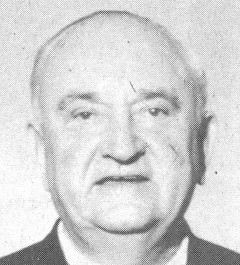 |
| ADOLPH RUPP |
"I asked the public-address announcer to announce that he was not there and that we all knew he would like to be there on this occasion, with Kentucky ranked No.1 and playing Kansas and that he was in the University hospital in a coma. Then the announcee asked that they have a short silent prayer and the whole crowd realized coach Rupp's situation."
"In Kansas, I thought about coach Rupp and the tradition that's out there," said Parsons, who captained the Wi,ldcats during the 1960-61 season. "You walk in Allen Fieldhouse and you see Dr. Naismith's picture and you see Phog Allen's picture.
"I know coach Rupp was interested in the game out at Kansas and late in the game we knew he was seriously ill. We were just hoping that maybe we could win that game and maybe dedicate it to him."
Impressive proof of Rupp's impact on the college basketball scene stands on a corner in downtown Lexington. It is called Rupp Arena," the 23,OOO-seat home of Kentucky's basketball Wildcats. It is the biggest of hndreds of basketball arenas in the country.
Rupp recalled shortly before his death that he was castigated in 1950 for pushing the university to build an 11,500,seat Memorial Coliseum.
"I remember they crucified me," he said. "They said we spent an awful lot of money and never would fill it. "We filled it that first night. . , and every seat for every game has been sold ever since."
Rupp's Kentucky teams won 874 games while losing just 190 during a 42-year career that ended with his forced retirement in 1972. Included in those victories are four NCAA titles, a National Invitation Tournament crown and 27 Southeastern Conference championships.
Twenty-two of his players made some kind of all-America team, and seven represented the United States in the Olympics. His 1948 team, dubbed "The Fabulous Five," won a national title and then performed as a unit for the winning U.S. entry in the 1948 Olympics.
The Baron, as he was fondly called, was born Sept. 2, 1901, in Halstead, Kan., was 28 years old and had no college coaching experience when Kentucky hired him away from an Illinois high school in 1930. His first outing was against Georgetown, Ky. The 67-19 final score was Kentucky's highest point total to that time.
Rupp, an average player at Kansas in the 19205, became an avid student of the game. He was years ahead of his time when be brought the fast-break offense to Lexington.
He was a strict disciplinarian of German ancestry, and an autocratic ruler who refused to change his style for anyone. Players who didn't like the way he did things soon found themselves shuffling off to another school.
People accused Rupp of taking the fun out of the game, but he retorted that "my boys" get theirs by playing for national championships.
Keenly aware of the importance of publicity, Rupp always had a good quote ready. Sometimes it was funny; often it was caustic and biting. And many times, when emitted in the heat of battle, it was unprintable. He could melt officials and players alike with a scowl that transformed his face into a mask of sheer rage.
He had a simple answer for his detractors-and there were many who didn't like his style.
"Look at my record," he'd say. "I'm not engaged in a popularity contest. I'm here to win basketball games."
The Baron didn't want Kentucky players working for anyone but the Baron. He fought retirement to the hilt in 1972 before finally being forced aside when the university's board of trustees officially handed the reins to Hall.
He was one of the few men who has stood up successfully to Paul (Bear) Bryant, the college football's answer to the Kentucky coach. Bryant directed Kentucky, football from mediocrity to excellence in the 40s and early 50s, but went to Texas A & M and, later, Alabama after tiring of the battle with Rupp over which sport should be No. 1 at Kentucky.
The two sports giants, however, remained close friends. "The word legend is sometimes thrown around too loosely, but he is truly a legend," said Bryant after learning of Rupp's death.
In 42 years, Rupp also tasted bitter defeats. His 1966 club, a ragamuffin unit called Rupp's Runts because no starter was taller than 6-5, shocked everyone by building a 27-1 record before losing to upstart Texas Western in the NCAA final.
His worst moments came in the early 1950s when several of his players were implicated in a massive point-shaving scandal that shook college basketball to its roots.
Rupp openly denied that his players could be influenced by gamblers. When he was forced to eat his words, he held a grudge against the players that subsided only in the waning years of his career.
"He's been a winner, and any way you look at life today, winners are respected," said Tommy Kron, who played point guard for the Rupp's Runts.
Return to Kentucky Basketball page, Kentucky articles, statistics, team schedules, team rosters, opponents, players, coaches, opposing coaches, games, assistance or search this site.