
Adolph Rupp, the Baron of Basketball, produces winning teams. Last year his team won 34 of 37 games and captured the Southeastern Confeence championship for the tenth time. Since going to Kentucky in 1930, his teams have been beaten only eight times on their home floor. In tournament competition which includs five major national meets, his teams have won 52 while losing but 11. In 1944 Rupp was elected to Basketball's Hall of Fame.
Published in Athletic Journal Magazine, December 1948, pp. 12, 51-52.
by ADOLPH RUPP
THERE are two schools of thought regarding the use of out-of-bounds plays. Some teams use set out-of-bounds plays while other teams are content to secure possession of the ball and start their regular offense.
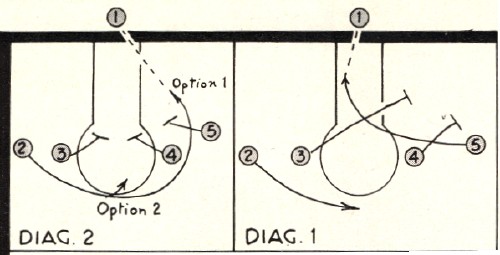 |
| In Diagram 1, players 3 and 4 screen for 5. Two covers defensively and is also available for an outlet pass in the event 5 is not open. In the event of a shift, 3 or 4 should be open. In Diagram 2, 3 and 5 start just as in Diagram 1. Four seals the center. Two starts as in Diagram 1 but uses 3, 4, and 5 to screen off his opponent. |
Here at Kentucky, we believe in he use of set out-of-bounds plays. There are several very good reasons for this belief:
1. With a definite set play every man has an assignment.
2. Players who shoot best are placed in those positions, which will give them the best opportunities for shots.
3. Our best passer always handles the ball from out-of-bounds.
4. Players do not cut or screen until every man is in position. They then cut and screen on the proper signal.
5. We can position our men to take advantage of our opponents' defensive weaknesses.
6. Basketball is fundamentally a team game. Set plays conform to this theory .
7. Good out-of-bounds plays offer several options for the passer.
8. A successful out-of-bounds play is demoralizing to an opponent.
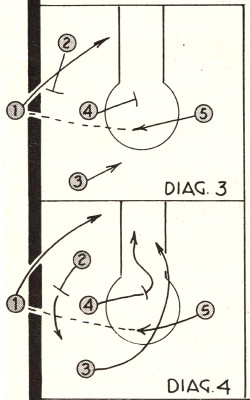 |
| In Diagram 3, 2 screens for 1. Four screens for 5. One passes to 5, cuts for the basket taking a return pass from 5. Three maneuvers in order to be available for an outlet pass. In Diagram 4, 2 screens for 1 and comes out to cover defensively. Four screens for 5, then cuts to his left into rebounding position. One passes to 5 and cuts for the basket. Three cuts off 5 using him as a post, taking a hand-off pass from 5. |
However, even the best out-of-bounds plays usually do not succeed more than three or four times per game if your opponent is a worthy one. We like the series idea, using certain plays the first half and in the second half using plays which start and look like those used in the first half but which end differently. We also like to save definite plays for definite opponents just as a football team will unveil new plays as the season progresses. Out-of-bounds plays should always be simple to execute and should use the fewest humber of passes possible to secure a shot, thus limiting the possibility of fumbles or poor passes. They require split-second timing and execution at top speed.
We start practice at Kentucky the latter part of October with our opening game usually the first week in December. We will start work on out-of-bounds plays about two weeks prior to our first game. During this period we will teach one series of three or four plays from under the basket and another series of two or three plays from the side. These plays will be our only plays until January. Then we start adding a new series from the side and from under the basket. These we hope will carry us until we reach our annual Southeastern Tournament. For the tournament we like to add at least two more from each out-of-bounds position. This plan, we feel, gives us sufficient versatility to enable us to execute well even against opponents already encountered during the regular season's play.
Time spent drilling on set out-of-bounds plays will pay good dividends. The amount of time to be spent drilling is determined by the success or lack of success in executing the plays against opponents.
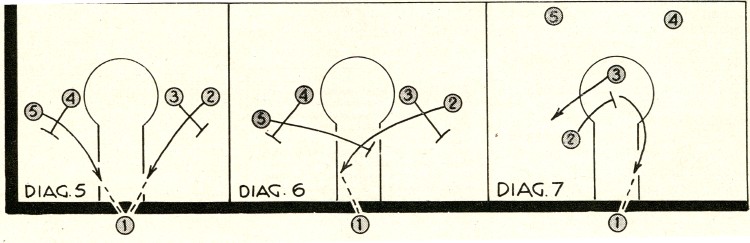 |
| In Diagram 5, 3 screens for 2. Four screens for 5. In the event of a shift, 3 and 4 should be open. In Diagram 6, 3 and 5 screen for 2. Four screens for 5 giving the play the same look and start as the play in Diagram 3. Diagram 7. This play is designed to pit individual against individual. If we have one player markedly superior to his opponent in speed and maneuverablity we use the following play. Two is our key man. He cuts as if planning to back-block 3's opponent. If opponents shift, 2 is open. Three cuts to his right. Any hesitancy or indecision on the part of the defensive men will result in either 2 or 3 being open. |
Our plays at Kentucky are no different from those used by other teams throughout the country. We attempt to screen an opponent and secure a shot by the player screened for. If our opponent shifts we believe the man screening should be the pass-receiver. Playing opponents from almost every section of the country we must be alert to rules interpretations in the different sections. For example, when we go East to play we must be sure that on our screens, our screener does not pick-off. In the South and Mid-West, screens may be tighter as the pick-off is not called as frequently as in the East. Officiating, however, is becoming more uniform and consequently better in all sections.
Return to Kentucky Basketball page, Kentucky articles, statistics, team schedules, team rosters, opponents, players, coaches, opposing coaches, games, assistance or search this site.