
Published in Athletic Journal Magazine February 1936 , pg. 11-14
One afternoon some thirteen years ago, I was sitting the gymnasium watching two small boys play with each other in a contest of goal shoting. They would alternate by taking the ball out about twenty feet from the goal and then by means of feinting and dribbling try to score on each other. When they had finished their game and were putting on their coats I asked them which one had won.
One of the boys replied, "He beat me when we were just shooting goals, but I beat him when we played against each other. It always comes out like that."
"That's funny," I commented. "How does that happen?"
"Well," answered the boy, "He's a better shot than I am, but when it comes to scrimmaging I just outfoot him."
To me that was a fine analysis of the contest. After all, we have many excellent goal shooters in practice who fail to score consistently in games. And I am wondering if much of the fault is not improper footwork.
Importance of Footwork
| After playing basketball for three years at hte University of Kansas, A.F. Rupp graduated in 1923 and began his coaching career in the high schools of Marshalltown, Iowa, and Freeport, Illinois. Following seven years of high school coaching, during which he produced a number of outstanding teams, he went to the University of Kentucky, where his teams won ninety games while losing but twelve. The Kentucky team under Rupp was undefeated in reularly scheduled conference play for three years, winning thirty-two successive games and losing but one game of forty-five played. The defnite footwork technique which Rupp teaches has attracted nation wide attention and has contributed much to the success of his teams. |
At the University of Kentucky, we have experimented until, at any place on the floor, our players have a stance that is proper for a quick-break from that particular position. In basketball the situations change with each pass of the ball. Players are constantly on the move. we tell our boys that, whenever they break or are in motion, they must break quickly and never loaf. Players should know where they are going before they start and should never jog along on the floor with no particular aim in view. We practice footwork by mixing in feints, deception, shifts, reverses, pivots and changes of pace. These are the instruments of footwork by means of which an offensive player can get away from his defensive opponent.
Analysis of the Fundamentals
We tell our boys to study the footwork of the opponents and to take advanage of any weaknesses. We ask them these questions: "Does your opponent play you close, or does he stay away? Can you feint him out of position? Can you throw him off balance ? Is he a ball-hawk? Can you throw him off by a change of pace? Does he leave his feet when you feint a shot?
These questions suggest individual responsibilities of team play which can be properly executed only if the players have prepared themselves by the fundamentals of footwork.
There has been much discussion as to how a man can play near the basket this year since the new pivot rule has been made. I am wondering if much of the rough work of previous years in connection with the pivot play did not result from the fact that the men playing in the free throw area were not well instructed in defensive footwork. Illustrations 5,6,7 and 8 show offensive and defensive footwork in the pivot play under the new rule.
The discussion and illustrations on the following pages have by no means exhausted the subject of footwork, as there are many other interesting situations. We have merely attempted to show that some teams "outfootwork" others.
| Illustration 1 - Shown here is the proper stance for a forward (the man on the left) when he plays out near the side of the floor. Notice that his inside foot is back of his outside foot and that he is facing the middle of the floor. | 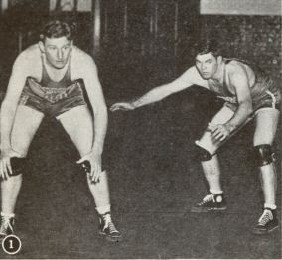 |
| Illustration 2 - Here we see the forward after he has received the ball, has taken his first step and is about to take his second. His first step, taken with his inside foot to meet the pass, placed his entire body between the ball and the defensive man. Suppose he had taken his first step with his outside foot. He would then have faced his opponent and allow him to play the ball. | 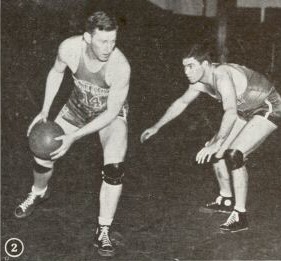 |
| Illustration 3 - The forward has taken his second step and is in the act of passing the ball with his outside hand, away from the guard. It will be noticed that there is no chance for the guard to break up this pass, even though he plays it properly. The guard is in excellent position. His knees are bent, his hips are down and his arms are ready to protect against a pass or dribble. Notice that by sliding his feet, the guard has kept between the offensive man and the basket. | 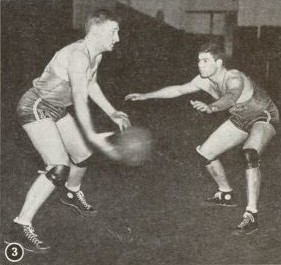 |
| Illustration 4 - The ball has been delivered, and the offensive man has taken another short step. Now notice the footwork of the defensive man. He is giving an excellent illustration of what not to do. Instead of sliding his feet properly, as he has done before, he has now crossed his feet and is in an awkward position to recover and get into the play. | 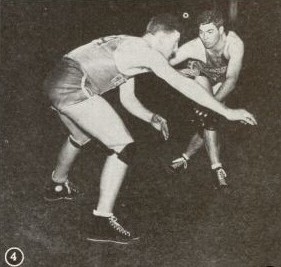 |
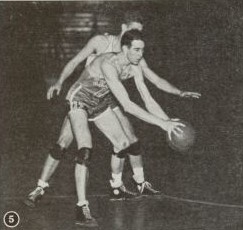 | Illustration 5 - In this and the following three illustrations is shown the footwork of a man playing the pivot position. The pivot player has stationed himself outside the free throw area. He has just received the ball. The defensive man has cleanly played to break up the pass, which he has been unable to do because of the fact that the ball was passed in by means of the bounce pass. |
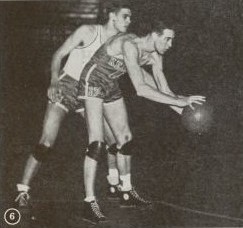 | Illustration 6 - The defenisve man has shifted between the offensive man and the basket. He is still trying to play the ball cleanly. Notice that his feet are also in proper position. The offensive man has not changed the position of his feet at all in this or in the illustrations immediately preceding and following it. Note that he has straightened his knees in Illustration 6. |
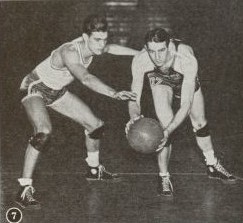 | Illustration 7 - The offensive man has turned his body and faked to the right to draw the defensive man in that direction. the defensive man has properly shifted his feet to meet this maneuver. |
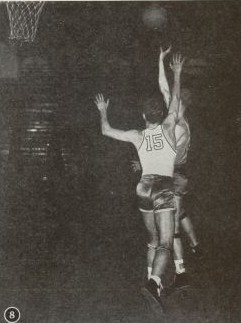 | Illustration 8 - The offensive man has not shifted his feet at all in the three preceding illustrations. So he swings back and jumps off his left foot, and, directly in front of hte basket, takes a shot with his right hand. By faking to the right, he has forced the defensive man out of position so that he is too late to interfere with the shot. It is important to remember that the feet of the offensive man have not changed position in the first three illustrations. |
| Illustration 9 - The man with the ball has been dribling and has been forced to stop by a guard in the vicinty of the basket. Notice that the feet of the offensive man are almost on a straight line with the free throw line. If he cannot take a good shot from this spot, his feet are in such excellent position that he can turn and pass the ball to a team mate trailing and cutting by on either side. | 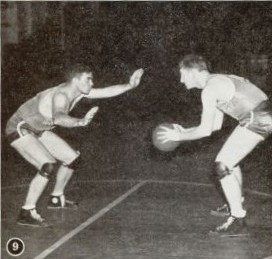 |
| Illustration 10 - This shows the position of the offensive man after establishing his right foot as the pivot foot and reversing his position by swinging his left foot into the position shown. | 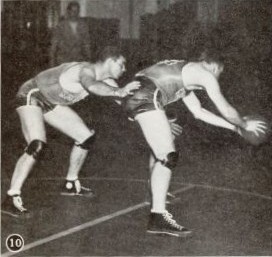 |
| Illustration 11 - The opposite of Illustration 10 is shown here. Refer to Illustration 9. Suppose the man with the ball decides to establish his left foot as the pivot foot. By turning his back on his opponent and swinging his right foot around to the position shown, he is able to pass the ball to a team mate cutting by on his right side. Notice the footwork and body position of the guard. | 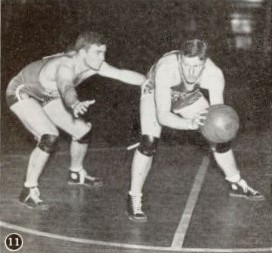 |
| Illustration 12 - The man with the ball has been dribbling and has come to a stop with his left foot advanced. Some coaches prefer to have the dribbler come to a stop in this position, while others prefer the stances shown in Illustration 9. The situation has much to do with the position. | 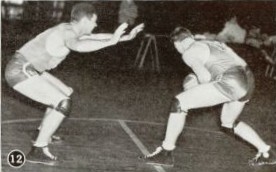 |
| Illustration 13 - This shows the offensive man, with the ball well protected, after having made his pivot on his left foot by swinging his right foot to the position shown. The defensive man has stepped up with his right foot, and the offensive man has placed his right foot outside of the defensive man's right foot. The defensive man by poor footwork has placed himself in an awkward position to check another offensive man cutting by to receive a pass. In fact, he, is out of the play. He could have avoided this had he shifted properly by sliding his feet. | 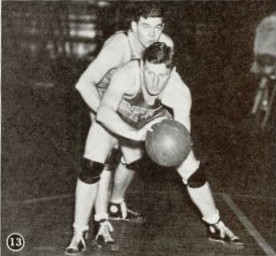 |
Return to Kentucky Basketball page, Kentucky articles, statistics, team schedules, team rosters, opponents, players, coaches, opposing coaches, games, assistance or search this site.