
Through the years, Kentucky has helped develop and utilized a number of different schemes and styles of play. The one constant is that Kentucky teams play hard and play as a team.
This page is intended to look back on a number of these schemes, discussing how they originated at UK (whether they were developed in Lexington or adopted from outside) and hopefully provides descriptions of how they were utilized.
As with most topics concerning Kentucky basketball history, much can be traced to former coach Adolph Rupp. Rupp was a tremendous (and under-appreciated) innovator, but was also a serious student of the game and much of his success came from learning from others and adopting it to suit his needs.
| Figure-8 Continuity Offense | Pivot-Post Offense | Guard-Around Plays | Stack Offense | Fast Break |
(Note, this page will be updated periodically with additional styles. If you have any comments or suggestions for additions to the page, please let me know.)
Origins
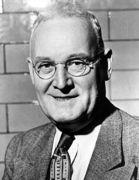
The Figure-8 was initially and predominantly developed by Harold "Doc" Carlson of the University of Pittsburgh in the 1930s. It was in a game in 1935-36 season against Pittsburgh that Rupp first faced the Figure-8 (which he later adopted for his own teams) and came away victorious.
From Russell Rice's book Big Blue Machine:
One of the fine teams UK met early in the 1935-36 season was Pittsburgh, which featured a "figure eight" offense that Dr. H.C. Carlson, the Panther coach, had made famous nationally. The object was to keep the entire team in perpetual motion, giving the defensive men no time to get set, and striking with what was considered furious speed in those days. There were times when Pitt kept the ball moving at top speed for as long as 15 minutes without taking a shot.
 |
En route to New Orleans, Carlson also scheduled games with Butler and Xavier. After watching the game in the Butler Field House, Rupp had his assistant Len Miller drive him back to the hotel where they were to spend the night.
"Pitt absolutely tore Butler apart," he recalled. "I told Len, 'Get the car. I'm not going to sleep after that game. I've got my work cut out for me.'"
They arrived in Lexington about 4 a.m., and Rupp still could not sleep. Finally he came up with the idea of virtually zoning the cutter on the Figure Eight. When Pitt sent a man out to screen, and the cutter went around the screen, Rupp temporarily abandoned his man-to-man defense and had his defender make an automatic switch on the cutter.
The move worked so well in the first half that Pitt only scored two points while UK was tallying 22 points. Rupp cleared his bench in the second half, holding the final margin to 35-17.
"I didn't want to crush Doc," he said. "It sure wouldn't look good to go to the Sugar Bowl with a whipping like we were inflicting on them in the first half."
The next day he and Mrs. Rupp took a box of oranges, bananas, and cookies to the train station for the Pitt players. Carlson had purchased 10 little elephant pins and attached one to each boy's shoulder. After he took a picture of Rupp and players, he told them, "An elephant never forgets. I want you to never forget the humiliation you got here in Lexington. I'm going to make each of you a copy of this picture to be sure you won't forget."
Kentucky and Rupp did face Carlson one more time, a 40-29 victory for the Wildcats. Rupp did adopt the tactic, as evidenced by the articles below. The tactic was widely adopted throughout basketball circles and is still used today at times.
Descriptions of the Figure-8
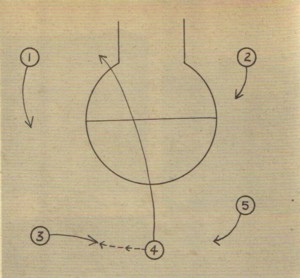 |
 | Rupp's Championship Basketball | 1957 | Kentucky's Continuity Offense | Kentucky's Continuity Offense (by Adolph Rupp) |
 | Sports Action | February 1962 | Figure 8 Offense | Figure 8 Continuity Offense |
Return to Kentucky Wildcat Basketball Page.
This page written by Jon Scott